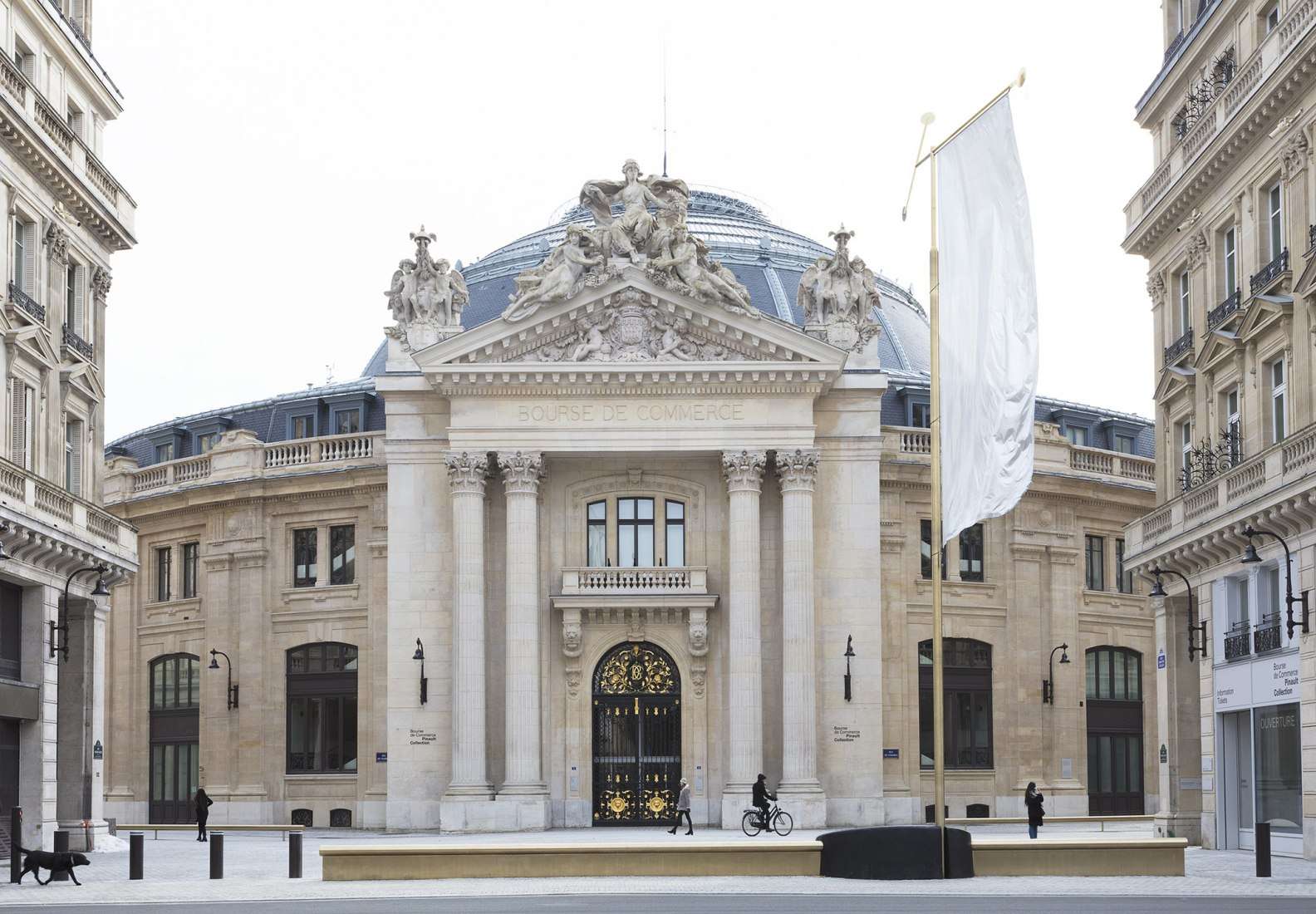
Tadao Ando spent fifteen years turning three of François Pinault’s historic shells — a Venetian palazzo on the Grand Canal, a seventeenth-century Dorsoduro customs house and an eighteenth-century Parisian wheat exchange — into the same room. The Tadao Ando Pinault Collection lineage runs from April 2006 to May 2021 and resolves, in all three cases, to a single architectural move: a free-standing concrete volume inside preserved masonry, with light arriving only where Ando lets it. Palazzo Grassi was the rehearsal, Punta della Dogana the proof, and the Bourse de Commerce the closing argument.
This is a chronology of those three projects, in the order they reopened, with the budgets, the dimensions, the dates the Pinault Collection took possession, and the Artémis holding structure that paid for the concrete. It also tracks the Naoshima vocabulary Ando developed across three Benesse Art Site projects between 1992 and 2010 and ported, almost wholesale, into Pinault’s European interiors.
Palazzo Grassi, 2006: the rehearsal
Palazzo Grassi sits on the Grand Canal at Campo San Samuele, San Marco 3231, opposite the Accademia. It was completed in 1772 by Giorgio Massari for the Grassi family — the last of the great Venetian patrician palazzi, built when Venice was already a museum of itself. The plan is a strict Massari grid: a central courtyard, two cross-axis staircases, four corner blocks of piano nobile rooms on each of three principal floors. Roughly 5,000 square metres usable, distributed across about forty rooms.
François Pinault acquired Palazzo Grassi in May 2005, paying around 29 million euros for a controlling stake in the foundation that owned the building. The acquisition closed a six-year search that had run through Île Seguin in Boulogne-Billancourt — Pinault’s original Renzo Piano–designed Paris museum site, abandoned in 2005 after twelve years of municipal delay — and ended at the most public address in Venice. Within weeks of closing, Pinault hired Tadao Ando.
The brief was tight: ten months to gut, restore and rehang in time for the 2006 Venice Biennale’s preview week. Ando worked with the Milanese studio of Eugenio Tranquilli and the Venetian heritage office. The decisions were minimal and consistent. The Massari shell — frescoes, stucco, scagliola — was conserved in place and re-whited to a uniform plaster. New interventions were limited to exposed reinforced concrete in the few volumes that needed structural reinforcement, and to a graphite-grey resin floor pulled across every gallery to unify the forty rooms into a single circulation. The central courtyard, which Massari had left open, was glazed over to make a covered atrium roughly 13 metres square.
Palazzo Grassi reopened on 30 April 2006 with Where Are We Going?, a 200-work selection from the collection curated by Alison Gingeras. The hang included Damien Hirst’s In and Out of Love, Jeff Koons’s Balloon Dog (Magenta), Maurizio Cattelan’s Charlie Don’t Surf, Cy Twombly canvases, and a Mark Rothko room. The opening drew François-Henri Pinault, who had been chairman of Artémis since 2003, and most of the European auction and museum apparatus. It was the first time the Pinault Collection — founded in 1999 and at that point roughly 2,500 works — had been shown publicly at scale.
The rehearsal worked. The press read Ando’s restraint at Palazzo Grassi as a deliberate refusal of the museum-as-statement mode then dominant in European institutional architecture. There were no new openings cut in the Massari envelope, no signature gestures inside the piano nobile, no rebranding of the facade. The Teatrino — a 225-seat auditorium carved into a former garden building on the Campo San Samuele side, all exposed concrete with a single light slot above the stage — was added in 2013 as a coda, and confirmed the method: when Ando intervenes at Palazzo Grassi, he intervenes outside the historic shell, not inside it.
Punta della Dogana, 2009: the cube inside the customs house
Punta della Dogana sits at the triangular tip of Dorsoduro, where the Grand Canal meets the Giudecca Canal, at Dorsoduro 2. It is one of the most photographed pieces of urban geometry in Europe. Giuseppe Benoni built the Dogana da Mar between 1677 and 1682 as the customs house for goods arriving from the sea — a long, narrow brick volume topped by a tower carrying the gilded bronze sphere and Fortuna weathervane by Bernardo Falconi. The customs function ended in the 1980s. The building sat closed for twenty-five years.
In 2007, the City of Venice ran a public competition for a 33-year cultural concession. Pinault’s bid, paired with a commitment to install the contemporary collection and to fund the restoration entirely with private money, beat the rival proposal from the Solomon R. Guggenheim Foundation. The concession was awarded in 2007 and the contract signed in spring 2008. Ando had the keys by April that year.
The renovation ran from January 2008 to March 2009 on a 20-million-euro budget — fully privately funded, with the City of Venice contributing only the building. The plan is forensic in its discipline. The Benoni envelope, a long sequence of parallel brick halls running the length of the promontory, was conserved and re-pointed. The wooden trusses were restored. The brick walls were left exposed where Benoni had left them exposed, and re-whited where seventeenth-century plaster had survived.
Inside the envelope, Ando placed a single new element: a free-standing concrete cube, roughly 11 metres on each side, dropped into the central hall as an autonomous architectural object. The cube has no contact with the Benoni masonry. It carries its own load, has its own roof, and is read from the brick galleries as a quiet grey volume sitting in the space the customs officers used to use. Around it, polished exposed-concrete floors were poured throughout — the only continuous new surface in the building — and a graphite-grey resin skim was used in the smaller side galleries.
Punta della Dogana reopened on 6 June 2009, three days before the preview of the 53rd Venice Biennale, with Mapping the Studio: Artists from the François Pinault Collection, co-curated by Alison Gingeras and Francesco Bonami. The hang included Maurizio Cattelan’s All (nine Carrara marble corpses on the floor), Charles Ray’s Boy with Frog installed temporarily outside on the punta itself, Cindy Sherman’s Society Portraits series, and Sigmar Polke canvases in the cube. The Boy with Frog became, for two years, the most-photographed object in Venice, until the City of Venice insisted on its removal in 2011.
What the Dogana clarifies, retrospectively, is what Palazzo Grassi was rehearsing. At Palazzo Grassi, Ando worked entirely subtractively — strip back, re-white, lay a continuous floor. At the Dogana, he allowed himself the additive move: a new concrete object, conceived as a building inside the building. The cube inside the customs house is the first time Ando’s Pinault grammar declares itself fully. It is also the first time the Pinault Collection had a permanent gallery wall — Palazzo Grassi’s hangs had been seasonal from the start. The Dogana introduced the possibility of a long-term hang and, with it, the possibility of a multi-venue institution running between Venice and, eventually, Paris.
Bourse de Commerce, 2021: the cylinder under the dome
Bourse de Commerce sits at 2 rue de Viarmes in the first arrondissement of Paris, between the Forum des Halles and the Louvre. The site is a circle. The current circular building was completed in 1763–67 by Nicolas Le Camus de Mézières as the Halle aux Blés, the city’s wheat exchange. In 1888–89 Henri Blondel re-covered the circular court with a 40-metre iron-and-glass dome — one of the great surviving examples of Second Empire metallic engineering, painted internally in 1889 with a five-panel allegorical fresco of global trade by Désiré François Laugée, Évariste Vital Luminais, Hippolyte Pierre Delanoy, Alexis-Joseph Mazerolle and Georges Clairin.
The Chamber of Commerce vacated the building in 2016. Mayor Anne Hidalgo offered Pinault a 50-year lease the same year, on substantially the same model as the Dogana concession but extended. Pinault accepted within weeks. Tadao Ando’s design was unveiled publicly in April 2017. Construction ran from June 2017 to early 2021, with a delay imposed by COVID-19 closures in spring 2020. The opening was set for 23 January 2021, then re-set for 22 May 2021 when the second French lockdown lifted.
The Ando move at the Bourse is the cleanest in the lineage. Inside Blondel’s circular court, beneath the painted dome, Ando placed a single free-standing concrete cylinder. The cylinder is roughly 29 metres in inner diameter and 9 metres tall. Its top is a flat concrete ring set just above the line of the original gallery balustrade, deliberately calibrated so a visitor standing on the cylinder’s roof — accessible by a new staircase — looks the dome’s fresco in the eye for the first time since 1889. The cylinder is closed at its base, defining a 1,000-square-metre central gallery, the Rotonde. Its outer wall, smooth board-formed concrete, sits roughly 80 centimetres inside the original masonry, leaving a continuous walkable gap on every level.
The opening hang — Ouverture, curated by Caroline Bourgeois, Emma Lavigne and Jean-Marie Gallais — placed Urs Fischer’s Untitled (a wax recreation of Giambologna’s Rape of the Sabine Women, set to burn down over the run of the exhibition) inside the Rotonde at the cylinder’s centre, and used the perimeter rooms for Cindy Sherman, David Hammons, Marlene Dumas, Tatiana Trouvé and Rudolf Stingel. The Fischer was the press image. The cylinder was the building.
The Bourse closes the trilogy because it formalises what was implicit at the Dogana. At Punta della Dogana, the concrete cube was one new object among several conserved galleries. At the Bourse, the concrete cylinder is the museum — every gallery in the building either sits inside it, sits outside it, or sits on top of it. The historic envelope, including Blondel’s dome and Le Camus de Mézières’s circular masonry, becomes a held condition, conserved precisely so the new object can read against it.
Tadao Ando Pinault Collection venues, 2006–2021
| Venue | City | Original Architect | Original Year | Pinault Move | Ando Reopening | Square Metres (or notable dimension) |
|---|---|---|---|---|---|---|
| Palazzo Grassi | Venice | Giorgio Massari | 1772 | Acquired May 2005, ~EUR 29m | 30 April 2006 | ~5,000 m² across 40 rooms; courtyard glazed at ~13 m square |
| Teatrino di Palazzo Grassi | Venice | (former garden building) | — | — | 2013 | 225-seat auditorium, single overhead light slot |
| Punta della Dogana | Venice | Giuseppe Benoni | 1677–82 | 33-year concession 2007–08 | 6 June 2009 | ~5,000 m²; free-standing concrete cube ~11 m per side |
| Bourse de Commerce | Paris | Nicolas Le Camus de Mézières; dome by Henri Blondel | 1763–67; dome 1888–89 | 50-year lease 2016 | 22 May 2021 | ~10,500 m² total; concrete cylinder ~29 m diameter, ~9 m tall |
The Naoshima vocabulary
Ando did not invent the Pinault grammar in Venice. He invented it on Naoshima, the small island in Japan’s Seto Inland Sea where the Benesse Art Site began in 1992. Three buildings there set the rules he would later import.
Benesse House Museum opened in 1992 as a hybrid hotel-and-museum, with Walter De Maria, Bruce Nauman and Yannis Kounellis works installed in galleries lit only from above through narrow concrete slots. The plan was rectilinear and the concrete was board-formed in the Ando manner already established at the Church of the Light in Ibaraki (1989). Naoshima added the museum programme.
Chichu Art Museum opened on 18 July 2004 — eighteen months before the Palazzo Grassi commission. The building is entirely subterranean, carved into the south side of Naoshima. Five Claude Monet Water Lilies, three James Turrell light works and Walter De Maria’s Time/Timeless/No Time occupy four rooms reached through a sequence of triangular and rectangular concrete courtyards open to the sky. The vocabulary is now complete: free-standing concrete volumes inside a conserved natural envelope (here, the hillside itself); light delivered exclusively through cut openings calibrated to each artwork; circulation forced through narrow concrete passages between rooms. Read against Punta della Dogana, opened five years later, Chichu is the prototype. The Dogana cube is a Chichu room moved from a hillside into a Venetian customs house.
Lee Ufan Museum followed on Naoshima in 2010 — a year after the Dogana opened, four years after Palazzo Grassi. Half-buried, three exposed-concrete galleries arranged around a single open court. By this point Ando had a portfolio of nine Pinault- and Benesse-related projects across Japan and Europe running on the same set of rules, and the rules had a name in the architectural press: the light slot museum.
The Tadao Ando Pinault Collection projects are, in the most literal sense, Naoshima ported to Europe. The European projects added one constraint Naoshima did not have: a heritage envelope, in three cases of significant institutional weight. The Ando method survived the addition essentially intact, because it had been a method about insertion all along.
Artémis: the holding that pays for Ando
The three buildings cost approximately, in total, somewhere north of 200 million euros across acquisition, concession fees and construction — a number nobody at the Pinault Collection has confirmed in full and most outside estimates triangulate from the disclosed Palazzo Grassi acquisition (around 29 million in 2005) and the Punta della Dogana budget (20 million in 2008–09). The Bourse de Commerce construction alone, on most reasonable estimates, sat above 150 million.
That money came from Artémis. Artémis is the Pinault family holding company, founded in 1992 by François Pinault, headquartered in Paris and wholly owned by Financière Pinault, the family’s master holding vehicle. François-Henri Pinault has chaired Artémis since 2003. Through Artémis, the family controls the majority of Kering (the listed luxury group running Gucci, Saint Laurent, Bottega Veneta, Balenciaga and Boucheron, and the focus of the Kering Florence strategy reshuffle), Christie’s (acquired 1998 in a private deal that took the auction house off the public market), the Pinault Collection itself, Château Latour, Courrèges, a majority of CAA (acquired 2023), the Ponant cruise line, Stade Rennais FC and Le Point magazine.
Artémis is the only one of the European luxury holdings that runs a museum programme directly through the family office rather than through a foundation parked beside a listed group. LVMH’s contemporary art programme runs through the Fondation Louis Vuitton, which is a Gehry-designed building owned by the listed group. Pinault’s runs through Artémis, which is private. That distinction matters because it explains why the Tadao Ando Pinault Collection projects could be commissioned, financed and executed without quarterly listed-company disclosure — and why the budgets remain partially opaque. Compare the luxury Q1 2026 vs design spend numbers and the Pinault museum line is invisible because it does not pass through Kering’s books. It passes through Artémis.
The other consequence of the Artémis structure is succession discipline. François-Henri took the chair in 2003, the year before the Palazzo Grassi search closed. Every Tadao Ando Pinault Collection commission since has been executed under his chairmanship, with François the elder as collector-in-chief and François-Henri as financier-in-chief. The fifteen-year arc from Palazzo Grassi to the Bourse de Commerce is, structurally, a single father-and-son cultural project routed through one architect.
Coda
Three buildings, fifteen years, one architect, one collection, one family holding. The Tadao Ando Pinault Collection sequence — Palazzo Grassi 2006, Punta della Dogana 2009, Bourse de Commerce 2021 — is the most disciplined museum-building campaign run by any private European collector this century, and it is disciplined precisely because the method never changes. Conserve the envelope. Insert a free-standing concrete volume. Cut light only where required. Trust the artwork to do the rest. The press read it as Japanese minimalism colliding with European heritage. It is more accurately read as Naoshima, three times, inside other people’s buildings — and as one of the clearest demonstrations that the most consequential private cultural infrastructure in Europe, including the wave of Venice palazzo takeovers that followed Pinault into the city, was financed not from a listed group’s quarterly results but from the long horizon of a family office that does not have to answer to anyone for the next fifty years.