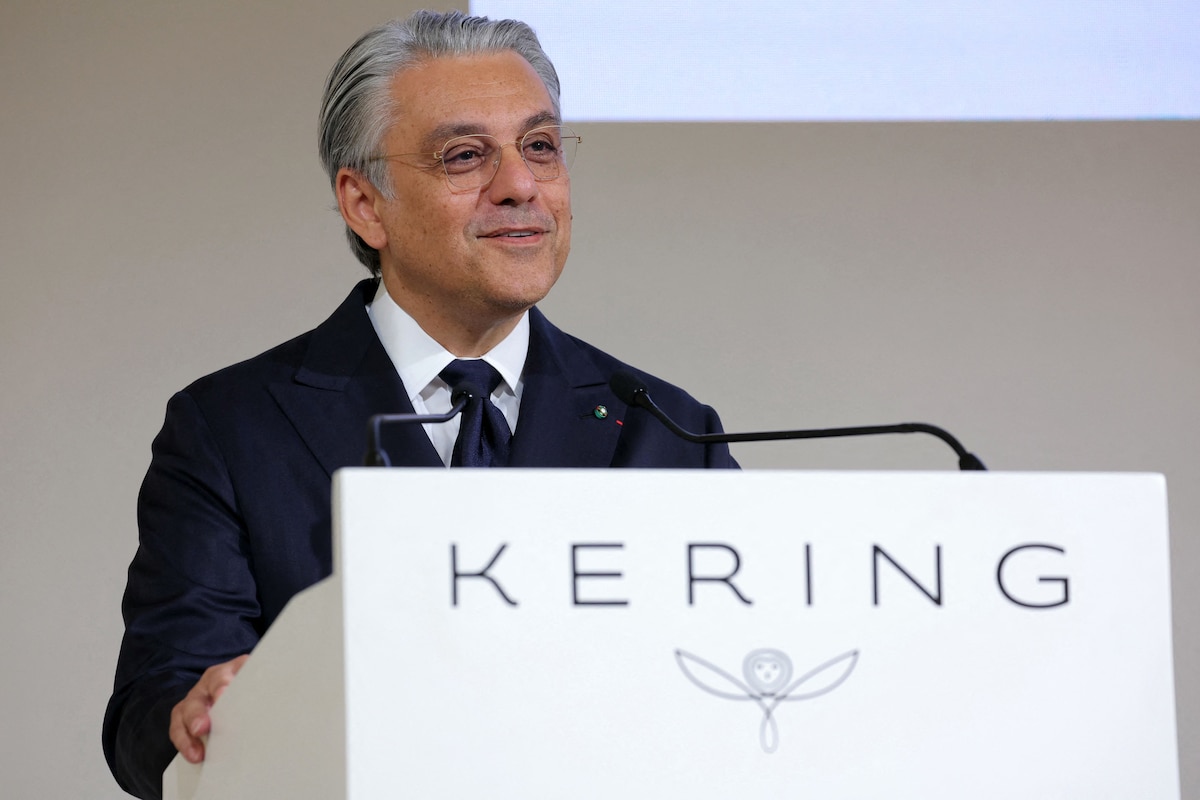
Luca de Meo’s first eight months as Kering CEO add up to a Capital Markets Day in Florence on April 16, 2026, five different creative-director appointments inherited or made across the portfolio, a Gucci Times Square takeover that BoF on May 24, 2026 called “back under the microscope,” and a three-phase plan called ReconKering that asks investors to wait until end-2030 to see the payoff. This is a Kering portfolio refresh on a scale the group has not attempted since the disposal of the sport-and-lifestyle assets, and it lands as the Kering AGM convenes May 28, 2026 at 3 PM Paris time at 40 rue de Sèvres. The question every house faces is no longer who runs it. It is what shape it should be by the time the Lead phase opens in 2029.
The shape of the answer is uneven. Saint Laurent is the asset that needs the least repair and gets the lightest hand. Gucci is the asset that defines the whole arithmetic of the plan and gets the loudest design intervention. Alexander McQueen gets the structural cut. Bottega Veneta gets an extension at the edges. Balenciaga gets a tonal reset under a designer whose entire grammar is the opposite of the house’s last decade. Below, every house, in the order de Meo’s deck implied at Florence.
The de Meo Mandate and the ReconKering Plan
Luca de Meo took office at Kering on September 15, 2025, the date the group formally separated the chairman and CEO roles for the first time since 2005. François-Henri Pinault stays on as chairman; de Meo runs the company. The pay package — €20M sign-on (€15M cash, €5M Kering shares), €2.2M fixed salary, €1.21M variable for 2025 — is the most expensive hire in the group’s history and was front-loaded because the asks are.
ReconKering, unveiled at the Kering Capital Markets Day 2026 in Florence on April 16, 2026, is the architecture. Three phases:
- Reset, by end-2026: stabilize Gucci, cut McQueen’s footprint, reposition Balenciaga and Bottega Veneta around their best-performing categories, get the cost base honest.
- Rebuild, by end-2028: grow the categories that should be growing — Saint Laurent menswear, Saint Laurent Asia, Bottega Veneta jewellery and home, Balenciaga leather goods, Gucci boutique productivity — and get the jewellery division to scale.
- Lead, the “Next Luxury” phase, by end-2030: a Kering that doubles its full-year 2025 recurring operating margin percentage at group level, mid-term.
That doubling target is the single most important number in the deck. It is also not the only one. De Meo explicitly named doubling targets for the jewellery business, for top-tier client sales, for Gucci boutique sales density, for Saint Laurent menswear and Asia, for Bottega Veneta non-leather, and for Balenciaga’s leather goods, women’s ready-to-wear, and U.S. business. He has Jean-Marc Duplaix beside him as deputy CEO with operations and finance — Jean-Marc Duplaix is the lifer who runs the machine while de Meo runs the room. The decision to choose Florence for the day rather than Paris was its own statement, of a piece with the Kering Florence strategy the group has been signalling since the Palazzo Settimanni reopening.
The strategic logic across the houses follows a single principle: stop indexing every brand to grow the same way, and let each one grow on its own native muscle. That principle is what makes the portfolio readable.
Kering Portfolio Refresh: House by House
The table below collapses the comparative picture. It is the most useful single artifact in this article, and the reason every paragraph that follows can be shorter than it would otherwise need to be.
| House | Creative Director | Appointed | Debut Collection | ReconKering Phase | Strategic Mandate |
|---|---|---|---|---|---|
| Gucci | Demna Gvasalia | July 2025 | Memoria, MDW April 2026; SS26 RTW shown later 2026 | Reset → Rebuild | Double boutique sales density; restore top-tier clientele; recover margin from FY25 trough |
| Saint Laurent | Anthony Vaccarello | April 2016 (10-yr anniversary 2026) | Already at scale (~$3B); Lyst Index 2025 #1 brand | Rebuild | Double menswear and Asia; protect leather goods and tailoring |
| Bottega Veneta | Louise Trotter | January 2025 (succeeded Matthieu Blazy) | SS26, Milan, September 27, 2025 | Rebuild | Extend into RTW, jewellery, home; double non-leather; protect leather volumes |
| Balenciaga | Pierpaolo Piccioli | July 10, 2025 | October 2025 Paris Fashion Week debut; “Heart and Body” campaign February 2026 | Reset → Rebuild | Double leather goods, women’s RTW, and U.S.; cut menswear dependency |
| Alexander McQueen | Seán McGirr | October 2023 | AW24 | Reset | Refocus on women’s RTW/tailoring/eveningwear; cut store count ~50% by end-2026 vs end-2025; fewer collections |
Gucci: The House That Sets the Arithmetic
Gucci is roughly half of Kering’s revenue and far more than half of its problem. The 2025 numbers — released in February 2026 in the run-up to Florence — were the trough de Meo inherited, and they made every other line in the deck contingent on Gucci recovering. The Reset phase is mostly a Gucci phase. The doubling of boutique sales density target is mostly a Gucci target. The top-tier client doubling is mostly a Gucci ask. The reason the rest of the portfolio gets lighter intervention is that the heaviest intervention has to land here.
Demna Gvasalia became Gucci artistic director in early July 2025, succeeding Sabato De Sarno — De Sarno had been hired in early 2023, shown his first collection in September 2023, and left in February 2025 after a two-year stint that the market read as undercooked and the press read as quiet. Demna was the highest-leverage hire Pinault could make. He arrived from Balenciaga, which under his decade had become the loudest house in the group, and he arrived at Gucci with a mandate that was the opposite of his Balenciaga grammar: rebuild Gucci’s relationship with its own archive, restore the codes the De Sarno period had filed down, and do it before Reset ends in 2026.
The first design statement was Memoria at Milan Design Week 2026 — twelve distressed-archive objects installed in the Basilica di San Simpliciano during the week of April 12 to 18, 2026, the same window as the Kering at Milan Design Week 2026 showings across the portfolio. Memoria was not a clothing collection. It was a thesis. The Gucci horsebit, the bamboo, the Jackie, the Diana, the GG monogram — each treated as an object you have to find in a state of decay before you can restore it, which is also a description of what de Meo is doing with the house. Whether the SS26 RTW collection holds the same thesis when it ships into stores is the question that decides whether Reset stays on schedule.
The Times Square takeover, which BoF on May 24, 2026 framed as “back under the microscope,” is the friction point. Times Square is a venue that no longer reads like luxury, even when the takeover is at the scale Gucci can afford, and the criticism is that it cuts against the boutique-density thesis. The defence is that Demna’s audience is in part the audience that recognizes Times Square as a cultural site rather than a shopping site. Both can be true and both are diluting the message the Florence deck is trying to send. The same week brought the Gucci × Alpine F1 partnership — the first luxury fashion title sponsorship in Formula One — which is the other Demna-era brand-extension move the deck has to absorb. The question is whether the takeover reads as a final transgressive Demna gesture or as a relapse. The next four quarters will decide.
Saint Laurent: The Asset That Needs the Least Repair
Anthony Vaccarello hit ten years as Saint Laurent creative director in April 2026 — appointed April 4, 2016. The house is a roughly $3 billion business inside Kering, topped the Lyst Index 2025 as the most influential brand of the year, and is the rare case in the portfolio where Reset is not really required. Saint Laurent gets Rebuild — and Rebuild here means doubling rather than fixing.
The targets de Meo named in Florence were menswear and Asia. Saint Laurent menswear has been growing faster than the house’s leather-goods business for three years and is still under-distributed relative to its design output; Vaccarello’s tailoring is the strongest answer the group has to the Brunello Cucinelli/Loro Piana quiet-luxury argument, and Asia is the geography where the silhouette translates with the least friction. Doubling either of those is a believable five-year target. Doubling both is the kind of stretch number that anchors a Capital Markets Day deck.
What is conspicuous in the Saint Laurent line is the absence of any creative-director question. Vaccarello has run the house longer than any Saint Laurent designer since Yves himself, and the ten-year anniversary in 2026 was not used to renegotiate. The signal is that de Meo, despite a portfolio where four of the five houses changed creative direction inside two years, sees no upside in moving the asset that works. That is a piece of judgment that buys him credibility on the harder calls below.
Bottega Veneta: Extension at the Edges Under Louise Trotter
Louise Trotter succeeded Matthieu Blazy at Bottega Veneta at the end of January 2025. Blazy left for Chanel — the matthieu blazy career trajectory reads as the cleanest exit of the recent designer cycle and is one of the cases that the designer buyback playbook discusses as a structural feature rather than an incident. Trotter’s debut SS26 collection shipped at Milan, September 27, 2025. The show was confident, restrained, and — importantly — did not break the house’s leather-goods grammar.
The Bottega mandate inside ReconKering is the most subtle of the five. The house is profitable. Its leather goods are the closest thing in the group to a defensive moat. The instruction is: do not break that, while doubling non-leather. That means ready-to-wear has to grow into a structural revenue line rather than a halo for the bags. It means jewellery has to scale — Bottega’s gold pieces under Blazy were already pulled into the Kering jewellery division strategy that the group is building separately. And it means home, the category the previous Bottega regime piloted with cautious capsules, now has to ship at a scale that matters.
Trotter’s strength, evident in her previous Carven and Lacoste tenures, is exactly the category-extension move Bottega needs — she designs through a wardrobe lens rather than a product lens, which makes ready-to-wear and home accessories feel native to the house rather than line extensions. The risk is the obverse: the leather-goods grammar Blazy built was so distinctive that any drift reads as loss. The Florence deck implied that protection of leather volumes is the floor; everything else is upside. That is the right framing.
Balenciaga: A Tonal Reset Under Piccioli
Pierpaolo Piccioli became creative director of Balenciaga effective July 10, 2025. His debut shipped at Paris Fashion Week in October 2025. The February 2026 “Heart and Body” campaign with Winona Ryder and Harris Dickinson read as a calibration exercise — moving Balenciaga from the irony-and-scale grammar Demna had perfected into something closer to Piccioli’s romantic-couture register. That move is the entire thesis of Balenciaga’s Reset.
The category mandate is explicit: double leather goods, double women’s ready-to-wear, double the U.S. business. The negative space inside that mandate is more revealing — menswear dependency goes down. Balenciaga under Demna had become a house whose growth was disproportionately menswear-driven and disproportionately viral-product-driven, and both of those dependencies are what made the FY24-FY25 numbers vulnerable to taste shifts. Piccioli’s grammar inverts that. He builds women’s RTW first, accessories second, menswear third. The U.S. business doubling is the geography where his couture-romantic register has the most cultural slack to occupy.
This is the riskiest reposition in the portfolio because it asks an audience that knew Balenciaga as a particular kind of cultural object to accept a different kind. The conservative read is that Piccioli is too soft for the house. The optimistic read — and the read de Meo is buying — is that the soft register is exactly the thing the house has been missing for five years and the thing that lets it grow categories that the old register was structurally bad at. The “Heart and Body” campaign was the first piece of evidence in favour of the optimistic read. Spring 2026 retail data will be the second.
Alexander McQueen: The Structural Cut
Of the five houses, Alexander McQueen gets the deepest cut. Seán McGirr — Irish, born 1988, ex-JW Anderson ready-to-wear head, McQueen creative director since October 2023, succeeding Sarah Burton, debut AW24 — keeps his job. De Meo, in Florence, ruled out selling McQueen. But the house’s footprint is going to look unrecognizable by end-2026.
The mandate: refocus on women’s ready-to-wear, tailoring, and eveningwear; fewer collections per year; a roughly 50% store-count reduction by end-2026 versus end-2025. That last number is the most aggressive single instruction in the entire deck. McQueen at the start of 2026 had a store network sized for an ambition that the brand has not had revenue to support since Sarah Burton’s departure in 2023. Cutting half of it is an honest move rather than a punishment. It restores McQueen to a scale at which McGirr’s design language — sharper, more architectural, more masculine-tailoring-informed than Burton’s — can read on its own terms rather than being smothered by a retail footprint built for a different house.
What McQueen does not get is investment in categories beyond the core. No jewellery scaling push. No home extension. No bag-driven retail strategy. The instruction is to be smaller and more focused. The implicit promise from de Meo is that once the house is right-sized through 2026 and 2027, the Rebuild phase will fund growth from a credible base. That promise will be tested. McGirr has shown enough in two years to deserve the chance to test it. The store-count cut is the cost of him getting it.
What the Plan Implies About the Rest of the Group
Two structural questions sit outside the house-by-house picture. The first is jewellery, which the Kering jewellery division is being assembled to address as a cross-brand growth vector — Boucheron and Pomellato run the core, but the doubling target for jewellery covers Bottega’s gold work, Saint Laurent’s fine pieces, and Gucci high jewellery as well. The second is top-tier clientele, where the doubling target is being run as a group programme rather than a house programme. Both of those are de Meo’s idea, both of them are unusual at Kering historically, and both of them are the kind of cross-portfolio leverage move that the LVMH playbook has been running for fifteen years and Kering has not.
The designer buyback playbook — the structural cycle in which luxury groups cycle creative directors faster than the houses can absorb them — sits behind the whole portfolio. Of the five Kering houses, three changed creative direction in 2025 alone (Gucci to Demna, Balenciaga to Piccioli, Bottega Veneta to Trotter). A fourth (McQueen to McGirr) changed in late 2023. Only Saint Laurent under Vaccarello is in continuity. That is the highest creative-director churn at a single conglomerate in a single window in luxury’s modern era. De Meo’s bet is that he has done all the churn in advance, and the next five years can be about execution rather than reinvention. That is the bet the Florence deck is asking investors to underwrite.
The Florence Choice and the AGM Calendar
The choice of Florence for Capital Markets Day, on April 16, 2026, was a piece of staging. Florence is Gucci’s headquarters city, the seat of the artisanal infrastructure the group spent two decades building, and the geography that lets de Meo physically separate the future-Kering narrative from the Paris-headquartered, Pinault-family-controlled past-Kering narrative. The signal — consistent with the broader Kering Florence strategy — is that the operational centre of gravity is moving south even as the formal corporate centre stays at 40 rue de Sèvres.
The May 28, 2026 AGM at 3 PM Paris time, at the rue de Sèvres headquarters, will give shareholders their first formal vote on the de Meo package and the ReconKering framing. The May 22 voting deadline for proxy ballots has now passed. The vote is not in doubt — Pinault family control of the share register makes it procedural — but the discussion will not be procedural. Investors will want detail on the Gucci recovery curve, on the McQueen store-cut execution, on the Bottega category extensions, on the Balenciaga U.S. doubling, and on whether Saint Laurent’s growth can absorb being asked to compensate for Gucci’s softness while doubling its own menswear and Asia numbers at the same time.
The Coda
De Meo’s portfolio refresh is the kind of plan that only makes sense if you accept that Kering, going into 2026, was a portfolio of houses managed as if they should all grow the same way and trade on the same multiples. ReconKering throws that out. Saint Laurent is asked to be Saint Laurent, faster. Bottega is asked to be Bottega, wider. Balenciaga is asked to be Balenciaga, softer. McQueen is asked to be McQueen, smaller. Gucci is asked to be Gucci, again — which is the hardest of the five instructions and the one the whole margin doubling depends on. The Florence deck is honest about the gradient. End-2026, end-2028, end-2030, with the heavy work front-loaded and the payoff back-loaded. Whether de Meo gets to the Lead phase is a question for 2029. Whether Reset lands is a question for the next four quarters. The Gucci Times Square takeover, the Bottega SS26 retail data, the McQueen store-cut pace, the Balenciaga U.S. number — those are the four screens the rest of the plan is being watched on. The May 28 AGM is where the watching formally begins.