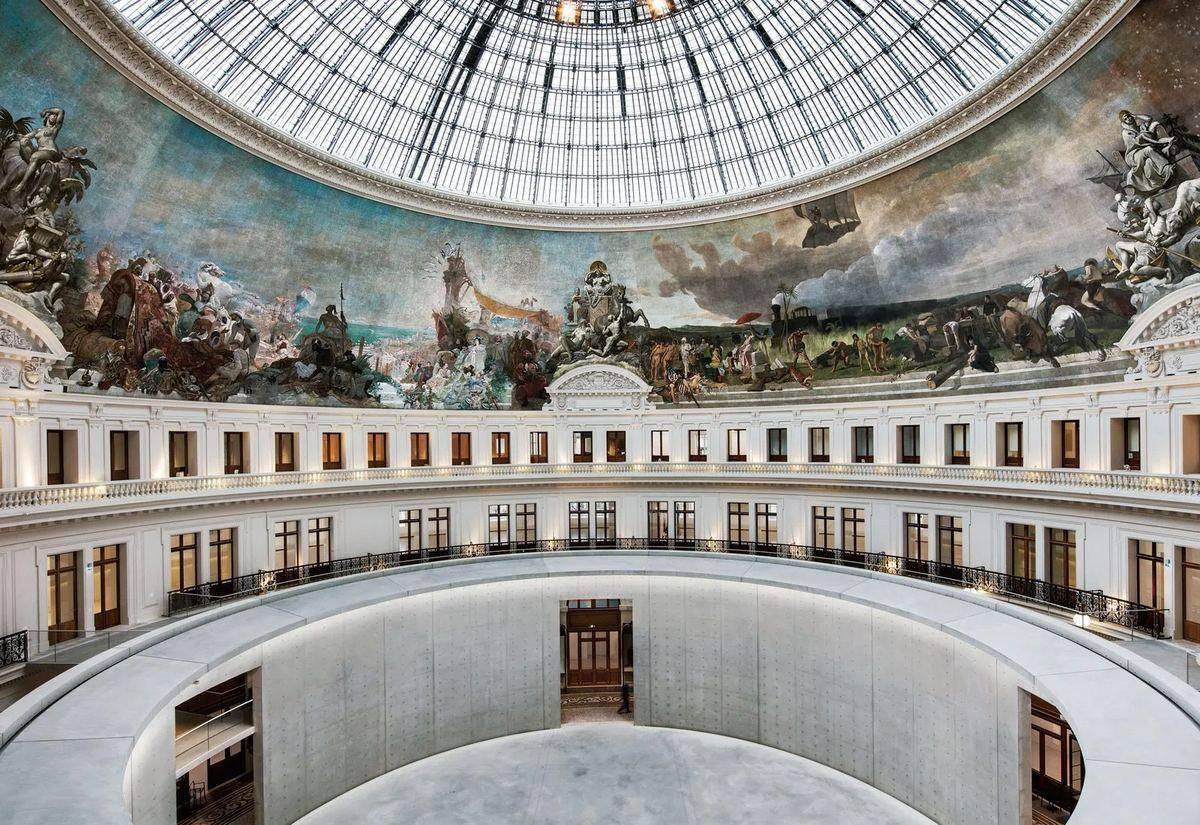
Fujiko Nakaya’s Cloud #07156 is the first work in the Bourse de Commerce installations sequence to delete Tadao Ando’s concrete rotunda instead of standing inside it. The 93-year-old Sapporo-born artist switched on her high-pressure pump nebulization system inside the Pinault Collection’s Parisian rotunda on 4 June 2026; the fog runs through 14 September 2026 as the centrepiece of the Clair-obscur programme at the Bourse de Commerce. Every other rotunda commission since 22 May 2021 — Urs Fischer’s burning wax Sabines, Anri Sala’s nocturnal sound piece, Danh Vo’s Before the Storm, Philippe Parreno’s permanent Medici-column light sequence — has answered Ando’s 29-metre-wide concrete cylinder by occupying it. Nakaya answers it by erasing it.
That, anyway, is the screenshottable claim. The longer one is that fog, when correctly aimed at a concrete cylinder, does something that wax, sound, sculpture and intermittent light cannot. Wax acknowledges the cylinder by burning down inside it. Sound acknowledges it by bouncing off it. Sculpture acknowledges it by being framed by it. Fog, at the densities Nakaya and the late atmospheric physicist Thomas Mee calibrated their pumps to deliver, refuses the acknowledgment. The 863 board-formed concrete panels Ando set inside Nicolas Le Camus de Mézières’s eighteenth-century circular masonry stop being a wall. The Henri Blondel iron-and-glass dome stops being a ceiling. The Rotonde, briefly, stops being a room.
The Pinault Collection’s own communications around Clair-obscur lean on the formulation Anne-Marie Duguet has been attaching to Nakaya since the 1990s: the antipanopticon. In Duguet’s reading, the mist “undermines the very idea of viewpoint” while asserting “the centrality of a totalizing physical experience.” That is a fair description of what happens when you stand on the cylinder’s roof and watch the fog reach the dome’s painted allegory of global trade. The five-panel Désiré François Laugée fresco disappears first. The concrete ring you are standing on disappears second. The other visitors disappear third. Then, because Nakaya has been doing this since 1970 and knows exactly how long an audience will tolerate near-total obscurity inside a museum, the system pulses, the fog thins, and the rotunda comes back.
This piece is a chronology of every Bourse de Commerce installation since the 22 May 2021 opening, anchored on what Nakaya’s Cloud #07156 does to the room she has been hired to disappear. It also reads the 2026 commission backwards through the 1970 Pepsi Pavilion and the 1998 Guggenheim Bilbao fog — because the Pinault rotunda is the first Ando interior her fog has been asked to dissolve.
Cloud #07156: how the fog is made
Nakaya’s fog is water and nothing else. The system is mechanical, not chemical. A closed-loop network of high-pressure pumps — co-developed with Mee, the American atmospheric physicist who joined Nakaya at the Pepsi Pavilion in 1970 and stayed her engineering partner until his death — drives municipal-grade water through a ring of nozzles set into the concrete cylinder’s upper lip. The water exits the nozzles at the pressure required to atomise into roughly 8-micron droplets, the size at which surface tension and air resistance balance long enough for the droplet to behave as suspended vapour rather than rain. Below 5 microns the cloud feels dry; above 15 it feels wet. At 8, the fog reads on the skin and on the camera as weather.
The nozzles are mounted at the inner edge of the 9-metre-high concrete ring that defines Ando’s rotunda. They fire downward and outward, so the cloud forms first inside the cylinder, then spills over the lip, then descends into the perimeter walkway, and finally rises again through the warm air of the dome. The total volume the system has to fill is approximately 6,000 cubic metres. The cycle Nakaya programmed for Clair-obscur — fifteen minutes of build, fifteen minutes of full saturation, fifteen minutes of dispersal, then a fifteen-minute interval — is roughly the same cycle she used at the Guggenheim Bilbao in 1998. The room is different. The cycle is not.
What changes, between Bilbao and Paris, is what the fog has to dissolve. At Bilbao, Nakaya’s F.O.G. #08025 envelops Gehry’s titanium volumes from the outside, and the question is whether the cloud will read against the curved metal or be lost into it. At the Bourse, the fog forms inside Ando’s cylinder and has to dissolve a single, smooth, board-formed concrete surface from less than fifteen metres away. The panels are sized after the Japanese tatami — 863 of them, each cast individually, arranged in horizontal courses that read as a single continuous board-marking across the cylinder’s 91-metre inner circumference. When the fog reaches 80% saturation, the courses go first. Then the joins go. Then the ring at the top, where Ando’s concrete meets the void under the dome, goes. The cylinder unbuilds in the order it was built.
Ando’s 863 tatami-proportioned panels
Ando’s rotunda is the cleanest of the three concrete moves he made for François Pinault between 2006 and 2021. At Palazzo Grassi he intervened subtractively; at Punta della Dogana he dropped an 11-metre concrete cube into Giuseppe Benoni’s customs house; at the Bourse he placed the cylinder, and only the cylinder. The dimensions sit at 29 metres inner diameter and 9 metres tall — a free-standing wall holding nothing up except its own ring beam. The wall is composed of 863 panels, board-formed in the manner Ando had been refining since the Church of the Light in 1989, and proportioned individually after the Japanese tatami mat. The full architectural restoration ran from 2017 to 2021, with the Parisian practice NeM / Niney et Marca architectes as architect of record and Pierre-Antoine Gatier as heritage architect for the eighteenth-century shell and Blondel’s 1888–89 dome. The building reopened on 22 May 2021.
The cylinder was, from the beginning, designed to be a stage for installation. Ando set the ring beam exactly at the height of Le Camus de Mézières’s original first-floor balustrade, so a visitor walking the cylinder’s roof would meet the painted fresco of the dome at eye level for the first time since 1889. The cylinder’s interior, the Rotonde, was conceived as the museum’s central commission space — a 1,000-square-metre room with no fixed programme, in which a single artwork would be reset every six to nine months for the life of the lease. That is the slot Nakaya has been hired to fill. It is the same slot Fischer filled in 2021, Sala in 2022 and Vo in 2023. For a fuller account of how the cylinder relates to the Venetian rehearsals at Palazzo Grassi and Punta della Dogana, see Tadao Ando and the Pinault Collection.
What matters for the fog is the surface. Board-formed concrete is a memorising surface — the timber grain of the formwork imprints on the concrete and survives every wash. The 863 panels at the Bourse carry that imprint at a uniform horizontal pitch, which means the cylinder reads, in normal light, as a continuous wood-grained wall. Nakaya’s fog is, technically, the first installation in the room to address that surface as a problem to be removed rather than a backdrop to be worked against. Fischer’s wax burned in front of it. Sala’s sound played off it. Vo’s sculpture sat inside it. Nakaya’s fog deletes it.
From Pepsi Pavilion 1970 to Bourse 2026: Nakaya’s fog lineage
The fog inside the Bourse de Commerce in June 2026 is, in a direct material lineage, the same fog Nakaya and Mee first produced inside Robert Breer’s polyester pavilion roof at Expo ‘70 in Osaka. The Pepsi Pavilion, commissioned by Experiments in Art and Technology (E.A.T.) and built for the 1970 Osaka world’s fair, was the first water-based atmospheric fog sculpture in modern art. Nakaya was 37. Mee was the atmospheric physicist she had hired specifically because the chemical-fog approach favoured by the rest of the E.A.T. engineers — burning oil or releasing dry ice — would have killed everyone inside the pavilion within forty minutes. The pump system Mee built for Osaka is the direct ancestor of the system pumping water into the Bourse cylinder in 2026. The nozzles are smaller, the pressure is higher, the closed-loop hygiene is more aggressive. The principle has not changed.
Nakaya’s fog lineage between 1970 and 2026 is unusually consistent for a fifty-six-year practice. She has installed roughly eighty fog works in that time, the majority of them site-specific and temporary, a minority permanent. The two permanent works that matter for reading the Bourse commission are the 1998 F.O.G. #08025 at the Guggenheim Museum Bilbao — Gehry’s titanium volumes wrapped, at scheduled intervals, in Nakaya’s mist — and the 2018 fog at the Yorkshire Sculpture Park’s Longside Gallery. Bilbao is the one that frames the Bourse most directly, because Bilbao was the first time a museum architect’s signature building was knowingly handed to Nakaya for partial erasure. Gehry agreed to it. Ando, in 2026, agrees to it. The pattern is now twenty-eight years old.
There is a smaller biographical fact worth keeping in mind. Nakaya is the daughter of Ukichiro Nakaya, the Sapporo physicist who in 1936 became the first person to synthesise a snowflake in a laboratory. Her father spent his career proving that ice crystals were a legible record of the atmospheric conditions that produced them. Her own career has spent fifty-six years producing atmospheric conditions, at scale, inside buildings. The genealogy is the cleanest in twentieth-century art: a physicist who made ice from water in 1936, a daughter who made fog from water in 1970, and a 2026 commission in which the daughter, now 93, makes fog from water inside a concrete cylinder designed by a Japanese architect who was nine years old the year her father synthesised the first snowflake.
Rotunda installations, 2021–2026
The Bourse de Commerce installations slot since the 22 May 2021 opening has run, in practice, at the cadence of one major rotunda commission per year, with the permanent Parreno light sequence on the historic Medici column running underneath every show. The table below sets the commissions in chronological order and asks, for each, what it does to Ando’s concrete cylinder.
| Year | Artist | Title | Dates | What it does to Ando’s concrete cylinder |
|---|---|---|---|---|
| 2021 | Urs Fischer | Untitled (2011) | 22 May 2021 – 29 January 2022 | Burns inside it. Wax replica of Giambologna’s Rape of the Sabine Women plus a wax figure of Rudolf Stingel and seven chairs, lit on opening day; the slow combustion turns the cylinder into a backdrop for entropy. |
| 2022 | Anri Sala | Time No Longer | 14 October 2022 – 16 January 2023 | Resonates off it. A nocturnal sound-driven installation that uses the cylinder’s interior as an acoustic chamber; the concrete becomes a tuned surface. |
| 2023 | Danh Vo | Before the Storm | 8 February – 24 April 2023 | Sits inside it. A site-specific sculptural staging that treats the cylinder as a held room and stages a quiet, low-density hang against the board-formed wall. |
| 2026 | Fujiko Nakaya | Cloud #07156 | 4 June – 14 September 2026 | Deletes it. A water-vapour cloud, generated by high-pressure pump nebulization, dissolves the perceptual boundary of the 863-panel concrete wall for fifteen minutes per cycle. |
| Permanent in-situ | Philippe Parreno | Mont Analogue (modified 2001) | Since 22 May 2021 | Ignores it. A modified version of Parreno’s 2001 work mounted on the historic Medici column outside the cylinder; the intermittent light sequence encodes René Daumal’s unfinished metaphysical novel and runs underneath every rotunda show. |
The pattern is legible. The first three rotunda commissions accept the cylinder as the room. Fischer’s wax acknowledges it by burning down inside it. Sala’s sound acknowledges it by exploiting its acoustic geometry. Vo’s installation acknowledges it by occupying it. Parreno, deliberately, never addresses it — his work is on the Medici column, outside the cylinder, and remains the constant against which the rotating rotunda commissions are read. Nakaya is the first artist in the slot to refuse the cylinder altogether. The fog is not an installation inside the Rotonde; it is a programmed dissolution of the Rotonde.
Why fog is harder than wax, sound or sculpture inside a heritage shell
The heritage envelope at the Bourse de Commerce is significant: Le Camus de Mézières’s 1763–67 masonry, Blondel’s 1888–89 iron-and-glass dome, and the painted allegory of global trade beneath that dome are all classified historic. Pierre-Antoine Gatier, the heritage architect on the 2017–21 Ando restoration, was hired specifically to police the line between Ando’s new concrete and the eighteenth-century fabric. Every Bourse de Commerce installation since 2021 has been written under Gatier’s constraints. Fischer’s wax was permissible because it was contained inside a steel tray inside the cylinder. Sala’s sound was permissible because it was non-physical. Vo’s Before the Storm was permissible because it was assembled from objects that did not touch the masonry.
Fog is the hardest case. Water vapour at 80% saturation, held inside a closed eighteenth-century shell for fifteen-minute pulses across a four-month run, is the kind of risk a heritage architect normally vetoes. The Pinault Collection’s engineering team spent the months between commission and opening proving that the closed-loop, high-pressure system would not deposit measurable moisture on Blondel’s painted dome or the masonry. The fog, in practice, is engineered to live within the cylinder and the perimeter walkway and to disperse vertically before reaching the historic surfaces.
The other reason fog is hard is that it cannot be photographed in a way that resolves to a press image. Wax burning is photogenic. Sculpture frames clearly. Fog, on a still image, reads as a smudge. The press materials for Clair-obscur are short videos, fifteen-second loops timed to the cylinder dissolving and returning. That is the right register for the work, and the first time a Bourse de Commerce installation has effectively refused the still photograph as its primary distribution surface.
Bourse de Commerce installations after Nakaya
The slot after Cloud #07156 closes on 14 September 2026, and the Pinault Collection has not yet announced its successor. The most useful question to ask about the next commission is whether it will treat Nakaya’s deletion as the new baseline. Three rotunda shows in five years addressed the cylinder as a room; Nakaya’s fog, for the first time, addresses it as a problem. If the next show goes to an artist who treats the cylinder as a backdrop, Cloud #07156 will read as a one-off. If it goes to an artist who treats the cylinder as a surface to be dissolved, transformed or contradicted, the 2026 commission will read as a hinge.
The first decade of the Bourse — 2021 to 2026 — was the cylinder-as-stage decade. Fischer, Sala, Vo and Parreno all worked from the cylinder’s geometry outward. The second decade, if Nakaya’s commission is read correctly, will be the cylinder-as-condition decade: works that treat Ando’s 863-panel wall as a fact about the room to be argued with rather than a frame to be filled.
Coda
Nakaya did not come to the Bourse de Commerce to install a fog sculpture inside Ando’s concrete cylinder. She came to delete it. The work is Cloud #07156, the dates are 4 June to 14 September 2026, the system is high-pressure pump nebulization on a closed loop calibrated to deposit nothing on the eighteenth-century masonry or the Blondel dome, and the result is fifteen minutes per cycle in which the 29-metre-wide, 9-metre-tall, 863-panel concrete wall that defines the museum stops being there. Every previous Bourse de Commerce installation since 22 May 2021 has acknowledged Ando’s room. The 93-year-old Sapporo physicist’s daughter, who synthesised her first fog inside Robert Breer’s polyester roof in Osaka the year before Ando was first published in Western architectural journals, is the first artist in the cylinder to argue, with water and pressure rather than wax, sound or sculpture, that the room does not need to be there at all.