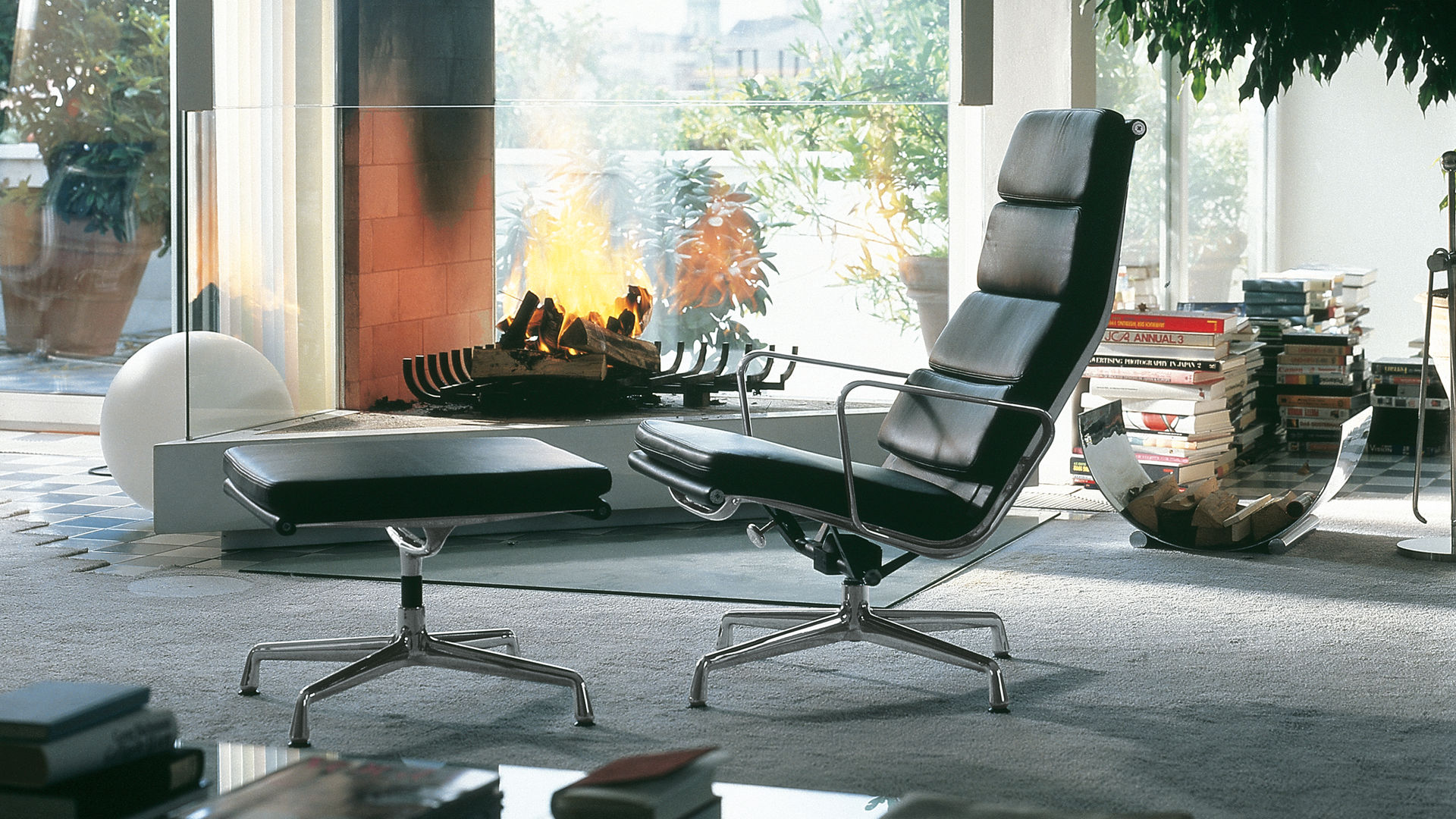
Thirty years separate Alberto Meda’s 1996 Meda chair from the Bascule lounge chair that Studio Œ unveiled at Vitra’s Nordhavn showroom this week. Read in sequence, Vitra lounge soft seating chairs trace a single arc: from the soft-net ergonomic engineering Meda imported into the office in the mid-1990s to the recyclable V-Foam upholstery Lisa Ertel and Anne-Sophie Oberkrome wrapped around Bascule like a loosely tailored jacket. In between sit Antonio Citterio’s ID Chair Concept of 2010, Konstantin Grcic’s pendulum-suspended Citizen of 2020, Panter & Tourron’s disassemblable Anagram sofa of 2024, and Stephan Hurlemann’s Reset chair from Salone this April. Six projects, six designers, one consistent question: how soft should a working chair be, and what should it be made of?
This article is a reference. It walks the seven projects chronologically — adding Grcic’s 2016 Hack desk as context for his Vitra office trilogy — and ends on the materials question that Bascule has just made central.
Meda 1996: the soft-net invention
Alberto Meda’s relationship with Vitra began in 1994. The Meda chair, released in 1996, was his first product for the company and the project that opened the soft-seating lineage this article tracks. It is also the chair that taught the Vitra office programme what a sling could do.
The Meda chair was the first sling-style soft-net ergonomic chair in Vitra’s catalogue. Its defining technical move was structural rather than mechanical: movement comes from a flexible aluminium seat structure, not from a concealed under-seat synchronous mechanism. The frame itself flexes, and the net follows. There is no spring pack, no levered tilt cassette. The Italian engineer-designer treated the chair the way he had treated his earlier carbon-fibre Light Light chair for Alias — as a structural problem in which softness is engineered into the load path rather than added on top.
The reference points this sets up matter for everything that follows. Meda’s chair establishes that, for Vitra, a soft chair is one in which the structure does the yielding. The reading is consistent with the broader architect-designed task chair lineage that runs through Vitra and its peers — chairs in which mechanical complexity is hidden inside material behaviour. The contrast with Herman Miller’s roughly contemporary Aeron, whose engineering legibility we examine in the Aeron ergonomic chair lineage, is sharp: Meda hid the mechanism by letting the frame become it.
Citterio’s ID system 2010: modularity reaches the office
Fourteen years later, Antonio Citterio’s ID Chair Concept extended the soft-net idea into a programme. Released in 2010, ID Chair was not a single model but a modular office chair system spanning five named variants: ID Trim, ID Trim L, ID Soft, ID Air, and ID Mesh. The system shared a common chassis and adjustable mechanism across all five; what changed was the upholstery and back type.
Citterio’s contribution was to treat soft seating as a configurable platform. ID Mesh kept the membrane-back logic Meda had introduced. ID Soft padded the back. ID Trim and ID Trim L offered upholstered versions at two heights. ID Air added a perforated mesh option for ventilation. A single procurement decision could equip a floor with chairs that read as different products but shared the same kinematics and replacement parts.
For Vitra, ID Chair Concept was the office’s answer to the modularity that had already become standard in the company’s storage and table programmes. Soft seating had so far been delivered as discrete models — the Meda chair, the AC series — each with its own logic. ID Chair Concept made the soft chair a system. The five variants are still in production sixteen years later, which makes ID one of the longest-running office programmes in Vitra’s history.
Hack 2016: Grcic’s office trilogy begins
Konstantin Grcic’s Hack desk, released in 2016, is not soft seating. It belongs in this reference for a different reason: it is the first object in the Vitra office trilogy Grcic developed across a decade. Reading Citizen without Hack — and without the Stool-Tool that completed the set — loses the design argument Grcic was building.
Hack is a folding, height-adjustable desk based on construction-site scaffold logic. Its frame folds flat, its top is reversible plywood, and its appearance is unapologetically industrial. Grcic’s premise was that the office had migrated into homes and informal workspaces, and that the furniture needed to acknowledge that the work itself had become improvised. Where Meda and Citterio’s chairs were engineered for the corporate floor plate, Hack was engineered for the loft, the studio, the bedroom corner.
Citizen four years later is the chair Hack predicts. Without the desk’s argument about informality and domestication, the chair’s pendulum-suspended seat reads as eccentric. With it, the logic clicks: Grcic was redesigning the office as a domestic object, and the chair had to follow.
Grcic’s pendulum: Citizen 2020
Citizen, released in 2020, is the soft-pad lounge chair Grcic built for the home office. Its defining move is mechanical: instead of a synchronous tilt mechanism, the seat is pendulum-suspended from a cradle, so it swings gently under load rather than reclining on a sprung axis. There is no synchronous mechanism at all. The user’s weight, transferred through the suspension, does the work.
The design reads as a deliberate rejection of office-chair convention. Synchronous mechanisms had been the soft-task-chair default since the 1980s; Vitra itself had built them into the Meda chair’s competitors and into much of the ID Chair Concept range. Grcic stripped them out. Citizen is a lounge chair in the formal language of an office chair — generous padding, soft-pad surfaces, a casual swing — and that recategorisation is what makes it sit inside this article’s lineage rather than alongside the engineered-task tradition.
Grcic has worked with Vitra since the mid-2000s, and Citizen is the most visible expression of the brief he has been refining there: chairs that admit the office is now a domestic space. The argument is consistent with the curatorial position visible in his exhibition staging projects of 2026, and with the broader programme on the Vitra Campus that Junya Ishigami is now reshaping for the company’s next decade.
Anagram 2024: Panter & Tourron’s disassemblable system
The Anagram modular sofa, released by Vitra in September 2024 after a 3 Days of Design preview earlier that summer, was designed by the Lausanne studio Panter & Tourron — Stefano Panterotto and Alexis Tourron, working as a partnership since the mid-2010s. Anagram is the first piece in this lineage to make circularity a primary design parameter.
The system comprises eleven components organised on a rail. The aluminium frame contains 80% recycled content. The cushions are polyurethane foam cubes that sit on, rather than being permanently bonded to, the rail structure. The whole sofa can be disassembled — by the owner, with hand tools — into its component parts for repair, replacement, or eventual recycling. No part is welded shut; no upholstery is permanently stapled to a frame that cannot be opened.
The eleven components allow the sofa to be configured as a single seat, a chaise, a corner, a long sectional, or various intermediate forms. Reconfiguration does not require a technician. Panter & Tourron’s argument was that the modular sofa, which had become a category dominated by foam-on-frame products that were structurally non-disassemblable, needed to be redesigned around the joint rather than around the silhouette.
For Vitra, Anagram is the first major soft-seating release in which the materials and joints are the lead story. Meda hid the mechanism in the frame; Citterio hid the configuration in the system; Grcic hid the mechanism altogether. Panter & Tourron, by contrast, made the joints visible and the assembly reversible. The lineage shifts here from concealment toward legibility.
Reset 2026: Hurlemann at Salone
Stephan Hurlemann’s Reset chair launched at Milan Design Week / Salone del Mobile 2026 in April. Hurlemann, the Zurich-based designer who served as creative director of Horgenglarus before moving into independent practice, brought Reset into Vitra’s catalogue as the spring 2026 office release, two months before Bascule’s Copenhagen preview.
Reset is a contemporary task chair, and its placement in the Vitra programme — alongside ID Chair Concept and Citizen — confirms the company’s continued investment in the engineered side of the soft-seating spectrum. Where Bascule will land in autumn as a lounge chair with a fashion-tailoring upholstery argument, Reset occupies the daily-driver office position. The two 2026 releases bracket the catalogue: a working chair and a lounge chair, launched five months apart in two different European design weeks.
The pairing is strategically clean. Salone is Vitra’s stage for the office; 3 Days of Design Copenhagen has become, over the last three editions, the company’s stage for the residential and lounge end of the catalogue. Reset and Bascule are being released to those two audiences, in that order, in the same year.
Bascule 2026: Studio Œ’s jacket on a chair
The Bascule lounge chair, designed by Studio Œ and previewed at 3 Days of Design Copenhagen between 10 and 12 June 2026 at Vitra’s Nordhavn showroom — Klubiensvej 22, Pakhus 48 — is the project that prompted this reference. Official launch is September 2026. It is the most consequential Vitra soft-seating debut since Anagram, and the one that brings together the two threads — mechanical softness and material circularity — that have run separately through the previous thirty years.
Studio Œ was founded by Lisa Ertel and Anne-Sophie Oberkrome, both born in 1990 and both graduates of the HfG Karlsruhe. The studio uses the ligature Œ; “Studio OE” is the accepted Latin-alphabet rendering. Bascule is their first Vitra commission of this scale.
The name is the chair’s clearest design clue. “Bascule” is the French word for seesaw, and the chair’s suspension auto-adjusts to user weight: lean back and the seat pitches; the heavier the user, the more it gives. There is no manual tension dial, no lever. The mechanism behaves like the pendulum suspension Grcic built into Citizen six years earlier, but rebalanced for a lounge posture rather than a working one.
The upholstery is the story Wallpaper* and Surface led with last week. Studio Œ developed the textile cover using a fashion-tailoring technique: drape onto working prototypes. Cloth is pinned and adjusted directly on the chair in the way a tailor fits a jacket on a mannequin, rather than being pattern-drafted to a CAD model and then cut. The result reads — in the published photographs from the Nordhavn preview — as a jacket on the chair. The cover hangs from the structure rather than wrapping it tightly; seams sit where a tailor would place them, not where an upholsterer would.
Underneath that cover, Bascule replaces conventional permanently bonded polyurethane with either recycled fibres or V-Foam, the recyclable polyurethane Vitra has co-developed with BASF. V-Foam is the material that makes the rest of the chair’s logic work. Because the foam is not permanently bonded to the structure or to the textile, the cover can be removed, the foam can be replaced, and the chair can be disassembled at end of life into separable streams. Bascule is fully repairable and replaceable.
The Nordhavn preview placed Bascule at the centre of the Vitra showroom that opened during last year’s 3 Days of Design — Klubiensvej 22, Pakhus 48 — putting the chair in the same architectural setting as Vitra’s wider residential argument. Copenhagen has, over the last three editions of the fair, become the city where Vitra debuts the residential side of its programme; Bascule’s preview there before its September launch confirms the pattern.
Vitra lounge soft seating chairs: from polyurethane to V-Foam
Read across the seven projects, the materials story is the through-line that has been quietly accumulating since Anagram in 2024.
For most of the period this article covers, the soft chair was a polyurethane object. Conventional polyurethane foam is bonded to its frame and to its cover during manufacture, in ways that are not reversible. The cover cannot be removed; the foam cannot be extracted; at end of life, the chair is a composite that cannot be separated into material streams. Every soft chair Vitra produced from Meda in 1996 through Citizen in 2020 worked on that model. Performance was the metric; circularity was not.
Anagram in 2024 broke the model on the joinery side. The cushions remained foam, but they sat on the rail structure rather than being bonded to it, and the frame’s 80% recycled aluminium content addressed the structural side. The chair could be disassembled. The foam could not yet be circular.
Bascule in 2026 closes the loop. V-Foam — the recyclable polyurethane Vitra and BASF co-developed — replaces the bonded conventional polyurethane that had been the soft-seating default. The textile cover, draped rather than stapled, can be removed. The chair becomes, for the first time in this lineage, a soft object that can be taken apart into materials that have somewhere to go.
This is the technical reading of why Bascule matters. It is the first Vitra lounge chair in which both the joints and the materials are designed for reversal. The fashion-tailoring upholstery — the jacket-on-a-chair argument that drove the press coverage — is the visible expression of that engineering. A chair that wears its cover like a jacket is, by construction, a chair whose cover can be removed.
A chronological table
The seven projects, in order:
| Year | Project | Designer | Type | Defining feature |
|---|---|---|---|---|
| 1996 | Meda chair | Alberto Meda | Office task | First sling-style soft-net Vitra chair; movement via flexible aluminium seat structure, no concealed under-seat mechanism |
| 2010 | ID Chair Concept | Antonio Citterio | Office system | Modular programme across ID Trim, ID Trim L, ID Soft, ID Air, ID Mesh |
| 2016 | Hack | Konstantin Grcic | Desk (context) | Folding scaffold-logic desk; first piece in Grcic’s Vitra office trilogy |
| 2020 | Citizen | Konstantin Grcic | Home-office lounge | Pendulum-suspended seat, no synchronous mechanism, soft-pad lounge feel |
| 2024 | Anagram | Panter & Tourron | Modular sofa | 11-component rail system; aluminium frame 80% recycled; polyurethane foam cubes; fully disassemblable |
| 2026 (Apr) | Reset | Stephan Hurlemann | Office task | Salone del Mobile 2026 launch; spring office release |
| 2026 (Sep) | Bascule | Studio Π| Lounge | Seesaw suspension auto-adjusts to user weight; textile cover draped like a tailored jacket; V-Foam or recycled fibres; fully repairable |
Designers in this lineage, by entry year
Alberto Meda began with Vitra in 1994 and delivered the Meda chair in 1996. Antonio Citterio’s ID Chair Concept arrived in 2010. Konstantin Grcic developed the office trilogy — Hack 2016, Citizen 2020, with Stool-Tool sitting alongside — across the last decade. Panter & Tourron’s Anagram in 2024 was the studio’s first Vitra release of system scale. Stephan Hurlemann’s Reset arrived in April 2026; Studio Œ’s Bascule arrives in September.
Six designers in thirty years, across one company’s lounge and soft-seating catalogue. That count is deliberately low. Vitra has worked with many more designers in the same period — Ronan and Erwan Bouroullec, Jasper Morrison, Hella Jongerius, Barber Osgerby — but on different briefs: dining chairs, accessories, textiles, exhibition design, the Vitra Home Collection. The soft-seating commissions, narrowly defined, have gone to this short list.
The continuity matters. Each new entrant has worked within the technical language the previous ones established. Citterio’s ID Chair Concept extended Meda’s soft-net thinking into a system. Grcic’s Citizen extended Meda’s no-mechanism principle into a lounge posture. Panter & Tourron’s Anagram extended the soft-pad surface vocabulary into a modular system. Studio Œ’s Bascule extends the no-mechanism, soft-pad vocabulary again — into a lounge chair whose defining technical move is the upholstery’s removability.
Where this sits inside Vitra’s wider programme
The soft-seating lineage runs parallel to other Vitra commissions this site has tracked. The Vitra Campus is being reshaped by Junya Ishigami and Grcic for the next decade; the Sirmai-Peterson House by Frank Gehry sits in the company’s architectural history. The soft-seating catalogue is one of three or four product programmes — alongside the dining chair, the storage system, and the table — that anchor Vitra’s industrial output. Each has its own designer roster and its own technical history.
What separates the soft-seating programme from the others is the proximity to the body. A storage system can be a frame and a panel; a dining chair can be a structure and a surface. A lounge chair is a chair you sit in for an hour at a time, and what you sit on is the upholstery. The materials decision is therefore harder to defer, and the circularity question is harder to dodge. Anagram and Bascule have answered it. Reset, launched two months before Bascule, occupies the working-chair position where the upholstery is less central to the product’s argument.
The coda
Vitra’s soft seating between 1996 and 2026 has moved from ergonomic engineering toward circular materials. The Meda chair solved the working chair as a flex problem in the frame. The ID Chair Concept turned that solution into a configurable system. Citizen recategorised the soft chair as a lounge object suited to the domesticated office. Anagram introduced disassemblability. Bascule introduces V-Foam and draped upholstery, and in doing so closes the loop the soft chair had left open for thirty years.
Read forward, this is a thirty-year argument in which the engineering brief has migrated from comfort and posture toward repair and reversal. Read backward, it is a single company keeping a short roster of designers on a consistent question: what is the right way to make a chair that yields under weight, and can be taken apart afterwards. Bascule, previewed at Klubiensvej 22 between 10 and 12 June 2026, is the most complete answer Vitra has given so far. The September launch will say what production at scale looks like.