Most fashion houses, when they enter a new category, announce themselves loudly. There is a press event, a celebrity ambassador, a dinner of 200, a press release that uses the words “vision” and “universe” with abandon. The point of the announcement is to be the announcement. Bottega Veneta did none of this. The house’s first home collection, Casa, opened in a single ground-floor space on Via San Maurilio during the final weekend of Milan Design Week, with no press event, no opening party, and no advance preview. The press materials arrived by post — physical, on heavy stock, no PDFs. This is, of course, its own kind of announcement. But the restraint is consistent with everything Bottega Veneta has done since Matthieu Blazy assumed creative direction in 2021, and the collection rewards close attention.
The Pieces
Casa consists of twelve objects: a low daybed, two armchairs, a cocktail table, a desk, three lighting pieces, a screen, and three smaller objects — a tray, a vessel, a magazine holder. The list is conspicuously legible. There is no bedding, no candle, no scented anything, no tableware in the conventional sense. A house that has spent six decades arguing for the woven leather bag as the central artefact of Italian craft has decided that its first foray into the home will look, at least catalogue-wise, like a single furnished room rather than a category catalogue.
The materials are unsurprising — leather, walnut, brass, hand-blown glass — but the execution is exceptional. The leather work, in particular, demonstrates what the house can do when it applies its accessories craft to a different scale. The daybed is upholstered in a single piece of intrecciato-woven calfskin measuring nearly four metres. The intrecciato weave, originated by Bottega Veneta in 1966 and now the house’s most cited signature, is built from diagonal strips of hand-cut calfskin nominally four millimetres wide. On a handbag the regularity of those strips is the point; on a four-metre surface the slight variation in width — visibly hand-cut, never identical — gives the daybed a quality of human attention that machine production cannot replicate. The weave reads as fabric at a distance and as drawing close up.
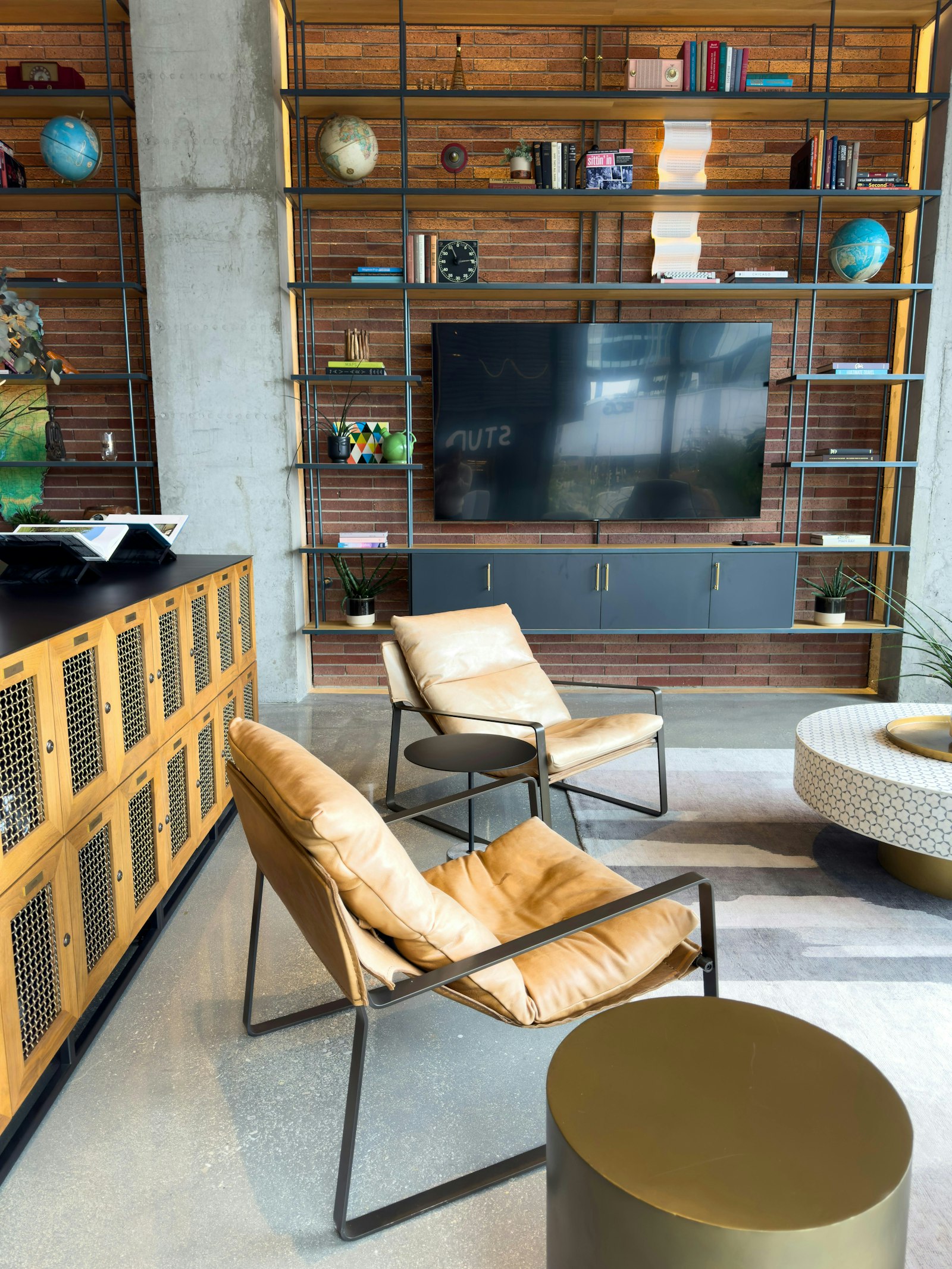
The armchairs use a different leather — vegetable-tanned, undyed, intended to age and patinate — wrapped over a frame of solid walnut. The construction is exposed; the leather is stretched and tacked rather than upholstered, with the tacks themselves serving as a visible decorative grid. It is the kind of detail that reads as casual until you understand how much care it requires. The cocktail table joins solid walnut to a brass-edged top with the same minimum-rhetoric joinery the armchairs employ. The desk is the only piece that reads as architectural rather than domestic — a long flat plane of leather over walnut, with a brass leg at each corner so spare it could be mistaken for a stand.
The three lighting pieces — a floor reader, a low table lamp, a wall sconce — share a single vocabulary: hand-blown glass, brass, leather flex. None of the three has a visible switch. The screen is the most unexpected object in the collection: three panels of intrecciato calfskin held in a brass frame, intended (the press card notes only this) “to divide light.” The smaller objects — tray, vessel, magazine holder — are each rendered in a single material discipline, and each is priced and made as if it were a major piece in miniature.
The Aesthetic
Blazy’s design vocabulary at Bottega Veneta has always been quietly maximalist — proportions slightly too generous, materials slightly too rich, details slightly too considered. Casa extends this approach into furniture without translating it literally. The pieces are recognisable as Bottega Veneta without being branded as Bottega Veneta. There are no logos, no signature colour stamps, no obvious motifs. The identity is in the leather, the proportions, the willingness to commit to expensive materials at expensive prices without apologising for either.
It helps that the intrecciato itself is now functioning as a logo replacement — a structural mark rather than an applied one. On the daybed, the screen, the magazine holder, the same diagonal weave appears at different scales and tensions; nowhere does the word “Bottega” appear in the room. This is the same move the house made on its bags some years ago, retreating from visible branding while leaning harder into the texture that already identified it. Casa is, in that sense, an interior-scale reading of a thesis the leather goods have been arguing for years: that craft can do the work of identification if you trust it to.
The collection also demonstrates a confidence about positioning. Casa is not aimed at the broad luxury market. The pieces are made in editions of 100 or fewer; the smallest object retails at roughly €4,800; the daybed is significantly into five figures. This is collectible-design pricing, not lifestyle-brand pricing, and the house has resisted the temptation to soften the entry point with cheaper accessories. The economics of the collection are honest in a way that fashion-house homewares rarely are: there is no €120 candle to capture the customer who can’t afford the chair.
The Strategy
Several fashion houses have tried this category and produced uneven results. The temptation is always to extend the brand into the home as quickly and broadly as possible — bedding, towels, candles, glassware, table linens — and to treat the resulting catalogue as a way to capture customers who can’t afford the leather goods. Bottega Veneta has gone in the opposite direction: a small number of expensive pieces that exist as objects rather than as merchandise.
This is the same strategy the house has applied to its main collections under Blazy. The runway shows have grown smaller, more disciplined, more committed to specific propositions rather than seasonal volume. Casa extends this discipline into a new category. It also signals an institutional commitment to design as a serious creative investment rather than a marketing extension. That commitment matters more in 2026 than it would have in any year prior, because the field around Bottega Veneta is suddenly crowded. Hermès showed Les Mains de la Maison at La Pelota — twelve home pieces of its own, saddle-stitched leather and sycamore. Louis Vuitton continued Objets Nomades at Palazzo Serbelloni, with new contributions from Studio Mumbai, India Mahdavi, and GamFratesi. Gucci’s Memoria, Demna Gvasalia’s first design-world statement, took the opposite tack — twelve domestic objects in distressed house materials, treated to read as discovered rather than designed.
Within that group, Bottega Veneta is the only house to commit to a single permanent address rather than a week-long installation. Hermès rents La Pelota each year. Louis Vuitton rents Palazzo Serbelloni. Gucci occupied the Basilica di San Simpliciano for the duration of the week and then left. Casa simply opens. The difference is not symbolic; it is a different financial commitment, and a different argument about what the line is for. A pop-up sells a moment. A permanent gallery sells the proposition that the line will exist long enough to require a building.
This is also, for Kering, the most patient luxury position the group has taken in furniture so far. Bottega Veneta sits inside a holding company that owns Gucci, Saint Laurent, Balenciaga and others; it is not the largest house under the Kering umbrella, and it has historically traded at a quieter register than its sister labels. Casa is consistent with that register. There is no attempt here to compete with Loro Piana’s Casa Brera on the LVMH side at the level of square footage or programme — Loro Piana has restored a four-floor townhouse on Via Solferino with Vincenzo De Cotiis and a cultural programme curated by Federica Sala — but as a counter-proposition at smaller scale, Via San Maurilio is plausibly the more disciplined gesture.
The Space
The Via San Maurilio space, which will operate as a permanent home gallery rather than a pop-up, is itself worth the visit. The interior was designed by the in-house team in collaboration with architect Andrea Caputo and reads as both gallery and apartment. There is no sales counter, no obvious display logic. The pieces are arranged as they would be lived with, in light that shifts naturally throughout the day. A daybed faces a window; the screen actually divides a corner; the cocktail table holds a glass and a book.
The address matters. Via San Maurilio sits in the 5Vie district, the historic quarter south of the Duomo that has, over the last decade, become the most articulate neighbourhood in the Fuorisalone map — quieter than Brera, denser than Tortona, with the highest concentration of independent galleries and atelier shops in central Milan. To open a permanent home gallery in 5Vie is to declare that you intend to be read in conversation with collectors and gallerists rather than with retail neighbours. It is a different building-language than the one Bottega Veneta speaks in its boutiques on Via Montenapoleone.
Caputo’s hand on the interior is restrained to the point of being almost invisible. Walls are finished in a pale plaster tinted slightly warm; floors are pale boards laid the length of the room; the ceiling has been left at its original height with the original mouldings preserved. Nothing in the architecture competes with the leather. This is a familiar position for Caputo, whose previous interiors for fashion clients have generally argued that the building should disappear into the merchandise rather than overpower it. Here he has done the same job in a residential register: the room reads, immediately, as somewhere a person could sleep, work, and eat, rather than as a showroom in which a person could imagine those activities.
This is now a recognisable Milanese typology — the brand-owned residential showroom that operates somewhere between gallery, retail space, and home — but Bottega Veneta has executed it with unusual intelligence. The space feels inhabited rather than staged. (For another considered example, see Loro Piana’s Casa Brera, which makes the case at a much larger scale on the other side of the city.)
The Verdict
Casa is, by some distance, the most considered fashion-house furniture launch of the year. It does not try to be a complete world. It does not try to be everything for everyone. It is twelve objects, made well, priced honestly, presented with the kind of confidence that does not require external validation. It is also a working argument about what a house can do with its craft when it stops thinking of furniture as a brand extension and starts thinking of it as a second native scale for the same hand.
There are risks. The collectible-design market is small; €4,800 for the smallest object excludes most of the audience that buys Bottega Veneta bags; editions of 100 or fewer mean the line cannot meaningfully grow in volume without abandoning the position that defines it. The house will have to decide, over the next several seasons, whether Casa remains a tightly bounded statement or expands into a more conventional homewares programme. Whether they extend the line or hold it at this scale will say a lot about how seriously they intend the project. For now, what they have made is good enough that the question of expansion can wait.
The other houses entering the home this week have made their choices in public. Hermès has staged its case in an industrial building used annually for the purpose. Louis Vuitton has invited an architects’ roster into a neoclassical palazzo. Gucci has used a fourth-century basilica as a stage for distressed materials. Bottega Veneta has, by contrast, simply unlocked a door on Via San Maurilio and walked away from the press cycle. The pieces are there; the address is there; the editions are there. If you want to know what they think furniture should look like, the building will tell you, in its own time, on its own terms. That is the whole argument, and the argument is convincing.
Bottega Veneta Casa is on permanent display at Via San Maurilio 14, Milan. Pieces are available by appointment.