The Loewe Foundation Craft Prize has, over its nine editions, become the most reliable indicator of where contemporary craft is heading. The winners are rarely the work that generates the most heat in the moment. They are, almost always, the work that the rest of the field will be talking about three years later. Founded in 2016, the prize has compressed a generational shift in how luxury houses speak about making — from the language of heritage and savoir-faire to the harder, less marketable language of contemporary practice — into a single annual announcement that the design world now treats as canonical.
The 2026 prize, awarded last week at the Palais de Tokyo in Paris, went to Korean ceramicist Lee Eun-bee for Mended Vessels — a series of seven porcelain forms, each broken intentionally and then reassembled using gold lacquer and the artist’s own hair. It is a small, slow, deliberate work that arrived in a year when the loudest conversations in design were about scale, hospitality, and the conversion of fashion houses into furniture publishers. That the jury chose to elevate something so quiet, in a season so noisy, is the most legible statement the prize has made in several editions.
The Work
The work is small. The largest piece is roughly 32 centimetres tall. In a room of finalists that included monumental textile installations and wall-sized lacquer panels, Mended Vessels could easily have been overlooked. That it wasn’t speaks to the precision of the jury, which this year included artist Theaster Gates, designer Patricia Urquiola, and outgoing prize director Sheila Loewe. The composition of that jury matters. Gates is a trained ceramicist whose practice has spent the last decade arguing for the tea bowl as a serious philosophical object; Urquiola has spent her career mediating between industrial production and the irregular tactility of handwork at Cassina and elsewhere; Loewe has overseen the prize since its inception. Their combined attention is the closest the contemporary field has to a quorum.
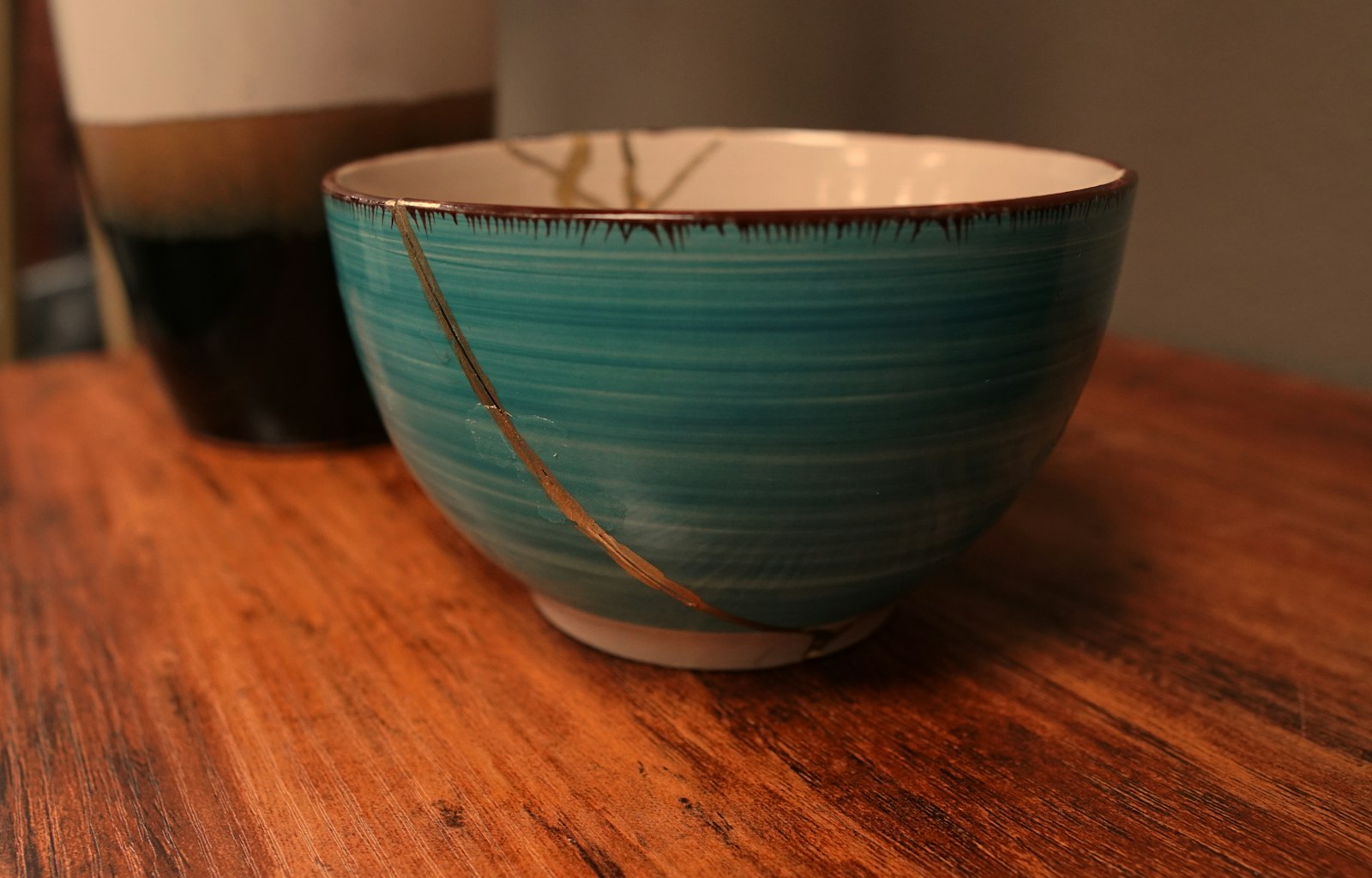
Each vessel is hand-thrown in Korean white porcelain and fired to maturity. The artist then breaks each piece deliberately, using a small hammer, before reassembling the fragments with a technique that draws on both Japanese kintsugi and Korean traditional repair practices. The departure is the inclusion of human hair — Lee’s own — woven through the gold to bind certain seams. The hair is not concealed. In strong light it reads as a dark thread laid across the porcelain, neither decorative nor invisible, situated somewhere between suture and ornament.
The effect is unsettling and beautiful. The hair reads as evidence of the body, of mortality, of the impossibility of perfect restoration. The gold reads as care, as preciousness, as the cultural insistence that broken things deserve to be made whole. The combination produces objects that operate simultaneously as containers and as quiet meditations on damage. Held in the hand, the seams are perceptible as raised topography; the porcelain is cool and weightier than expected; the gold catches the gallery light unevenly because the lacquer has been applied by brush, not sprayed. There is no version of this work that scales. That is the point.
The Jury Statement
In the jury statement, Gates noted that the work “refuses the consolations of nostalgia.” This is the right reading. Mended Vessels is not a sentimental piece about traditional Korean craft. It is a contemporary work that uses the vocabulary of repair to ask harder questions — about whose bodies are present in the objects we use, about what we choose to mend and what we discard, about the relationship between value and damage. The Korean white porcelain tradition that Lee draws on has been mined hard by other contemporary makers, often in ways that flatten the tradition into a marketable surface. Lee’s intervention is to refuse that flattening: by breaking before mending, she insists on damage as the precondition of the work rather than as its absence.
Urquiola, in her remarks, drew a connection between Lee’s work and the broader shift in design culture toward what she called “post-perfect” aesthetics. The phrase is useful. We are clearly past the moment when industrial perfection was the unquestioned aspiration. The question of what comes next — celebrating imperfection without fetishising it, valuing repair without sentimentalising it — is one that craft is uniquely positioned to address. Industrial design can simulate the appearance of post-perfect work; only handwork can produce the thing itself, because the irregularities are not styled but inherent. This is why the prize, which sits at the most rigorous edge of that argument, has accumulated the cultural weight it has.
There is also a useful pairing to draw with the Prada Chawan Cabinet presented earlier this season at Milan Design Week 2026. Gates’s chawan curation argued that the tea bowl is a category capable of carrying contemporary thought; Lee’s vessels make a parallel argument from a different angle. Both presentations refuse the museum’s usual mode of address, which is to historicise craft until it becomes safely past. Both insist that the small ceramic object is a present-tense form.
The Finalists
The shortlist this year was unusually strong. Particular mentions for Brazilian textile artist Joana Vasconcelos, whose loom-woven copper wire pieces operated at a scale that pushed against the prize’s traditional emphasis on intimate work, and for Japanese lacquer artist Genta Ishizuka, whose bowl forms suggested entirely new possibilities for a medium that has felt static for decades. Vasconcelos’s work in particular sits in productive tension with the prize’s instincts. Copper wire at architectural scale is closer to installation than to craft as the prize has historically defined it, and the fact that the work was shortlisted at all suggests that the jury is actively interrogating its own boundaries — which is what one would want a prize of this stature to do.
The geographic spread of finalists has continued to broaden. This year’s shortlist included makers from twenty-three countries — a record for the prize and a meaningful index of how craft is being practiced globally rather than within national traditions. The implicit argument of the shortlist, taken as a whole, is that craft is no longer most usefully read through a country-by-country canon. The Korean porcelain tradition matters to Lee’s work, but Lee is not making “Korean ceramics” in any nationalist sense; she is making contemporary ceramics that happen to draw on a tradition she trained inside. The same is true, in different registers, for most of the finalists. The prize has, by selection rather than by manifesto, become an argument against the country-pavilion model that still organises most international design fairs.
The Loewe Strategy
It is worth observing what Loewe has built here. The prize is now, by general consensus, the most prestigious in the field. The €50,000 award is significant. The accompanying exhibition tours major institutions globally. The catalogue is collected. The brand association with contemporary craft has become so naturalised that it is easy to forget how deliberate it has been. Ten years ago there was no obvious reason that a Madrid-founded leather house — owned, like Louis Vuitton and Loro Piana, by LVMH — should be the convening institution for global studio craft. Today the question is rarely asked, which is the surest sign that the positioning has worked.
Jonathan Anderson, who departed as Loewe’s creative director last year after eleven years in the role, established craft as the brand’s institutional commitment in a way that has survived his leaving. He took on the creative direction in 2013 and founded the Craft Prize in 2016; the two decisions, taken together, did more to reframe what a fashion house could be in the 2010s than any of the parallel logo-driven turns at competing brands. New creative direction has continued the prize without modification, which suggests it has become genuinely separate from any individual creative agenda — a piece of cultural infrastructure rather than a brand exercise.
The Loewe model is now widely studied and partially imitated. Prada’s Chawan Cabinet with Theaster Gates is patronage in a classical mode, providing context without branding. Phoebe Philo, in her own register, used a small hand-cast bronze edition rather than a campaign to introduce her first non-clothing object. Loro Piana’s Casa Brera houses Carlo Scarpa and Charlotte Perriand alongside the brand’s home collection in a four-floor townhouse on Via Solferino, restored over three years by Vincenzo De Cotiis. Bottega Veneta Casa, Matthieu Blazy’s home collection at Via San Maurilio 14, sits permanently rather than as a pop-up. Hermès, at La Pelota, presented Les Mains de la Maison around saddle-stitched leather and sycamore — material intelligence as the entire pitch. Cassina’s Le Corbusier Inédits, six previously unproduced pieces from 1928–1952, made the same case from the furniture-publisher side. The argument across all of these projects is the one Loewe made first and has continued to make annually: that the most credible thing a luxury house can do, in 2026, is provide resources to specific makers and step out of the way.
What separates the prize from the imitators is its discipline. Loewe does not insert its products into the show. It does not require finalists to reference the brand. It does not co-brand the catalogue. The press copy talks about the artists, not about the house. This is harder to do than it looks, especially at the scale Loewe operates at, and the fact that it has been done consistently for nine editions is the actual achievement. The €50,000 prize is incidental; the institutional restraint is the structural choice.
The Object
Lee’s Mended Vessels will tour with the rest of the shortlisted work through 2027. The first stop, after Paris, is Seoul. The pieces will eventually be acquired by institutions, collectors, possibly the Loewe Foundation’s own collection. They will outlast the news cycle that announced them, which is more than can be said for most of what gets covered during a season as crowded as this one. The vessels are too small to dominate a room and too specific to translate into product. They will be photographed, then mostly forgotten by the broader audience, and then over the next several years they will be cited — in catalogues, in studio visits, in essays — as the work that crystallised something the rest of the field was already moving towards.
That permanence — small, specific, hand-made — is what the prize exists to recognise. It sits in deliberate counterpoint to the season’s dominant tendency, which has been towards bigger gestures: hotels, residences, four-floor townhouses, monumental installations in deconsecrated basilicas. None of those formats are bad; some of them, in this season alone, have been excellent. But the prize’s case, made annually since 2016, is that the most enduring contemporary objects continue to be small, slow, and made by individual hands. The seven Mended Vessels are at most four kilograms of porcelain between them. The work they will do in the field over the next decade will be considerably heavier than that.
It is also worth saying what the prize is not. It is not a sales mechanism. It is not a brand-collaboration platform. It is not a discovery vehicle in the venture sense — most of its winners and finalists are already serious mid-career practitioners. What it is, at this point in its history, is a publishing function: a yearly, jury-vetted statement about which directions in studio craft are worth following. Read across nine editions, the prize describes a coherent thesis — that craft is best understood as a contemporary practice rather than a heritage one, and that the small object made by a single maker is still the densest unit of meaning the design world produces.
Coda
The most useful thing about the Loewe Foundation Craft Prize is its annual cadence. Once a year, the same jury procedure produces a single name and a small body of work. The format is unflashy and slightly old-fashioned, and that is what gives it weight. In a season saturated with announcements — collections, residences, hotels, archives reissued, archives unbuilt — the prize remains one of the few that consistently picks the work worth remembering. Mended Vessels is the 2026 entry in that ongoing list. Three years from now, in catalogues describing what contemporary ceramics looked like at the middle of the decade, Lee Eun-bee’s name will appear. The hair through the gold will be the detail that registers.
The Loewe Foundation Craft Prize 2026 exhibition runs at the Palais de Tokyo through June 14 before touring to Seoul, Tokyo, and New York.