There is a particular kind of tension that arises when a fashion house enters the design world — a productive friction between the codes of luxury and the principles of function. With Memoria, staged inside the 4th-century Basilica di San Simpliciano, Demna Gvasalia makes his first design-world statement as Gucci’s creative director, and it is characteristically provocative. The thesis of the show is not that Gucci is now a furniture brand. It is something stranger and more useful: that a 1921 house from Florence, owned by Kering, can stop selling newness and start selling the imagined past of its own objects. This is the argument that reorganises everything else on view at Milan Design Week 2026, and it is the argument worth taking seriously.
The Space
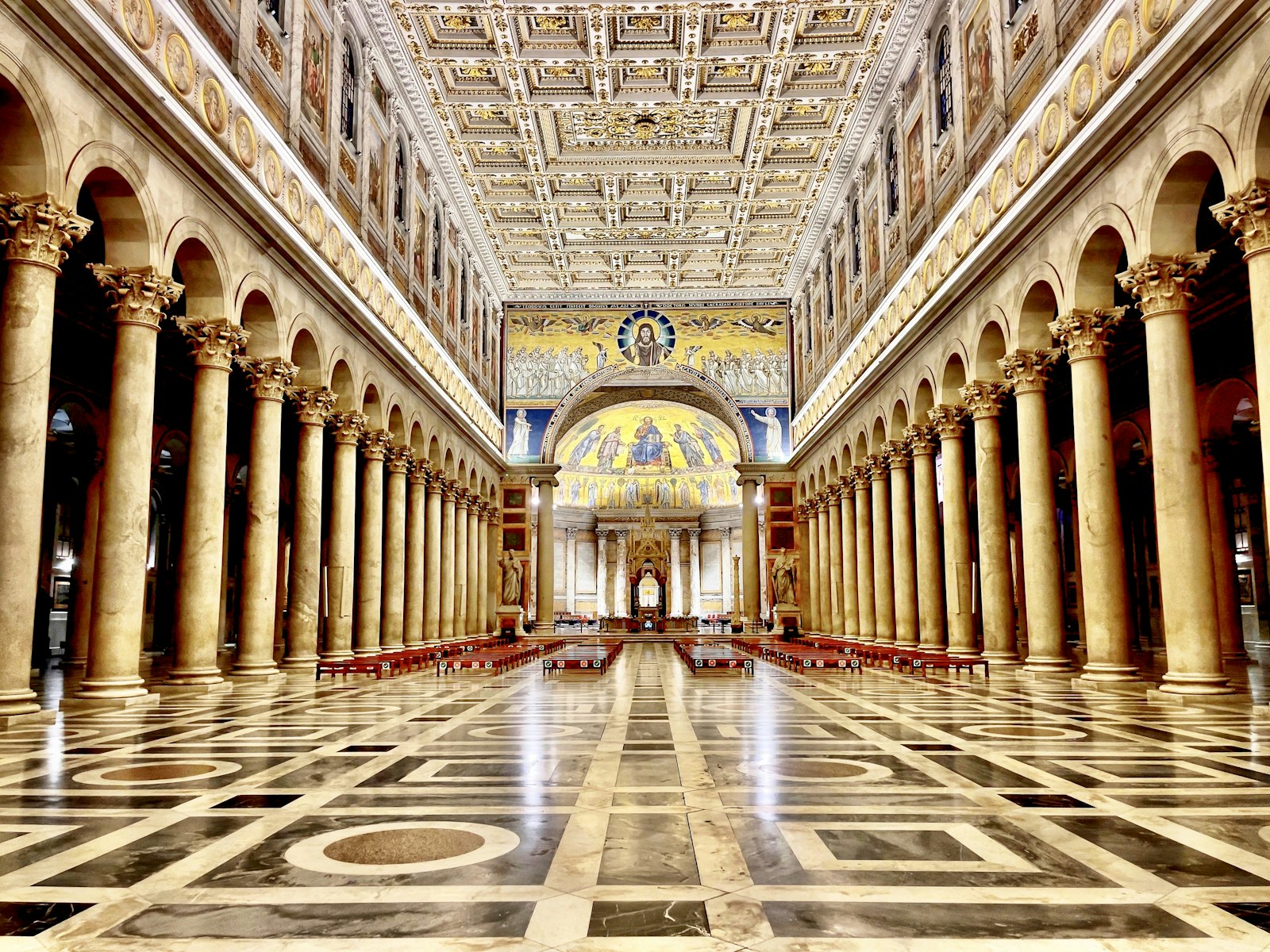
San Simpliciano is one of Milan’s oldest churches, founded in the 4th century and rebuilt in the Romanesque period, its nave offering the kind of austere grandeur that most exhibition designers can only dream of. It sits two minutes from the Pinacoteca di Brera, embedded in a district that has become Milan Design Week’s most legible centre of gravity — the same neighbourhood where Loro Piana opens its Casa Brera on Via Solferino 11 and where the off-site Fuorisalone programme funnels its most architecturally serious shows. The choice is not incidental. A church of this age sets a baseline of gravity that no white-cube installation can match, and it dictates a particular discipline: anything theatrical reads as vulgar against stone that has been working since the late Roman empire.
Demna has resisted the temptation to fill it. The installation is sparse — almost confrontationally so. Twelve domestic objects are arranged across the nave like artefacts in an archaeological dig, each one illuminated by a single overhead light that creates pools of warmth in the otherwise dim space. The space between objects does as much work as the objects themselves. One reads them slowly, in sequence, with the long silences between cases standing in for everything Gucci is choosing not to say.
The number twelve is also worth noting because it recurs across this Design Week’s fashion-house presentations. Hermès brought twelve home pieces under Les Mains de la Maison to La Pelota in Via Palermo. Bottega Veneta launched Casa with a twelve-object home collection at Via San Maurilio 14. Twelve is the canonical edition number that signals collectible design rather than retail — small enough to be artisanal, large enough to publish. Demna borrows the convention and inverts it. Where Bottega’s intrecciato daybeds and Hermès’s saddle-stitched armchairs offer twelve pieces of evident newness, Memoria offers twelve pieces of evident oldness.
Twelve Objects, Pre-Aged
The collection includes seating, lighting, and what Gucci describes as “memory vessels” — containers that reference both traditional Italian ceramics and Demna’s own Georgian heritage. Every piece is wrapped in Gucci’s house materials — the GG canvas, the flora print, the Web stripe — but deconstructed, faded, treated to look as though they’ve been discovered rather than designed.
A sofa upholstered in distressed GG canvas sits like a relic from a forgotten Gucci palazzo. A floor lamp wrapped in aged leather feels both precious and abandoned. The flora print, which the house has used since its 1960s scarf commissions, appears bleached almost to ghost-pattern on a stretched textile screen. The Web stripe — that green-red-green band lifted from saddle girths — is reduced to a single faded line on the back of a wooden bench, as if the original colours have walked off the object over forty years of imagined use. It is disorienting in the best way: each piece reads as if it has survived something rather than as if it has just arrived.
The “memory vessels” are the most overtly autobiographical gesture. Gucci’s framing draws an explicit line between Italian ceramic traditions and Georgian domestic crafts — a connection that, on paper, sounds tenuous, but in person becomes the show’s most persuasive argument. Demna, born in 1981 in Sukhumi, has built his career on grafting outsider material onto established luxury vocabularies, first at Vetements from 2014 and then through a long Balenciaga tenure from 2015 to 2024. Memoria extends that grafting from clothing into objects that sit on the floor.
Distress as a Design Language
The deliberate ageing of the materials is the exhibition’s single most consequential decision, and it deserves to be read carefully. Pre-distressing is a familiar device in fashion — Demna’s Balenciaga sneakers became a meme partly on this basis — but it is rare in furniture and almost unheard of in furniture released by a house at this price tier. The standard luxury logic is that newness is the value: the canvas should be crisp, the leather unbroken, the lacquer mirror-flat, because that is what the customer is paying for. Memoria rejects the premise outright.
The distress reads in three registers. First, materially: the GG canvas is faded, abraded, in places almost translucent; the leather is cracked at the stress points; the metal is dulled rather than polished. Second, structurally: corners are rounded as though by hands rather than tools, edges show the kind of asymmetric wear that no factory finish reproduces. Third, contextually: under the basilica’s single-source overhead lighting, every imperfection is photographed in relief. There is nowhere for the surfaces to hide.
What this produces is a clear rebuttal of the lifestyle-fantasy mode that fashion-house furniture usually inhabits. The pieces are not staged in a hypothetical Milanese drawing room. They are not ringed by orchids and Aesop hand cream. They sit on raw stone under raking light, and they look like they have been used.
Where Memoria Sits in the Fashion-Into-Design Map
This Milan Design Week is, in headline terms, the week in which fashion-into-design stopped being a side-bar and became the structuring story. The signal is the volume and the seriousness: Bottega Veneta’s Casa opened a permanent home gallery on Via San Maurilio 14 with intrecciato-woven calfskin daybeds in editions of 100 or fewer; Loro Piana’s Casa Brera, restored over three years by Vincenzo De Cotiis, presents the house collection alongside Carlo Scarpa, Charlotte Perriand and Japanese folk furniture; Louis Vuitton returned to Palazzo Serbelloni with the 2026 edition of Objets Nomades, the furniture programme it has run since 2012, with new contributions from Studio Mumbai’s Bijoy Jain, India Mahdavi and GamFratesi; Marni installed a three-month residency inside Pasticceria Cucchi on Corso Genova 1; and Phoebe Philo released her first non-clothing object, a hand-cast bronze mirror in an edition of 200, from the Fondazione Battaglia foundry in Milan.
Read against that field, Memoria is doing something nobody else is doing. Bottega’s Casa argues that fashion craft (intrecciato) translates to furniture craft. Loro Piana’s Casa Brera argues that fashion taste (cashmere, restraint) is continuous with mid-century interior taste. Louis Vuitton’s Objets Nomades argues that fashion’s travel imaginary can underwrite collectible furniture. Hermès’s Les Mains de la Maison argues that saddle-stitched leather is saddle-stitched leather whether it covers a bag or an armchair. All five claim continuity between the fashion product and the design product — and all five frame their domestic objects as new.
Demna refuses the frame. Memoria does not argue that Gucci has always been a furniture house, and it does not argue that the GG canvas was secretly a textile of architectural ambition. It argues, more interestingly, that a fashion house’s design statement should look as though the house’s design history was longer and more unhappy than it actually was. The provocation is that pre-aged objects work harder than new ones at convincing you the house has a past worth caring about.
The Demna Continuity
For anyone following Demna’s work, Memoria is recognisably his. The Vetements years (2014 onward) treated normcore tailoring and DHL-courier graphics as luxury substrate. The Balenciaga tenure (2015–2024) industrialised the move: trash bags became bags, vintage car upholstery became evening wear, the worn-out sneaker became a $1,000 object whose value resided in its degradation. Pre-distress, value-from-decay, the dignifying of the disposable — these are the consistent moves. Memoria applies them to the Gucci codes Demna inherited in 2025: the GG, the flora, the Web stripe, the horsebit, the bamboo handle. Each enters the show in a state of refusal of its own freshness.
What is new at Gucci, and not present at Balenciaga, is the religious framing. Balenciaga’s couture-revival shows used cathedral lighting and church-music staging, but the brand environment was always about bleeding-edge contemporaneity. Memoria moves in the opposite direction. By siting the show inside an actual functioning basilica, Demna asks the viewer to read the objects with the patience and silence reserved for older religious objects. It is a more vulnerable register than Balenciaga ever permitted itself, and it is one of the reasons the show lands.
The Brera Geography
The choice of San Simpliciano also reads as a piece of district politics. Milan Design Week is now decisively centred on Brera and 5Vie rather than Tortona, and the basilica anchors the show within walking distance of the most important fashion-into-design openings of the week. A visitor can move from Memoria at San Simpliciano to Loro Piana’s Casa Brera on Via Solferino in under ten minutes, then south to Bottega’s Casa on Via San Maurilio in another twenty. The geographic compression is part of the editorial argument: these projects share both a thesis (fashion houses can speak to domestic space without lapsing into licensing) and a territory.
It is also a reminder that this district is currently absorbing unusual amounts of Kering and LVMH capital. Gucci and Bottega both belong to Kering. Loro Piana and Louis Vuitton both belong to LVMH. The week’s most considered fashion-into-design statements are, financially, a two-house conversation between France’s two largest luxury groups, conducted in Milanese stone. Memoria is Kering’s quietest entry and, on the evidence of the basilica, its most artistically ambitious.
What the Statement Refuses
What makes Memoria compelling is its refusal to play the game that most fashion-meets-design exhibitions play. There is no lifestyle fantasy here, no aspirational living room vignette. There is no co-branded coffee bar, no scent diffuser, no moodboard wall. There is no QR code to pre-order the pieces, and there is conspicuously no pricing on display. Instead, Demna asks what it means for a fashion house to have a domestic memory — to imagine that these objects have existed for decades, accumulating the wear and warmth of actual use.
This is a subtle critique of the newness that typically defines luxury. These pieces don’t want to be coveted. They want to be lived with. The reading is reinforced by the absence of seating for visitors and by the slow, processional path the curators have laid out across the nave. One walks rather than browses. The standard fashion-show grammar — the front row, the runway, the influencer riser — is entirely missing.
There is a real risk in this strategy: distress can read as costume, and pre-aged luxury can come off as cynical, particularly when staged inside a religious building. Memoria skirts the edge. What keeps it on the right side is the restraint of the object count — twelve pieces, no more — and the refusal to commercialise the show within the show. Whether the commercial collection, due later this year, holds the line is the question that will determine whether Memoria is remembered as an argument or as an aesthetic.
Against the Loewe Comparison
It is tempting to read this against the Loewe craft programming under Jonathan Anderson, who ran the house from 2013 to 2024 and founded the LOEWE Foundation Craft Prize in 2016. The Loewe approach made craft itself the brand thesis: weaving, basketry, ceramics, lacquer — fields with their own deep histories — recognised and elevated through the prize and the annual Salone exhibitions. Loewe argued that the fashion house’s most important contribution to the design world was patronage of craft already in existence.
Memoria takes a different position. It is not a craft show. The objects are not by named external makers, and the production is not framed as a recovery of disappearing techniques. The thesis is internal: it is about Gucci’s own materials, faded into a fabricated history. If Loewe under Anderson said we will fund what already exists, Demna’s Gucci says we will manufacture the past we wish we had. Both are coherent positions. The latter is harder to pull off without sliding into pastiche, which is partly why the basilica setting matters so much: real age underwrites invented age.
The Prada–Theaster Gates Chawan Cabinet, running concurrently this week, sits closer to the Loewe model — patronage of an outside artist working with chawan tea bowls, displayed in a utilitarian wooden cabinet against a spare backdrop, with Prada providing the context but no branding. Memoria is the inverse: maximum house DNA, minimum external authorship, all of it inflected by a single creative director’s worldview.
Coda
A first design statement from a new creative director is usually read for evidence of brand strategy. Memoria is unusually clear on that front. Demna’s Gucci will not pursue fashion-into-design as a brand-extension exercise, and it will not pursue it through the patronage-of-craft route that Loewe made canonical. It will pursue it as autobiography — a fictional autobiography of a house that Gucci, founded in Florence in 1921, never actually had, but that Demna seems determined to write into existence one distressed canvas at a time. Whether the commercial pieces, when they arrive, hold the same conviction is a separate question. For one week in Brera, inside a basilica that has been working since the late Roman empire, the conviction is enough.
Gucci Memoria is open to the public at Basilica di San Simpliciano, April 22–28.