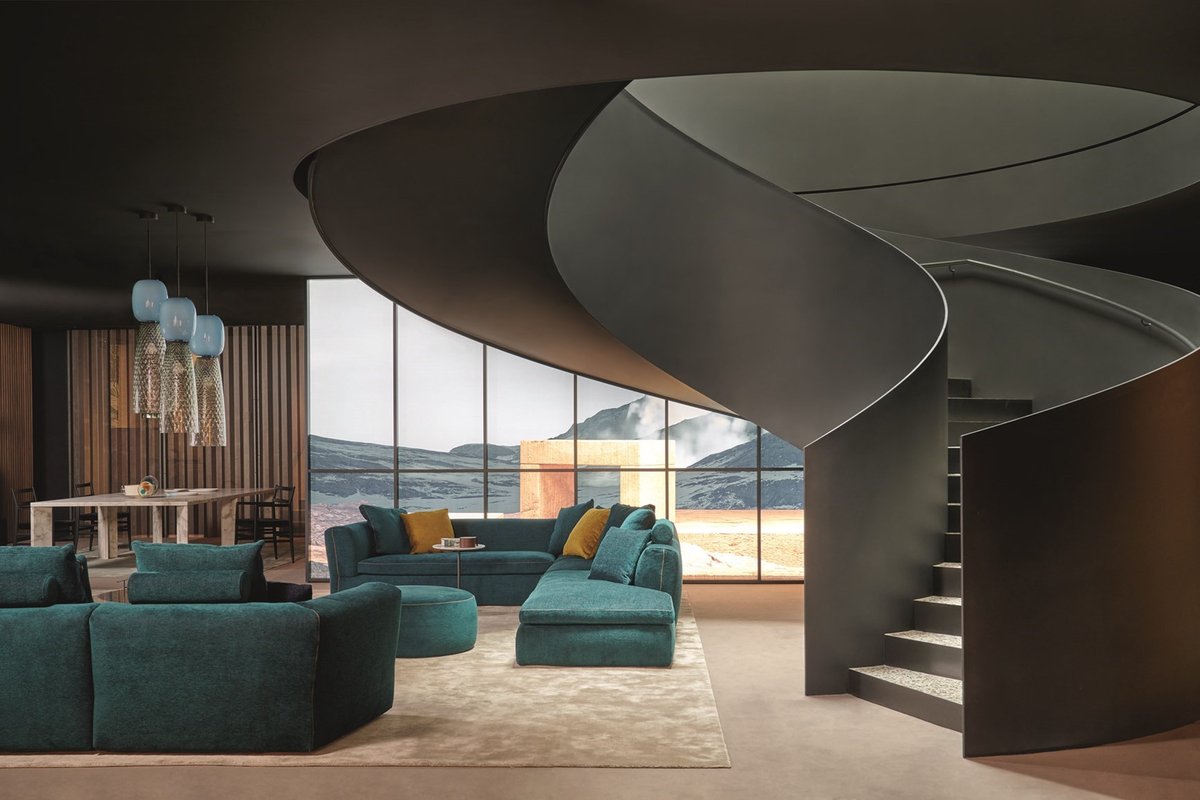
Linde Freya Tangelder’s Cassina Fluid Re-Collection is the first Cassina commission that asks the company’s industrial-design machine to behave like a glassblower’s workshop — six days at 10 Corso Como, four materials, three named pieces, and a thesis about whether the Cassina catalogue has room for objects that cannot be reproduced. Open from 21 to 26 April 2026 in the first-floor Project Room at Corso Como 10, the show was the Italian solo debut of the Dutch-born, Belgium-based designer who runs the studio Destroyers/Builders out of Antwerp, Brussels, and a workshop in Asse. It was also the most legible thing Cassina did during Milan Design Week 2026, which is a strong claim against a company that also activated the Le Corbusier archive the week before.
The premise is narrower than the press materials suggest. Tangelder did not redesign a Cassina sofa. She did not propose a serial product. What she did, under the company’s Patronage programme for emerging talent, was install a small body of handcrafted limited editions made in her own studio alongside a handful of Cassina-produced pieces, and let the room argue for itself about which side of the production line each object belonged to. The four materials — blown glass, cast bronze, sheet metal, lacquered wood — were the curatorial frame; the three named families — Wax Desk Light, Sculpting Archetypes, Fluid Joinery — were the proofs; and an early prototype of a chair currently in development with Cassina sat in the corner as the bet on what comes next.
This piece tracks the Fluid Re-Collection object by object, places Tangelder’s practice inside the Destroyers/Builders programme she has been running since 2014, and sets the commission against the rest of the 2026 Cassina output — the iMaestri archive at one end, Patricia Urquiola’s art-direction-led catalogue in the middle, and the Patronage strand at the emerging end. The argument lands in a single comparison table.
The Fluid Re-Collection, piece by piece
The Project Room at 10 Corso Como is a small space on the first floor, above the Sozzani-era courtyard, and Tangelder did not try to fill it. The installation is staged around three families of objects and a handful of contextual loans, with vitrines kept low and lighting kept warm enough that the cast-bronze surfaces hold their tonal range. The Cassina Fluid Re-Collection reads, on the floor, as a workshop opened to the public rather than a showroom in costume.
The Wax Desk Light is the piece the room is built around. It is a cast-bronze table lamp in white-bronze finish, with a raw external texture that records the wax-loss process by which it was made. Bronze casting in the lost-wax method always carries the negative of its mould; what Tangelder has done is decline to polish that negative away. The lamp’s body therefore reads as a record of its own manufacture — dripped, pooled, occasionally seamed where the wax was applied in two passes — and the shade and the base read as a single continuous gesture. The colour, white-bronze rather than the more common yellow-bronze or patinated brown, pushes the object toward statuary rather than fixture. It is the most museum-coded thing in the room, and it sets the register for everything else.
Sculpting Archetypes is a low chair, carved by hand from a single block of lacquered wood. The piece is the closest the show gets to a chair-as-chair: a seat, a back, four points of ground contact. What distinguishes it is that the carving is left visible — the chisel marks on the seat are not finished out, and the lacquer is applied over the texture rather than under it. The result is a low seat with a tactile, almost geological surface, in a tone that draws the carved wood toward the chromatic range of the bronze. Sculpting Archetypes is the piece that argues for furniture as a primitive category, antecedent to the chair as we have inherited it from the twentieth-century catalogue, and it is the most obvious bridge between the limited-edition end of Tangelder’s practice and the serial end of Cassina’s.
Fluid Joinery is the glass collection, and it is the largest single grouping in the room. The hero piece is a mushroom-shaped table — a flat, slightly domed circular top resting on a thick, asymmetric blown-glass stem that swells toward the floor — paired with a matching table lamp in the same vocabulary. The glass is blown, not cast, and the joinery the title points to is the way the stem meets the top: a fused continuation rather than a fitted connection. There are no brackets, no screws, no metal collars. The piece is one object, made in one operation, by a glassblower in a furnace. The other Fluid Joinery objects extend the same idea — vessels, smaller side tables, a wall-mounted element — but the table is the argument the family is built to make. It is the piece that explains why the show is called Fluid: not as an adjective about appearance, but as a technical claim about how the material was joined.
The fourth named element on the floor is the prototype chair in development with Cassina. The show describes it as an early prototype rather than a finished piece, and it is staged accordingly — in the corner, on a low plinth, without the gallery framing applied to the limited-edition objects. This is where the Patronage programme’s logic becomes visible. The Fluid Re-Collection is, in part, a six-day public sketch session for a chair that Cassina expects to ship serially in a later catalogue year. The 2026 visitor at Corso Como 10 was seeing both ends of the timeline at once: the limited editions that Tangelder will continue to make in Asse, and the seed of a serial Cassina piece that will eventually be made in a factory in Meda.
Around these four anchors, the show also included new versions of pieces from Tangelder’s existing Reworked and Remould series. These are not Cassina commissions; they are Destroyers/Builders objects, brought to Milan because the Project Room context invited the longer view. Reworked is the series in which Tangelder treats existing industrial components — extrusions, fittings, found sheet metal — as raw material for hand-finished objects; Remould is the cast-and-recast series, where bronze and other metals are repeatedly broken down and re-poured so that the lineage of the material becomes the work. Several Reworked pieces exploit folded and bent sheet as a structural device, which closes out the four-material vocabulary Cassina’s press text foregrounded: blown glass (Fluid Joinery), cast bronze (Wax Desk Light), sheet metal (Reworked), lacquered wood (Sculpting Archetypes). The Re-Collection is, in a literal sense, a material survey before it is anything else.
Linde Freya Tangelder and Destroyers/Builders
Tangelder is Dutch-born and Belgium-based; she founded Destroyers/Builders in 2014 and runs the studio from offices in Antwerp and Brussels, with a workshop in Asse where most of the limited-edition work — including the Wax Desk Light and Sculpting Archetypes pieces shown at Corso Como — is physically made. The studio takes its name from the dual posture it has cultivated since its first projects: each object is the product of breaking something down and reassembling it, with the joints and the discontinuities left legible. The Remould series is the cleanest expression of that programme; the Fluid Joinery glass works, with their fused rather than fitted junctions, are the inverse case — the same argument made by making the joint invisible rather than visible.
The studio’s earlier exhibition history sits mostly in collectible-design rather than commercial-product channels — Tangelder has shown with Galerie Philia and at Design Miami, has had pieces enter the collections of European design museums, and was named Designer of the Year by the Belgian platform Knack Weekend in 2020. The Cassina commission is the first time her work has crossed into a major industrial publisher’s programme, and the show materials specify it is also her first solo exhibition in Italy.
The Asse workshop is the part of the practice that the Fluid Re-Collection foregrounds. Asse is a small town in Flemish Brabant, roughly fifteen kilometres west of Brussels, and the workshop is a working studio rather than a production facility — Tangelder oversees the casting, carving, and assembly of limited-edition pieces in person, while the Antwerp and Brussels offices handle design development and the commercial relationships with galleries. The geography of the practice is split: design in the city, making in the suburb, exhibition in the world.
That geography is what makes the Cassina commission interesting on its own terms. Cassina is an industrial publisher whose nominal production is in Meda, in Lombardy, and to commission Tangelder is to commission a practice whose production is in a Belgian village workshop and whose limited editions cannot in any obvious sense be transferred to a factory floor. The Patronage programme exists precisely to host that contradiction rather than to resolve it.
Cassina’s Patronage programme: the emerging-designer end of the catalogue
Cassina’s commissioning structure, in 2026, has three legible tiers. At the historical end sits the iMaestri programme, founded in 1964 to acquire reproduction rights to twentieth-century master designers — beginning with the Cassina Le Corbusier Inédits and the wider LC archive drawn from the Fondation Le Corbusier in Paris, and extending across the decades to Charlotte Perriand, Gerrit Rietveld, Frank Lloyd Wright, Charles Rennie Mackintosh, Gio Ponti, and the rest of the canonical bench. The 2026 iteration of that programme is Le Corbusier Inédits, the six previously unproduced Le Corbusier pieces released this April, and the ongoing Cassina LC Series reissues of the Pierre Jeanneret and Charlotte Perriand work that defined Chandigarh’s civic interiors. iMaestri is the archive pole of the catalogue; it is what Cassina sells when it sells history.
In the middle sits the art-direction-led commissioning programme that Patricia Urquiola has run since she became Cassina’s art director in 2015. Urquiola’s own Cassina catalogue under that role tracks the major shape of the brand’s contemporary output: Back-Wing in 2019, Sengu in 2020, Dudet in 2021, Moncloud in 2023, with adjacent pieces in the years between. These are serial products, designed for industrial production at Meda, sold through the global Cassina dealer network. Around Urquiola’s own work she has commissioned a wider circle of contemporary designers — Michael Anastassiades, Konstantin Grcic, Rodolfo Dordoni, Patrick Norguet — whose pieces sit on the same tier of the catalogue. This is the art-director-led pole: contemporary, serial, commercially central, and curated by a single editorial voice that has now held the role for eleven years.
The Patronage programme, where the Fluid Re-Collection sits, is the third tier. It is the emerging-designer end of the catalogue, and it is the only tier of the three whose commissions are not, in the first instance, serial products. Patronage commissions are exhibitions, installations, prototypes, and limited editions; they are designed to introduce a new practice to the Cassina audience rather than to produce a new product for the Cassina catalogue. Some of the practices the programme has hosted have crossed into the serial tier afterward; some have not. The economic logic is closer to a residency programme than to a development pipeline.
Tangelder is the 2026 Patronage commission, and the structure of the Fluid Re-Collection makes that explicit. The Cassina-produced pieces in the room are not branded as the show’s anchors; the handcrafted limited editions made in Asse are. When Urquiola ships a Back-Wing or a Dudet, the Cassina production line is the medium and the design is the message. When Tangelder ships a Wax Desk Light, the Asse workshop is the medium and the Cassina patronage is the frame.
The chair-in-development prototype is the case where the tiers will eventually need to negotiate. If the prototype becomes a serial Cassina piece, it will cross from the Patronage tier to the art-director tier — the production will move from Asse to Meda, the edition from limited to open, the commercial logic from collectible to catalogue. The 2026 Patronage exhibition is, in that reading, the front edge of a 2028 or 2029 serial product.
10 Corso Como’s Project Room: why Cassina chose Brera over Tortona
10 Corso Como was founded in 1990 by Carla Sozzani, the former editor-in-chief of Elle Italia, at Corso Como 10 in the 20154 Milan postcode. The building is a converted garage off Piazza XXV Aprile; the courtyard, with its lattice screen and its planted ground, is the Kris Ruhs commission that has defined the venue since its second year. The site sits in the Brera Design District during Fuorisalone, a few minutes’ walk north of the Brera Pinacoteca.
The first-floor Project Room is the venue’s commissioned-exhibition space — small, focused, conventionally used for fashion and editorial photography presentations rather than for furniture. Cassina’s decision to install the Fluid Re-Collection there, rather than in a Tortona warehouse or in its own Durini showroom, is the venue choice that tells you the most about how the company framed the commission. Brera is, in the Fuorisalone vs Salone proper distinction the FORMA guide tracks, the editorial-led district where the press and the curators settle and where a small show with a strong thesis lands harder than a large show with a slack one. Tortona, by contrast, is the brand-activation district where Audi parks a Zaha Hadid Architects pavilion and Loro Piana takes a palazzo. Cassina installed its Patronage commission in the editorial district because the Patronage commission is, structurally, an editorial gesture.
The Sozzani context matters too. 10 Corso Como was built as a fashion editor’s shop, and its programming has always sat at the intersection of fashion, design, photography, and publishing. Cassina, by installing there, was associating the Fluid Re-Collection with the editorial register of the venue rather than with the commercial register of its own Durini showroom. The choice is consistent with the Patronage tier’s logic: this is a commission that wants to be reviewed, not bought.
The dates matter as well. The show ran from 21 to 26 April 2026, the central week of Milan Design Week — Tuesday to Sunday, with the Salone-week midpoint on the Thursday. That is the window in which the visiting design press is at peak density in Milan and the gallery openings in Brera are scheduled to maximum overlap. A six-day window in that slot, in that district, in that venue, is the editorial-engineering of the highest possible reception per square metre of installation. The Patronage tier rewards small shows that read large, and the Fluid Re-Collection was structured to do that.
Cassina at Milan Design Week 2026, ranked by commission tier
The cleanest way to see the Cassina output of the spring is in a single table. The columns below sort by commission tier — iMaestri archive, art-director serial, Patronage emerging — and within each tier by year. The rows are restricted to projects that were active in the 2026 catalogue or activated during the 2026 Salone window.
| Designer | Project | Year | Cassina tier |
|---|---|---|---|
| Le Corbusier (archive) | Cassina Le Corbusier Inédits | 2026 | iMaestri / archive |
| Pierre Jeanneret (archive) | Cassina LC Series (Chandigarh) | ongoing | iMaestri / archive |
| Charlotte Perriand (archive) | LC range (Perriand attributions) | ongoing | iMaestri / archive |
| Patricia Urquiola | Back-Wing | 2019 | Art-director / serial |
| Patricia Urquiola | Sengu | 2020 | Art-director / serial |
| Patricia Urquiola | Dudet | 2021 | Art-director / serial |
| Patricia Urquiola | Moncloud | 2023 | Art-director / serial |
| Linde Freya Tangelder | Fluid Re-Collection | 2026 | Patronage / emerging |
The table makes several things visible that the press releases tend to obscure. The archive pole is dense and continuous: the LC series alone has been in production since 1965, and the Inédits are an additive expansion rather than a replacement. The art-director pole, under Urquiola, has shipped a major new piece roughly every two years — Back-Wing 2019, Sengu 2020, Dudet 2021, Moncloud 2023 — with the cadence slowing slightly as Urquiola took on the Effe and Loro Piana commissions tracked elsewhere on FORMA. The Patronage pole is structurally different from the other two: the 2026 commission is not a product, it is an exhibition, and its catalogue presence will be a footnote in the brand’s annual report rather than a line in the price list. The 2026 calendar — Inédits in April, Urquiola’s adjacent Salone work, the Tangelder show at Corso Como, the ongoing LC reissues — is the demonstration that all three poles got air this year.
Coda
The Cassina Fluid Re-Collection is, in the long view, a small show: six days, three named families of objects, four materials, one early prototype, a workshop in Asse, a project room in Brera. None of it will move tonnage at Meda. But the small show is the one that locates the brand most precisely. The iMaestri programme tells you what Cassina inherited; the Urquiola catalogue tells you what Cassina manufactures; the Tangelder commission tells you what Cassina is willing to host. The third claim is the one most easily underweighted, and the one that matters most for what the company will look like in 2030.
The defence is not that Cassina has changed its production model — it has not. The defence is that Cassina has built a tier of the catalogue where the production model can be someone else’s. The Patronage programme exists so that the Asse workshop and the Meda factory can sit on the same brand without either pretending to be the other. Whether the chair-in-development eventually ships as a serial Cassina piece is the question the 2028 catalogue will answer. If it does, the Fluid Re-Collection will be remembered as the front edge of a product. If it does not, it will be remembered as a six-day editorial exhibition that introduced a Belgian-Dutch practice to the Italian audience and then let the practice return to its workshop. Both outcomes sit inside the Patronage programme’s design envelope, and that is what makes the programme worth running.
Sources: Dezeen, Linde Freya Tangelder crafts Fluid Re-Collection for Cassina, 6 May 2026, dezeen.com/2026/05/06/linde-freya-tangelder-crafts-fluid-re-collection; 10 Corso Como, Linde Freya Tangelder in collaborazione con Cassina, 10corsocomo.com; Destroyers/Builders studio site, destroyersbuilders.com.