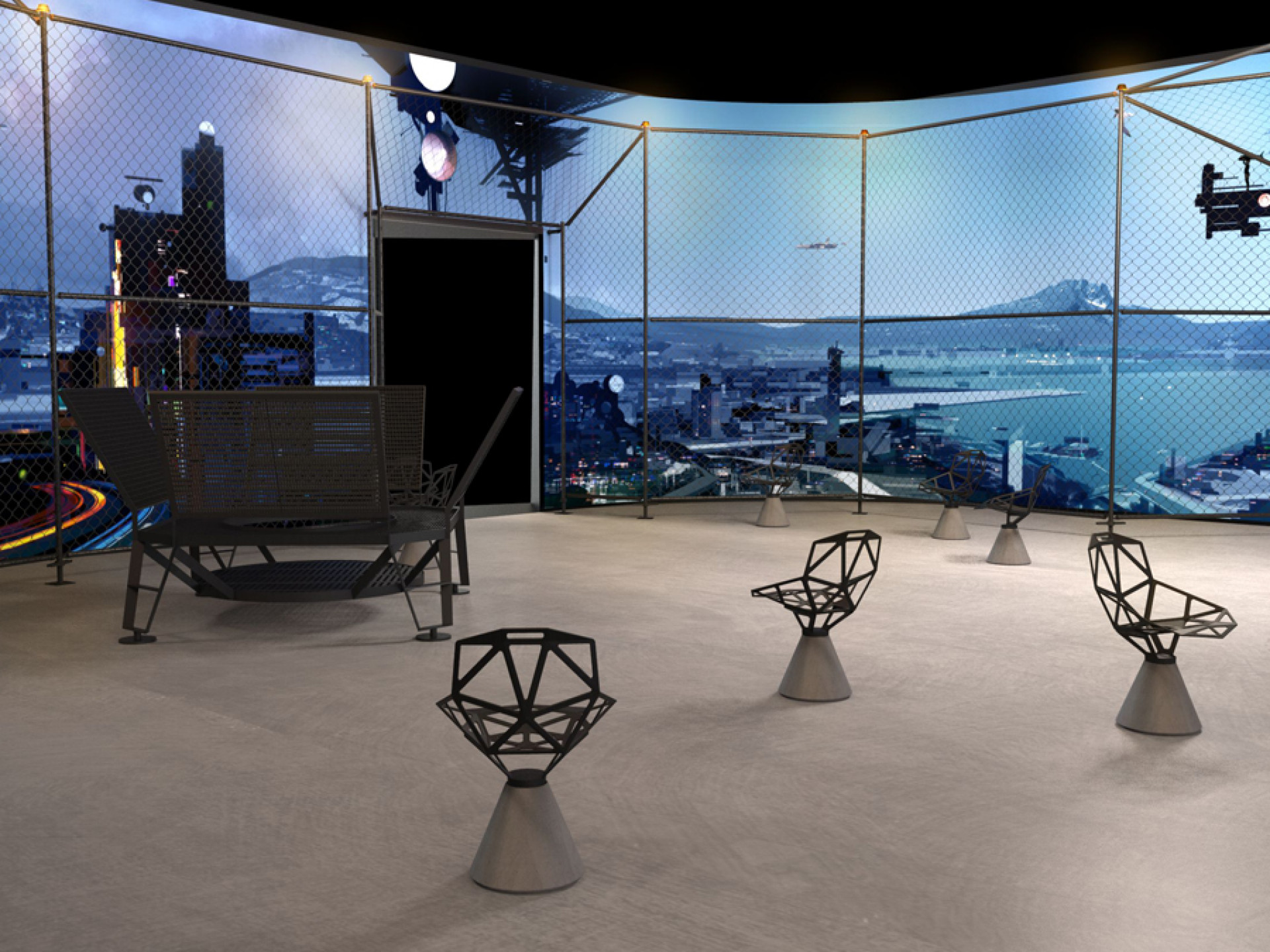
Konstantin Grcic’s scenography for “Pauline Deltour: An Apparent Simplicity”, the roughly 180-object survey of his former assistant that opened at MADD Bordeaux on 22 April 2026, is the seventh major exhibition the Munich-born industrial designer has co-curated or staged since 2009, and the first in which his role is to memorialise rather than to introduce. Co-curated with Bérengère Bussioz, Caroline Perret and Etienne Tornier, the show is one of the inaugural exhibitions of the partial reopening of the Musée des Arts décoratifs et du Design at 39 rue Bouffard in Bordeaux, and the clearest demonstration to date that Konstantin Grcic exhibition design is a second body of work running parallel to his industrial output for Magis, Vitra, Plank and Mattiazzi.
Grcic was born in Munich in 1965, trained as a cabinetmaker at the John Makepeace School in Dorset, completed the Industrial Design MA at the Royal College of Art in London under Jasper Morrison and Floris van den Broecke, and founded Konstantin Grcic Industrial Design (KGID) in Munich in 1991. He relocated the studio to Berlin in 2018–19. Over thirty-five years the practice has produced the Chair_One stamped-aluminium seat for Magis (2003), the Myto cantilever for Plank (2008), the Mayday lamp for Flos (1998), the Diana side-table series for ClassiCon (2002), the 360° stool for Magis (2010), the Karbon for Mattiazzi and the Pro school chair for Flötotto. These objects are studied in detail in the firm’s own monograph “Konstantin Grcic — Industrial Design” (Phaidon, 2005). The exhibition practice, by contrast, has never been catalogued in a single place. This piece does that, and reads the seven shows from Serpentine 2009 to MADD 2026 as a continuous design project with its own grammar.
“Design Real” at the Serpentine Gallery, 2009: The First Curated Room
The earliest exhibition Grcic curated outright was “Design Real”, which ran at the Serpentine Gallery in Kensington Gardens, London, from 26 November 2009 to 7 February 2010. The Serpentine, then under directors Julia Peyton-Jones and Hans Ulrich Obrist, had given over its main galleries to single-artist surveys for two decades; the invitation to a working industrial designer was, for the institution, a deliberate widening of its programme to include the made object.
Grcic’s response was unsentimental. He selected forty-three industrially produced objects — a Glock 17 pistol, a Stanley Knife, an Ikea Lack side table, a Bic Cristal pen, an SRAM bicycle chain, a Mag Lite torch, a Nokia 1100 handset, an Adidas Predator football boot — and installed each on a bespoke shelf running waist-height around the Serpentine’s central rotunda. There were no plinths, no glass cases and no extended text panels. Each object received a typeset label naming the manufacturer, the year of introduction and the unit production volume. The Glock label recorded that more than five million had been produced since 1982; the Bic Cristal that more than one hundred billion had been sold since 1950.
The show was widely reviewed as a manifesto. Industrial design, Grcic argued by selection alone, is the production of objects in volumes large enough that the named author becomes statistically irrelevant. The exhibition design itself — the waist-height shelf, the absence of hierarchy between the pistol and the pen — became the model for every subsequent Grcic-staged show. The shelf is the unit. The argument is in the sequence.
“Comfort” at the Biennale Internationale du Design de Saint-Étienne, 2010
Six months after Design Real closed in London, Grcic was invited to curate “Comfort” at the seventh Biennale Internationale du Design de Saint-Étienne, the design biennial founded in 1998 by the École supérieure d’art et design de Saint-Étienne and held at the disused Manufacture d’Armes de Saint-Étienne site converted into the Cité du Design by LIN architects (Finn Geipel and Giulia Andi) and inaugurated in October 2009.
Grcic’s brief was a single word — “comfort” — and his response was to read it as the slipperiest possible category in industrial design. Comfort is unmeasurable, culturally specific and almost always invoked to defend bad decisions. The show was installed in the long central platform of the Cité du Design’s new exhibition hall and combined ergonomic chairs (an Aeron, an Eames Lounge), unergonomic chairs (a Rietveld Zig-Zag), Japanese floor cushions, military camp beds, airline economy seats and a domestic recliner. Wall texts addressed posture, climate, fabric and habit rather than form. The installation tone was diagnostic: comfort as a research problem, not a marketing word.
The Saint-Étienne show is the least documented of Grcic’s curatorial projects — the biennial’s archive holds only the floor plan and a partial photographic record — but it is the first in which the exhibition itself adopts a thesis rather than presenting objects against neutral walls. From 2010 forward every Grcic-staged room has a sentence at its centre.
“Black2” at the Istituto Svizzero, Rome, 2010–11
Between 12 December 2010 and 12 February 2011 Grcic mounted “Black2” at the Istituto Svizzero in Rome, the Swiss cultural institute housed in the Villa Maraini at Via Ludovisi 48, a 1905 mansion bequeathed to the Swiss Confederation by the architect Carlo Maraini’s widow in 1946. The institute, then directed by Christoph Riedweg, hosted Grcic for a four-week installation built around a single colour.
The show is the most formally radical Grcic has staged. Every object — chairs, tables, lamps, vessels, a bicycle frame, a typewriter, a coffee pot — was painted, anodised or upholstered black. They were arranged in the Villa Maraini’s piano nobile against walls left in their original umber and ochre, with the windows uncovered so that Roman afternoon light raked across the matte and gloss surfaces. The visitor moved through what was effectively a single chromatic field interrupted by silhouettes.
The argument was about figure and ground. Industrial design, Grcic suggested in the accompanying broadsheet, has lost the capacity to distinguish an object from its setting because the colour palette of the contemporary product is too narrow to register against an interior. Painting everything black is the diagnostic test. What is left of an object when its surface has been collapsed into a single value? The objects that survived the test — the ones that retained legibility as profile rather than as material — included an Eames LCW, a Brno chair, a Pelikan typewriter and Grcic’s own Chair_One. The objects that did not — most contemporary moulded plastics, most rounded vessels — were exposed as dependent on surface for their identity.
“Konstantin Grcic — Panorama” at the Vitra Design Museum, 2014
The first solo retrospective of Grcic’s work was “Konstantin Grcic — Panorama”, which opened at the Vitra Design Museum in Weil am Rhein on 29 March 2014 and ran through 14 September 2014 before travelling to Z33 House for Contemporary Art in Hasselt, Belgium, where it was reinstalled from 8 February to 24 May 2015. The Weil am Rhein institution, founded by Rolf Fehlbaum in 1989 and housed in Frank Gehry’s first European building, has produced solo retrospectives for Charles and Ray Eames, Jean Prouvé, Verner Panton, Joe Colombo, Ron Arad and Hella Jongerius; Grcic was the youngest designer offered the room in the museum’s history at the time.
Grcic refused the conventional retrospective format and made the exhibition itself a project. The Gehry main hall was divided into four full-scale environments, each a “panorama” of a possible future setting in which his objects might be used. The first was a domestic landscape titled “Life Space”, a kitchen-living-bathing continuum staged with twenty Grcic-designed pieces. The second was a public-realm scene titled “Work Space”, a small office floor with desks, partitions and the Pro chair. The third, “Public Space”, placed the 360° stool, the Bell stool and bench prototypes in a transport-hall setting. The fourth, “Factory”, was a 1:1 reconstruction of a workshop floor with raw stamping presses, sheet aluminium and the prototype tools used to produce Chair_One.
The retrospective form was inverted. Rather than a chronological survey of finished objects on plinths, Panorama presented the objects as performers in four staged scenes. The catalogue, edited by Mateo Kries with Janna Lipsky and published by Vitra Design Museum Publishing in March 2014, ran to 320 pages and remains the canonical secondary source on Grcic’s first quarter-century. The Hasselt reinstall in 2015, in the Francesca Torzo-designed Z33 wing, compressed the four panoramas into a single linear gallery and is the most-photographed version of the show.
Panorama is the project that established Grcic as a designer who works at architectural scale. After Weil, the studio began to receive scenography commissions directly.
“Night Fever” at the Vitra Design Museum, 2018: Scenography for Club Culture
Grcic’s first commission as a pure exhibition designer — not curator — came four years later. “Night Fever: Designing Club Culture 1960–Today” opened at the Vitra Design Museum on 17 March 2018 and ran through 9 September 2018 before a four-year international tour. The exhibition was curated by Jochen Eisenbrand, the Vitra Design Museum’s chief curator, with the design historians Catharine Rossi (Kingston School of Art) and Katarina Serulus (Design Museum Brussels). The scenography was Grcic’s; the lighting design was by Matthias Singer, the Munich lighting designer who has been Grcic’s collaborator on multiple projects since the 2014 Panorama installation.
The brief was difficult. Night Fever surveyed sixty years of nightclub interiors — Piper Pluriclub in Turin (designed by Pietro Derossi in 1966), Space Electronic in Florence (Gruppo 9999, 1969), Le Palace in Paris (Gérard Garouste, 1978), Studio 54 in New York (Scott Bromley, 1977), the Paradise Garage, the Haçienda in Manchester (Ben Kelly, 1982), Berghain in Berlin — through ephemera, photographs, original Verner Panton lighting from the Visiona installations, club flyers, music systems, and architectural documentation. The objects ranged from poster fragments to a four-metre Panton-designed lamp cluster on loan from the Vitra collection.
Grcic’s response was to build the exhibition as a club. The main Gehry hall was darkened, walls were lined in matte black panels, and the visitor moved through a continuous low-lit promenade punctuated by floor-set vitrines and overhead clusters of Matthias Singer’s coloured fixtures. A small Berghain-derived dance floor sat at the centre of the second room, the bass-line of a curated music selection (the playlist commissioned from Optimo’s JD Twitch and Keith McIvor) felt rather than heard through bench seating. Wall text was kept to a minimum and rendered in fluorescent yellow Univers.
Night Fever toured to ADAM Brussels, Museu do Design e da Moda in Porto, the National Museum in Krakow, the Mudec in Milan and the Museum of Arts and Design in New York between 2019 and 2022, and the Grcic scenography travelled in modified form to each venue. It is the only one of his exhibition designs to have been seen on three continents.
German Pavilion at the Venice Architecture Biennale
In parallel with the Night Fever tour, Grcic’s studio delivered the exhibition design for the German Pavilion at the Venice Architecture Biennale. The pavilion, in the Giardini at Sant’Elena, is a 1909 Daniele Donghi building reworked by Ernst Haiger in 1938; Germany participates in every Biennale Architettura on a curator rotation managed by the Bundesinstitut für Bau-, Stadt- und Raumforschung. Grcic’s involvement was as the designer of the pavilion interior — partitions, vitrines, signage, lighting — for one of the recent biennali, working with the curatorial team that had won the BBSR brief.
The pavilion commission is the least visible of Grcic’s exhibition projects in the public record — the credit usually goes to the curators rather than the scenographer — but it is the one in which his vocabulary translated most directly to architecture: full-height matte partitions, raked overhead lighting, low-vitrine sightlines and a refusal to ornament wall surfaces. The same vocabulary returns in the MADD Bordeaux scenography eight years later.
“White Out” at Triennale Milano, 2025–26
The most recent exhibition Grcic has co-curated before MADD Bordeaux is “White Out”, which opened at Triennale Milano in late 2025 and runs through 15 March 2026. The Triennale, the Giovanni Muzio-designed 1933 palazzo in the Parco Sempione behind the Castello Sforzesco, is directed by Stefano Boeri with Marco Sammicheli as director of the Museo del Design Italiano; Sammicheli was Grcic’s co-curator on White Out.
The conceit reads as a sequel to Black2. Where the Istituto Svizzero project of 2010 reduced its room to a single dark value, White Out fills the Triennale’s upper galleries with objects, environments and projections in which white has been stripped of its modernist innocence. The exhibition reads white not as the absence of colour but as a particular industrial and cultural choice — the white of the Smeg fridge, the white of Apple packaging, the white of medical interiors, the white of the Eames LCW reissue, the white of the Vitra Plastic Chair in basic white. Grcic and Sammicheli grouped roughly one hundred and twenty objects from Italian and international postwar manufacturing alongside contemporary commissions, including a custom Karbon white-on-white prototype produced by Mattiazzi for the show.
The Triennale closure on 15 March 2026 falls five weeks before the MADD Bordeaux opening. White Out and An Apparent Simplicity should be read in sequence: the first is Grcic the working curator turning a colour into a thesis; the second is Grcic the colleague turning a friend’s career into a room.
“Pauline Deltour: An Apparent Simplicity” at MADD Bordeaux, 22 April – 21 September 2026
Pauline Deltour was born in 1983, completed her diploma at the École nationale supérieure des arts décoratifs (ENSAD) in Paris in 2008, and joined KGID in Munich the same year as the studio’s first female assistant. She remained with Grcic for four years, working on projects including Chair_One revisions, Magis collaborations and the Mayday series, before opening her own Paris studio, Pauline Deltour Design Studio, in 2010 at the age of 27. Over the next ten years she produced roughly 180 industrial designs across metal, porcelain, glass, textile, technology, furniture, leather goods, clothing, rugs and interiors. She died suddenly on 10 September 2021, aged 38; the studio’s posthumous launches continued, including the Offecct furniture programme presented in 2022.
The MADD Bordeaux retrospective is the first museum survey of her work. “Pauline Deltour: An Apparent Simplicity” opened on 22 April 2026 and runs through 21 September 2026 at the Musée des Arts décoratifs et du Design in the Hôtel de Lalande at 39 rue Bouffard, Bordeaux. The MADD, founded 1924 in a late-eighteenth-century hôtel particulier built for the magistrate Pierre de Raymond de Lalande, is undergoing a phased renovation: the building itself reopens in full in 2027, with the Deltour show one of the inaugural exhibitions of the partial reopening on 22 April 2026.
The curatorial team is Bérengère Bussioz (director, MADD Bordeaux), Konstantin Grcic, Caroline Perret and Etienne Tornier. The scenography is by Caroline Perret of CPWH — the Berlin studio she co-founded with Winston Hampel after leaving Grcic’s office — and Konstantin Grcic, with Claire Pondard from the Pauline Deltour Design Studio. Perret’s involvement is the show’s structural detail. She is a former member of KGID and her own design studio, CPWH, is one of two principal heirs to the Grcic exhibition vocabulary; her role at MADD is to translate that vocabulary into a memorial.
The exhibition presents roughly 180 designs across the full taxonomy of Deltour’s ten-year practice. The metal works include the A Tempo stainless-steel wire baskets and dish drainer designed for Alessi between 2011 and 2014, manufactured in Crusinallo and now a fixture of the Alessi catalogue. The porcelain section is anchored by the Bonhomie tea service Deltour designed for the Arita Japan 2016/Project, the Saga Prefecture porcelain initiative directed by Teruhiro Yanagihara that paired sixteen designers with sixteen Arita kilns to mark the four-hundredth anniversary of Japanese porcelain. The furniture section includes the Patio chair for Tolix (the steel-furniture manufacturer founded in Autun in 1927), various Offecct upholstered pieces produced posthumously, and a run of textile and rug commissions. The jewellery vitrine displays the Étreintes collection Deltour produced for the Parisian ethical-gold house JEM (Jewellery Ethically Minded). Bags, clothing, technology objects and interior fragments complete the survey.
A second room reconstructs Deltour’s Paris design office. Notebooks, sketches, sample books, personal objects, photographs and prototypes are installed on a single long Perret-Grcic-designed work-table running the length of the room. The reconstruction is the emotional centre of the show, and it is the device through which the curators sidestep the standard retrospective form. An Apparent Simplicity is not a chronological wall, nor a typological grouping, nor an environment in the Panorama sense. It is a survey of finished work paired with a single staged room of the working studio that produced it.
Konstantin Grcic Exhibition Design, 2009–2026: The Chronology
A full chronology of the seven shows Grcic has co-curated or staged, with year, title, venue and role:
- 2009–10 — “Design Real” — Serpentine Gallery, London, 26 November 2009 – 7 February 2010. Curator. Grcic’s first museum-level curatorial project. Forty-three industrially produced objects on a single waist-height shelf. The exhibition that established the Grcic exhibition vocabulary.
- 2010 — “Comfort” — Biennale Internationale du Design de Saint-Étienne, Cité du Design, Saint-Étienne, France. Curator. Single-word brief; the show that introduced thesis-driven curation into Grcic’s practice.
- 2010–11 — “Black2” — Istituto Svizzero, Villa Maraini, Rome, 12 December 2010 – 12 February 2011. Curator. A four-week installation of objects in monochrome black across the Villa Maraini piano nobile.
- 2014 — “Konstantin Grcic — Panorama” — Vitra Design Museum, Weil am Rhein, 29 March – 14 September 2014. Subject and exhibition designer. First solo retrospective; four full-scale staged environments rather than a chronological wall. Catalogue 320pp, Vitra Design Museum Publishing.
- 2015 — “Konstantin Grcic — Panorama” — Z33 House for Contemporary Art, Hasselt, Belgium, 8 February – 24 May 2015. Travelling reinstall of the Vitra retrospective. The most-photographed version of the show.
- 2018 — “Night Fever: Designing Club Culture 1960–Today” — Vitra Design Museum, Weil am Rhein, 17 March – 9 September 2018, with international tour 2019–22. Scenography by Konstantin Grcic, lighting by Matthias Singer. Curators: Jochen Eisenbrand, Catharine Rossi, Katarina Serulus.
- c. 2018–22 — German Pavilion exhibition design — Venice Architecture Biennale, Giardini, Sant’Elena. Pavilion exhibition design for the BBSR-managed German entry; Grcic’s studio responsible for partitions, vitrines, signage and lighting.
- 2025–26 — “White Out” — Triennale Milano, until 15 March 2026. Co-curator with Marco Sammicheli, director of the Museo del Design Italiano. Sequel-in-reverse to Black2: white as cultural and industrial choice across roughly 120 objects.
- 2026 — “Pauline Deltour: An Apparent Simplicity” — MADD Bordeaux, Hôtel de Lalande, 39 rue Bouffard, 22 April – 21 September 2026. Co-curator with Bérengère Bussioz, Caroline Perret and Etienne Tornier; scenography by Caroline Perret (CPWH) and Konstantin Grcic with Claire Pondard. Roughly 180 designs from Deltour’s ten-year career, plus a reconstructed studio. One of the inaugural exhibitions of MADD Bordeaux’s partial reopening.
The Grcic Exhibition Grammar
Read together, the seven shows constitute a coherent design practice with a small set of operating principles. The shelf is the unit: from Design Real onward, Grcic prefers a continuous horizontal surface that runs around the perimeter of the room rather than discrete plinths. The wall text is short: object label, manufacturer, year, sometimes production volume. The colour palette is monochromatic in the room — black at the Istituto Svizzero, white at the Triennale, matte black at Night Fever — and the colour is the thesis. The lighting is raked rather than centred, and from Night Fever on it is collaborated with Matthias Singer. The scenography is structural: full-height matte partitions, low vitrines, no glass cases unless the object requires environmental control.
The grammar is the inverse of the Italian curatorial tradition that runs from Carlo Scarpa’s Castelvecchio installation through Achille Castiglioni’s plinths for the 1968 Triennale to the Fondazione Prada’s vitrine-led shows. Where Scarpa privileged the object on its bespoke support, Grcic privileges the field — the dark room, the white room, the painted black object, the single long shelf — within which the object is one term among many. The curatorial argument is in the field, not in the support.
The Deltour show at MADD Bordeaux is the most fully developed application of the grammar. The roughly 180 objects sit on a Perret-Grcic-designed perimeter shelf in the Hôtel de Lalande’s eighteenth-century enfilade rooms; the reconstructed Paris studio occupies a single dedicated room as the staged environment, in the lineage of Panorama’s “Life Space” and “Work Space” but compressed to one. The lighting is raked. The text is minimal. The colour of the rooms is the original cream-and-ivory of the Lalande hôtel, left visible behind the work as the Villa Maraini’s umber and ochre walls were left visible behind the black objects of 2010–11.
Coda: The First Memorial
In the Night Fever scenography of 2018 and the White Out installation of 2025–26, Grcic is the designer translating someone else’s thesis into a room. In Design Real, Comfort, Black2 and Panorama, he is the designer making the argument himself. In An Apparent Simplicity, for the first time, he is the designer staging the work of a colleague who can no longer stage her own. The reconstructed Paris office at the end of the MADD enfilade — the notebooks, the sample books, the personal objects on a single long table — is the device by which the Grcic exhibition grammar holds a memorial form without sentimentality. Pauline Deltour spent four years inside KGID in Munich before opening the Paris studio in 2010 and producing 180 designs in ten years; the room at the Hôtel de Lalande returns her, in the shelf-and-table vocabulary she helped develop with Grcic, to the public she had begun to find when she died on 10 September 2021. It is the seventh show in seventeen years, and the first one Grcic has staged for someone else’s complete career rather than the start or middle of his own.