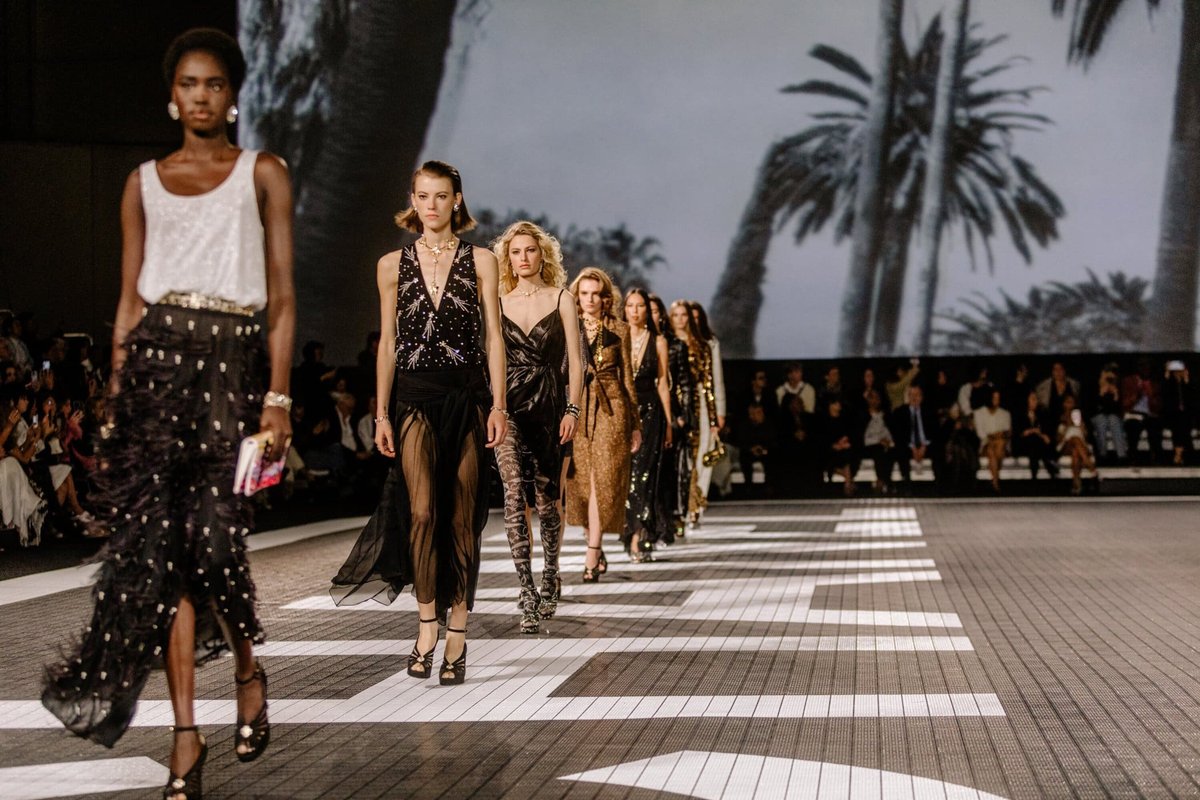
The cruise 2026 creative director turnarounds are the season the post-Sarno, post-Kim-Jones, post-Tisci creative resets stop being announcements and start being read commercially. Demna at Gucci, Jonathan Anderson at Dior, Daniel Lee and Joshua Schulman at Burberry, and Matthieu Blazy at Chanel have between them produced the most concentrated wave of artistic-director changes the four flagship houses of European luxury have ever shared in a single calendar year — and the Q1 2026 earnings prints arrived on the same desks as the cruise images. Business of Fashion’s 10 May briefing — “Gucci, Dior, Burberry: A Tale of Three Turnarounds” — named the three explicitly. The fourth, Chanel, is private and unrated; the fifth and sixth, Balenciaga and Versace, sit inside Kering and the Prada Group; and the cohort underneath them — Sarah Burton at Givenchy, Louise Trotter at Bottega Veneta, Duran Lantink at Jean Paul Gaultier and Glenn Martens at Maison Margiela — extends the same logic down the holding-company chart.
This piece reads each turnaround against its parent group, against the Q1 2026 earnings print that landed alongside it, and against the cruise debut that is now functioning as the first publicly-measurable output. Cruise is the season because cruise sells — the longest-tail commercial collection of the calendar, in stores from November to March, absorbing the gift quarter at full price. A debut staged here is not a press exercise. It is a balance-sheet event.
Gucci: the Kering reset
Gucci is the spine of the cruise 2026 creative director turnarounds because it is the single house whose decline has rewritten the share price of an entire conglomerate. Demna Gvasalia was named artistic director of Gucci in March 2025, succeeding Sabato De Sarno after a tenure of less than two years. The announcement crossed the same week as the Kering Florence strategy reset that named Gucci the group’s primary problem rather than its primary asset. Demna’s move from Balenciaga, where he had built a decade of identifiable hoodie-and-distortion vocabulary, to Gucci, where his job was to reverse a thirteen-quarter trajectory, was the single most-watched artistic-director appointment of 2025.
The Q1 2026 numbers, attested in our luxury Q1 2026 results map, are the frame the debut has to clear. Kering group revenue fell 6.2% reported to €3.57 billion in Q1 2026 and ran flat on a comparable basis. Gucci itself fell 14.3% on a reported basis and 8% organic — the worst single-quarter print of any flagship house in European luxury this cycle. The house contributed roughly €1.35 billion to the group total, against a 2023 quarterly peak above €2.5 billion. Demna inherited a brand whose top line has, in two years, shed roughly the annual revenue of a mid-cap luxury name. The cruise show is therefore the first public moment at which the Kering reset stops being a strategy slide and becomes a Lyst search index and a wholesale order book.
Demna’s vocabulary at Balenciaga — the broken-shoulder oversizing, the sock-sneaker, the deliberate ugly — does not transfer to Gucci by default. Gucci’s commercial spine sits in the Jackie 1961, the Horsebit loafer, the GG monogram canvas, and the Bamboo handle. Those are codes installed in the 1950s and 1960s, with refinements from Tom Ford in the late 1990s and Alessandro Michele’s 2015 maximalist overlay. Demna’s job is not to invent a new Gucci vocabulary. It is to re-tension the existing one against a price architecture that lost the entry consumer somewhere between Michele’s exit in November 2022 and De Sarno’s underwhelming reception across 2024. The cruise show is the first place the re-tensioning will be visible on actual product, not on a mood board.
Three constraints make the Gucci reset harder than the others. The price architecture: Gucci raised entry pricing through the Michele years to a level the consumer revolted against during the 2024 wholesale pullback, and Demna has to bring it down without cannibalising the gift-quarter margin that funds Kering’s debt-service schedule. The wholesale relationship: department-store and multi-brand buyers have been cutting Gucci open-to-buy budgets for six consecutive seasons. The comparison set: the same Q1 print that hammered Gucci showed Saint Laurent and Bottega Veneta as Kering’s “resilience pockets,” so the internal benchmark Demna is being measured against is not last year’s Gucci — it is this year’s Saint Laurent.
Dior: the Anderson rollout
The Dior turnaround is the LVMH counterpart and the structurally different one. Jonathan Anderson was named artistic director of Dior menswear in 2025, debuted in Paris in June 2025, and then had womenswear and couture added to his remit in late 2025 — a sequence rather than a single announcement. He came from eleven years at Loewe, where he had taken a quiet Spanish leather house and turned it into the most-talked-about LVMH minority property of the late 2010s and early 2020s. The Loewe-to-Dior pivot is, in scale terms, the inverse of Demna’s Balenciaga-to-Gucci move: Anderson went from a Loewe of roughly €2.5 billion in annual revenue to a Dior that sits inside LVMH’s Fashion & Leather Goods segment at a scale several times larger.
LVMH’s Q1 2026 print, attested in our Q1 results map, is the backdrop. Group revenue came in at €19.1 billion, up 1% organic and down 6% on a reported basis. Fashion & Leather Goods — the segment that includes Louis Vuitton, Dior, Loewe, Celine and Fendi — fell 2% organic. That is the gentlest decline of any flagship segment in the group, but it is still a decline, and Dior is one of the two houses (with Louis Vuitton) that have to do the heavy work of reversing it. Anderson’s appointment was structured as a sequence rather than a single shock precisely because LVMH does not need a reset of the Demna-at-Gucci shape. It needs a re-platforming of a house whose codes — the Bar jacket, the J’Adior, the Book Tote, the Saddle — are intact and whose commercial machinery has been running at scale for two decades.
The cruise show in Anderson’s first full womenswear cycle is the first integrated readout across menswear, womenswear and pre-collection. His Loewe vocabulary — the inflated proportions, the trompe-l’oeil leather, the cinema-history references — does not arrive at Dior unchanged. The Bar jacket is not a piece you can inflate without losing what it is. The Anderson rollout is the test case Bernard Arnault has staged for the proposition that a creative director with a personal narrative as strong as Anderson’s can scale from a €2.5 billion house to a €10-billion-plus house without thinning out. Cruise 2026 is the first moment that proposition is tested at full collection scale rather than on the menswear preview.
Burberry: the Lee and Schulman tandem
Burberry is the structural outlier in the cruise 2026 creative director turnarounds because it does not have a luxury-conglomerate parent. The house was founded in 1856 in Basingstoke by Thomas Burberry, listed on the London Stock Exchange, and now sits on the FTSE 100 as an independent — no Arnault, no Pinault, no Wertheimer family, no Prada family. Its strategic clock is set by quarterly reporting to UK institutional investors and by a public cost-cutting plan, not by a parent-group capital allocation. That is the difference that has shaped every move of the last two years and is the reason the BoF 10 May briefing put Burberry next to Gucci and Dior rather than next to LVMH and Kering.
The turnaround is, uniquely on this list, a tandem rather than a single appointment. Daniel Lee has been chief creative officer of Burberry since September 2022, when he succeeded Riccardo Tisci. Lee was previously creative director of Bottega Veneta from 2018 to 2021 — the immediate predecessor of Matthieu Blazy, and the designer who turned the Italian leather house into the first half of the Bottega story Blazy then continued. His Burberry brief on arrival was to re-anchor the house in its British outerwear codes — the trench, the gabardine, the equestrian knight, the check — after the Tisci years had pushed the brand toward a streetwear adjacency it could not credibly hold.
Joshua Schulman was appointed CEO of Burberry in July 2024, succeeding Jonathan Akeroyd. He arrived from Coach, where he had run the Tapestry-owned American leather-goods business through a stretch of growth that has become the implicit comparison BoF’s “Why Wall Street Prefers Coach to Gucci” briefing built on. His Burberry brief is the operational counterpart of Lee’s creative one: rebuild gross margin, rebuild wholesale, and execute a public cost programme of £40 million by 2025 rising to £60 million by 2027. The cost target is the only number on this list that is fully public, fully time-bound, and fully outside the family-controlled or Wertheimer-private envelopes that govern the other turnarounds.
The Schulman–Lee tandem is the model the rest of the FTSE 100 luxury cohort (a category that, after the Prada Group’s Versace acquisition, is essentially Burberry on its own) will be judged against. Cruise 2026 is the first season in which both halves of the tandem have been in post for long enough to share authorship of a commercial result. Lee’s check-and-outerwear language is the only of the four turnaround vocabularies that has an immediate, century-and-a-half-old code system to mine; the Burberry archive contains the trench, the check, and the equestrian knight in a more legible form than Gucci’s archive contains the Horsebit or Dior’s contains the Bar jacket. The question is whether Schulman’s cost discipline lets Lee deliver against that archive at a price the wholesale book can absorb.
Chanel: the Blazy debut
Matthieu Blazy’s Chanel cruise debut on 28 April 2026 at the Casino Municipal de Biarritz is the cruise show critics universally praised, and the one that did not need to be measured against an earnings call. Chanel is privately held by the Wertheimer family through Chanel Limited, files no quarterly accounts, and was free to spend sixteen months between the December 2024 announcement of Blazy’s appointment and his first public collection. Across that window the house also bought 23 Rue Cambon for €118 million ($133 million) in September 2025, a property purchase no listed conglomerate would make between artistic directors.
The show itself: 79 looks staged across two back-to-back collections for approximately 900 guests at the 1929 Casino Municipal, on the Grande Plage at Biarritz, the town in which Gabrielle Chanel opened her first couture house at Villa Larralde in 1915. Blazy used the Double C monogram as construction grammar rather than print, reinterpreted the 1926 Little Black Dress across at least seven looks, and worked in a beige-deep-pile-carpet register that read deliberately closer to his prior Bottega work than to Virginie Viard’s seven cruise collections at Chanel. The full reading of the show, the deed, the Lyst Index #1 ranking that followed, and the Wertheimer ownership structure that made the timeline possible, is in Blazy Chanel Biarritz: A Debut, a Deed, a Lyst #1.
For the cruise 2026 cohort, Chanel is the control case — the debut that did not have to be defended on a quarterly call, did not have to read against an organic-growth print, and did not have to optimise its venue for client geography. Demna’s, Anderson’s and Lee’s cruise 2026 collections will all have been staged with margin and wholesale calculus in the room. Blazy’s was staged with biography in the room. The asymmetry is the reason Chanel debuted at #1 on the Q1 2026 Lyst Index — the first time the house has ever appeared on the ranking at all.
Balenciaga: the Piccioli reset
The Balenciaga side of the Kering portfolio is the Pierpaolo Piccioli debut, which staged in Paris in October 2025 — six months before Demna’s first full cruise at Gucci. Piccioli, 60 years old when he took the seat and 25 years into a Valentino tenure that ended in March 2024, is the most pronounced creative pivot of the entire 2025–2026 wave: the house’s Ghesquière-to-Wang-to-Demna line, unbroken since 1997, ended on a runway that looked back to Cristóbal’s 1950s. Balenciaga, inside Kering, is not a turnaround in the Gucci sense. The Florence Capital Markets Day named it a “resilience pocket” alongside Saint Laurent, Bottega Veneta and Brioni. Piccioli’s brief is image, not spine.
The cross-house move is the Kering chess piece. Demna shifted from Balenciaga to Gucci, opening the Balenciaga seat for Piccioli to occupy after his Valentino exit. The internal logic is that the house with the harder turnaround (Gucci) gets the designer with the largest installed audience (Demna), and the house with the lighter brief (Balenciaga) gets the designer with the strongest critical signal (Piccioli, twice Designer of the Year). For the cruise 2026 cohort, Piccioli’s Balenciaga is the second Kering data point — and the one that has been visible in the market longer, with two full retail quarters now feeding into the same Q1 2026 print that Gucci ended -14.3% on.
Versace: the Mulier–Prada Group integration
Versace is the cohort’s Prada Group entry and the most operationally complex of the cruise 2026 creative director turnarounds because it involves an acquisition rather than only an artistic-director swap. The Prada Group’s acquisition of Versace from Capri Holdings, announced in 2025 and closed across the back half of the year, brought the Italian house into the same portfolio as Prada and Miu Miu. Pieter Mulier was appointed creative director of Versace under that new ownership, arriving from Alaia and the Richemont group, where he had run the house since 2021.
Mulier is the cohort’s most precise structural inversion: he leaves a privately-held, family-foundation-owned brand (Alaia, controlled through the Azzedine Alaia Foundation inside Richemont) for a listed-group brand (Versace, inside the Hong Kong-listed Prada Group). The Prada Group is itself an outlier in the Q1 2026 cohort: while Miu Miu’s growth has begun to stall after several quarters as the group’s headline performer, Prada the brand has continued to grow, and Versace is the integration project that has to absorb both the operational change in ownership and the creative change in director simultaneously. Mulier is also the only one of the six to cross from one listed luxury group to another — Demna stayed inside Kering; Piccioli moved from Valentino (Mayhoola) into Kering; Anderson moved within LVMH; Blazy moved from Kering to private Chanel.
The cruise 2026 creative director turnarounds, scored
The table below is the cohort scored across the dimensions that the Q1 2026 results and the cruise shows have between them made measurable. House, year of artistic-director appointment, the director’s previous post, the parent group, the parent’s most recent Q1 movement, and the status of the cruise debut as of 11 May 2026.
| House | Appointed | New CD (from) | Parent | Q1 2026 print | Cruise 2026 status |
|---|---|---|---|---|---|
| Gucci | March 2025 | Demna Gvasalia (Balenciaga) | Kering | -14.3% reported / -8% organic | Pending — first commercial readout |
| Dior | 2025 (menswear); late 2025 (women + couture) | Jonathan Anderson (Loewe) | LVMH | F&LG -2% organic; group +1% organic, -6% reported | Rolling out — menswear debuted June 2025 |
| Burberry | CCO Sept 2022 / CEO July 2024 | Daniel Lee (Bottega Veneta) + Joshua Schulman (Coach) | FTSE 100 independent | £40m cost cuts by 2025; £60m by 2027 | Tandem in second full year |
| Chanel | Dec 2024 (announce) | Matthieu Blazy (Bottega Veneta) | Wertheimer family (private) | Not disclosed (no quarterly reporting) | Debuted 28 April 2026, Biarritz — 79 looks, ~900 guests |
| Balenciaga | July 2025 | Pierpaolo Piccioli (Valentino) | Kering | “Resilience pocket” cluster within Kering -6.2% reported | Debuted October 2025, Paris |
| Versace | 2025 (under Prada Group ownership) | Pieter Mulier (Alaia/Richemont) | Prada Group | Group continues to grow; Miu Miu stalling | Integration year — first full cruise under new owner |
| Bottega Veneta | December 2024 (effective January 2025) | Louise Trotter (Carven) | Kering | “Resilience pocket” cluster | Defending Blazy-era position |
| Jean Paul Gaultier / Maison Margiela / Mugler / Diesel / Jil Sander | Various 2024–2026 | Duran Lantink, Glenn Martens, Miguel Castro Freitas, Jack McCollough & Lazaro Hernandez | OTB / Puig / private | — | Cohort underneath the flagship six |
Read across the table, the cruise 2026 creative director turnarounds split into three rows. The top row is the Q1-tested cohort: Gucci, Dior and Burberry, the three houses BoF named on 10 May, all listed and all measured against a quarterly print that landed alongside the cruise shows. The middle row is the structurally protected cohort: Chanel (Wertheimer-private) and the two Kering “resilience pockets” (Balenciaga and Bottega Veneta), whose Q1 2026 print did not land as a turnaround question. The bottom row is the Prada Group integration (Versace under Mulier) and the cohort underneath the flagship six — Sarah Burton, Louise Trotter, Duran Lantink, Glenn Martens and the rest of the 2025–2026 debut chart — where the creative reset is broader than the parent-group earnings story.
The cohort is the largest single-season turnaround wave the four flagship houses of European luxury have run together. Demna, Anderson, Lee and Blazy are between them responsible for the creative direction of roughly €30 billion in annual revenue across Kering, LVMH and the FTSE 100. All four are being measured against cruise 2026 specifically — the framing BoF’s turnarounds briefing made explicit.
Why Wall Street prefers Coach to Gucci
The BoF briefing of 8 May 2026 — “Why Wall Street Prefers Coach to Gucci” — is the financial mirror image of the cruise 2026 creative-director story. Tapestry, the American holding company that owns Coach, Kate Spade and Stuart Weitzman, is now valued nearly as highly as Kering on a market-capitalisation basis. Coach inside Tapestry has been Wall Street’s preferred luxury-adjacent exposure across the back half of 2025 and Q1 2026; Gucci inside Kering has been the asset analysts have been writing down assumptions on for three consecutive quarters. The implicit equity-market verdict is that the speed of an American accessible-luxury turnaround has, this cycle, exceeded the speed of a European flagship-luxury reset.
Joshua Schulman’s Burberry appointment is the connective tissue. Schulman ran Coach for Tapestry through the early part of the cycle Wall Street now prefers, then arrived at Burberry in July 2024 to run an independent FTSE 100 house against a £60-million-by-2027 cost-cutting target — the same operating discipline that produced the Coach valuation Tapestry now trades on. The Burberry investment case is, in effect, the Coach playbook applied to a British heritage brand with a 169-year archive.
The Kering-versus-Tapestry valuation gap is the strongest single number in the cruise 2026 creative-director context that does not appear on a Q1 income statement. It says, on current visibility, that the cruise 2026 turnarounds at Gucci and Dior have to deliver not against last year’s Gucci or last year’s Dior, but against a Coach-style growth narrative that an American competitor has demonstrated is possible inside a different price segment and a different sourcing model. Demna and Anderson are being measured against Coach by analysts they have never met.
Coda
The cruise 2026 creative director turnarounds are the moment the European luxury reset stops being a slide in a Capital Markets Day deck and becomes a wholesale order book, a Lyst search index, and a same-store-sales delta. Demna at Gucci has to deliver against a -14.3% reported Q1; Anderson at Dior against a -2% organic Fashion & Leather Goods segment; Lee and Schulman at Burberry against a £60-million cost programme set against a public FTSE 100 share register; Blazy at Chanel against an audience of 900 in a 25,000-population French town and no quarterly disclosure at all. Piccioli at Balenciaga and Mulier at Versace are the cohort’s lighter-brief and integration cases respectively, both arriving inside the same season and both feeding the parent-group narrative that the broader wave of creative-director exits and entries has now produced its largest single-cycle set of debuts on record.
The structural lesson — and the one BoF’s 10 May briefing implicitly endorses — is that the four turnarounds are not directly comparable. The parent-group structure determines what each debut is allowed to optimise for. Burberry has to optimise for a UK cost target. Gucci has to optimise for a Kering debt schedule. Dior has to optimise for an LVMH Fashion & Leather Goods margin. Chanel does not have to optimise for any of those, because the Wertheimers do not file. The cruise show is the same artefact across all four houses. The constraint envelope around it is not.
The next four quarters will test whether the cohort’s outliers — Chanel above the cohort, Burberry beside it — hold their position. Blazy at Chanel has the structural advantage and the founder’s biography to mine. Lee and Schulman at Burberry have the trench, the check, and a public cost programme to deliver against. Demna at Gucci and Anderson at Dior have the largest turnaround surfaces and the strictest analyst counts. The cruise 2026 creative director turnarounds are the season the four lines first cross a measurable axis. The Q2 print will be the first time we know which of them have crossed it in the right direction.