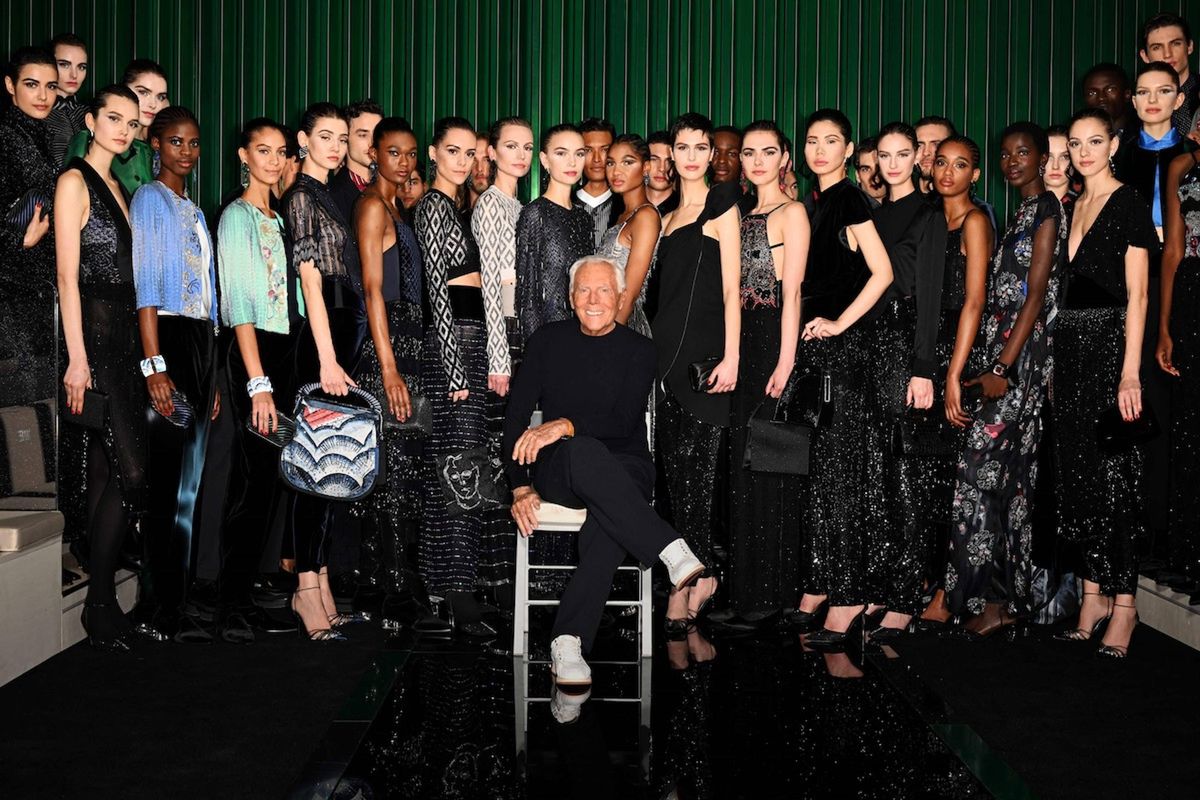
Armani’s 15% stake is the largest contested block of independent Italian luxury since LVMH bought Fendi in 2003, and three luxury suitors are now in the room: LVMH, L’Oréal and EssilorLuxottica. Business of Fashion reported on 10 May 2026 that Giorgio Armani Group CEO Giuseppe Marsocci is preparing to appoint two financial advisers to run the sale of an initial 15% stake to a preferred luxury group within 18 months, the window written into Giorgio Armani’s own succession plan before his death on 4 September 2025. The buyer of that first 15% has an option to take its position up to 54.9% over three to five years. The Giorgio Armani Foundation, the founder’s instrument of control, retains at least 30% indefinitely. Those are the numbers that shape every move the three named suitors are about to make.
This is, in the most literal sense, a contest written by a dead founder. Giorgio Armani built Giorgio Armani S.p.A. in Milan in 1975 and ran it as one of the last fully owner-controlled European luxury houses for fifty years. The succession plan he left behind is unusually prescriptive — a 15% tranche first, a 54.9% option later, a Foundation floor of 30% in perpetuity — and it forces the buyer to accept a governance structure no other recent Italian luxury transaction has had to live with. Bulgari was sold outright to LVMH in 2011. Versace was sold outright to Capri Holdings in 2018 and then onward to Prada Group in 2025. Armani is the first marquee Italian house to be sold partially, in tranches, with the founder’s foundation guaranteed a permanent governance seat — and that structural fact disqualifies several houses that would otherwise be obvious bidders.
The succession plan, written by the founder
The mechanics matter more than the headline. Giorgio Armani’s plan, as reported by BoF on 10 May 2026, gives Marsocci 18 months from the opening of the process to place 15% with a buyer the Foundation will accept. The buyer is not free to choose how it scales up: it has the right to acquire additional tranches up to 54.9% of the company, but the path runs three to five years and the Foundation has approval rights along the way. After all tranches are exercised, the Foundation still holds at least 30% — meaning the largest position any single industrial buyer can ever assemble is 54.9%, and the remaining float sits with a body whose mandate is to protect the founder’s name, not to maximise quarterly margin. The plan is closer to a Hermès-style governance lattice than to a clean LVMH acquisition. It is designed to be hard to unwind.
The financial backdrop is unusually concrete. On 29 April 2026, Armani Group reported that 2025 revenue dipped 2.8% — the first full-year figure since the founder’s death, and a softer print than 2024. That dip matters for the auction in two ways. First, it is small enough that no suitor will use it to renegotiate price; a single-digit decline in the year a 91-year-old founder dies is, if anything, a sign of operational stability. Second, it gives Marsocci a clean reason to move now: a protracted post-founder dip is the worst outcome for the Foundation’s long-term valuation, and the 18-month window was always going to be exercised on the early side.
Marsocci’s own position is the other variable worth naming. He was appointed CEO in 2024, in the founder’s last full year, with a brief that already anticipated this moment. The two advisers he is about to appoint will run a process the founder framed, the Foundation approves, and the CEO executes — closer to a structured auction than an open-market sale. The three suitors named in the BoF report are not the universe of interested parties; they are the shortlist the Foundation and its advisers are willing to talk to. Anyone outside that shortlist is being kept out for a specific reason.
Why LVMH wants the stake
LVMH is the most obvious suitor, and not only because it usually is. The Fendi reference point is exact: in 2003, LVMH took control of Fendi from Prada and the Fendi family for an independent Italian luxury house with a strong leather identity and a soft post-founder phase. That deal anchored a generation of LVMH’s Italian portfolio strategy, sitting alongside Bulgari (2011) and Loro Piana (2013). Armani is, in scale and in cultural weight, the natural fourth pillar in that sequence — a Milan-headquartered, founder-built, ready-to-wear-first house with a fragrance license and an eyewear license already running through external partners. The structural shape of an LVMH Armani would look very similar to the structural shape of LVMH Fendi after 2003: keep the Italian creative engine, plug into LVMH’s retail and supply infrastructure, internalise the highest-margin licensing categories over time.
The succession-grooming logic also lines up. Bernard Arnault has spent the last two years visibly rotating his children into operating roles inside the group, and the appointment of Frédéric Arnault at Loro Piana on 1 June 2025 was the clearest signal yet that LVMH is building the second-generation map around individual Italian maisons rather than around the central group. Armani, with its Milan headquarters, its 50-year house history and its own founder-built archive culture, would be a fourth Italian flagship inside that map, after Fendi, Bulgari and Loro Piana — and the LVMH playbook for slotting a fourth Italian maison into a generational chairmanship is now visible enough that the Foundation can read it. Whether the chairman of Armani-inside-LVMH would be Antoine Arnault (the Italian portfolio’s senior figure), Frédéric Arnault (the youngest, already running a 101-year-old maison) or a new external operator under their oversight is the open question. The point is that LVMH is the only suitor with a stocked bench for that role.
LVMH has the deepest war chest of the three named suitors and has demonstrated, repeatedly, that it will commit balance-sheet capacity to a single Italian transaction — Bulgari in 2011, Loro Piana in 2013, Tiffany in 2021 at $15.8 billion. A 15% Armani tranche is small relative to those reference points. The question for Arnault is not whether to bid; it is whether to bid in a way the Foundation will accept — meaning, in practice, whether to accept a 30% permanent Foundation floor LVMH has never lived with at any of its other Italian houses. That is the friction. LVMH’s Fashion & Leather Goods division has been the most-watched line in the luxury Q1 2026 comparators, and a marquee Italian acquisition — even a 15% one — resets the group’s growth narrative. Arnault has a strategic reason to bid that has nothing to do with Armani itself, and the Foundation will know that.
Why L’Oréal wants it
L’Oréal is the most under-discussed suitor on the list and arguably the one with the cleanest commercial logic. The Armani fragrance and beauty license has historically sat with L’Oréal Luxe and is, by some industry measures, the single largest luxury beauty license inside the group’s portfolio. Acquiring an industrial stake in the Armani trademark itself — rather than continuing to operate it under a renewable license — is the move L’Oréal has been positioning for across the last 24 months of beauty consolidation. In 2026 the group absorbed Kering Beauty’s perfume rights and acquired Creed in the same broader move; that deal, taken alongside the Armani license, makes L’Oréal Luxe the dominant industrial owner of European luxury fragrance rights. A 15% Armani stake is the logical capstone.
The thesis is not that L’Oréal wants to run Armani’s ready-to-wear. The thesis is that L’Oréal wants to lock in, on an ownership basis rather than a contractual one, the trademark that drives its largest single luxury beauty SKU set. License terms come up for renegotiation, and a new fashion-house owner — particularly one under LVMH or EssilorLuxottica — can extract better terms than an independent Foundation has historically demanded. License revenue is also recognised differently from owned-brand revenue, and L’Oréal Luxe’s investor narrative has moved towards owned-brand beauty as the higher-quality line. A 15% block hedges renewal risk and converts the relationship from contractual to structural in a single move.
The Foundation compatibility question is harder for L’Oréal than for LVMH. L’Oréal is an industrial owner of beauty brands, not a luxury house operator, and the Foundation will want to see how it intends to govern a 15% stake in a ready-to-wear-led Milanese maison whose fashion business is the cultural anchor for everything else. The answer L’Oréal will offer is probably a holding-company-style passive position: 15% for option value and trademark security, with no operational ambition over the fashion business itself. That is coherent. It is not obviously what the Foundation wants to hear, but it is what L’Oréal can credibly deliver — and a non-operating 15% block is the least disruptive of the three bids on offer.
Why EssilorLuxottica wants it
EssilorLuxottica is the suitor with the deepest historical tie to Armani and the suitor that most analysts will under-weight in the early commentary. The relationship runs back to 1988, when Giorgio Armani was Luxottica’s first designer eyewear licensee, and it has continued for nearly four decades — through Luxottica’s listing, through the 2018 merger with Essilor that created EssilorLuxottica on 1 October 2018, and through the wholesale realignment of designer eyewear licensing across the last decade. Armani eyewear is one of the longest-running designer licenses inside EssilorLuxottica’s portfolio, and the strategic logic for converting that license into a direct equity position in the trademark is structurally identical to L’Oréal’s logic on fragrance.
What EssilorLuxottica offers that L’Oréal does not is vertical integration on a category where Armani’s pricing power is unusually high. Luxury eyewear is the only luxury category where EssilorLuxottica owns the manufacturing, the optical lens technology, the wholesale distribution, the optical retail (LensCrafters, Sunglass Hut, GrandVision) and the prescription-and-sunglass sales motion. A 15% stake in the underlying Armani trademark would let EssilorLuxottica deepen its capital commitment to a license that already runs through every node of that vertical, with the added option — under the 54.9% pathway — to take a much larger position over three to five years. The strategic fit on eyewear is precise.
The Foundation compatibility question, again, is medium rather than high. EssilorLuxottica is an industrial conglomerate, not a luxury house operator, and its scale (it is one of the world’s largest eyewear groups by revenue) means a 15% Armani position is small relative to its balance sheet. The bid will be capable; the cultural fit is the more uncertain leg. EssilorLuxottica’s leadership has demonstrated, across the long Armani relationship and across other designer licenses, that it can run luxury-brand eyewear without diluting the underlying brand’s positioning. Whether it can extend that discipline to a 15% governance seat on the parent maison is the question the Foundation will have to test.
The under-rated argument for EssilorLuxottica is duration. Of the three suitors, EssilorLuxottica is the only one whose existing relationship with Armani predates the death of the founder by nearly four decades. The 1988 license is older than the Giorgio Armani Foundation itself. That kind of historical continuity carries weight in a Foundation-led process whose explicit mandate is to protect the founder’s name across generations. It is the soft factor the LVMH bench cannot match.
Who isn’t in the room — Kering, Prada Group, Richemont
The three suitors named in the BoF report are not the universe of plausible bidders. They are the shortlist the Foundation will entertain. The houses kept out — Kering, Prada Group, Richemont — are kept out for specific reasons that say as much about the 2026 luxury landscape as the three accepted names do.
Kering is absorbed in its own Florence-strategy turnaround under Luca de Meo, who took over as CEO in 2025 and presented a multi-pillar restructuring at the group’s Florence Capital Markets Day. Kering has neither the bandwidth nor the balance-sheet flexibility to run a parallel Italian acquisition while consolidating Gucci, integrating its new jewellery division and managing the Bottega Veneta and Saint Laurent perimeters. The group’s Q1 2026 print, read alongside LVMH and Prada Group in the luxury Q1 comparators, was the softest of the three majors. François-Henri Pinault is not in the Armani room because the Armani room is not a room Kering can credibly enter in 2026.
Prada Group is the more interesting absence. On paper, an Italian-listed luxury house with a controlling founding family, two strong creative leads and a recent track record of executing complex transactions is the natural Italian acquirer for an Italian asset. In practice, Prada Group is currently digesting Versace, which it acquired from Capri Holdings in 2025 and whose creative reset under Dario Vitale and the post-Pieter-Mulier debut cycle is the group’s largest operational task for 2026 and into 2027. A simultaneous Armani transaction would stretch even the most disciplined integration team, and the Foundation will know it. Prada Group is not in the room because it is in another room next door, and that other room is already full.
Richemont is the third absence. The group’s centre of gravity is hard-luxury watches and Cartier-anchored jewellery, the categories where its returns are highest and where its competitive position against LVMH’s Tiffany and Bulgari needs defending. A ready-to-wear-led Italian fashion house is structurally a poor fit for the Richemont portfolio, which has historically been allergic to mass fashion exposure. The group is not in the Armani room because Armani is not the kind of asset Richemont is trying to buy.
Two further names worth registering as absences: Puig (the Spanish family-owned group behind Carolina Herrera, Paco Rabanne and Dries Van Noten) and Capri Holdings (which sold Versace to Prada Group in 2025). Puig is the size at which a 15% Armani stake would be transformational rather than additive; the Foundation will view it as a less-credible governance partner than a tier-one luxury group. Capri has just exited the Italian luxury operator role. Neither is in the BoF shortlist for that reason.
The broader founder-exit context matters too. The Armani transition sits inside the same 2024–2026 wave of luxury founder departures that produced the Phoebe Philo and Dries Van Noten exits and the long tail of post-founder succession questions across mid-sized houses. Armani is the largest of those transitions and the most clearly structured. It is also the one being negotiated with the founder’s own architecture still in place — the Foundation, the 30% floor, the 54.9% ceiling, the 18-month window — rather than against a vacuum.
The Armani 15% stake suitors, ranked
The three suitors do not split evenly across the criteria that the Foundation and Marsocci’s advisers will weight. The comparison below pulls out four axes — existing tie depth, capital available, strategic fit, and Foundation governance compatibility — and ranks each suitor honestly against them.
| Suitor | Existing tie to Armani | Capital available | Strategic fit | Foundation compatibility |
|---|---|---|---|---|
| LVMH | None direct (Fendi 2003 / Bulgari 2011 / Loro Piana 2013 portfolio precedent) | Deepest war chest of the three | Luxury conglomerate playbook; Italian maison map already built | High — Arnault has visible succession-plan track record across Fendi, Loro Piana and Bulgari |
| L’Oréal | Long-running beauty / fragrance license (industry’s largest single luxury beauty license, per market commentary) | Largest pure-beauty cash position globally | Beauty roll-up after Kering Beauty + Creed in 2026 | Medium — industrial beauty owner, not a luxury house operator |
| EssilorLuxottica | Eyewear license since 1988; first designer eyewear licensee in Luxottica’s history | Industrial conglomerate balance sheet | Vertical eyewear integration; only suitor with manufacturing-to-retail control of an Armani category | Medium — industrial owner; longest historical relationship of any suitor |
The ranking on strategic fit is the closest call. LVMH offers the most complete luxury-operator answer; L’Oréal offers the cleanest fragrance-trademark answer; EssilorLuxottica offers the deepest single-category vertical. The Foundation will weight differently depending on which dimension of the Armani brand it considers most exposed in the post-founder decade. If the answer is “the ready-to-wear business needs an LVMH-style operator”, LVMH wins. If the answer is “the fragrance trademark is the highest-margin asset and needs protecting from license renewal risk”, L’Oréal wins. If the answer is “the eyewear vertical is where the brand’s category control is most fragile”, EssilorLuxottica wins. All three answers are defensible.
The ranking on Foundation compatibility is less close. LVMH is the only one of the three suitors that has, in the public record, run a multi-decade founder-built Italian maison through a Foundation-adjacent governance structure without visibly damaging the brand. Fendi after 2003, Bulgari after 2011, Loro Piana after 2013, and now Loro Piana under Frédéric Arnault, are all live examples that the Foundation’s advisers will study. L’Oréal and EssilorLuxottica do not have that record because they have not been in that operating role. The Foundation can either decide the LVMH playbook is the most likely to keep Armani intact across the 54.9% pathway, or it can decide that a non-operating industrial 15% partner (L’Oréal or EssilorLuxottica) gives the Foundation more long-term governance freedom than a luxury-house operator that intends to scale up.
That choice — operator or non-operator — is the real ranking. The three suitors line up cleanly on it. LVMH is the operator. L’Oréal and EssilorLuxottica are non-operators. The Foundation’s preference, once revealed, will tell the market what kind of Armani the founder’s plan was always designed to protect.
The most concrete fact about the 50th-anniversary Armani/Archivio activation at Armani/Silos is that it positions the founder’s archive as a permanent cultural address in Milan independent of whoever ends up owning 15% of the operating company. That separation is deliberate. Armani/Silos is held by structures that sit alongside the operating company; the Foundation’s 30% floor in Giorgio Armani S.p.A. is held alongside whatever industrial partner enters through the 15% door. The archive and the trademark are designed to outlast any single owner, and that architecture is the founder’s last and most quietly aggressive corporate decision.
Coda
What the Foundation has on the table, on 11 May 2026, is the cleanest test of post-founder governance the European luxury industry has run in a generation. The three suitors named in the 10 May BoF report — LVMH, L’Oréal, EssilorLuxottica — each carry a different theory of how Armani should be owned after the founder. LVMH believes Armani should be operated by a luxury house with a built-in successor bench. L’Oréal believes Armani should be capital-partnered by the industrial owner of its largest single license. EssilorLuxottica believes Armani should be deepened with its longest-running category partner. The Foundation will choose between those three theories inside Marsocci’s 18-month window, and the choice will set the terms not only for the next 39.9% (the path from 15% to 54.9%) but for the next generation of how independent Italian luxury houses sell themselves into bigger groups while keeping their founders’ names governable. Armani is the precedent every founder-built Italian house under €5bn revenue will study next. The three suitors know it. So does the Foundation.
References
- Business of Fashion, 10 May 2026 — Report: Armani Could Split 15% Stake Among L’Oréal, LVMH, EssilorLuxottica
- Business of Fashion, 29 April 2026 — Armani 2025 Sales Dip as Group Flags Market Shifts