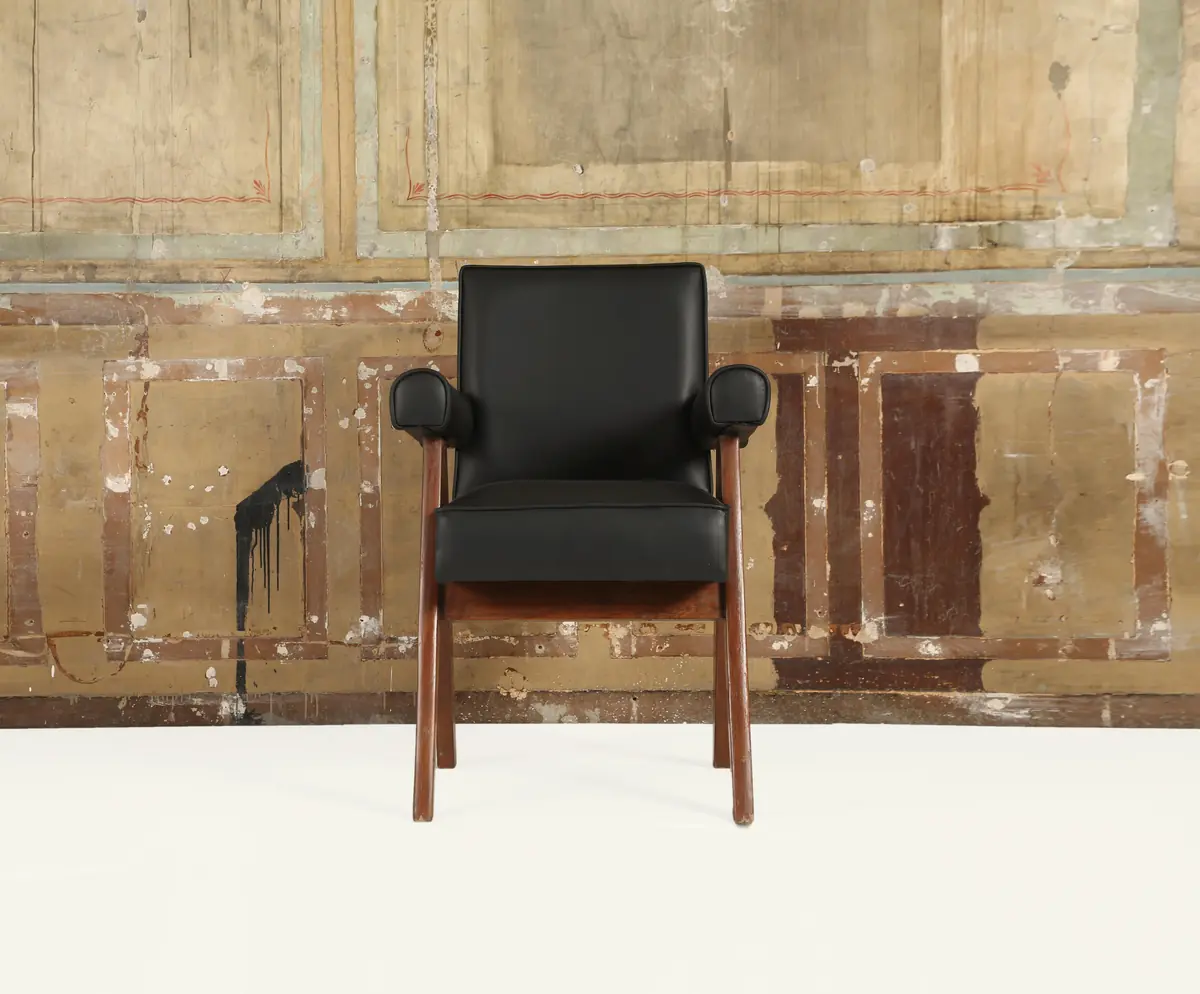
When the High Court of Punjab and Haryana opened in March 1955, every committee chair, library seat and demountable workstation inside it was a Pierre Jeanneret design — and seventy-one years later, those same teak-and-cane typologies are the second great mid-century price story after Eames. Chandigarh furniture, as the trade now calls it, was built for the civic interiors of the Capitol Complex that Le Corbusier drew between 1951 and 1965; it was declared obsolete in batches between the 1980s and the early 2000s; it was repatriated, restored, and resold by a small number of European dealers; and it has, since roughly 2007, run a parallel canon to the Cassina LC series whose 1928 Paris drawings sit at the other end of the same architects’ careers.
The LC series and the Chandigarh furniture are usually read as separate canons — one industrial, one vernacular; one French, one Indian; one tubular steel and pony hide, the other teak and woven cane. They share two of the same three authors and were produced, in Jeanneret’s case, by the same hand. The argument here is that they should be read together.
The Capitol Complex commission
Le Corbusier took over the Chandigarh master plan in 1951, after the original American team led by Albert Mayer and Matthew Nowicki dissolved following Nowicki’s death in a plane crash the previous August. The brief was a new capital for Indian Punjab — Lahore had become Pakistani at Partition in 1947 — and Le Corbusier accepted on condition that he would direct the master plan and the Capitol Complex (High Court, Secretariat, Assembly, Open Hand), with day-to-day execution falling to Maxwell Fry, Jane Drew, and his cousin Pierre Jeanneret.
The city was inaugurated on 7 October 1953. The High Court of Punjab and Haryana — designed by Le Corbusier, supervised on site by Jeanneret — became functional in March 1955. The Secretariat opened in 1958, the Assembly in 1962. UNESCO inscribed the complex on the World Heritage List in July 2016 as part of “The Architectural Work of Le Corbusier”.
Jeanneret’s role is the part most often misstated. He was Chief Architect of the Punjab Government from 1951 until 1965, lived in Chandigarh continuously (in Sector 5, in a house he designed for himself), and was responsible — solely or principally — for almost all of the building stock outside the four monumental Capitol structures: the housing programme, the markets, Panjab University (Gandhi Bhawan, library, student housing, most academic buildings), the schools, the dispensaries, the cinemas. Le Corbusier visited roughly twice a year; Jeanneret built the city.
The furniture programme arose from this division of labour. There was no Indian furniture industry in 1952 capable of producing the volume that a new state capital needed; importing was politically untenable. Jeanneret therefore designed, between roughly 1953 and 1963, a vocabulary of perhaps thirty-five distinct pieces, produced in volume by carpentry workshops in Chandigarh, Kalka, and Ambala. The pieces were not signed. They were stencilled, in many cases, with departmental codes — “PU” for Panjab University, “HC” for High Court, “SEC” for Secretariat — and those stencils are now the closest thing the work has to a maker’s mark.
Jeanneret’s typology vocabulary
Before the auction story, the work itself. The Chandigarh furniture is not one corpus but several overlapping ones, designed for different programmes (civic, academic, residential), in different materials (almost always teak or Indian rosewood, often woven cane, sometimes leather), and at different price points within Jeanneret’s own internal economy. The canonical typologies — the ones that have entered the design literature and the secondary market — number around a dozen. Six of them carry the bulk of the auction value.
The canonical Jeanneret typologies
| Type | Approx. year | Primary material | Site of origin | Current secondary-market signal |
|---|---|---|---|---|
| Committee chair / Chandigarh armchair | 1953–55 | Teak frame, woven cane back and seat | High Court, Secretariat | Authenticated examples routinely pass $40,000; pairs with strong provenance enter six-figure territory |
| Kangaroo lounge chair | c. 1955 | Teak frame (zigzag profile), cane seat | Officer housing, Capitol Complex | Five-figure range; rarer than the committee chair |
| Library chair | 1959–61 | Teak, light cane back, no arms | Panjab University library | Mid-five figures in good condition |
| Demountable chair | c. 1955 | Teak, no metal fasteners, knock-down construction | Multiple programmes | Lower-five-figure range, prized as a flat-pack precedent |
| Student writing chair | c. 1960 | Teak with attached writing surface | Panjab University classrooms | Low five figures; volume on the market |
| Senate / officer easy chair | c. 1958 | Teak, leather or cowhide upholstery | Capitol Complex offices | High five to low six figures depending on upholstery survival |
The committee chair is the headline object. Its silhouette — V-leg construction splayed front-to-back, curved cane back and seat held in a bent-teak frame — has become, since the late 2000s, the international shorthand for Chandigarh as a market category. It fitted out courtrooms and conference rooms across the Capitol, and was made by carpenters working from detail drawings Jeanneret refined between the first prototypes in 1953 and the version that stabilised into production around 1956. Half a dozen variants are distinguishable by seat depth, back rail curvature, and cane weave, all now adjudicated as separate sub-types by the major auction houses.
The Kangaroo lounge — named retrospectively for its zigzag side profile, which arches forward like an animal at rest — was designed for senior officers’ housing in the Capitol sector. Surviving examples are markedly rarer than the committee chair. The library chair is lighter, armless, with a cane back that is a single curved sheet rather than a framed panel; it was produced for the reading rooms at Panjab University and reads more obviously as an industrial-design object than the committee chair does, showing the work of removing material rather than the work of accommodating posture.
The demountable chair is structurally the most interesting object in the corpus. It was designed without metal fasteners — the joins are wood-on-wood, held by tension and gravity — and it knocks down for shipping and storage in a way that anticipates the IKEA flat-pack vocabulary by roughly two decades. The same chair could be assembled in a school in the morning and a courtroom in the afternoon, then disassembled and stored against a wall.
The student writing chair and the officer easy chair sit at the two ends of Jeanneret’s programmatic spectrum: the first austere and repeatable, designed for assembly in volume; the second upholstered, often in cowhide, produced for senior civil-service interiors. The price gap between them at auction — by an order of magnitude — is the gap between Chandigarh as a programme and Chandigarh as a brand.
Materials: teak, Indian rosewood, woven cane
The material vocabulary is unusually narrow. Almost all of Chandigarh furniture is built from one of two woods (Burmese teak or Indian rosewood, with teak dominant by a ratio of perhaps four to one) and one of two seating materials (woven cane or, in upholstered variants, leather or cowhide). There is no metal in most pieces, no glass, almost no plywood. By Indian post-independence standards the economy was rigorous: every species had to be sourceable in country, every joint cuttable without specialised machinery, every piece capable of surviving a Punjab plain that delivered 44°C summers, monsoon humidity, and dust loads heavy enough to abrade upholstery within a season.
Burmese teak — sourced through colonial trade routes that survived Partition into the early 1950s — has the dimensional stability and resistance to insect attack the climate demanded, and joints cleanly with hand tools. Indian rosewood (sheesham, Dalbergia sissoo) was used as a secondary species. Woven cane is the seating choice for the same reason it dominates most of South Asia: it ventilates in heat, dries quickly after monsoon, and is repairable by any furniture worker with a roll of cane and a good knife. The cane on a surviving Chandigarh chair is rarely original; reputable dealers disclose recaning as a matter of course. Originality of frame is the test, not originality of cane.
The PWD stencils deserve their own note. Hand-stencilled letter codes on the underside of the seat or the rear stretcher — “PU/HC” for a chair transferred from Panjab University to the High Court, “SEC/A1” for a Secretariat office, “GH” for Government House — were the inventory marks of the Punjab Public Works Department, applied at procurement and updated on reassignment. They are now the most reliable single authentication signal in the market. A committee chair with intact PWD stencils, original teak, and a documented chain of custody from the Capitol Complex to a European dealer to an auction house is the gold-standard provenance. A chair without stencils sells for a fraction.
From obsolete to coveted: the 2000s revaluation
The story of how Chandigarh furniture entered the international market is principally the story of one French dealer. Eric Touchaleaume, who had been collecting Le Corbusier and Jean Prouvé furniture since the 1980s, made his first expedition to Chandigarh in 1999. The trigger was a visit to the Capitol Complex during which he saw the Punjab administration burning surplus furniture in courtyard fires — chairs and desks that had been declared obsolete by the local government and were being disposed of as scrap. Touchaleaume understood, before almost anyone else outside India did, that what was being burnt was Pierre Jeanneret production work.
Between 1999 and roughly 2008 he ran a programme of acquisition that was, in retrospect, one of the great salvage operations in twentieth-century design history. Working through local intermediaries and with the formal cooperation of the Punjab Public Works Department — which had no use for the pieces and was happy to sell them at scrap rates — he extracted thousands of items and shipped them to a restoration facility outside Paris. They then entered the market through his own Galerie 54 in Paris and a small number of partner dealers in London, Brussels, and New York.
The first major auction-house sales followed quickly. Christie’s London held its first Chandigarh-focused design sale in 2007. Phillips and Sotheby’s followed within two years. By 2012 the major design departments at all three houses were running dedicated Chandigarh sections within their twentieth-century evening sales, and a Pierre Jeanneret committee chair had become, alongside an Eames lounge chair and an Eileen Gray side table, one of the recognisable visual anchors of the post-war canon. The price trajectory was steep. In 2005 a committee chair could be acquired for the low four figures from a Paris dealer who knew what it was. By 2010 the same chair routinely passed $20,000 at auction. By the late 2010s the secondary-market price for an authenticated committee chair routinely passed $40,000, and pairs with strong provenance moved into six-figure territory.
The revaluation was not without controversy. Indian commentators — academics, architects, conservators — argued, correctly, that the export of the furniture from Chandigarh constituted a loss of national patrimony, and that the gap between the prices Touchaleaume paid the Punjab government and the prices he obtained at auction amounted to a wealth transfer from the Indian state to European dealers. The legal position was less clear-cut than the moral one: the pieces had been formally declared obsolete, sold under proper procurement procedure, with export licences issued. The Indian government’s response, beginning in the early 2010s, was twofold: it tightened export rules to prevent further extraction, and it began to commission its own restoration programme for the pieces still in situ. Several rooms at the High Court and the Assembly have since been restored with the original Jeanneret pieces returned to use.
The revaluation is the closest mid-century parallel to what happened with the Lalanne market two decades later. In both cases a body of work that had been valued at retail prices during its makers’ lifetimes was repositioned, after their deaths, into a serious auction-house category through the persistent work of a small number of dealers and a single major collector or estate. The Lalannes had Jean and Terry de Gunzburg; Chandigarh had Touchaleaume and Galerie 54. The mechanism is the same.
Cassina i Maestri and the LC canon
The other end of the lineage is in Italy. Cassina launched its I Maestri programme in 1964, the year before Le Corbusier’s death and three years before Jeanneret’s. The initial commission was the exclusive worldwide rights to the 1928 furniture series that Le Corbusier had developed with Charlotte Perriand and Pierre Jeanneret at the rue de Sèvres atelier. The pieces — LC1 sling armchair, LC2 Grand Confort, LC3 Grand Confort Grand Modèle, LC4 chaise longue (originally the B306), LC6 dining table, LC7 swivel chair — had been produced in small numbers by Thonet in the late 1920s and early 1930s, then disappeared for thirty years. Cassina’s 1964 commission re-industrialised them and made them available globally for the first time at meaningful volume.
The LC series is now the most widely-distributed body of mid-century modernist furniture in the world. Cassina has produced it continuously for sixty-two years. The LC2 alone has been made in numbers that comfortably exceed every other piece of modernist club seating combined — the Mies Barcelona Chair is its only serious volume rival. The pieces have aged into a slightly different object than the 1928 originals: steel tube drawn from different mills, chromium plating using different baths, leather from different tanneries, cushion fills reformulated for contemporary fire-retardant standards. None of this is hidden. Cassina publishes the production specification for each piece, the Fondation Le Corbusier authorises the reissues, and the certificate of authenticity is one of the more rigorous documentation packages in the industry.
The relationship between the LC canon and the Chandigarh furniture is the part the design literature under-reads. The two corpora share Jeanneret. The LC series carries his attribution alongside Le Corbusier and Perriand; the Chandigarh furniture is his solo work or close to it. The LC series is industrial, tubular-steel, designed for Paris apartments and intended for global production; the Chandigarh furniture is artisanal, teak-and-cane, designed for Indian civic interiors and made by hand in regional workshops. The two bodies were drawn by the same hand, twenty-five years apart, and they document the full arc of what one of the great mid-century design partnerships was capable of when separated from its collaborators and dropped into a different material economy.
Jeanneret in Paris in 1928 produced the LC2. Jeanneret in Chandigarh in 1955 produced the committee chair. The seat depth, the back angle, the relationship between frame and infill, the impulse toward distinctness of construction — these are continuities of vocabulary across a quarter-century and two continents. The Cassina catalogue and the Chandigarh auction market are, viewed this way, the two distribution mechanisms for a single body of work.
Le Corbusier Inediti
Cassina’s Le Corbusier Inediti programme, launched at Salone del Mobile 2026 alongside Linde Freya Tangelder’s Cassina Fluid Re-Collection at 10 Corso Como, is the first time the company has formally extended the LC canon since the 1980s. The collection — six pieces drawn from the Fondation Le Corbusier archive in Paris, dated between 1928 and 1952, never previously produced — is presented under Le Corbusier’s name alone. The Perriand and Jeanneret attribution that Cassina has, since the 1990s, applied retrospectively to the LC series is conspicuously absent from the Inediti catalogue.
What is worth adding here is that Inediti opens the question of whether Cassina or another publisher will eventually take the same approach to the Chandigarh corpus. Jeanneret’s drawings from the period survive in two main archives: the Fondation Le Corbusier in Paris and the Chandigarh College of Architecture, where Jeanneret’s personal papers were deposited after his return to Geneva in 1965 and his death there in 1967. The Vitra Design Museum on the Vitra Campus at Weil am Rhein holds a representative collection of Jeanneret production pieces from Chandigarh, acquired in stages between 2007 and 2018, and has staged two exhibitions on the corpus.
A licensed Cassina or Cassina-adjacent reissue of the committee chair is theoretically possible. The drawings exist; the rights situation is more complicated than the LC series (Jeanneret’s estate is more dispersed, and the Indian government has an articulable interest in the corpus), but it is not insurmountable. The case against doing it is the case Cassina has, so far, made by inaction: the Chandigarh furniture is, in part, valuable precisely because it is not in serial production, and any reissue would have to be positioned carefully to avoid collapsing the secondary market built around the originals over the last twenty years. A €4,500 Cassina committee chair would, within five years, halve the auction price of an authenticated 1955 example.
The opposing argument is that Jeanneret’s name should not require an auction-house premium to reach a designer’s studio in Mexico City or Lagos or Jakarta. The Chandigarh corpus was, in its original conception, civic furniture — designed for use, in volume, by a state that needed seating for its courtrooms and its classrooms. Its current status as a six-figure auction object is a function of post-revaluation market dynamics, not of authorial intent. A reissue programme executed in dialogue with the Chandigarh administration would arguably restore the work to something closer to its original civic register. We do not expect this to happen soon. We expect Cassina, or a peer publisher, to reach the question within the next decade.
What Chandigarh furniture proves about authorship
The Chandigarh corpus is the cleanest available test case for one of the longest-running questions in twentieth-century design: how much of a building’s furniture programme is the work of the lead architect, and how much is the work of the supervising studio. Le Corbusier’s name is on the Capitol Complex; Pierre Jeanneret’s name is on the furniture. The split is unusually clean — Le Corbusier visited, Jeanneret lived there — and the auction market has, over twenty years, ratified it by treating the furniture as Jeanneret’s work and pricing it on the strength of his individual authorship rather than as Capitol Complex memorabilia.
This is a useful corrective to the way the LC series is still discussed. The LC2 is usually described as a Le Corbusier chair. It is, in fact, a piece designed by three people in close collaboration over roughly eighteen months in 1928. The Chandigarh furniture lets us read the LC series more carefully: in the committee chair we can see what Jeanneret was capable of producing alone, and therefore form a better-grounded estimate of what he was contributing in the rue de Sèvres years. The committee chair is not the LC2 in teak — it is a different chair entirely — but it is recognisably the work of someone who had also drawn the LC2, and that recognisability is the basis on which the question of LC attribution can be sharpened beyond the catalogue line.
The same point holds for the Capitol Complex itself. The High Court is signed Le Corbusier and is rightly regarded as one of the great civic buildings of the twentieth century. But the High Court was, on a daily operational basis, supervised, executed, and finished by Jeanneret. The relationship between the building and its furniture is two phases of the same authorial collaboration: Le Corbusier draws the envelope; Jeanneret draws the inhabitation. To collect a Jeanneret committee chair without thinking about the High Court is to under-read the chair. To visit the High Court without thinking about the chair is to under-read the building.
Coda
Pierre Jeanneret left Chandigarh in 1965, returned to Geneva, and died there in 1967, two years after his cousin. His ashes were returned to Chandigarh at his own request and scattered, by his wishes, in the Sukhna Lake at the foot of the Capitol Complex. The committee chairs in the High Court, the kangaroo lounges in the officer housing, the library chairs in the Panjab University reading rooms, and the demountable chairs in the schools and clinics remained in use, in many cases, into the 1990s. They were declared obsolete in batches, burnt in some cases in courtyard fires, extracted by a French dealer between 1999 and 2008, and have since 2007 been the subject of a continuous auction-market revaluation that has pushed authenticated pieces into five and six-figure dollar prices. Cassina, in Meda, has produced the LC series continuously since 1964, and produced the first volume of Le Corbusier Inediti this April. The two halves of Jeanneret’s life as a furniture designer — Paris in the late 1920s, Chandigarh in the 1950s and early 1960s — are now both fully readable, in the saleroom and on the showroom floor, for the first time since his death.