The fashion collaboration has become, by and large, a transaction. A celebrity lends their name. A brand provides the product. A campaign is photographed. Social media does the rest. The creative involvement of the famous person ranges from negligible to non-existent, and everyone involved understands this. The audience understands it too, which is why most collaborations generate a brief spike of attention and nothing more. Notes from the Precipice, the six-piece capsule that HADES and Tilda Swinton released this month, is interesting because it refuses that bargain. It does not borrow a face; it commissions a co-author. The result is a small object lesson in what the format could still be when the celebrity is also a working designer and the brand is small enough to let her work.
HADES, a British knitwear label with a cult following and a deliberately slow production model, has done something that shouldn’t feel as remarkable as it does: it has made a collaboration where both parties actually designed. The piece count is six. The aesthetic register is austere. The press machinery around it is almost non-existent. None of those choices are accidents.
The Collection
Notes from the Precipice is a six-piece capsule developed between HADES and Swinton over an extended period. Swinton was involved at every stage — not as a muse, not as a face, but as a designer, contributing to silhouette, colour, textile selection, and the conceptual framework that holds the collection together. There is a meaningful difference between a credited collaborator and a co-author, and the collection makes that difference visible: it does not look like a HADES collection with Swinton’s name on the label, and it does not look like Swinton dressed in HADES. It looks like a third object, produced in the friction between two practices.
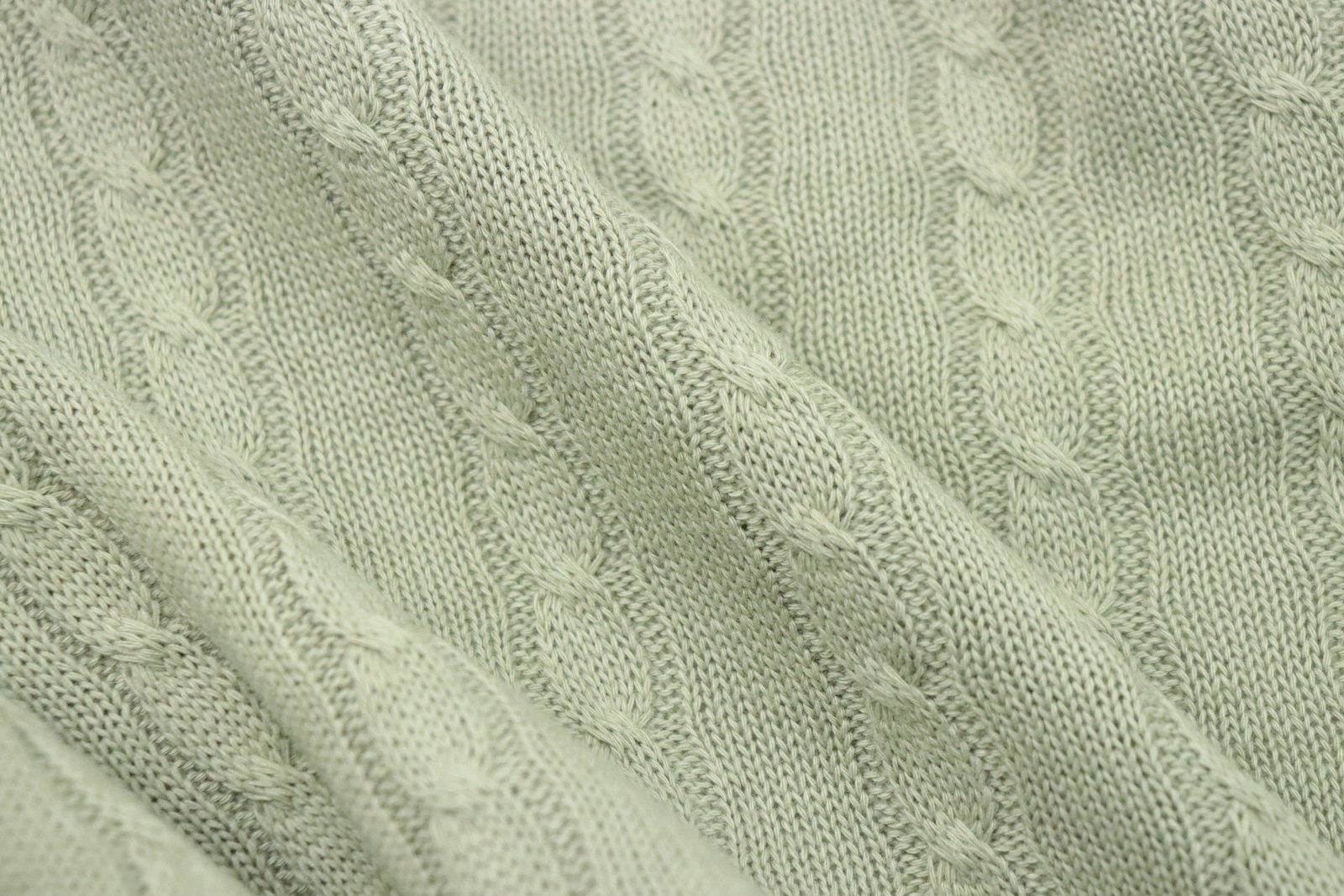
The pieces are knitwear — HADES’ medium — but pushed into territory the label hasn’t explored before. Proportions are exaggerated: sleeves that extend past the hands, hemlines that fall asymmetrically, necklines that frame the face like architectural elements. The colour palette is muted but specific — shades that suggest Scottish landscapes, institutional interiors, the grey-green of lichen on stone. There is no obvious branding, no graphic motif, no logo treatment. The garments read first as garments and only second, on inspection, as collaborative authorship. That sequence — object before label — is itself an editorial position.
Swinton’s influence is legible without being literal. She is one of the few public figures whose personal style is genuinely authored, not managed by a stylist nor dictated by brand contracts, but developed over decades as an extension of her artistic practice. Her long association with Comme des Garçons, her on-screen costume work with directors who treat clothes as architecture rather than ornament, her instinct for the colour fields and proportions of post-war European cinema — all of these inform the capsule without being quoted. That authorship translates into garments that have the same quality of deliberate oddness, the same refusal to flatter conventionally, the same confidence in asymmetry and volume.
What is unusual is how confident the collection feels at six pieces. Most fashion collaborations expand to fill the commercial expectations attached to them. This one contracts. Each garment has a clear job. There is no filler — no cap, no tote, no t-shirt riding on the strength of the headline pieces. A capsule that refuses to pad itself is a quiet act of editorial discipline, and discipline of that kind is rarer than the marketing machinery of fashion likes to admit.
The Label
HADES deserves context. Founded in 2016 by Eamonn McGill, the label produces knitwear in the British Isles using heritage techniques — hand-framing, linking, fully-fashioned construction — at a scale that sits between artisanal and industrial. The pieces are expensive because the processes are slow, not because the margins are inflated. Each garment is traceable to the machine and the operator who made it. Hand-framing in particular is the technical hinge: a flat-bed knitting frame operated by a single technician, one row at a time, capable of shaping the garment as it is made rather than cutting it from yardage. The result is fewer seams, less waste, and a garment whose silhouette is engineered into the knit itself. It is also the reason the production calendar bears almost no resemblance to a conventional fashion cycle.
The label has built its reputation on a kind of anti-fashion rigour: no seasonal drops, no trend-chasing, no influencer strategy. Growth has been organic and word-of-mouth, which means the audience tends to be people who care about how clothes are made, not just how they look. McGill has been consistent on this point in interviews — that the label’s commercial ceiling is set deliberately, by the rate at which trained framers can produce, and that the right answer to growth pressure is not to abandon the technique but to refuse the volume.
That refusal places HADES in a small but coherent group of contemporary practices that have decided, quietly, to opt out of the volume conversation altogether. Phoebe Philo’s eponymous label, launched in 2023 with LVMH backing and operational independence, runs on the same logic — small drops, no seasonal calendar, sold-out editions that the brand declines to chase with restocks. So does the broader quiet-luxury register that Loro Piana and Hermès have made commercially viable at the top of the market. HADES sits below those houses in scale but adjacent to them in posture: the assumption that scarcity is not a marketing tactic but a production fact.
This ethos makes the Swinton collaboration both surprising and logical. Surprising because HADES has never needed celebrity association to generate demand. Logical because Swinton is the rare public figure whose involvement represents a genuine alignment of values rather than a marketing calculation. She has no incentive to lend her name to a project that wouldn’t survive scrutiny — her cultural capital is entirely built on not doing that.
The Question
Notes from the Precipice raises a question that the fashion industry prefers to avoid: what would collaborations look like if the famous person had to actually work? If they had to attend fittings, discuss yarn weights, argue about proportions, compromise on colour? If the collaboration were treated as a creative process rather than a licensing deal?
The answer, based on this collection, is that the work gets better. The six pieces in Notes from the Precipice are more interesting than anything HADES has produced alone — not because Swinton is a better designer than McGill, but because the friction between two distinct sensibilities produces results that neither could reach independently. McGill’s technical knowledge of knitwear meets Swinton’s instinct for dramatic proportion. His discipline meets her willingness to push. A sleeve that extends past the hand is a small decision in isolation; in the context of a hand-framed garment, where every additional row is an additional pass at the frame, it is also a manufacturing decision, a costing decision, a wearability decision. Each of those would have been negotiated in the room. That negotiation is what the capsule documents.
The deeper structural point is that the collaboration’s six-piece scope is itself a precondition for the collaboration working. At sixty pieces it would have required a design language broad enough to populate categories — outerwear, accessories, day-to-evening progression — that neither party particularly cares about. At six, both can stay inside their respective competences and meet at the seam. There is a reason most genuine creative collaborations in adjacent fields — a small print run, an artist’s edition, a furniture capsule — converge on similar numbers. Scale forces the loss of authorship; scarcity protects it.
The Broader Shift
This is not the only collaboration this season to suggest a shift toward genuine creative partnership. Cecilie Bahnsen’s work with Alpha Industries — sculpting MA-1 and N-2B bombers into something that reads as both military and romantic — operates in a similar register. So does Sacai’s fourth collaboration with Carhartt WIP, where Chitose Abe’s deconstructive approach has been refined through repeated engagement with workwear forms. What unites these projects is duration. They are not one-off drops designed for a news cycle. They are ongoing relationships where each iteration builds on the last, where the collaborators know each other’s work well enough to challenge it rather than simply combine it.
The same logic, scaled up, is what makes Prada’s Chawan Cabinet with Theaster Gates read as a serious project rather than a sponsorship. Gates is a working ceramicist; Prada is providing the venue, the production support, and the contextual frame, but not editing the work. That is patronage in the classical sense — resources without authorship — and it shares a moral grammar with what HADES has done here, even if the scales and outputs are entirely different. In both cases, the brand’s role is to enable a body of work that could not have happened at the same fidelity inside a conventional commercial brief, and then to step back from the credit line.
The contrast with what passes for collaboration at the upper end of fashion is instructive. The dominant model — celebrity designs collection, brand executes collection, both parties split press — treats authorship as a marketing variable. Swap one celebrity for another, swap one brand for another, the underlying mechanic is the same. Notes from the Precipice is unswappable. There is no other collaborator who could have produced this exact register, and no other brand of HADES’ size and technical orientation that could have absorbed Swinton’s input without losing the thread. That singularity — the inability to be replaced by an analogue — is the test that distinguishes a genuine partnership from a merchandising exercise.
Craft as the Unspoken Argument
There is a second argument running beneath the collaboration, which is about craft. HADES sits in the same broader conversation as the Loewe Craft Prize, as Bottega Veneta’s hand-cut intrecciato work, as the Cassina–Le Corbusier reissue programme — the thread in luxury at the moment that takes seriously the idea that the slow process is the point, not a story attached to the product.
What makes HADES’ position inside that conversation distinctive is the absence of marketing language around the technique. The label talks about hand-framing in functional terms — what it allows, what it constrains, why the lead time is what it is — rather than as heritage theatre. Many luxury houses have adopted craft as a brand asset; fewer have organised their actual production around it. The Swinton capsule is, on one reading, a test of whether that organisational discipline can hold under the pressure of a celebrity collaboration, a pressure that almost always pulls toward speed, scale, and volume. The fact that the capsule is six pieces and was built on the framers’ calendar rather than the press calendar suggests the discipline held.
Swinton’s choice to work this way is also a form of argument. There is no shortage of houses that would have offered her a much larger, much more visible collaboration on much more conventional terms. She elected the smaller frame. That election is itself the editorial — a vote for the slow object over the fast campaign, for the technique over the headline.
The Verdict
Notes from the Precipice won’t sell in the quantities that a celebrity collaboration typically demands. It doesn’t need to. What it does is demonstrate that the collaboration format — overused, underinvested, frequently cynical — can still produce work of genuine quality when both parties show up with intent.
HADES and Swinton have made six garments. They are beautifully knitted, thoughtfully designed, and clearly the product of a real conversation between two people who care about making things well. In an industry drowning in collaborations, that simplicity is its own distinction. The capsule’s quietness — the absence of campaign theatrics, the refusal to expand, the insistence on the framers’ time rather than the press cycle’s — is what makes it credible. It is also, as a model, almost impossible to scale. That is part of the argument too. Not every good idea needs to be repeatable. Some are only good because they happened once, between these two parties, at this size, on these terms.
The deeper takeaway, for designers and editors watching the format wobble, is that the collaboration as a genre is not exhausted; the celebrity-licensing version of it is. There is still a way to do this in which both names on the label correspond to hands in the work. Notes from the Precipice is small enough to be that way and confident enough to insist on it. Six garments, two authors, no filler. The format, properly used, still has something to say.
The HADES x Tilda Swinton ‘Notes from the Precipice’ collection is available through hfrankades.com and select retailers.