Prada’s annual presence at Milan Design Week has always been more intellectually ambitious than most fashion brands. While competitors build immersive brand worlds and photograph-ready installations, Prada runs Prada Frames — a symposium on the relationship between natural environment and design that produces more thinking than content. It is an unusual strategy for a luxury house founded in 1913, and it works precisely because it does not try to sell anything. This year, alongside the symposium, Prada presents Chawan Cabinet — an exhibition of ceramic tea bowls crafted by Japanese potters and curated by Chicago-based artist Theaster Gates, one strand of Japanese design at Milan Design Week 2026. It is the most restrained and, ultimately, the most powerful fashion-house presentation in Milan this April.
The Object
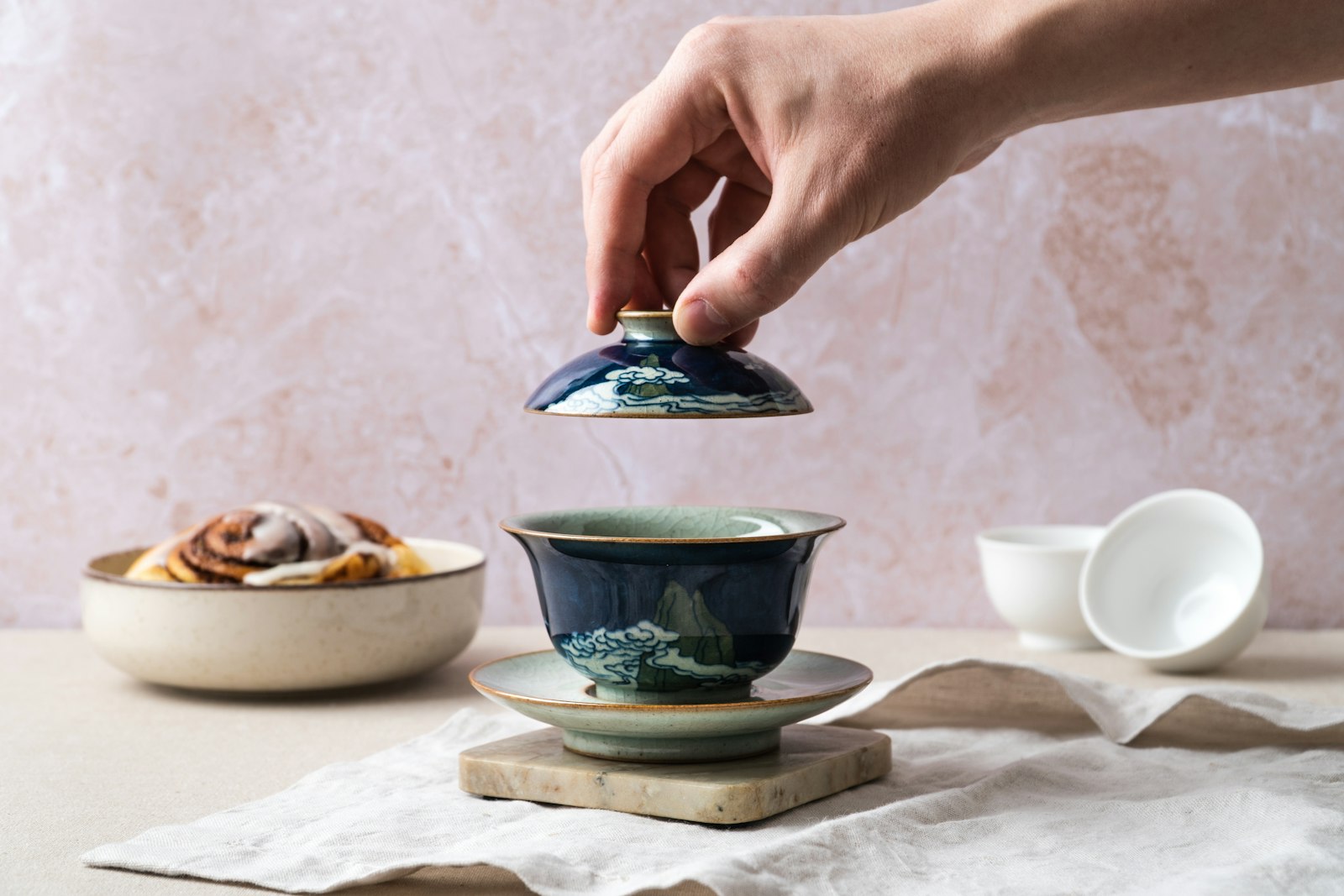
A chawan is a tea bowl. In the Japanese tea ceremony, it is the most important utensil — the object that passes from host to guest, that holds the tea, that is examined, appreciated, and discussed. A great chawan is valued not for perfection but for character: the unevenness of the glaze, the asymmetry of the form, the evidence of the maker’s hand and the kiln’s fire. The bowl is held with two hands, rotated so its decorated face is turned toward the guest, and after drinking it is examined as carefully as any work of art. The vocabulary used to discuss a chawan is closer to architectural criticism than to product description. Foot, lip, wall, interior. The tea ceremony, in this reading, is a piece of design pedagogy disguised as hospitality — a slow lesson in how to look at a single object made by a single hand.
Gates, born in 1973, trained as a ceramicist before becoming one of the most important contemporary artists working today. His practice moves between sculpture, installation, urban planning, and craft, but clay has remained central — the material through which he thinks about history, race, labour, and beauty. The same instincts that shape the chawan exhibition have, since 2009, produced a sustained Chicago South Side cultural patronage practice of acquired buildings and archives that now runs from the Dorchester Projects to the Stony Island Arts Bank. He has spent extended periods in Japan working with potters in established kiln traditions, and the chawan has been a recurring subject of his attention for years. To bring those years of relationship into a Milan exhibition is not to import an idea; it is to allow a long-running practice to surface in public.
The Exhibition
Chawan Cabinet presents a collection of bowls crafted by Japanese potters with whom Gates has collaborated over several years. The installation is deliberately simple. The bowls are displayed in a wooden cabinet — the kind of utilitarian storage furniture you might find in a potter’s studio — against a spare backdrop that draws attention to the objects themselves. Lighting is even and unflattering by exhibition standards; there are no plinths designed to dramatise the work, no vitrines that turn the bowls into relics behind glass. The cabinet is a piece of equipment from a working life, and the bowls are arranged in it the way a maker would store them at home.
There is no spectacle. No immersive lighting. No soundtrack. No branded anything. Prada’s name appears at the entrance and nowhere else. The effect is of entering a space where the usual rules of Design Week — the loudness, the competition for attention, the relentless brand presence — have been suspended. Each bowl is accompanied by minimal information: the potter’s name, the clay body, the firing technique. The curatorial approach trusts the viewer to look — really look — at an object that fits in the palm of a hand. In a fair where scale is currency and where the dominant gesture is to fill a palazzo with something photogenic, this intimacy is radical.
What the cabinet does, formally, is to refuse the exhibition’s usual hierarchy of gestures. There is no entrance moment, no climax wall, no exit through a gift shop. The cabinet sits where you find it. You walk to it. You bend slightly. You see twenty or thirty bowls — fewer than would be in a working potter’s storage at any given moment — and you are left to make sense of why these and not others. The decision-making is handed back to the maker, where it belongs. Prada’s contribution is the conditions under which that decision becomes visible.
The Statement
What makes Chawan Cabinet significant is what Prada chooses not to do. The brand does not reinterpret the chawan. It does not commission Gates to create a Prada-branded tea ceremony. It does not use the exhibition as a platform for a product launch or a lifestyle proposition. There is no capsule. There is no limited edition. There is no co-signed merchandise at the door. Prada simply provides the context — the space, the funding, the audience — for an artist to present work that matters to him.
This is patronage in its most classical form, and it is vanishingly rare in contemporary fashion. Most fashion-meets-art projects are collaborations in name only — the artist provides credibility, the brand provides visibility, and the result serves both parties’ marketing interests in roughly equal measure. The artwork ends up legible primarily as content. Prada’s relationship with Gates, and with the cultural programming the house has funded for years through its Fondazione, operates on a different premise. The brand gains association with serious cultural work without demanding that the work reference the brand. The trade is clean: visibility for the maker, reputation for the patron, and a body of work that is whole on its own terms regardless of who paid for the room.
It is worth being precise about why this matters. Patronage is not philanthropy. The Medici did not fund Brunelleschi out of charity, and Prada is not funding Gates out of altruism. Patronage is a long-term cultural position taken by an institution that has decided its identity is bound up with the production of certain kinds of work. The institution accepts that the work belongs to the maker, that the work may not be flattering, and that the value of the relationship is measured over decades, not seasons. That is the bet Prada is making, and it is one almost no other house in luxury is currently willing to make.
The Craft Question
There is a larger conversation here about fashion’s relationship with craft. Luxury houses have always claimed craft as part of their identity — the atelier, the artisan, the hand-finished detail. But the craft they celebrate is typically their own: leather-working, tailoring, embroidery, the in-house techniques that justify the price tag and underwrite the marketing. The crafts of other traditions — ceramics, woodworking, textile weaving outside the European studio — are borrowed for inspiration but rarely supported on their own terms.
Gates’s ceramics practice exists entirely outside the fashion system. The potters he collaborates with in Japan work within traditions that predate the modern luxury industry by centuries — kilns whose lineages run back through generations of named makers, glaze recipes passed down within families, firing schedules tied to seasons rather than to fashion calendars. By exhibiting their work without subordinating it to a fashion narrative, Prada acknowledges that some forms of making are not raw material for brand storytelling. They are complete in themselves, and they were complete long before any luxury house existed to notice them.
The contrast across this year’s Milan programme is instructive. Hermès, at La Pelota, presents Les Mains de la Maison — a celebration of its own artisans, a logical extension of brand identity built around saddlery and leather. Bottega Veneta’s Casa at Via San Maurilio 14 makes intrecciato — the diagonal, four-millimetre-wide woven leather technique it has used since 1966 — into a full architectural language. Both are excellent presentations of houses pulling craft inward, presenting it as proprietary capability. Chawan Cabinet does the opposite. It points outward. It says: there is craft we do not own, that we will never own, and our role is to make it visible without claiming it. That is a different posture, and a much harder one to sustain commercially. It also happens to be the posture craft itself most needs.
The same distinction sits at the heart of the LOEWE Foundation Craft Prize, founded in 2016 under Jonathan Anderson, which awards an annual prize to a working craftsperson chosen from an open international call. The Loewe model and the Prada model are not the same — the prize structure formalises support, and the maker is selected by a jury rather than by a single artistic interlocutor — but they share the principle that a luxury house can use its capital to underwrite makers it does not employ. That principle is now visible enough across the European luxury system to be called a movement. It is, importantly, a recent one.
The Patronage Position
If you stand back from the Chawan Cabinet and consider what Prada is actually doing across its cultural footprint, a coherent strategy emerges. Prada Frames convenes architects, scientists and writers to think publicly about the ecology of design, with no obligation to produce anything that references the brand. The Fondazione Prada commissions exhibitions whose intellectual lineage runs through art history, not through fashion. The same instinct runs through the house’s architectural patronage — the twenty-five year OMA fashion retail practice from the 2001 Prada Epicenter at 575 Broadway onwards — where Miuccia Prada and Patrizio Bertelli have backed Koolhaas’s argument that a store can be a public room rather than a brand surface. Chawan Cabinet sits within this same logic. The brand has built, over years, an institutional capacity to host work that is not about it.
This is rarer than it sounds. Most luxury patronage in 2026 still operates on the campaign model: the artist makes a thing, the brand attaches a logo, the result is photographed and distributed as content. The financial relationship is real but the cultural relationship is thin, and at the end of the cycle there is nothing left except the campaign. Prada’s model produces durable artefacts — symposia transcripts, archives, exhibitions documented for the historical record — that remain valuable when the season ends. That durability is the actual luxury good being manufactured. It is also why the brand can afford to keep its name out of the room: the asset is the long position, not the moment.
This same instinct surfaces in Phoebe Philo’s first object, the bronze mirror cast at Fondazione Battaglia, where a fashion designer chooses to enter the design conversation through the historic foundry that handled Manzù and Pomodoro rather than through a furniture brand. The vocabulary is different, but the strategic move is the same. Treat craft as a real institution with its own history and authority, rather than as a service hired to produce content.
The Vessel and the Viewer
Walk slowly through Chawan Cabinet and the show begins to do something the rest of Design Week cannot. It slows you down. The objects are too small for distance viewing. You have to step close. The differences between bowls — the way one carries a thicker rim, the way another’s foot has been trimmed at a sharper angle, the way the glaze breaks over an edge — only resolve when you are within reading distance. This is the chawan’s native scale, and it is the inverse of the fairground scale that defines most of the Salone del Mobile circuit, where work is built to read at thirty paces under camera light.
The crowd in the room reorganises itself accordingly. People do not pose in front of these bowls. They look. They lean in. They talk, when they talk at all, in lower voices than they would in a brand activation across town. There is a discipline being asked of the viewer, and the viewer mostly accepts. That alone is a victory. Most luxury exhibitions in Milan during Design Week assume an audience moving at velocity through a phone screen. Chawan Cabinet assumes the opposite, and is rewarded with the seriousness it asks for.
The gesture is also continuous with how the chawan operates in the tea ceremony itself, where a guest is expected to handle the bowl, to comment on it, to know who made it. By translating that protocol into an exhibition, Gates is not orientalising the form — he is preserving its argument. This is an object made to be considered. The show simply restages the conditions under which considering it is possible.
The Verdict
Chawan Cabinet is a small exhibition. You can see it in fifteen minutes. Most visitors to Design Week will walk past it in search of larger, louder things, and they will be poorer for it. For those who stop — who stand in front of a tea bowl and consider the hands that shaped it, the fire that hardened it, the centuries of practice that inform its imperfections — the experience is one of the most genuinely moving at this year’s fair. It is also one of the few that survives translation away from the venue. You can describe it in a sentence and the sentence does not become marketing copy. That, in 2026, is the test of a serious cultural project.
Prada does not need Design Week to sell clothes. What it does at Design Week, consistently, is demonstrate that a fashion house can engage with culture without consuming it. The exhibition’s restraint is not a stylistic preference; it is a structural decision about how the house relates to the work it underwrites. Chawan Cabinet is the clearest expression yet of that principle, and it sets a standard the rest of luxury has been reluctant to match. The bowl, held in two hands, asks more of the viewer than any of the season’s larger statements. That asking is the show.
Prada Chawan Cabinet is on view during Milan Design Week, April 21–26.