Phoebe Philo’s eponymous label, since launching in late 2023, has been notable for what it has refused to do. There has been no celebrity dressing strategy, no influencer programme, no seasonal calendar that aligns with the established fashion week structure. The drops have been irregular, the communications have been minimal, and the work has spoken — to the extent that it has spoken at all — for itself. This week’s release continues the pattern, but extends it into a new category. The first non-clothing object from the label is a bronze mirror, hand-cast in Italy, available in a single edition of 200 pieces. It went live on the Phoebe Philo website on Tuesday at 10am London time. It was sold out by 2pm.
The four-hour sell-through is the headline, but it is the least interesting fact about the release. The interesting facts are: that the label chose a mirror as its first object rather than a candle, a tray, a vessel, or any of the usual fashion-into-homeware entry points; that it chose bronze rather than ceramic or glass; that it cast the piece at a Milanese foundry whose ledger includes Marini and Fontana; and that it priced the object at £4,800 with no marketing apparatus to justify the number. Each of these decisions is legible. Together they describe a quiet, deliberate move by one of the most disciplined operations in contemporary fashion into a category — domestic objects — that has become, in 2026, the terrain on which luxury houses now compete for cultural authority.
The Object
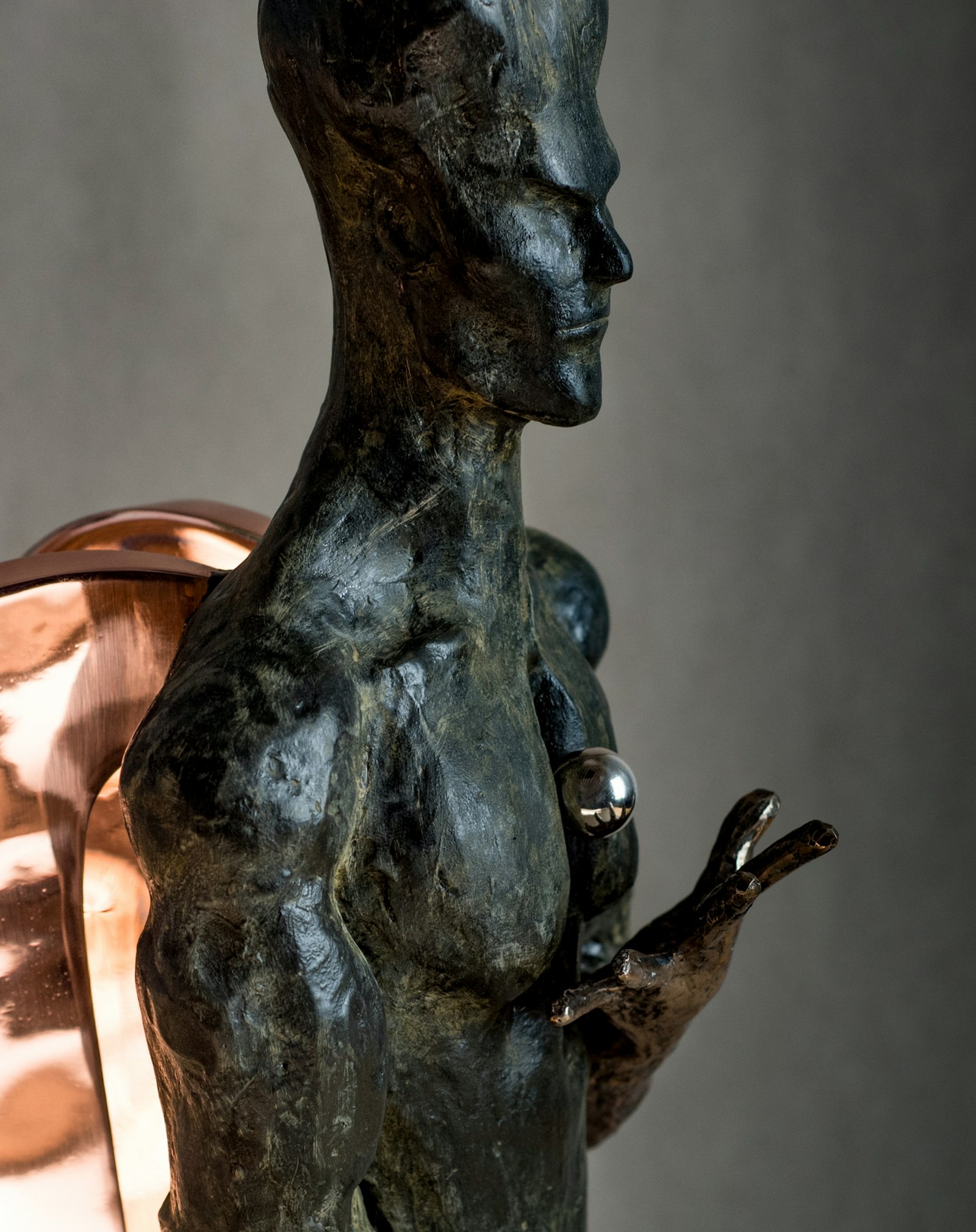
The mirror is small — roughly 28 centimetres in diameter — and shaped as an irregular oval, slightly asymmetrical, with the cast bronze visibly showing the marks of its making. The reflective surface is mercury-silvered, which produces a softer, warmer image than conventional mirror coating. The back is unpolished bronze, with a small hand-stamped Philo cipher.
The piece is sold without instructions for hanging or displaying. It comes in a fitted wool felt pouch, hand-stitched, with a single handwritten card noting the edition number and the foundry where it was cast — the Fondazione Battaglia in Milan, which has cast pieces for Marino Marini and Lucio Fontana, among others. The choice sits inside the larger fashion-exits arc of designers turning patronage and craft institutions into a second medium. There is no other documentation, no styling suggestion, no instruction in how to use it.
This is, of course, very Philo. The object is presented as if its existence is self-explanatory. The buyer is trusted to know what to do with it. If they don’t, the implicit suggestion is that they shouldn’t have bought it. The same logic governs the label’s clothing: the catalogue images are flat, the model is rarely identified, the captions describe fabric and cut and nothing else. The reader either understands the proposition or doesn’t. There is no concession to the latter.
What separates this from mere austerity is the material decision. A mirror is, by definition, an instrument for looking at oneself. To make that instrument out of cast bronze — a material associated with sculpture, with mid-century interiors, with Marini’s horses and Fontana’s spatial concepts and the Lalanne menagerie that just set a $33.5M auction record — is to displace the object away from cosmetic utility and into something closer to a domestic sculpture that happens to reflect. Mercury silvering, which is older than modern mirror coating and more difficult to produce, reinforces the displacement. The reflection is not a clear image but a softened one — an image of looking, rather than a clean look.
The Foundry
The choice of Fondazione Battaglia is worth examining on its own. Battaglia is a Milan foundry whose archival client list includes Marino Marini and Lucio Fontana, among others; a label commissioning its first object there, rather than at a generic luxury workshop, is making a positioning statement about lineage. The foundry has the technical capacity to handle work at a serious scale, which means the mirror is unlikely to be the limit of what the relationship will produce. The handwritten card naming the foundry is therefore not a courtesy. It is a credential.
This pattern — fashion houses commissioning at workshops with twentieth-century art-historical pedigree — is increasingly the way the sector signals seriousness about objects. Hermès’ Les Mains de la Maison leans on saddle-stitched leatherwork that the house has been producing since 1837. Bottega Veneta Casa, under Matthieu Blazy, anchors itself to a single intrecciato daybed cut from a 4-metre piece of woven calfskin. Prada’s Chawan Cabinet, curated by Theaster Gates at Milan Design Week 2026, displaces the brand entirely and lets ceramics do the talking. The Philo mirror sits within this register. It is the work of a foundry, not a marketing department.
The Price
The mirror retailed at £4,800. This is, by any rational measure, an enormous price for a small bronze mirror. It is also entirely consistent with the label’s pricing strategy across its clothing — pieces priced at the absolute high end of the luxury market, with no discount programme, no seasonal sales, and no apparent interest in expanding the customer base. The number is also consistent with the operational logic of an edition of 200. Two hundred pieces at £4,800 is roughly £960,000 of gross revenue. This is not a meaningful number for a label of this scale, which clarifies what the mirror is for. It is not a revenue line. It is a positioning device.
What this strategy demonstrates is that Philo has built a business that does not require volume. The label is privately held, with backing from LVMH but operational independence — a structure the graph notes as minority-backed and operationally independent — and the financial structure clearly does not depend on producing and selling at scale. This is rare in contemporary fashion, where almost every label of comparable cultural visibility is structured around growth. LVMH’s other holdings — Louis Vuitton, Dior, Loro Piana — operate at volume. Philo is the LVMH portfolio’s experiment in the opposite direction: a label deliberately structured around scarcity, run by a designer with the cultural capital to make scarcity work.
The freedom this provides is visible in the work. Pieces that would not survive a commercial filter — a coat priced at the absolute high end, a cashmere sweater similarly placed, trousers that would be unthinkable in a buyer’s open-to-buy at any other house — are produced because the label can afford to produce them. The mirror, at £4,800, is consistent with this approach. It is what the label does when it is not optimising for anything.
The Pattern Across Houses
The mirror does not appear in isolation. It arrives in a year — 2026 — that has been defined, more than any single year before it, by fashion houses moving into objects, interiors, and architecture. Milan Design Week 2026 functioned as an extended demonstration of this. Gucci’s Memoria at the Basilica di San Simpliciano put twelve domestic objects in distressed Gucci materials inside a fourth-century Romanesque basilica — Demna Gvasalia’s first design-world statement at Gucci. Louis Vuitton’s Objets Nomades returned to Palazzo Serbelloni with new pieces by Studio Mumbai’s Bijoy Jain, India Mahdavi, and GamFratesi, extending a furniture programme that has been running since 2012. Loro Piana opened Casa Brera — a four-floor nineteenth-century townhouse on Via Solferino restored by Vincenzo De Cotiis, programmed by Federica Sala — placing the brand’s home collection alongside Carlo Scarpa, Charlotte Perriand, and African and Japanese folk furniture.
The Philo mirror is the smallest gesture in this group. It is also, in some ways, the most precise. Where the other houses have built spaces, opened residences, and staged exhibitions, Philo has produced a single object and sold it on a website. The economy of the gesture matches the economy of the work. There is no palazzo, no curator-of-record, no architect-of-record other than Battaglia’s craft tradition. The mirror is the minimum viable expression of fashion-into-design, and the fact that it sold out in four hours suggests the minimum is enough when the underlying brand has already done the cultural work.
What It Suggests
The release of the mirror is interesting less as a product than as a signal. It suggests that the label is preparing to expand into homeware, or at least into objects that exist beyond clothing. It also suggests that this expansion will follow the same logic as the clothing: small editions, exceptional materials, prices that exclude most of the market, no marketing infrastructure.
Several signals support this reading. The website was quietly updated last month with a new category labeled “Pieces” — initially empty, now containing only the mirror. The label has posted job listings in recent weeks for product designers with experience in furniture and lighting. And the Battaglia foundry, where the mirror was cast, has the capacity to produce furniture-scale work — chairs, tables, lighting, larger sculptural pieces — should the label choose to commission them.
If Philo does extend into furniture, lighting, or larger domestic objects, it will be one of the more interesting fashion-into-design moves of the decade. The label’s design sensibility — restrained, materially serious, allergic to obvious branding — translates well to the home category. And the customer base, which has demonstrated willingness to spend significantly on clothing, is likely to follow. The Bottega Veneta Casa precedent is instructive: editions of 100 or fewer, a permanent gallery rather than a pop-up, and a pricing logic that locates the work in the collectible-design market rather than in the showroom. Philo would not need to copy this. It would only need to find its equivalent.
Quiet Luxury Without the Term
The mirror also clarifies what “quiet luxury” actually means when the term is applied with discipline. The phrase has been overused since 2023 — pinned to anything beige, anything logo-free, anything photographed against a stone wall. Two labels have earned the term in the operational sense rather than the aesthetic one: Loro Piana, whose business is genuinely built on textile intelligence rather than logo equity, and Phoebe Philo, whose label refuses to perform for an audience.
Quiet luxury, properly understood, is not an aesthetic. It is a structural decision about what to optimise. Loro Piana optimises for fibre — which animal, which valley, which spinning mill — and the aesthetic follows. Philo optimises for the designer’s editorial standard — what the work is, not how it photographs — and the aesthetic follows. The mirror is the clearest object expression of this so far. It is small, materially serious, expensive, hard to photograph well, and indifferent to whether it ends up on Instagram. A piece designed to be looked at in person. A piece, almost defiantly, not designed for the algorithm.
The Cultural Position
What Philo has achieved, more broadly, is the rare fashion label that operates as a cultural institution rather than a commercial brand. The work is referenced in critical writing, exhibited in museums, discussed in terms usually reserved for art. The label has acquired the kind of cultural weight that most brands chase for decades and never achieve. This weight is partly inherited — Phoebe Philo’s tenure at Céline from 2008 to 2018 is the foundational decade of contemporary quiet luxury, and the label benefits from the unfinished business of that period — but it is also actively maintained. The refusal to participate in the seasonal calendar, the refusal to produce content for content’s sake, the refusal to treat the label as a marketing apparatus: these refusals compound.
The mirror demonstrates that this weight transfers across categories. A bronze mirror from any other label, at this price, would struggle. From Philo, it sold out in four hours. The brand value, in other words, is not specific to clothing. It is portable. This is the quality that LVMH presumably saw when it took its minority stake — the capacity of a single designer’s editorial authority to extend across categories without dilution — and it is the quality that explains why the mirror was a sensible first object even though, on paper, mirrors are an odd category for a label to enter.
Whether this portability is something Philo wishes to monetise systematically — through a sustained homeware programme, through licensing, through expansion — is the question that the next year will answer. The label has shown no interest in licensing. It has shown sustained interest in production. The middle path, a small homeware line built around bronze, leather, wool, and the same workshops that already supply the clothing, is the most plausible direction. It is also the direction that would distinguish Philo from the fashion-into-design field as it currently stands. Where Bottega Veneta has built a gallery, where Loro Piana has restored a townhouse, where Louis Vuitton runs a programme that commissions external designers — Philo could simply extend the label, on its own terms, one object at a time. A homeware line as quiet as the clothing.
Coda
The mirror is, by itself, a single object: 28 centimetres of cast bronze, mercury-silvered, sold in a wool felt pouch with a handwritten card. It is also, almost certainly, a test — of whether the label’s cultural authority transfers, of whether the customer base will follow, of whether the operation can produce objects at the standard the clothing has set. The four-hour sell-through answered the first two questions. The third will be answered, slowly, over the next several years, in the form of objects that the label has not yet announced and may not announce in the conventional sense at all. The next one will arrive, as this one did, without warning. It will be sold out before most people know it exists. And the question it answers will be the same question the mirror answered: whether a label can hold the line — small editions, exceptional materials, no marketing apparatus, no concession — across the full surface of a domestic life. The mirror suggests it can.
The Phoebe Philo bronze mirror is sold out. The label has not announced when, or if, future objects will be released.