The carlo mollino zanotta archive deal is now public, dated, and contractually shaped. On 15 April 2026, Italy’s Agenzia del Demanio — the state property agency that manages Carlo Mollino’s artistic heritage on behalf of the Italian State — announced the outcome of a public tender awarding Zanotta the exclusive industrial-design licence on a selected group of 30 Mollino projects, sourced from drawings held in the Fondo Carlo Mollino at the Politecnico di Torino. The licence runs through 2043. Seven of the 30 designs were already in Zanotta’s catalogue under earlier tribute editions; the other 23 have not been reissued since their original mid-century versions. The first to enter serial production is the 1950 Vertebra table, unveiled at Zanotta’s Milan flagship during Milan Design Week 2026.
That is the deal. The structural arguments — how a state agency arrived at a public tender for a designer’s intellectual property, why the Politecnico’s 17,000-drawing archive made the engineering tractable, and what the 20% revenue-share clause does for Italian university archives that hold similar holdings — are the part that will travel.
Agenzia del Demanio, 15 April 2026
The Demanio announcement is short on rhetoric and long on procedure. The agency, which holds Mollino’s intellectual property on behalf of the Italian State, ran a public procurement tender for the industrial-design use rights on a defined group of 30 Mollino projects. Zanotta was the winning bidder. The licence — exclusive, for industrial-design exploitation, on the 30 named designs only — runs until 2043, giving the winner a seventeen-year window from announcement.
The procurement route is what makes the deal unusual in the European archive-licensing context. The standard template, set by Cassina’s 1965 LC Series agreement with the Fondation Le Corbusier and replicated across the mid-century archive revivals of 2026, is a bilateral negotiation between a single manufacturer and either a private foundation or a designated set of family heirs. The Mollino case routes the same outcome — a manufacturer-of-record with a multi-decade horizon — through a state procurement process. The bidder field, the technical and economic scoring, the award and the appeal window all sit on a procurement record, not a private contract.
Two preconditions made that route possible. The first is that Mollino’s intellectual property is held by the Italian State at all, an outcome that took shape after the architect’s death on 27 August 1973 and that consolidated Mollino’s rights into a single public-sector counterparty. The second is that the drawings themselves sit, physically, in a university holding — the Fondo Carlo Mollino at the Politecnico di Torino — that is statutorily required to keep the material accessible. Without the Politecnico holding, there would be nothing to source the licensed designs from. Without the Demanio rights consolidation, there would be no single counterparty to award them through.
What 7 became 30
Zanotta’s catalogue has carried Mollino tribute pieces, on and off, for decades. CEO Luca Fuso, in framing the announcement, was explicit that the 2026 licence is continuous with that earlier history rather than a clean break from it: seven pieces were already being produced under narrower agreements that did not amount to a full licence on Mollino’s name. The new tender converts those seven into part of a 30-design programme and adds 23 designs that have not been reissued since Mollino’s original commissions — most of them executed by Apelli & Varesio or by the joinery attached to Casa Mollino, on a one-off or near-one-off basis, between the late 1940s and the early 1960s.
Six of the new pieces beyond the Vertebra were presented alongside it at Milan Design Week 2026, in a staged reading-room arrangement at Zanotta’s Milan flagship: the Ardea CM armchair, the Fenis CM chair, the Gilda CM armchair, the 1949 Arabesco CM table, the Reale CM table and the Milo CM mirror. The “CM” suffix is the licensing convention — Carlo Mollino as the named author, with the suffix attached to typology names that have circulated for decades in the dealer market and the secondary-market literature without consistent attribution. The suffix is small print, but it is the part that converts dealer-market shorthand into a catalogue line.
The table below sets out the structural split between the seven tribute pieces and the 30-design programme. The first column lists the seven Mollino pieces that have appeared in Zanotta’s catalogue at various points under earlier tribute editions; the second column lists the seven pieces released or named at the Milan Design Week 2026 launch (the Vertebra plus the six MDW companions), with the remaining 16 designs in the 30-piece programme still to be sequenced over the licence period through 2043.
| Slot | Already-produced tribute pieces (7) | Pieces named at MDW 2026 (7 of 23) |
|---|---|---|
| 1 | Gilda armchair (earlier tribute edition) | Vertebra table (1950) — first serial-industrial release |
| 2 | Ardea armchair (earlier tribute edition) | Ardea CM armchair (relaunch under licence) |
| 3 | Fenis chair (earlier tribute edition) | Fenis CM chair (relaunch under licence) |
| 4 | Arabesco table (earlier tribute edition) | Gilda CM armchair (relaunch under licence) |
| 5 | Reale table (earlier tribute edition) | Arabesco CM table (1949) — relaunch under licence |
| 6 | Milo mirror (earlier tribute edition) | Reale CM table (relaunch under licence) |
| 7 | Casa del Sole-derived seating tribute | Milo CM mirror (relaunch under licence) |
| 8–30 | — | 16 further unreissued designs to be sequenced through 2043 |
The point the table makes visible is that the MDW 2026 launch is not entirely a “new” event — five of the six companions to the Vertebra are typologies Zanotta had already been producing, now reset on the formal licence — but the Vertebra itself is. So is the 23-piece backlog. The licence converts a partial, ad-hoc tribute history into a full archive programme with a known endpoint.
Vertebra (1950) finally goes serial
The Vertebra table is the piece that justifies the announcement timing. Mollino designed it in 1950; until April 2026 it had been realised in two examples only, both of which entered the auction market and were sold there. There has never been a serial-industrial production of the Vertebra; the design, like most of Mollino’s furniture, was conceived for a specific room and a specific client, with a sinuous, skeletal structure that Mollino framed as furniture-as-anatomical-extension. The dimensions, the timber selections and the joinery sequence all sit in the drawings at the Politecnico; the engineering job is to convert that one-off specification into a Zanotta production line without losing the formal idea.
Zanotta debuted the production Vertebra at its Milan flagship during Milan Design Week 2026, alongside the six MDW companion pieces. The choice of venue — the brand’s own retail space rather than a Salone del Mobile stand or a Fuorisalone palazzo — is part of the framing. The Vertebra is presented as the inaugural piece of a multi-year programme rooted in the flagship’s permanent staging, not as a fair-week novelty. The other six Mollino pieces in the staging read against the Vertebra; the Vertebra reads as the proof of concept.
The economic logic of the Vertebra reissue is the logic of every manufacturer licence in the mid-century archive revivals 2026 cluster. The auction market sets the upper reference — the two original Vertebrae are priced as unique objects, and Mollino’s Casa Orengo desks have cleared seven figures at Phillips and Christie’s since 2018. The Zanotta licence sits well below that reference and converts archive scarcity into catalogue access. A Zanotta Vertebra at industrial scale will never approach the auction reference; that is the point. The catalogue access is what the manufacturer is paying for, and what the licensor — Demanio, on behalf of the Italian State — is selling.
Fondo Carlo Mollino, Politecnico di Torino
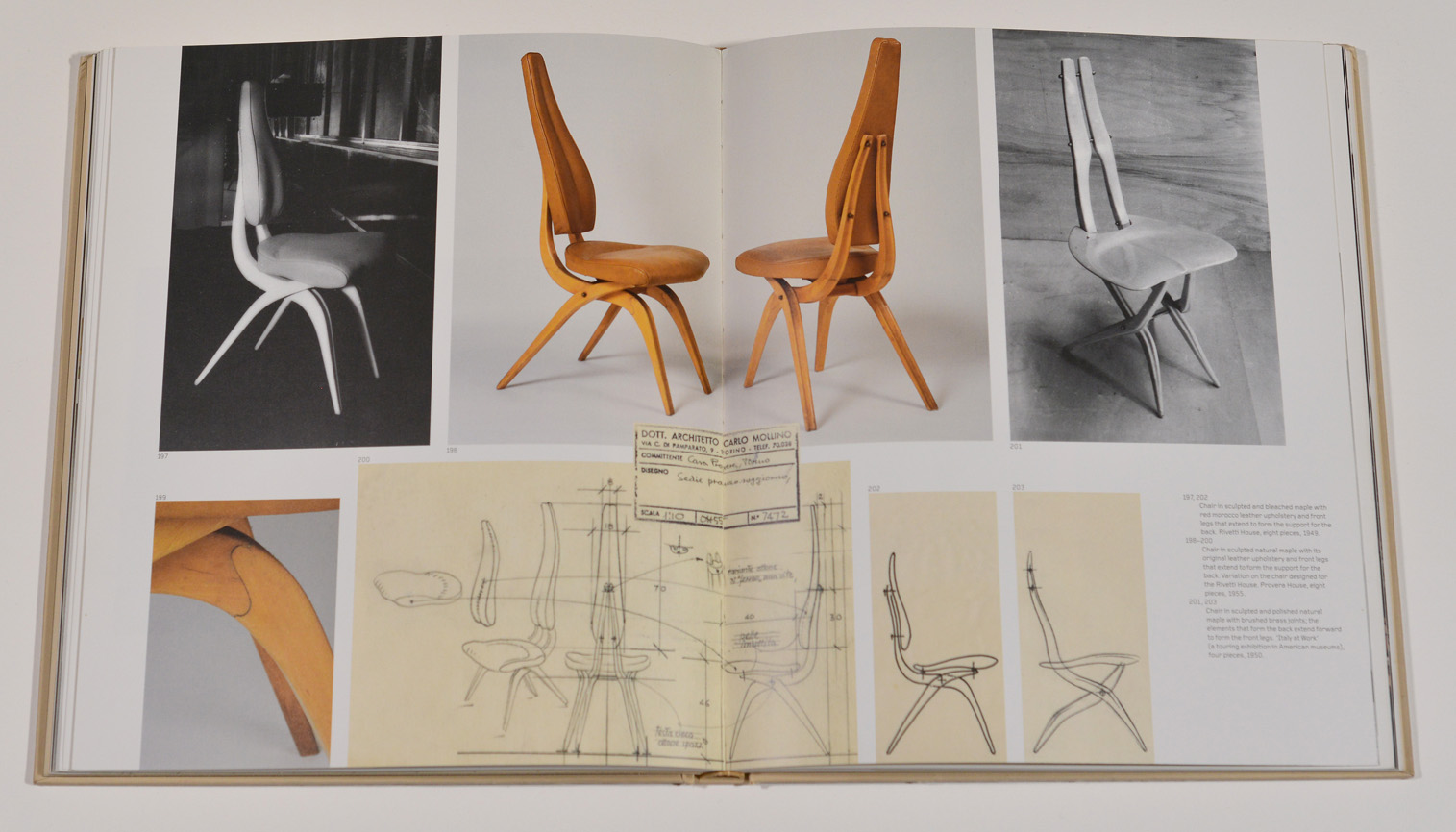
The reissue is tractable because the archive is intact. The Politecnico di Torino has held the Fondo Carlo Mollino since 1973, the year of Mollino’s death. The holding comprises roughly 17,000 graphic plates, working drawings and sketches; around 15,000 photographs; and more than 70 folders of writings and correspondence — assembled across Mollino’s working life and consolidated, at the Politecnico’s Faculty of Architecture where he had taught as full professor from 1953, into a single research archive. It is, by volume, the most thorough single-architect furniture archive in Italian hands.
That depth matters for the licence in two concrete ways. The first is that the engineering work for the Vertebra is a question of pulling the correct sheet, not of reconstructing a lost drawing from photographs or dealer-market measurements. The Politecnico holding contains Mollino’s own dimensioned plates for the Vertebra and the Arabesco; the Zanotta production line can be drawn against the originals. The second is that the 23 unreissued designs in the licence are scoped against an archive that already contains them. The Demanio tender did not need to define the 30 designs in the abstract; it was able to define them by reference to drawings the Politecnico physically holds.
The Politecnico’s institutional position in the deal is the part that is easy to miss. The university is not the licensor — Demanio is — but it is the custodian, and the agreement is structured to keep it that way. The Politecnico retains perpetual free use of the archive for conservation and teaching purposes; the manufacturer licence does not contract over the academic use of the material. Mollino taught at the Faculty of Architecture for two decades; the Fondo is, among other things, a teaching resource, and the 2026 deal preserves that function rather than displacing it.
The 20% clause
The numerical detail in the agreement that travels furthest is the revenue-share. The Politecnico di Torino receives 20% of the rights revenue Agenzia del Demanio earns from market licences on the Mollino corpus — including, directly, the Zanotta licence. That percentage flows back to the university that holds the archive, in exchange for the conservation, cataloguing and access work the Politecnico is statutorily required to provide.
The clause does two things at once. The first is operational: it funds the Politecnico’s ongoing custodianship of the Fondo. Conservation of 17,000 drawings, 15,000 photographs and 70 folders of correspondence is an indefinite cost; pinning a percentage of the licence revenue to the holding institution turns a state-budget question into a contractual revenue stream. The second is structural: it sets a template. Italian universities and research institutions hold a substantial volume of twentieth-century architectural and design archives — Gio Ponti’s papers at the Triennale, the Carlo Scarpa material at MAXXI and the Università Iuav di Venezia, the Castiglioni archive at the Triennale’s Fondazione, the BBPR papers at the Politecnico di Milano. None of those holdings is structurally identical to the Fondo Mollino, but the 20%-to-the-archive-holder clause is a model the relevant ministries can copy.
It also resolves a chronic friction between archive custodians and rights-holders. The custodian — typically a university — bears the conservation cost; the rights-holder — typically heirs, a foundation, or in the Mollino case the state — collects the licence revenue. Without an explicit share, the custodian is asked to subsidise the rights-holder’s commercial activity out of academic budget. The 20% clause inverts that. It treats the archive as a productive asset whose returns flow, in part, back to the institution that produces them.
The carlo mollino zanotta archive in the licensing landscape
Read against the broader 2026 cluster, the carlo mollino zanotta archive sits closest, structurally, to the Chandigarh furniture licence with Cassina — both are programmes in which a manufacturer with industrial capacity converts a mid-century practice that had been produced one-off, on site, by joiners or public-works workshops, into a serial catalogue line under a defined rights regime. The differences are diagnostic. Cassina’s Jeanneret line runs through the iMaestri programme it opened in 1964 and through licences from the Jeanneret heirs; the Mollino line runs through a state agency and a public tender. The Cassina template is reproducible by other private foundations and other family heirs; the Mollino template is reproducible by other ministries holding the intellectual property of state-employed architects. Both can scale. Neither can replace the other.
The third reference point — the Lalanne suite that cleared $33.5M at Sotheby’s New York on 22 April 2026 — sits at the other end of the spectrum. The Lalanne archive is closed at the foundry; there is no manufacturer licence in the chain, and the secondary market is the only market. What the Lalanne result does for the Mollino tender is set the upper reference for archive material that has not been opened to industrial production. The Mollino Vertebra at Zanotta will never approach a Lalanne mirror at Sotheby’s, but the gap is what the licence economics depend on. The two original Vertebrae sold at auction define the ceiling; the Zanotta-Demanio licence defines the floor; the catalogue is the corridor between them.
Mollino’s own catalogue history is part of why the licence took until 2026 to land. The architect was idiosyncratic on every axis that makes archive licensing easy. He drew for himself and for specific commissions — the Casa Devalle (1939), the Casa del Sole at Cervinia (1947–55), the Lutrario ballroom in Turin (1959), the Camera di Commercio (1965–73), the Teatro Regio di Torino (1965–73) — and most of the resulting furniture was executed by Apelli & Varesio or by Casa Mollino’s own joinery rather than by a manufacturer with a serial line. Bringing a Vertebra or an Arabesco into industrial production means redrawing a one-off for tolerances Mollino never set. Fuso’s framing of Mollino’s “extraordinary uniqueness” is, beneath the marketing register, an admission that the licence has to absorb that engineering cost on every one of the 30 designs.
Luca Fuso’s framing
Zanotta CEO Luca Fuso framed the deal, in the company’s announcement, as continuous with Zanotta’s earlier tribute editions of Mollino — not as a rupture from them. That framing matters for two reasons. The first is internal: it positions the 30-design programme as an extension of an existing brand commitment, which gives the 23 unreissued designs a place in the catalogue before they are released. The second is external: it concedes, gracefully, that the seven pre-existing tribute pieces existed under narrower agreements that the new licence supersedes. The continuity is real, and the upgrade is real, and Fuso’s framing does not try to obscure either.
The “extraordinary uniqueness” line is the part that will be quoted. It is a precise piece of language: Mollino is, in the postwar Italian canon, the architect whose work is least convertible to a catalogue. Gio Ponti drew for Cassina; Castiglioni drew for Flos and Zanotta; Magistretti and Vico Magistretti drew for half a dozen serial manufacturers. Mollino drew for rooms. Converting that drawing practice into a 30-design industrial programme is the engineering challenge the licence formally accepts. The Vertebra is the first proof; the next 22 will play out across the licence period.
Zanotta itself is the right industrial partner. Founded in 1954 by Aurelio Zanotta in Nova Milanese, the firm’s catalogue already mixes domestic radicalism with serial production — the Sacco bean bag (1968), the Castiglioni Mezzadro stool (1957), the Blow inflatable chair (1967). The Mollino licence is the largest single archive expansion in the company’s seventy-year history and fits the register the catalogue has carried since the late 1960s.
What the Milan Design Week 2026 staging said
The MDW 2026 staging at Zanotta’s Milan flagship arranged the seven Mollino pieces — the Vertebra plus the six companions — as a curatorial group rather than a product launch. The Vertebra sat as the formal anchor; the Ardea CM and Gilda CM armchairs flanked it as upholstered counterpoints; the Fenis CM chair and the Arabesco CM table (1949) sat as the structural pair; the Reale CM table referenced Mollino’s 1946 commission for the Turin headquarters of Reale Mutua Assicurazioni; the Milo CM mirror closed the room. The seven hold together as a single 1949–50 reading of Mollino’s furniture grammar — the moment in his practice where the formal vocabulary is densest. The remaining 23 designs will be sequenced against the 2043 horizon.
The flagship-rather-than-Salone choice is a comment on category. The Cassina Le Corbusier Inédits collection launched at Salone del Mobile 2026 on the fair floor; the Zanotta Mollino programme launched at the brand’s own retail address. The decision treats the archive as the protagonist and the licence as the mechanism by which the protagonist enters the catalogue. The 30 designs are presented as a Mollino programme that Zanotta produces, not as a Zanotta programme that draws on Mollino.
Coda
The 20% clause is the part that will travel. The Vertebra is the part the trade will photograph; the 30-design licence is the part the European furniture press will analyse; the Demanio public tender is the part that will be cited in every subsequent procurement notice for state-held twentieth-century intellectual property. But the part that changes the Italian archive-licensing landscape is the contractual mechanism by which the Politecnico di Torino — the institution that holds the drawings, conserves them, and teaches against them — receives a fifth of the rights revenue Demanio earns from the Mollino corpus. That clause turns the Fondo Carlo Mollino from a custodial cost into a productive asset, and it gives every other Italian university holding a twentieth-century design archive a model to point at.
Italy’s twentieth-century design archives are scattered across a small number of institutions — the Triennale’s Fondazione, the Politecnico di Milano, MAXXI in Rome, the Università Iuav di Venezia, the Politecnico di Torino — and they have, until now, been treated as research holdings rather than licensable rights pools. The Mollino tender is the first public-procurement licence in the Italian system that treats a single-architect university archive as a productive asset, runs the rights through a state agency, awards them through an open process, and channels a fifth of the revenue back to the holding institution. The Vertebra debut at Milan Design Week 2026 is the photographable end of that mechanism. The 2043 horizon is the part that will keep paying out.