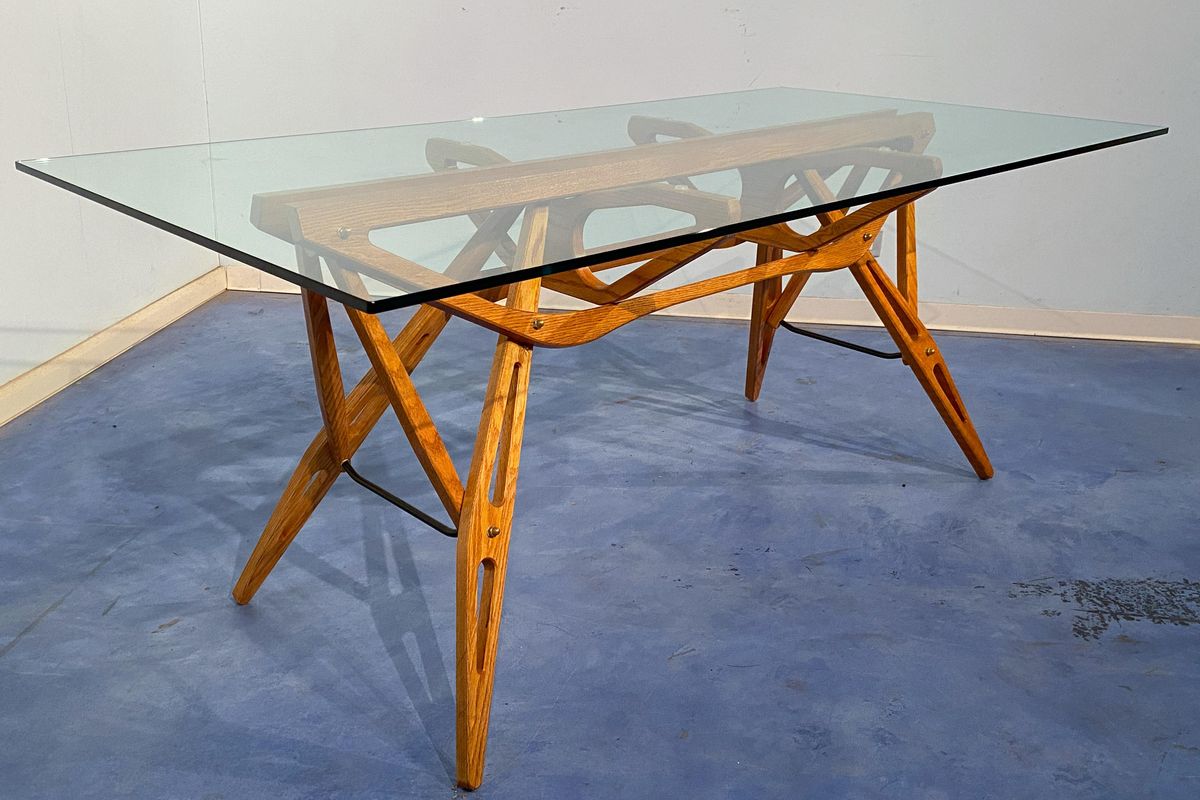
On 11 May 2026, Domus confirmed that Zanotta had been granted an exclusive licence to manufacture 30 Carlo Mollino designs, awarded by Italy’s Agenzia del Demanio via public tender — the year’s most consequential entry in a wider wave of mid-century archive revivals that runs from Cassina’s Le Corbusier Inédits at Salone del Mobile 2026 back through the same company’s 1965 LC Series, sideways into Pierre Jeanneret’s Chandigarh furniture, and out to the $33.5M Claude Lalanne mirror suite auctioned at Sotheby’s New York three weeks earlier. The Mollino licence closes a circuit that the Cassina template opened in 1964.
Zanotta and the 30 Mollino Designs
The deal made public on 11 May 2026 is a manufacturing licence, not a coffee-table licence: Zanotta has the exclusive right to produce, distribute, and commercialise 30 specific Mollino designs at industrial scale, with the rights administered by Agenzia del Demanio — the Italian state property agency that holds Mollino’s intellectual property after a 2014 transfer from the Politecnico di Torino. The award came through a public tender, which is the unusual part. Italian archive licences for twentieth-century masters are normally negotiated bilaterally between heirs or foundations and a single manufacturer; the Mollino settlement instead ran the rights through a state procurement process and let the bidder field do the price discovery.
Of the 30 licensed designs, 7 were already in Zanotta’s catalogue as “tributes” — pieces the company had been producing under earlier, narrower agreements that did not amount to a full licence. The remaining 23 are unreissued and slated for future production, which is the part the trade has been waiting for. The first piece launched under the new licence is the Vertebra table, a Mollino design never previously produced at industrial scale, unveiled during Milan Design Week 2026. The programme also covers the Reale table, originally drawn by Mollino for the Turin headquarters of Reale Mutua Assicurazioni — a 1946 commission whose name has stayed attached to the design through six decades of dealer-market reproduction.
Zanotta CEO Luca Fuso, quoted in Domus on 11 May, located the difficulty precisely: “many of these pieces had been conceived as commissions…which made them difficult to reconcile with the demands of industrial production.” This is the canonical problem of the Mollino archive. Mollino did not draw for catalogues. He drew for the Casa Devalle (1939), for the Casa del Sole at Cervinia (1947–55), for the Lutrario ballroom in Turin (1959), for the Camera di Commercio (1965–73), and for the Teatro Regio di Torino (1965–73) — every piece dimensioned to a specific room and a specific client, and most of them executed by Apelli & Varesio or by Casa Mollino’s own joinery rather than by a manufacturer with a serial line. Bringing a Vertebra or a Reale into industrial production means redrawing it for tolerances Mollino never set.
The source material is, in volume, the most thorough mid-century furniture archive in Italian hands. The Fondo Carlo Mollino at the Politecnico di Torino holds roughly 17,000 graphic tables and working drawings, 15,000 photographs, and more than 70 folders of writings and correspondence — assembled after Mollino’s death on 27 August 1973 in Turin, the city where he had been born on 6 May 1905 and where he had taught as full professor at the Faculty of Architecture from 1953. The Politecnico holding makes the Vertebra reissue a matter of pulling the right sheet, not of reconstructing a lost drawing.
Zanotta itself is well placed for this work. The firm was founded in 1954 by Aurelio Zanotta in Nova Milanese, and its catalogue includes some of the most reproduced postwar Italian designs: the Sacco bean bag by Gatti, Paolini and Teodoro (1968), the Castiglioni Mezzadro stool (1957), and the De Pas, D’Urbino, Lomazzi and Scolari Blow inflatable chair (1967). Tecno acquired an 80% stake in Zanotta in 2017, which gave the company the industrial capacity to absorb a 30-design programme without diluting the existing canon. The Mollino licence is, in catalogue terms, the largest single archive expansion in Zanotta’s history.
The Cassina Template: iMaestri, LC Series, and the 2026 Inédits
Every Italian archive licence since 1964 has been measured against the Cassina precedent. Cassina launched its iMaestri programme in 1964 — the framework under which it manufactures, under exclusive licence, the furniture of canonical twentieth-century architects whose original production was either bespoke or out of print. One year later, in 1965, Cassina secured the LC Series rights from the Fondation Le Corbusier and the Charlotte Perriand and Pierre Jeanneret heirs, which converted the 1928 LC1, LC2, LC3, LC4 and LC6 prototypes into a perpetual industrial line. The LC chaise longue alone has been in continuous production at Cassina for more than sixty years.
The 2026 update to that programme is the Le Corbusier Inédits collection, which Cassina brought to Salone del Mobile 2026. The set comprises six previously unproduced Le Corbusier, Perriand and Jeanneret pieces drawn between 1928 and 1952, pulled from the Fondation Le Corbusier holdings and reconstructed for industrial production. The Inédits collection is the structural twin of the Zanotta Mollino programme: an archive-rights holder licenses a manufacturer to convert unproduced drawings into a serial line, and the manufacturer absorbs the engineering cost of translating bespoke dimensions into a catalogue product.
The difference is the rights structure. The Cassina arrangement runs through a private foundation (Fondation Le Corbusier) and two sets of family heirs. The Mollino arrangement runs through a state agency (Agenzia del Demanio) and a public tender. Both arrive at the same product — a manufacturer-of-record with a multi-decade licence — but the Mollino route is reproducible by other ministries holding the IP of state-employed architects, and the Cassina route is not. This is why the Mollino tender matters outside Turin.
Chandigarh: How the Jeanneret Furniture Came Back
The Jeanneret furniture programme is the third leg of the Cassina archive. Pierre Jeanneret’s Chandigarh furniture — committee, library and kangaroo lounge chairs, demountable chairs, writing chairs, all built in teak and Indian rosewood with woven cane — was designed during his tenure as Chief Architect of Chandigarh from 1951 to 1965. The city was inaugurated on 7 October 1953; the High Court of Punjab and Haryana, fitted out entirely with Jeanneret pieces, became functional in March 1955; the housing programme, the markets, the Panjab University library and the dispensaries were drawn or supervised by Jeanneret over the same fourteen years. The furniture was not catalogued. It was specified by typology and built locally, in Punjab, by the Public Works Department workshops.
That decentralised production is the reason the Chandigarh canon entered the auction market before it entered the catalogue market. Pieces were declared obsolete by the Punjab administration in batches between the 1980s and the early 2000s, repatriated by European dealers, restored, and resold; by roughly 2007, six-figure prices for committee chairs and library tables were routine. The Cassina Hommage à Pierre Jeanneret line, brought into the iMaestri programme more recently, is the industrial answer to that secondary market — a new-production teak-and-cane committee chair, manufactured under licence from the Jeanneret heirs, sitting alongside an auction lot of the same typology at ten or twenty times the price. The two markets co-exist because the typologies are robust enough to carry both.
Lalanne / de Gunzburg: $33.5M for a Single Suite
The Lalanne sale at Sotheby’s New York on 22 April 2026 is the auction-market correlate of the manufacturer-licence story. The lot in question was a suite of 15 bronze botanical mirrors made by Claude Lalanne between 1974 and 1985 for Yves Saint Laurent and Pierre Bergé’s Paris music room — passed by inheritance and private sale to Jean and Terry de Gunzburg, and offered as a single ensemble in the 107-lot “Collection of Jean and Terry de Gunzburg: Design Masters” sale. The mirrors sold for $33.5 million; the full sale totalled $96 million. The suite was the highest-priced single design lot in 2026 by a margin.
The Lalanne result is structurally different from the Cassina and Zanotta licences because there is no manufacturer in the chain. Claude Lalanne (1925–2019) and François-Xavier Lalanne (1927–2008) produced the bronze suite themselves, in numbered editions; there are no LC Series equivalents, no Cassina-style reissue line. The Lalanne archive is closed at the foundry. What the $33.5M result tells the manufacturer market is the upper bound — the price ceiling for archive material that has not been opened to industrial production, against which the Cassina and Zanotta licence economics have to be argued. A Mollino Vertebra at industrial scale will never approach the Lalanne suite at auction; that is the point. The licence converts archive scarcity into catalogue access, and the catalogue access is what the manufacturer is paying for.
Why Mid-Century Archive Revivals Matter Now
The 2026 cluster — Mollino at Zanotta, Le Corbusier Inédits at Cassina, Chandigarh teak via the Cassina Hommage line, and the de Gunzburg Lalanne suite at Sotheby’s — is the densest year of mid-century archive revivals since Cassina opened iMaestri in 1964. Three reasons are visible from the data.
The first is rights consolidation. The relevant archives are now in the hands of bodies (Fondation Le Corbusier, the Politecnico di Torino, Agenzia del Demanio, the Jeanneret and Perriand heirs) that have, in the last decade, professionalised their licensing operations. The Mollino tender is the public-procurement version of this trend; the Cassina Inédits is the private-foundation version. Both produce a single manufacturer-of-record with a multi-decade window.
The second is the auction-market signal. The $33.5M Lalanne suite, the six-figure Chandigarh committee chairs, and the Mollino Casa Orengo desks that have cleared $1M at Phillips and Christie’s since 2018 have re-priced the entire mid-century reissue category upward. A new-production Vertebra at Zanotta will sit in catalogue at a fraction of the secondary-market price for an Apelli & Varesio original — but that fraction is now anchored against a higher reference, which improves the unit economics of the licence for both parties.
The third is curatorial. The Cassina LC Series and the iMaestri canon have, since 1965, defined what serial mid-century production looks like at the high end of the European catalogue. Adding Mollino — a Turinese, idiosyncratic, photography-and-architecture practice that resists the LC Series’ rationalist register — broadens that canon in a way the Cassina line cannot do from inside. Zanotta is the right firm for it. The Sacco-Mezzadro-Blow catalogue already mixes domestic radicalism with industrial production; Mollino fits the register.
The architects and designers the new licence reaches matter, too. Mollino’s Turin practice intersected, directly and indirectly, with the broader Italian postwar canon — Gio Ponti’s Milan, Ettore Sottsass’s Memphis, Andrea Branzi’s radical-design milieu — and the Vertebra and Reale tables read, against that catalogue, as the missing Piedmontese register. That register has been absent from serial production for sixty years. The 2026 licence ends that gap.
A Living Archive in 2026: The Branzi Codicil
The fourth quadrant of the 2026 archive year is not a reissue at all. Andrea Branzi’s Continuous Present retrospective at Triennale Milano, curated and designed by Toyo Ito, runs 19 March to 4 October 2026 — the first comprehensive Branzi retrospective since the designer’s death and a counter-argument to the manufacturer-licence model. Branzi’s archive, unlike Mollino’s or Le Corbusier’s, was not built for industrial reissue. The radical-design programme — Archizoom, the Domestic Animals collection, the No-Stop City — is constituted by drawings, manifestos, and one-off prototypes that resist the LC Series treatment.
What Toyo Ito’s installation does, in the Triennale’s first-floor galleries, is treat the archive as exhibition material rather than catalogue material. The pieces are not reissued; they are shown. The distinction matters because it marks the upper limit of the archive-revival model. Cassina and Zanotta can convert dimensioned drawings into industrial products; the Lalanne foundry can recirculate numbered bronzes at auction; the Branzi archive can only be exhibited. Three of the four 2026 programmes are licensing operations. The fourth is a museum.
That distinction is the reason the Branzi show belongs in this account. The Mollino tender, the Cassina Inédits, and the Chandigarh Hommage line are all bets that a twentieth-century archive can keep paying out as a serial product. The Triennale retrospective is the bet that some archives cannot — and that the curatorial frame, not the catalogue, is where they continue to be present. Both bets are now in the 2026 market.
The four programmes, compared
| Programme | Archive holder | Licensing year | Number of designs | First piece released | Venue |
|---|---|---|---|---|---|
| Cassina x Le Corbusier Inédits | Fondation Le Corbusier (+ Perriand, Jeanneret heirs) | 2026 (under 1965 LC master licence) | 6 unproduced 1928–1952 pieces | Six-piece Inédits collection | Salone del Mobile 2026, Milan |
| Cassina x Jeanneret (Hommage à Pierre Jeanneret) | Pierre Jeanneret heirs | iMaestri programme since 1964 | Chandigarh typologies (teak, Indian rosewood, woven cane) | Committee chair, in-line | Cassina catalogue (continuous) |
| Sotheby’s x Lalanne (de Gunzburg sale) | Jean and Terry de Gunzburg (private collection) | n/a — single-owner auction | 15-mirror bronze suite (1974–1985) | de Gunzburg “Design Masters” sale | Sotheby’s New York, 22 April 2026 |
| Zanotta x Mollino | Agenzia del Demanio (Italian state) | 2026 (public tender) | 30 designs (7 existing tributes + 23 new) | Vertebra table | Milan Design Week 2026 |
The table makes the structural point visible. The Cassina and Zanotta entries are manufacturer licences with multi-decade horizons; the Sotheby’s entry is a single sale that sets the upper reference; the Cassina Jeanneret line is the continuous case that has been quietly running, inside iMaestri, since 1964. Four different mechanisms, one archive-revival year.
Coda
The Vertebra table at Milan Design Week 2026 is a small object — a redrawn 1950s Mollino dimensioned for a Zanotta production line — and it carries, on its industrial-scale debut, the weight of a sixty-year licensing tradition that Cassina opened in 1964 and that Agenzia del Demanio has, on 11 May 2026, extended through public tender to the Politecnico di Torino’s Fondo Carlo Mollino. The Le Corbusier Inédits, the Chandigarh Hommage line, the $33.5M de Gunzburg Lalanne suite and the Branzi Continuous Present show at Triennale are the four corners of the same architecture: a year in which the Italian and French mid-century archives moved, simultaneously, from dealer market to catalogue, from private sale to public tender, from prototype to product, and — in the Branzi case — from product back to exhibition. The Mollino licence is the entry that closes the loop.