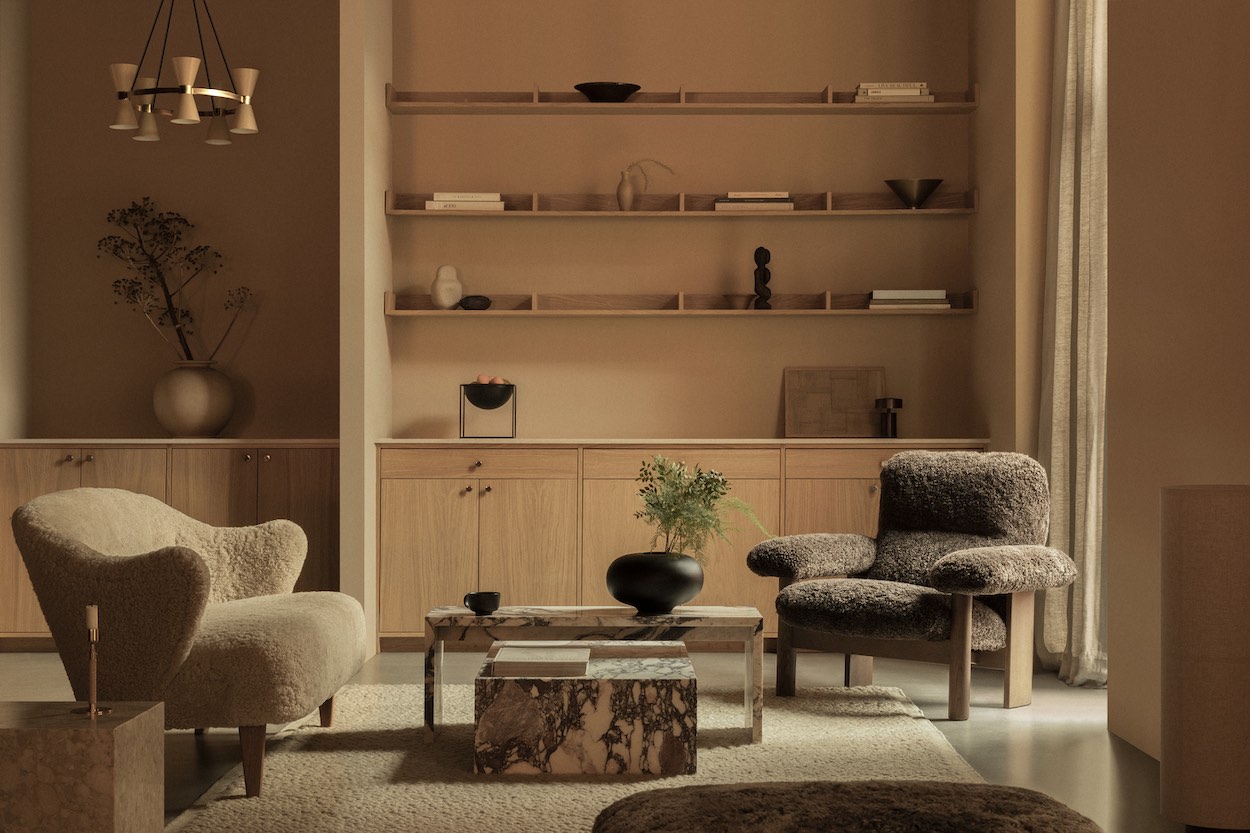
The Audo Copenhagen Tribeca showroom opened in early May 2026 at 62 Laight Street as the Danish design house’s first flagship outside Scandinavia — a roughly 3,500 sq ft ground-floor space inside a landmarked New York City building, with interiors by Jonas Bjerre-Poulsen of Norm Architects and styling by New York interiors stylist Colin King. The room is arranged as a sequence of residential vignettes around a single Androgyne dining table, with paintings and sculptures by the Portland artist Benjamin Ewing placed across the floor. It is also the clearest statement so far of what the 2023 merger of Menu, By Lassen and The Audo under Italian group Design Holding was supposed to produce: a single Danish house with a single language, exportable to a single American room.
The 65 N. Moore Street showroom that the brand opened in June 2024 was a beachhead. The Laight Street move, two years later and three blocks east, is the actual flagship — timed deliberately to NYCxDesign 2026, the citywide festival running 14–20 May. The brand could have opened the room in March, or in September. It chose the week the international design press was already in town.
62 Laight Street, Tribeca
The building sits on the south side of Laight between Hudson and Greenwich, in the part of Tribeca that the New York City Landmarks Preservation Commission designated as the Tribeca North Historic District in 1992. The block belongs to the late-nineteenth-century warehouse fabric that the district was drawn around: cast-iron storefronts at ground level, masonry above, deep floor plates inherited from a period when the neighbourhood was the city’s butter, egg and cheese wholesale market. Audo Copenhagen took a ground-floor unit on that fabric and treated the existing envelope as the brief.
The interior leaves the exposed brick walls and the structural columns in place. Both are washed in a soft beige paint — not white, not stone, the warmer of the two cooler greys that the Norm Architects palette has tended toward for the last decade. The floors are dark-stained wood, laid in wide planks, and the contrast between the beige walls and the dark floor is the room’s single largest design move. It is also the move that decides everything else in the showroom: the furniture is photographed against the walls, not the floors, which is why the Eave sectional and the Crescent shelving read at full saturation when you stand at the entrance.
The decision to wash the brick rather than expose it is not the obvious choice in Tribeca. The neighbourhood’s design vernacular over the past twenty years has been red-brick-and-cast-iron archaeology — leaving the original masonry visible, scrubbed but not painted, as a signal of authenticity. Norm Architects’ choice runs the other way. By coating brick and column in a single tone the studio dissolves the building’s history into the background and pulls the furniture forward. The architecture becomes the field; the objects become the figure. This is a Danish reading of a New York building, not a New York reading.
The total square footage — about 3,500, or roughly 325 m² — is small for a flagship but large for a Tribeca ground floor. It is also more than three times the footprint of the 65 N. Moore Street space the brand vacated. The extra room is what makes the vignette format possible.
Norm Architects, Copenhagen 2008
Norm Architects was founded in 2008 by Jonas Bjerre-Poulsen and Kasper Rønn von Lotzbeck. The studio sits in the Copenhagen practice tradition that produced Cecilie Manz, GamFratesi and Space Copenhagen — a generation of design offices that work across architecture, interiors and product, and that take a position on every scale of a project from the building envelope to the table lamp. Norm’s practice has run, since the early 2010s, on a small set of long-term client relationships: Karimoku Case Study, &Tradition, Vipp, Reform, and — most consistently — Menu, the predecessor brand inside the current Audo Copenhagen consolidation.
That last relationship is the relevant one for Tribeca. Norm Architects has been the in-house design intelligence for what is now Audo Copenhagen for more than a decade. The studio designed the Audo House flagship in Nordhavn, the converted 1918 trading post that gives the brand its physical centre of gravity in Copenhagen. It has designed multiple Menu collections — the Harbour chair, the Yeh wall table, the Androgyne table that anchors the Tribeca room — and it has supplied the brand’s photographic art direction across catalogue and campaign for the same period. When Audo Copenhagen needed a New York interior, it did not run a competition. It called the studio that had drawn most of the furniture already in the room.
The studio’s interior work outside Denmark has a recognisable through-line. The Kinuta Terrace residential project in Tokyo (with Keiji Ashizawa, 2019). The Karimoku Case Study showroom programme in Tokyo and Kyoto. The Tatamiza house at Karuizawa. The Áreas residential interiors in Lisbon. The studio works by reducing the room to two or three material tones, deploying soft natural light through a single dominant window or skylight, and arranging the furniture in conversational groups around low tables. None of those moves is original to Norm Architects. What is original is the consistency with which the studio refuses any other move. The Tribeca showroom is a textbook deployment of the same vocabulary, transplanted into a Manhattan envelope.
Vignettes, not retail
The room is not a retail layout. It is staged as a sequence of residential vignettes, in the manner of a real-estate styling job — which is what Colin King’s involvement signals. King is a New York-based interior stylist and creative director who has built his reputation on styling editorial and brand interiors for the slow-furniture and homewares market: Saint Heron, Stahl + Band, his own monograph Arranging Things (Rizzoli, 2023). He is the right collaborator for a brand that wants its furniture photographed in scenes rather than on plinths, and his fingerprints are visible in the way the Tribeca room is composed.
The centrepiece is a large Androgyne dining table — the Danh Vo–shaped, marble-topped dining piece that Norm Architects drew for Menu in 2018, here in the longest version of the family with chairs grouped around it as though for a real meal. The arrangement around the table reads as a domestic interior in mid-set rather than a furniture exhibition. Behind it, the Eave sectional turns the room’s back corner into a low conversational seating area, with the Volume side table at one armrest. The Crescent shelving runs along the long beige wall opposite the entrance, holding a mixed library of books and ceramics rather than the unbroken product line of a flagship. Two lounge chairs — the Elizabeth, a tubular-frame easy chair from the Menu archive, and the Tire Man, the Karimoku Case Study x Norm Architects collaboration in oak and curved-back upholstery — sit on opposite sides of the room, calibrated to be photographed from a single sight line through the front window.
The Benjamin Ewing pieces are the variable in the composition. Ewing is a Portland, Oregon-based painter and sculptor whose work tends toward thick-impasto figurative painting and small ceramic forms. The Tribeca showroom places his canvases above the Eave sectional, between the Crescent shelves and the front column, and on the wall behind the Androgyne table; a pair of small sculptural objects sit on the Volume side table. The art programme is not a curatorial frame; it is a styling decision, in line with what King and Norm Architects have done in the Audo House Nordhavn room. Audo Copenhagen will rotate the art at intervals — the Ewing inclusion is the opening hang, not a permanent installation.
The implication of the vignette format is that the room is selling a way of living more than it is selling a piece of furniture. That distinction has been the central marketing argument of every Scandinavian design brand since the late 2000s, and it has been over-claimed for most of that period. What makes the Tribeca room a credible version of the argument is that it actually commits to it: there is no point-of-sale desk, no price tag, no visible signage other than the Audo wordmark above the entrance. A New York buyer who walks in off Laight Street has to ask the staff what anything costs.
From Menu and By Lassen to Audo Copenhagen
The brand currently operating the Tribeca room is the result of a three-way consolidation. Until 2023, Menu, By Lassen and The Audo were three separately marketed entities; in late 2022 and early 2023, all three were folded into a single brand called Audo Copenhagen, owned by Italian luxury group Design Holding, which had acquired Menu and By Lassen during 2021–2022. The consolidation is the necessary context for the Tribeca opening. The American market needed a single Danish brand to anchor a New York showroom; Design Holding produced one by merging three.
| Predecessor brand | Founded | Country | Key designers / heritage | Path into Audo Copenhagen |
|---|---|---|---|---|
| Menu | 1979 | Denmark | Norm Architects, Big-Game, Afteroom, Anderssen & Voll | Acquired by Design Holding (via the Bagnara family) and consolidated into Audo Copenhagen in 2023 |
| By Lassen | revival 2008 | Denmark | Mogens Lassen, Flemming Lassen (1930s–60s archive) | Acquired by Design Holding through the Menu transaction; merged into Audo Copenhagen 2023 |
| The Audo | 2019 | Denmark | Norm Architects (interior); Menu’s hospitality vehicle | Folded into Audo Copenhagen 2023 as the brand’s hybrid showroom-and-hotel format |
| Audo Copenhagen | 2023 | Denmark | Norm Architects (lead studio); Joachim Kornbek Engell-Hansen, design and brand director | Current unified brand under Design Holding |
The table reads as a tidy reorganisation, and on the corporate side it is. On the design side it is more delicate. Menu had spent the 2010s building a recognisable house style around Norm Architects’ material palette and a clutch of younger Scandinavian and Italian designers. By Lassen carried a much narrower brief — the modernist archive of two specific brothers, the Mogens and Flemming Lassen heritage, with the Kubus candleholder as the single product the average buyer could name. The Audo, the 2019 hospitality vehicle housed in the Nordhavn building, was a marketing project as much as a brand: the converted 1918 trading post operated as a hotel, restaurant, café and event space, and Menu used it as the staged context for its product photography.
The 2023 merger collapsed all three into one. The new brand kept Menu’s product breadth, absorbed the By Lassen archive as a permanent sub-collection, and turned The Audo’s Nordhavn building into the flagship the unified house could show clients. Joachim Kornbek Engell-Hansen — design and brand director since June 2023 — is the executive responsible for holding that consolidation together. The Tribeca opening is the first New York test of whether the unified brand reads as a single voice. The vignette format is, partly, an argument that it does: a Menu Eave sectional, a By Lassen archival object, a Karimoku Case Study × Norm chair, and a Norm Architects Androgyne table can sit in one room without competing.
NYCxDesign 2026 timing
The opening was scheduled to coincide with the 2026 edition of NYCxDesign, the citywide design festival running 14–20 May 2026 across Manhattan and Brooklyn. The festival is not yet at the scale of Salone or 3 Days of Design, but it has become the reliable May moment when European furniture brands open or refresh their New York presence: 2024 brought Hay’s SoHo flagship; 2025 brought the &Tradition reopening on Crosby Street; 2026 has now brought Audo Copenhagen to Laight Street. The same week is bracketed by a Frieze New York calendar that pulls international collectors into the city, which is why an early-May opening sits at the precise overlap of the design and art markets the brand wants to address.
The NYCxDesign window matters for one more reason. Audo House Tribeca, like the Nordhavn original, is a hybrid model — retail-and-events space rather than a pure showroom. The opening week was programmed with a launch event for trade and press, followed by a public week tied to the festival map. This is the operating mode that Audo developed in Copenhagen and is now exporting: the building is a place to buy furniture, but it is also a place to host dinners, talks, brand collaborations and the occasional residency. Opening during NYCxDesign signals that the events programme is part of the proposition, not an afterthought.
The timing also marks an inflection in the wider Scandinavian-in-Manhattan story. Hay, Gubi, &Tradition, Frama, Muuto and Fritz Hansen all already operate New York retail or showroom space; Vipp runs an apartment-as-showroom in Tribeca; the Reform kitchen brand has SoHo. Audo Copenhagen is the latest entry, but it is the first of the post-consolidation Design Holding brands to make the move at this scale. The implicit pitch to American buyers is that the Audo flagship now offers, in one room, the breadth that previously required visits to several Scandinavian rooms. Whether the breadth reads as range or as compromise will depend on how aggressively the brand rotates the vignettes through the year.
What the Audo Copenhagen Tribeca room translates from Nordhavn
The Nordhavn flagship is the reference against which the Tribeca room has to be read. Audo House in Copenhagen is a converted 1918 trading post — six storeys, brick exterior, deep floor plates, harbour-side. The building does most of the work. The interiors are restrained because the envelope is loud. Tribeca is the reverse problem: the envelope is small and quiet, a single ground-floor unit, and the interior has to carry the brand identity on its own. The studio’s answer is to compress the Nordhavn vocabulary — same beige tones, same dark floor, same vignette logic, same Norm-led art direction — into a room a tenth the size, and to use Colin King’s styling sensibility to keep the compression from reading as miniature.
The translation is not perfect. The Nordhavn room can stage a full dining tableau, a bedroom, a working library and a courtyard cafe; the Laight Street room can stage one dining tableau and one lounge. That edit is the part where the New York flagship differs most from the Copenhagen original: it is a single edited scene, not an ensemble of scenes. Which is also why the Androgyne table reads as the centrepiece. There is, by design, only one centrepiece to choose.
The other translation problem is light. Nordhavn has Baltic light through tall industrial windows on three exposures; Tribeca has southern light through a single shop-front window on Laight Street. Norm Architects has compensated by darkening the floor and lifting the wall tone, so that the room reads as warmer than the Copenhagen original at the same hour. This is not the Scandinavian-design cliché of cool light and pale wood; it is a more grown-up reading of how a Danish interior survives transplant into a New York shop front, and it is the most quietly competent decision in the room.
What the room is actually arguing
Audo Copenhagen has been making a single argument since the 2023 merger: that a unified Danish brand, owned by an Italian group, can sustain a single design voice across a Menu-era product, a By Lassen archival object, a Karimoku Case Study collaboration and a Norm Architects interior. The Audo House Tribeca opening is the first New York test of the claim. The brand’s answer is a 3,500 sq ft ground-floor room in a landmarked building, designed by the studio that has drawn most of its furniture for a decade, styled by a New York stylist who works in the same vocabulary, and opened to coincide with the week the design press is in town.
The interesting part is the structural ambition. Most European furniture brands open American flagships as outposts — branded showrooms run by US subsidiaries, designed by local interiors offices, stocked from European warehouses. The Audo House model is different. The Tribeca room is meant to be an exact translation of the Nordhavn building’s operating logic — retail-plus-events, vignette-not-grid, in-house design direction, controlled art programme — into a New York envelope. If it works, the same template is exportable to a second American city, or to a European capital outside Scandinavia. If it does not, the brand will have spent the cost of a Tribeca lease to learn that the Audo House idea does not survive translation.
Either way, the architectural moves the room makes — washing the brick to beige, darkening the floor, dissolving the warehouse into the background and pushing the furniture forward — are the cleanest demonstration to date of how Norm Architects reads a New York building. The studio has been working in this language for fifteen years. The 2026 Tribeca room is the version that the American market can finally walk through.
For broader context on the Danish-modernist archive revivals shaping the 2026 furniture cycle, see our companion piece; for the parallel question of how a single architect’s vocabulary survives translation across continents, the Frank Gehry interiors-as-architecture argument sets up the same problem at a different scale.