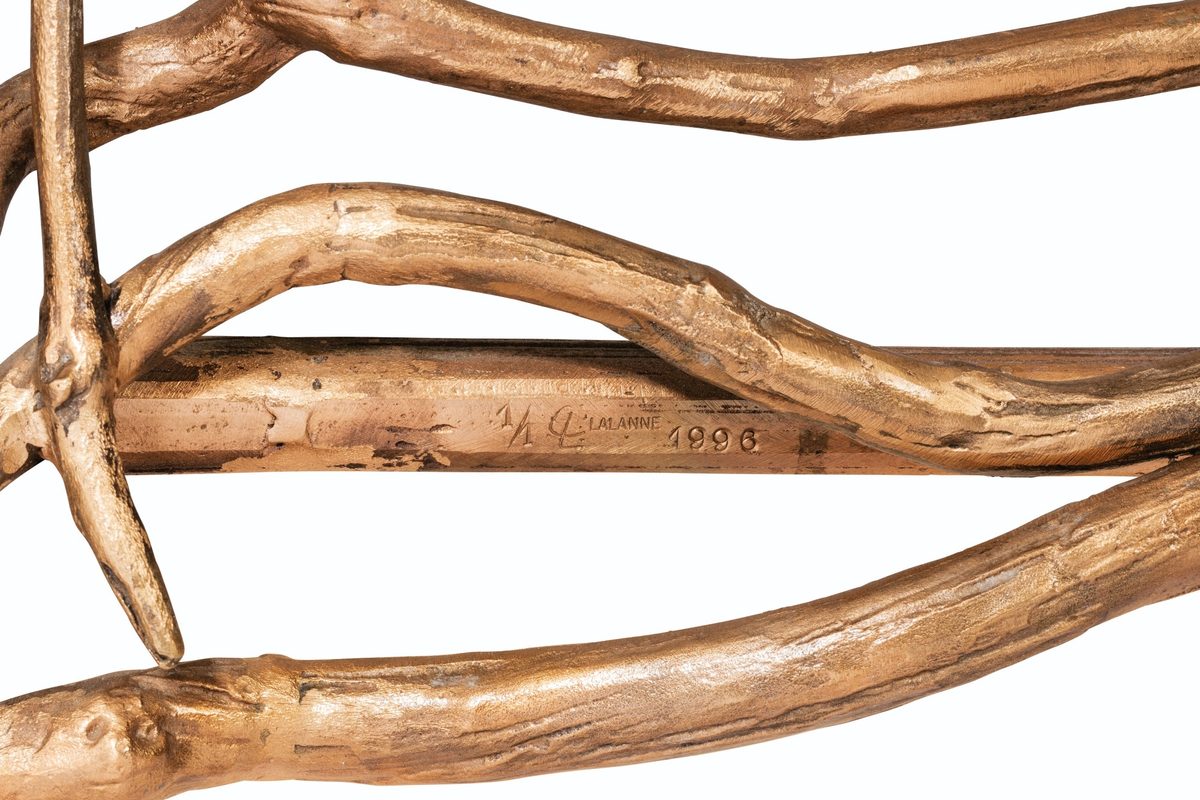
On 22 April 2026, while fashion houses across Milan were debuting editioned furniture at €4,800-and-up, Sotheby’s New York sold fifteen Claude Lalanne bronze mirrors as a single lot for $33.5M — and quietly redrew the ceiling that those same houses are now climbing toward. The price set a new collectible design auction record, the highest ever paid for a work of design at auction, and arrived at the close of a sale — The Collection of Jean and Terry de Gunzburg: Design Masters — that totalled $96M across 107 lots. The mirrors had hung, originally, in the Paris music room of Yves Saint Laurent and Pierre Bergé. The buyers in Milan a fortnight earlier — Bottega Veneta Casa, Hermès, Louis Vuitton — were watching closely.
This is the article’s wager. The Lalanne mirror result is not, primarily, a story about a single object or a single collector. It is a story about whether late-twentieth-century French design has reached its terminal valuation, or whether $33.5M is the opening price of a category that fashion houses, during Milan Design Week 2026, just entered en masse.
The Sale at 1334 York Avenue
Sotheby’s moved its design department into 1334 York Avenue in 2024, and the room has hosted the auction house’s most consequential decorative-arts sales since. Design Masters was scheduled as a single-owner evening sale on the night of 22 April 2026, deliberately timed to land between the close of Milan Design Week (which formally ended on 21 April) and the opening of New York’s spring auction season. The catalogue ran to 107 lots — most of them produced between 1955 and 2010, most of them French, most of them objects that had passed through Jean and Terry de Gunzburg’s hands at least once.
The headline lot, Lot 14, was catalogued as Ensemble of Fifteen Bronze Mirrors, Claude Lalanne, 1974–1985. The mirrors had been commissioned, individually and in pairs across more than a decade, for the music room of the apartment Yves Saint Laurent and Pierre Bergé kept at 55 rue de Babylone. They were made by Lalanne’s signature galvanoplasty process — real botanical specimens, mostly ivy and oak leaves and small wild grasses, electroplated in copper sulphate baths until the original plant matter calcified inside a skin of bronze. Each frame is unique. The largest mirror in the group measures roughly 220cm; the smallest is closer to 60cm. Hung as the de Gunzburgs eventually hung them in their own Paris apartment, they form an irregular foliate canopy above a low banquette.
The hammer fell at $29M, with buyer’s premium bringing the total to $33.5M. Sotheby’s, in the post-sale release issued at 11:47 p.m. New York time, described the price as “the highest ever paid for a work of design at auction” — a claim that, as of this writing, holds. The previous record had stood for less than five months. In December 2025, François-Xavier Lalanne’s Hippopotame Bar — Claude’s husband’s bronze hippo whose hinged jaw concealed a mirrored bar interior — sold at Christie’s Paris for $31.4M. Both records belong to the same household.
The total for the de Gunzburgs’ Lalanne holdings, across fifteen separate lots in the sale, came to $64.7M. Beyond the mirror ensemble, the most-watched result was Très Grand Choupatte, Claude’s monumental bronze cabbage on chicken legs, which sold for $5.9M against a high estimate of $4M. Thirteen further Lalanne pieces — smaller Choupattes, a bronze fish bench, a Rhinocrétaire writing desk by François-Xavier in an edition of eight — accounted for the remainder. The de Gunzburgs were, as Sotheby’s design head Jodi Pollack noted from the rostrum, “probably the most concentrated private collectors of Les Lalanne working at the moment of the work itself.”
The de Gunzburgs as Collectors
It is worth setting out who the de Gunzburgs are, because the provenance is part of the price. Terry de Gunzburg founded the beauty house By Terry in 1998. Before that she spent fifteen years at YSL Beauté, where as creative director she developed Touche Éclat, the cosmetic that has now sold roughly forty million units globally and remains one of the most profitable single SKUs in the history of luxury beauty. She knew Claude Lalanne personally. The two women met through Bergé in the late 1980s, and the friendship — Terry would describe it later, in a 2018 interview with AD France, as “thirty-five years of lunches” — gave her early access to Claude’s studio in Ury, the village south of Fontainebleau where the Lalannes had lived and worked since the 1960s.
Jean de Gunzburg is a molecular and cell biologist whose career has taken him from the Pasteur Institute in Paris to the Whitehead Institute at MIT and back again. He is also a descendant of the Gunzburg banking family, whose Russian Jewish branch funded the construction of the Choral Synagogue in Saint Petersburg in 1893 and whose French descendants have collected art continuously since the Belle Époque. The collection that came up at Sotheby’s in April was not an investment portfolio assembled by an adviser. It was, in Jean’s own framing in the catalogue essay, “four decades of two people buying what they wanted to live with.”
The Lalanne mirrors entered the de Gunzburg collection at Christie’s on 23 February 2009, at the Collection Yves Saint Laurent et Pierre Bergé sale held in the Grand Palais after Saint Laurent’s death the previous summer. That sale, conducted over three nights, totalled €373.9M and was at the time the most valuable single-owner sale in European history. The mirrors went for €1.9M then, against an estimate of €600,000–€800,000 — a result that, in 2009, was considered remarkable. Seventeen years later, the same fifteen objects have multiplied roughly fifteen-fold in dollar terms. The 2009 sale had, in retrospect, been an accumulation event: a generation of collectors who had grown up reading about Saint Laurent’s Paris apartment in World of Interiors finally got to bid on the contents. The 2026 sale was the distribution event for that same generation.
What Claude Lalanne Made
Claude Lalanne (1924–2019) trained at the École des Arts Décoratifs and then briefly at the École des Beaux-Arts in Paris in the late 1940s. She worked initially as an architectural draughtswoman before discovering, around 1956, the technique that would define her output for the next sixty years. Galvanoplasty — the electrochemical deposition of copper, and later bronze, onto a non-metallic substrate — had been used industrially since the nineteenth century for plating tableware. Lalanne adapted it to a sculptural purpose. She would arrange a real plant specimen on a metal armature, immerse the assembly in a bath of copper sulphate, and run a current through the bath until the plant was sheathed in metal. The vegetable matter inside was then burnt out, leaving a precise hollow bronze cast that retained every vein, serration, and accidental tear of the original leaf.
The technique allowed her to make objects that read, almost confusingly, as both sculpture and specimen. The mirrors at the centre of the de Gunzburg sale are exemplary. Each frame is constructed from dozens of individually plated leaves and stems, soldered together into a continuous foliate band. Light catches them as it would catch real foliage. The mirror glass at the centre — made by Saint-Just, the French historic mirror house — is silvered with the slight greying that distinguishes hand-poured tin amalgam from modern aluminium. Hung in the music room at rue de Babylone, the ensemble was photographed only twice for publication, both times by François Halard, in 2003 and 2008.
Beyond the mirrors and Choupattes, Claude’s signature ranges include the Croco furniture (chairs and benches whose surfaces are clad in articulated bronze plates resembling crocodile hide) and a long-running series of bronze jewellery, made for Yves Saint Laurent’s 1969 couture collection and continued under her own name until her death. She made objects in galvanoplasty until her late eighties.
What François-Xavier Lalanne Made
François-Xavier Lalanne (1927–2008) trained at the Académie Julian in Paris in the late 1940s, the same private art school that had produced Bonnard and Vuillard a generation earlier. He met Claude in 1952. They married in 1967 and adopted the joint moniker Les Lalanne in 1966 — a year before the wedding — for an exhibition at Galerie J in Paris. From that point forward almost all of their work was signed jointly, although the two practised in distinct media and produced distinct objects.
François-Xavier’s territory was zoomorphic sculptural furniture: animals at architectural scale, executed in patinated bronze or epoxy or wool, that doubled as functional furniture. Moutons de Laine — life-sized sheep whose bodies are upholstered in long-pile woollen fleece, intended to be sat on as ottomans — were first shown in 1965 and have been remade in editions every decade since. Hippopotame Bar, the work that briefly held the design auction record before April 2026, is a hollow bronze hippopotamus whose dorsal surface lifts on hidden hinges to reveal a mirrored interior fitted with bottle clamps and ice channels. Rhinocrétaire, the rhinoceros-shaped writing desk, is the most architecturally ambitious of the three: 1.7 metres tall, with the rhino’s horn doubling as a lamp and its flank opening to a fitted desk surface. Editions of all three remain in production through Galerie Mitterrand, the Lalanne estate’s primary representative.
The point worth making is that François-Xavier and Claude pulled in opposite directions formally — he toward animal volume, she toward botanical surface — but their work has been read, since the late 1960s, as a single corpus. The de Gunzburg sale is the first single-owner event to test the corpus comprehensively, and the result suggests that the corpus is currently valued, at the top end, at roughly twice what it was worth two years ago.
The New Collectible Design Auction Record in Context
Auction records in design are notoriously slippery, partly because the category itself is contested — is a 1929 Eileen Gray cabinet a piece of design or a piece of decorative art? — and partly because the major sales houses use overlapping but not identical catalogue conventions. The table below assembles the rows that are well-documented enough to be treated as comparable. Each price is the hammer-plus-premium total at the moment of sale, in the original currency where reported, with USD equivalents at the contemporaneous rate.
Auction milestones for editioned design, 2009–2026
| Date | Lot | Sale | Result | Note |
|---|---|---|---|---|
| 24 Feb 2009 | Eileen Gray, Fauteuil aux Dragons, 1917–1919 | YSL–Bergé, Christie’s Paris | €21.9M | Then a record for any 20th-century decorative art object |
| 24 Feb 2009 | Claude Lalanne, ensemble of 15 bronze mirrors, 1974–1985 | YSL–Bergé, Christie’s Paris | €1.9M | Acquired by the de Gunzburgs |
| 17 Dec 2018 | Wendell Castle, Environment for Contemplation, 1969 | Sotheby’s New York | $1.6M | Castle benchmark; American studio craft |
| 13 May 2021 | Jean Royère, Polar Bear sofa and pair of armchairs, c. 1955 | Sotheby’s New York | $4.2M | Royère mid-century apex to that point |
| 17 Dec 2025 | François-Xavier Lalanne, Hippopotame Bar, 1968–1978 | Christie’s Paris | $31.4M | Previous design auction record |
| 22 Apr 2026 | Claude Lalanne, ensemble of 15 bronze mirrors, 1974–1985 | de Gunzburg, Sotheby’s New York | $33.5M | Current record; same object as row 2 |
Two readings of this table suggest themselves. The first is that the design market has moved roughly an order of magnitude in seventeen years — a Lalanne mirror group worth €1.9M in 2009 is worth $33.5M in 2026 — and that the rate of acceleration is itself accelerating, with the last two records set within five months of each other. The second is that the records are concentrated. Six of the top ten design results of the last twenty years are by Les Lalanne. Two are by Eileen Gray. One is Royère. One is Diego Giacometti. The market, at the very top end, is a market for roughly four names.
This is unusual relative to the contemporary art market, where the top ten results are spread across forty or so artists. It suggests that the late-twentieth-century French design canon — Les Lalanne, Royère, Giacometti, Charlotte Perriand, Jean Prouvé — is currently functioning as a closed list, the way the Impressionists functioned in the 1980s. New names are not entering it. The question is whether new names will enter, and through which door.
The Door the Fashion Houses Just Walked Through
This is where the Milan Design Week timeline matters. The de Gunzburg sale closed on 22 April. Salone del Mobile had closed on 21 April. The week before — 14–20 April — was the most concentrated moment of fashion-house furniture activity in the history of the fair. Bottega Veneta Casa opened a permanent twelve-object home gallery on Via San Maurilio, with editions of 100 or fewer; the centrepiece daybed, a four-metre intrecciato calfskin surface designed by Matthieu Blazy, was priced into six figures. Hermès showed Les Mains de la Maison at La Pelota from 22 to 28 April, twelve home pieces by Charlotte Macaux Perelman and Alexis Fabry — the show’s closing days literally overlapped with the New York auction. Louis Vuitton’s Objets Nomades 2026 expanded to fill Palazzo Serbelloni, with new commissions from Estudio Campana, Raw Edges, and Franck Genser. And Phoebe Philo’s bronze mirror — her first non-clothing object, a 28cm hand-cast bronze edition of 200 produced at Milan’s Fondazione Battaglia, retailing at £4,800 — sold out in four hours on its 16 April release.
The fact that Salone del Mobile launched Salone Raritas — a dedicated collectible-design section, the fair’s first — in the same week sharpens the picture. The collectible-design category, which Patrizia Moroso and Murray Moss had been arguing for as a distinct fair-floor proposition since the early 2000s, finally got its own real estate inside the Salone tents in April 2026. Three weeks later, $33.5M of Les Lalanne moved through a New York saleroom. The market is being constructed at both ends simultaneously: a new primary supply (the fashion houses) and a confirmed secondary ceiling (the auction record).
The structural question is what the relationship between the two ends will be. There are at least three possibilities, and the next two years of the market will probably show which one is operative.
The first possibility is that the fashion-house editions are decorative product without secondary-market depth, and that the Lalanne result is a closing valuation on a finite canon. In this reading, Bottega Veneta’s daybeds and Philo’s mirrors will sell at retail and stay in the homes that bought them, never returning to auction in volume. The Lalanne ceiling will hold for a generation, then drift, because no replacement names will mature into it. This is the bear case for the market and is consistent with how, for example, mid-century Italian glass has behaved since the 2010s — high primary demand, thin secondary depth.
The second possibility is that the fashion-house editions are functioning as the entry-level layer of a new primary market, and that the Lalanne ceiling is the aspirational anchor for it. In this reading, Philo’s £4,800 mirror is a serious collectible at its own scale, and the buyers — there are 200 of them, by definition — are being onboarded into a category whose top end is now valued in the tens of millions. Three editions in, an early Philo mirror could plausibly trade at five-figure premiums on the secondary market. This is the bull case, and it is consistent with how the early Lalanne market actually behaved between 1965 and 1980: small editions, fashion-adjacent collectors, retail prices that look modest in retrospect.
The third possibility is some combination. Most fashion-house homewares will not develop secondary markets; a small number — the houses with serious craft credentials, the editions made in genuine scarcity, the pieces that are bought by people who would otherwise be buying Lalanne — will. In this reading, the question for any specific house is not whether the category supports a secondary market in the abstract, but whether its edition does. Bottega Veneta’s commitment to editions of 100 or fewer in solid walnut and vegetable-tanned leather, on a permanent gallery in 5Vie, looks structurally different from a 1,000-edition candle in a department-store window. Philo’s commitment to bronze, lost-wax casting, and Fondazione Battaglia — the Milanese foundry that has cast for Lucio Fontana, Pino Pascali, and Maurizio Cattelan — looks structurally different from a printed silk pillow.
Why the de Gunzburg Sale Will Be Cited
There is a category of auction event that gets cited not because of a single price but because of the position the sale occupied in a longer story. The 1997 Sotheby’s sale of the Duchess of Windsor’s jewels is one. The 2009 Saint Laurent–Bergé sale, where the de Gunzburgs first acquired the Lalanne mirrors, is another. The 2018 sale of David Rockefeller’s collection at Christie’s is a third. Each of those events functioned, in retrospect, as both a market high-water mark and a generational handover — the moment a particular taste exited private hands and re-entered the auction system at scale.
The de Gunzburg sale of 22 April 2026 will, with reasonable confidence, be cited in this register for the design market. The combination of provenance — Saint Laurent and Bergé, then Terry and Jean de Gunzburg — is rare enough that the same fifteen mirrors will not appear at auction again for at least a generation. The total ($96M) is the largest US single-owner design sale on record. The headline price ($33.5M) is the highest ever paid for a work of design at auction. And the timing, three days after the close of Milan Design Week 2026, ensures that the sale will be read as part of the same season as Bottega Veneta Casa, Phoebe Philo’s first object, and Hermès Les Mains de la Maison rather than as an isolated New York auction event.
What the sale does not settle is the structural question. Sotheby’s headline number tells us that the canon, at the top end, is currently valued at $33.5M per fifteen-object ensemble. It does not tell us what an ensemble of fifteen Bottega Veneta intrecciato pieces, in twenty years, will be worth. Nor what a Philo bronze, in thirty. The market for those objects has not yet had a single major secondary moment, and it would be premature — in the strict sense — to claim that it will.
But the market is now being constructed in a way that anticipates one. The editions are being kept small. The materials are being chosen for durability. The makers are being credited by name on the objects themselves. The galleries are being opened on permanent leases in the city — Milan — that has become the global capital of collectible-design conversation. And the auction houses are, plainly, watching. Sotheby’s published a separate section on its website on 28 April 2026 — six days after the de Gunzburg sale — titled “The Future Lalannes,” with editorial-form coverage of seven living designers whose work is currently being acquired by the same private collectors who used to bid on Les Lalanne. Three of the seven are working with fashion houses.
Coda
The de Gunzburgs spent four decades building a collection in Paris with a friend who happened to be one of the great twentieth-century sculptors. The mirrors had hung first in a music room at rue de Babylone, then in a private apartment whose photographs were never published, and now they will hang somewhere new — Sotheby’s has not disclosed the buyer beyond confirming that the lot was won by a single bidder over the telephone. What the room will look like with the mirrors in it is a private question. What the saleroom looked like at 11:47 p.m. on 22 April 2026, as the hammer fell on the highest design price ever recorded, is a public one — and the rooms in Milan that opened a fortnight earlier, where Matthieu Blazy’s daybeds and Phoebe Philo’s bronze mirrors were waiting, were already, that same night, being read against it.