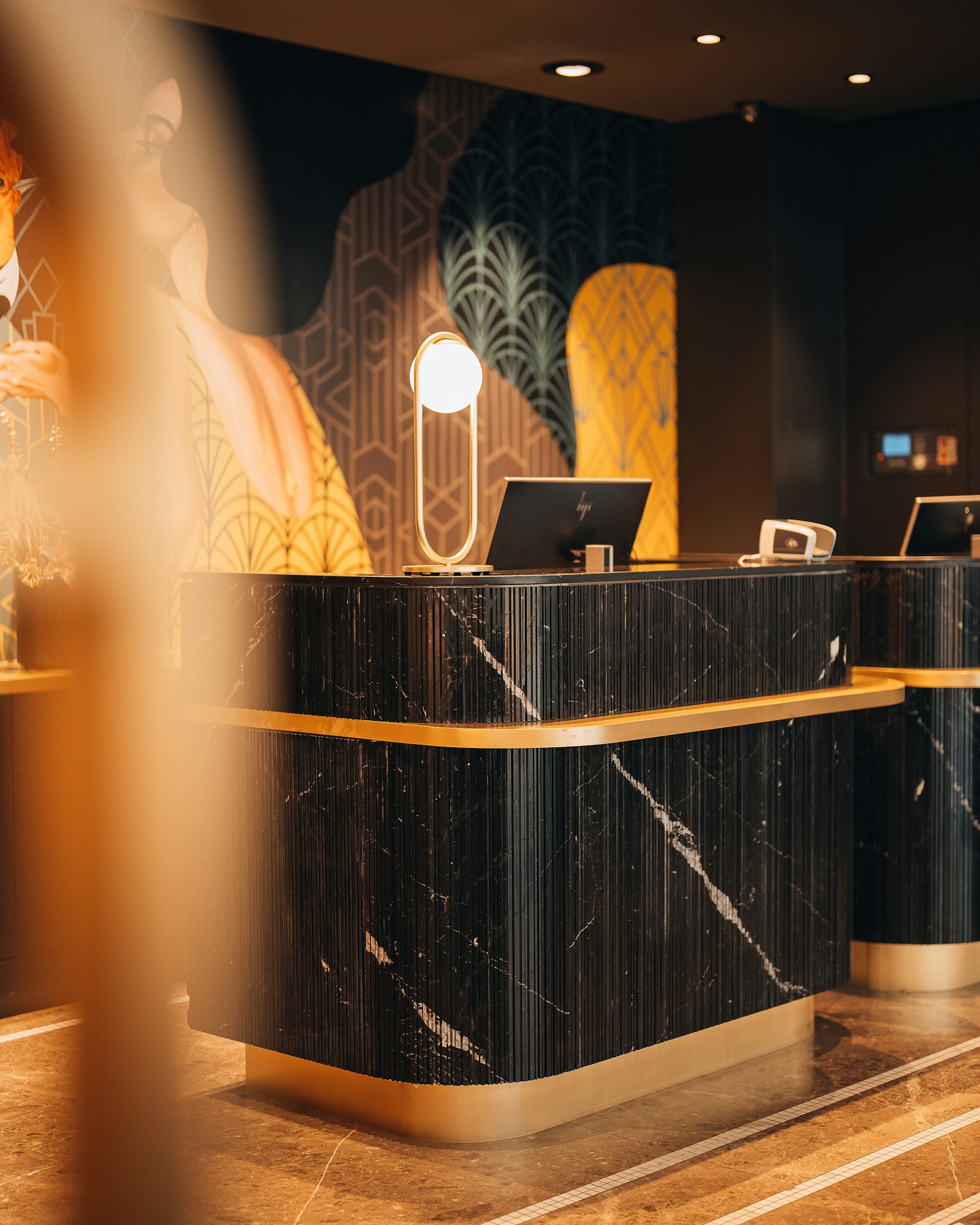
There is a long tradition of designers staging domestic vignettes at Milan Design Week — the aspirational living room, the fantasy kitchen, the bedroom that exists only as a backdrop for a new lamp. Tom Dixon has never been particularly interested in fantasy. At the Mulino Estate, a 1929 complex designed by Chiodi and Gio Ponti for the Sordelli family, Dixon and his Design Research Studio have done something more committed than a vignette: they’ve built an actual hotel. The objects on view here are not waiting to be photographed. They are waiting to be slept on, sat in, switched off at two in the morning by a guest who paid for the room.
That single shift — from exhibition to accommodation, from showroom to address — is the most interesting move in Dixon’s career in years, and one of the more revealing propositions of the 2026 design week. Mua Mua belongs alongside Marni’s three-month residency at Pasticceria Cucchi and Loro Piana’s Casa Brera townhouse as evidence of a wider tilt: design-week presentations are no longer vanishing on the Sunday after Salone closes. They are converting into permanent infrastructure. The pop-up has finally outgrown its tense.
The Premise
Mua Mua is a twelve-room micro-hotel concept where Dixon’s AW26 collection isn’t displayed on plinths or arranged for photography — it’s integrated into functioning rooms. Beds you can sleep in. Bathrooms that work. Lounges where you can sit and read and forget, briefly, that you’re at a design fair.
The distinction matters. Most brand presentations at Design Week exist in a liminal space between showroom and installation — objects arranged to suggest use without actually accommodating it. The chair has been positioned at an angle that flatters the upholstery; the lamp is on a dimmer that has been tuned for the press preview, not for an evening. Dixon’s proposition is that design is best understood in context, under the pressure of actual habitation. A chair is not a chair until someone has sat in it for an hour. A lamp reveals its character at three in the morning, not under exhibition spots. A bed is honest only when you have to wake up in it.
This is in keeping with the longer arc of Dixon’s practice. Since founding the brand in 2002 — after his stint as creative director at Habitat — he has consistently preferred the language of utility over the language of sculpture. Lighting that doubles as heating. Restaurants that double as showrooms. Mua Mua extends that grammar one more sentence. The room that doubles as the catalogue.
The Estate
The Mulino Estate is the kind of venue Milan does better than any other city: a layered industrial-domestic complex whose history is still legible in its walls. Designed in 1929 by the architects Chiodi and Gio Ponti for the Sordelli family, it predates the Ponti vocabulary that most foreign visitors recognise — the Pirelli Tower, the Villa Planchart, the slim ceramic-clad façades of the late fifties. Mulino is earlier, more eclectic, less canonised, which is part of why it works as a host. It is not a museum to its architect. It is a working building with a serious pedigree.
Under the care of the Virga family since 1955 and curated in recent years by Ludovica Virga as a multidisciplinary hub, the estate has accumulated the kind of programming history that distinguishes a real venue from a rented one. Its slight remove from the Tortona circuit gives it calm; its Ponti pedigree gives it architectural weight. Dixon has described the location as “a place that doesn’t need to prove anything” — high praise from a designer who rarely undersells.
Choosing Mulino is also a strategic choice in the wider geography of design week. Tortona, Brera, and 5Vie all carry their own gravity, and a brand presentation in any of them inherits that district’s prevailing tone. Mulino does not have a prevailing tone. The estate sits slightly outside the standard tour, which forces the visitor to make a small pilgrimage and rewards them with quiet on arrival. The framing of the work is therefore Dixon’s, not the neighbourhood’s. Few houses get to control their own context that completely.
The twelve rooms are distributed across the complex, each one a collaboration between Dixon’s studio and a different partner: Vispring for the beds, Coalesse for workplace seating, VitrA for bathrooms, Ege Carpets for flooring, Prolicht for technical lighting. The effect is layered rather than monolithic — each room has its own character, united by Dixon’s material palette of copper, smoked glass, and dark textiles. The collaboration list is also a discreet flex: these are the partners hospitality operators ordinarily go to themselves. By absorbing them into the project, Dixon collapses the distance between designer-of-the-room and supplier-of-the-room into a single authored stack.
The Objects
Dixon’s AW26 collection leans into what he calls “industrial warmth” — a phrase that could describe his entire career, but which feels particularly apt here. New pendant lights in blown glass and patinated copper cast the kind of uneven, amber light that makes every room feel like a late evening. A series of upholstered chairs in heavyweight linen and bouclé are deliberately oversized, designed to pull you into them rather than perch you on an edge.
The most striking piece is a freestanding room divider in woven copper mesh that functions simultaneously as screen, light fixture, and acoustic panel. It is the kind of multi-purpose object that emerges from thinking about real spaces rather than catalogue pages — designers solve different problems when they have to keep a room quiet at night.
The collection also clarifies something about Dixon’s relationship to material. His work has often been read in terms of metals — the copper shades, the brass cones, the polished steel — but Mua Mua makes the textile half of his vocabulary much more visible. Bouclé absorbs sound. Heavy linen reads warmer in low light. Dark wools at the foot of a bed do something to the room temperature that no chrome surface can. Spending an evening in one of the rooms is a useful corrective to the assumption that Dixon is essentially a metalwork designer who happens to upholster things. He is, on this evidence, equally a textile designer who happens to also work in metal.
The Hospitality Stack
It is worth being precise about the partners, because the partner list is most of the argument. Vispring beds carry a pocket-sprung-mattress reputation that hotel operators take seriously; Coalesse, part of Steelcase, makes the kind of contract seating that survives a decade of guests; VitrA is one of the larger ceramic-sanitaryware producers in Europe; Ege Carpets is a Danish broadloom specialist that turns up in airports as often as in apartments; Prolicht is an Austrian technical-lighting house. None of these are vanity collaborations. They are the names a hospitality consultant would put on a procurement document.
Reading the list this way exposes a quieter ambition. Mua Mua is not just a Tom Dixon furniture collection moved into a hotel. It is a complete hospitality fit-out — beds, seating, sanitaryware, flooring, technical lighting — proposed as a single Dixon-authored package. That is a meaningfully different product than a set of pendant lamps. It is the kind of integrated offer typically assembled by an interior architect or a hospitality group, not by a furniture brand. Done convincingly, it positions Dixon less as a supplier in the room and more as the room itself.
The Proposition
What makes Mua Mua significant beyond the objects themselves is the business model it implies. Following Design Week, the Mulino Estate will transition into a fully operational hotel — not a pop-up, not a temporary activation, but a permanent hospitality venue furnished entirely with Dixon’s collection. The designer becomes hotelier, the showroom becomes accommodation, the exhibition never closes.
It’s a logical endpoint for a trajectory that has seen Dixon open restaurants, co-working spaces, and retail environments. But it also represents a broader shift in how design brands think about exposure. Why stage a week-long exhibition when you can build a permanent destination? Why show objects in isolation when you can demonstrate an entire way of living? The economics start to look different too. A brand pop-up at Milan amortises across maybe ten days of foot traffic, plus whatever press it generates. A permanent hotel amortises across years of paying guests, each one effectively renting the catalogue by the night.
This is where the Mua Mua concept rhymes with the wider 2026 picture rather than belonging to Dixon alone. Bottega Veneta’s Casa on Via San Maurilio is a permanent gallery, not a pop-up. Loro Piana’s Casa Brera, restored over three years by Vincenzo De Cotiis, is a four-floor townhouse intended to operate well past April. Marni’s residency at Cucchi runs for three months. These are not all hotels — but they share with Dixon a refusal of the expiry date that has historically defined Milan presentations. The week-long fair as the natural unit of design-brand storytelling is quietly being replaced by the hospitality lease.
The Lineage at the Address
There is also a longer historical arc embedded in the choice of Mulino itself. Ponti’s career was, more than almost any other twentieth-century Italian architect’s, a career that refused the gallery-versus-life distinction. He edited Domus for decades. He designed cutlery, ceramics, lamps, ocean liners, hotel interiors, university buildings. The Hotel Parco dei Principi in Sorrento, completed in 1962, is one of the most thoroughly designed hospitality environments of the post-war Italian canon — Ponti drew the tile patterns, the headboards, the door handles. To stage a designer-run hotel inside a building Ponti drew in 1929 is therefore a quieter homage than it first appears. Dixon is not just borrowing Ponti’s roof. He is borrowing Ponti’s argument that design and hospitality are the same discipline, viewed from different angles.
That continuity makes Mua Mua feel less like a stunt and more like a return to an older Milanese mode. For a long stretch of the twentieth century, Italian design was inseparable from Italian hospitality — the hotel, the bar, the train carriage, the cruise ship were all design clients in good standing. The mid-century object-as-art frame, which Salone helped create, briefly displaced that. Mua Mua puts the objects back into rooms with beds.
The Question
There is, of course, a tension in all of this. A hotel room is not a neutral context — it’s a commercial one. Guests are not just experiencing design; they’re paying for the privilege, which reframes the relationship between object and observer. The critical distance that an exhibition provides evaporates when you’re lying in the bed. You cannot pretend to consider a chair as a sculpture when the chair is also where you put your jacket overnight.
There is a second tension, harder to dismiss. When a designer’s work is encountered exclusively inside an environment the designer has also authored, every object reads better than it would in a less sympathetic room. Dixon’s pendant lamps cast amber light across upholstery Dixon also signed off on, in a hotel Dixon controls. The risk is that Mua Mua becomes the perfect set of conditions under which Dixon’s work cannot be tested critically — a sealed loop in which everything supports everything else. Galleries are imperfect, but they are at least imperfect in ways the designer cannot tune.
Dixon would likely argue that this is exactly the point — that design has spent too long hiding behind the gallery wall, and that the truest test of any object is whether it improves daily life. He may be right. The collection has been built to be inhabited, and the only honest review of an inhabitable object is written by an inhabitant. But as the line between design culture and luxury hospitality continues to blur, it’s worth asking what gets lost in the merge: the moment of detachment in which a viewer can decide, calmly, that a chair is not for them.
That moment is harder to find inside Mua Mua. The hotel is too convincing.
Coda
Either way, Mua Mua is the most interesting thing Dixon has done in years — and one of the most thought-provoking propositions at this year’s Design Week. It tests a real hypothesis: that a furniture brand can become a hospitality brand without losing its centre, and that a 1929 estate by Chiodi and Gio Ponti can absorb a 2026 collection without becoming costume. If the permanent hotel opens as planned, the truer review will be written six months in, by a guest who arrived for a wedding and stayed the night. The objects will have stopped being a presentation by then. They will simply be the furniture in the room.
Tom Dixon’s Mua Mua Hotel is open to visitors at Mulino Estate through April 26. The permanent hotel is expected to open later in 2026.