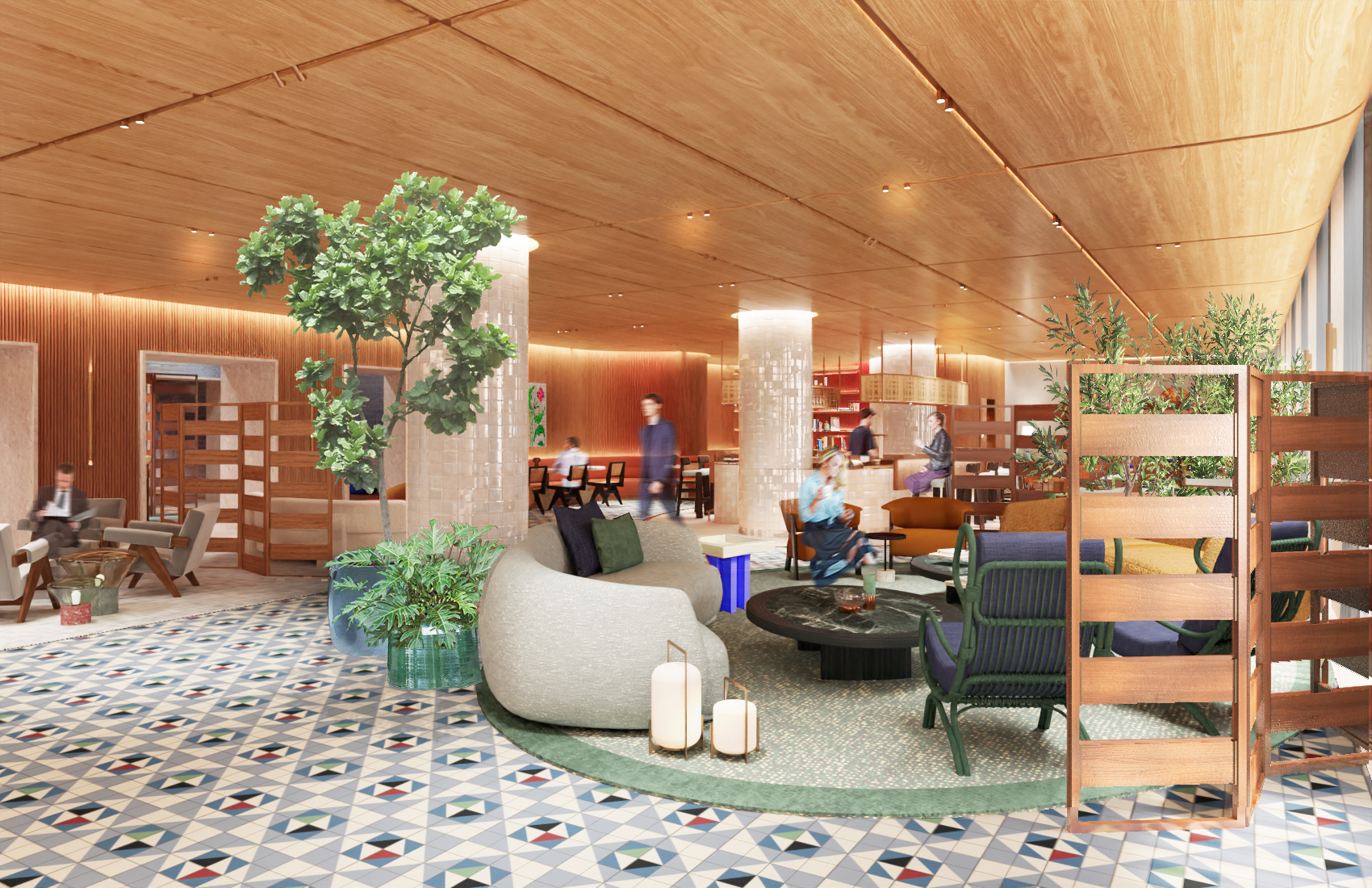
On 11 March 2026 the Praça do Comércio acquired a new tenant, and the Patricia Urquiola Andaz Lisbon opened its doors at R. do Comércio 132 — a 170-key conversion by Patricia Urquiola for Hyatt’s Andaz lifestyle brand, with Lisbon practice Moerschel Arquitectos as architect of record. It is Hyatt’s first Andaz in Portugal, the first opening since the brand’s refresh, and the sixth hotel in a Urquiola lineage that already runs through Lake Como, Milan, Rome and Knightsbridge. The Baixa address overlooks the Tagus from the river edge of the 18th-century Pombaline grid; the building itself is older than the hotel and considerably older than the lifestyle category it has been enrolled into. What Urquiola has done is a reading rather than a rebuild.
R. do Comércio 132
The address is load-bearing. R. do Comércio runs east-west along the northern edge of Praça do Comércio, the riverfront plaza laid out after the 1755 Lisbon earthquake by the Marquês de Pombal’s reconstruction commission as the formal hinge between the Tagus and the inland city. The Pombaline grid that fans out behind it is one of the earliest large-scale examples of regularised seismic-resistant urbanism in Europe — the gaiola pombalina, a wooden cage structure intended to flex rather than collapse — and the four-storey arcaded blocks that frame R. do Comércio are products of that programme. The Andaz building sits on the south side of the street, three blocks east of the Arco da Rua Augusta, with its principal elevation oriented toward the plaza and the river.
The 170 rooms and suites — including four Arch Suites whose windows track the arcade rhythm of the façade — have been arranged across the building’s existing floorplate rather than driven through a tower extrusion. The Baixa’s height controls would not have permitted a tower in any case; what the constraint produces is a hotel that reads, from the plaza, as continuous with its neighbours. Moerschel Arquitectos handled the architecture of record, which in a Lisbon heritage conversion of this scale means the seismic re-engineering, the integration of mechanical systems through walls that cannot be drilled at will, and the negotiation with the municipal preservation regime that governs every Pombaline elevation. The visible work is Urquiola’s; the work that is not visible — the work that allows the visible work to exist — is Moerschel’s.
The ground floor opens to two food-and-beverage rooms behind the arcade: the Andaz Lounge, which functions as the hotel’s lobby and informal day bar, and Bar Z, the dedicated cocktail room. A spa and a permanent gym are planned; for the opening, a Technogym-equipped temporary gym occupies the gym’s eventual footprint. The rooftop, where most of the hotel’s public choreography lives, is given over to Luzzi, the destination restaurant. Between the arcaded ground floor and the rooftop, the building is essentially residential in its organisation — corridors, room doors, suites — and the interior argument is made room by room rather than through a grand spatial gesture.
Trade-route materials
Urquiola’s stated brief was to use the building’s interior surfaces to trace Portugal’s historical reach. The country’s trade-route history — the early-modern circuit through Mozambique, Angola, Cape Verde, Goa, Brazil, Japan and Macau — is not, in this reading, a postcolonial flourish layered over a contemporary hotel; it is the actual material specification. The palette begins with local Lioz stone, the cream-and-pink limestone that has been quarried in the Lisbon basin since the Roman period and used in every major civic project from Jerónimos Monastery to the post-earthquake reconstruction itself. Lioz appears in the lobby flooring, in vanity tops, and in the threshold details where the hotel meets its existing masonry shell.
Above and around the stone, the inventory shifts to materials whose histories run outward from Iberia. Cork — Portugal’s signature export, harvested from the Quercus suber of the Alentejo — is used as wall panelling and as upholstery substrate in selected public-room seating. Mosaic and ceramic tiles, the azulejo idiom that Portugal absorbed from Moorish Andalusia in the 15th century and then exported back across the Atlantic, line the bathrooms and recur as accent panels in the corridors. Mahogany, rattan and wood panelling carry the Brazilian and East-Indian trade lines; velvet, deployed sparingly on lounge furniture and bedheads, picks up the Macau-via-Canton silk circuit that ran through the Estado da Índia for three centuries.
The room interiors compress the same argument into 35 square metres of standard guest accommodation. Bathrooms are tiled in red-and-white — the tile is the colour memo — with glossy red walls and Byredo bath products on the vanity. The rooms themselves are finished in wood panelling, with rattan and mahogany accents reading as colonial-revival without descending into pastiche. Urquiola’s recurring move, here as in her other hospitality work, is to load the interior with enough material specificity that the room feels distinct from the brand template, while leaving the brand template’s basic gestures — the welcome ritual, the open-format lobby, the in-room hospitality bar — intact.
The colour discipline matters. Urquiola has not used Portugal’s trade-route history as a justification for an everything-everywhere palette. The reds are concentrated in the bathrooms. The Atlantic blues are concentrated on the rooftop. The Lioz cream-and-pink stays on the ground floor. The wood panelling that does the bulk of the room finishing is a single tone, with the rattan and mahogany breaking that tone in specific accent positions. The hotel is dense with material referents but not visually noisy — a distinction that separates Urquiola’s better hospitality work from the cluttered “international eclectic” register that most lifestyle hotels in this category default to.
Luzzi rooftop, Atlantic blue
The rooftop restaurant is named Luzzi and is run by chef Bruno Alves. The menu is positioned as “modern Lusitanian” — an awkward marketing phrase that in practice means seafood-forward Portuguese cooking with technique borrowed from the contemporary Iberian fine-dining canon. The room is the strongest piece of decorative argument in the hotel. The floors are blue, in a deep saturated Atlantic register that reads, from a corner banquette, as continuous with the actual Tagus visible through the windows. The chairs are upholstered, the lighting is low and warm, and the bar runs along the inland edge of the room so that the seating faces the water.
The Luzzi floor is the most explicit Urquiola gesture in the hotel — a single colour move whose effect is to merge the room with the view. It is also the move that pays back the brief’s geographic argument most directly. Portugal’s trade-route history is, at its base, a maritime history; the country’s reach outward was not by caravan but by ship, and the relevant historical surface is not a road but the Atlantic. To make the floor of the rooftop restaurant read as that water is to compress the building’s entire material thesis into a single decision. It is the kind of move that surfaces on Instagram before it surfaces in a review, which is to say it is also a commercially sharp piece of interior design.
Alves’s kitchen, behind the choreography, is its own argument. The “modern Lusitanian” framing places Luzzi inside a small cluster of Lisbon and Porto destination restaurants — Belcanto, Alma, the Vila Joya outpost, the Henrique Sá Pessoa rooms — that have, over the last decade, pulled Portuguese cooking into a fine-dining register comparable to the Catalan and Basque benchmarks. Hotel-restaurant economics being what they are, Luzzi does not need to win a star to justify itself; it needs to fill its 80-odd covers twice a night, three hundred and sixty days a year, with a mix of guests and locals. The Atlantic-blue floor and the Praça do Comércio view are the half of that brief Urquiola has solved. Alves is the other half.
The art programme
The art programme is curated by Federica Sala, who is the same curator running the cultural programming at Loro Piana’s Casa Brera in Milan. Sala’s signature is a roster of mid-career and emerging European artists working in textile, ceramic and craft media rather than blue-chip canvases — a programmatic choice that suits a hotel interior in which the material substrate is already doing a lot of work. At Andaz Lisbon, three names anchor the programme. Beatrice Bonafini has supplied cork works that read as both painting and substrate sample, picking up the Alentejo cork already deployed elsewhere in the building. Rosarinho Andrade has produced the textile commissions, with the Portuguese-Mozambican backstory that the trade-route brief was always going to want. Farinha Rosa has supplied a sequence of abstract diptychs distributed across the public floors.
The programme’s logic mirrors the material programme’s logic. Sala has not assembled a collection of named-artist trophies; she has assembled a coordinated set of commissions in which the medium of the work — cork, textile, paint on paired panels — extends the brief that the architecture is already executing. The art is not on the wall to be looked at as a separate object; it is on the wall as an additional finish layer. Hotel art programmes routinely fail because the curatorial brief is incompatible with the interior brief — too dominant, too neutral, too unrelated. Sala’s Andaz Lisbon programme has the inverse problem solved by design: the art and the interior are working off the same set of references, and the result reads as continuous rather than additive.
Patricia Urquiola Andaz Lisbon in the hotel lineage
The Andaz Lisbon is the sixth hotel in a Urquiola lineage that now spans a decade. The trajectory is consistent in some ways and notably restless in others, and the cleanest way to read it is in order. Room Mate Giulia, opened in Milan in 2016 in the building adjacent to the Galleria Vittorio Emanuele II, was the first urban hotel in the catalogue. Il Sereno Lago di Como, also 2016, was the first stand-alone lakeside hotel, with both architecture and interiors. Six Senses Rome, opened in 2023 in the converted Palazzo Salviati Cesi Mellini near the Pantheon, was her first historic-palazzo hotel and her first Six Senses commission. Casa Brera in Milan — the Marriott Luxury Collection property, distinct from the Loro Piana townhouse on the same street — followed in 2024. The Emory in Knightsbridge, also 2024, gave her a single signature-suite floor inside an all-suite Maybourne property with multiple named architects sharing the floors. Andaz Lisbon, in 2026, is the largest and most operator-templated of the six.
| Year | Hotel | City | Building / context | Operator |
|---|---|---|---|---|
| 2016 | Room Mate Giulia | Milan | Building adjacent to Galleria Vittorio Emanuele II | Room Mate Hotels |
| 2016 | Il Sereno Lago di Como | Torno (Como) | New-build lakeside hotel | Sereno Hotels |
| 2023 | Six Senses Rome | Rome | Palazzo Salviati Cesi Mellini, near the Pantheon | Six Senses (IHG) |
| 2024 | Casa Brera | Milan | Milan, Brera district | Marriott Luxury Collection |
| 2024 | The Emory | London | Knightsbridge, signature-suite floor | Maybourne Hotel Group |
| 2026 | Andaz Lisbon | Lisbon | R. do Comércio 132, Baixa, Pombaline arcaded block | Hyatt (Andaz) |
Read across the six, the lineage tells a specific story. Urquiola began with hospitality projects in which she was the only author on the visible interior — Room Mate Giulia and Il Sereno are both top-to-bottom Urquiola jobs. The Six Senses Rome commission expanded the brief to architecture and interiors of a major historic palazzo, with the operator’s templated wellness programme layered over a Urquiola shell. Casa Brera (2024, Marriott Luxury Collection) and The Emory (2024) were each a step closer to the operator-led model, with The Emory’s signature-floor arrangement explicitly limiting her authorship to one floor of a multi-architect building. Andaz Lisbon completes that movement: a major branded operator (Hyatt), a refreshed lifestyle template, an architect of record holding the building together, and Urquiola supplying the full interior concept within the operator’s parameters.
What stays constant across the six is the material discipline. Stone-and-textile pairings, restricted colour palettes deployed room-by-room, art programmes curated to extend the interior rather than punctuate it, and an underlying conviction that a hotel interior is at its strongest when it makes a specific geographic argument rather than a generic luxury one. Il Sereno’s interiors read as Lake Como; Six Senses Rome reads as Pantheon-quarter Rome; Andaz Lisbon reads as Tagus-edge Lisbon by way of the Estado da Índia. The lineage is consistent at the level of method.
Andaz, after the refresh
Andaz as a brand was launched by Hyatt in April 2007 as the group’s first lifestyle brand. The name is a Hindi-Urdu word commonly glossed as “personal style”, chosen to mark a deliberate break from the corporate Hyatt vocabulary. The first Andaz hotel opened in November 2007 as the rebranded Great Eastern Hotel in Liverpool Street, London — a 19th-century railway hotel that Hyatt had acquired and re-clad with the new identity. The Andaz template that emerged from the London opening and its immediate successors (Andaz 5th Avenue in New York, Andaz Amsterdam Prinsengracht, Andaz Tokyo Toranomon Hills, Andaz Mayakoba on the Yucatán) has a small set of recurring features: an open-format lobby that functions as the lounge and the check-in desk simultaneously, an emphasis on locally referenced art and material programmes, a free in-room minibar of regional snacks and drinks, and a generally less formal service register than the parent Hyatt brand.
By the early 2020s the template had started to age. Lifestyle hotels — the category Andaz had partly invented in 2007 — had proliferated, and the Andaz vocabulary was no longer distinct from a long list of competitors (1 Hotels, the Standard, the various Marriott Bonvoy lifestyle brands, Hyatt’s own Thompson and Alila acquisitions). The brand refresh that Hyatt has signalled across the 2024–2026 cycle is the response. Andaz Lisbon has been positioned, in Hyatt’s own communications, as the first opening since that refresh — which makes it both a hotel and a brand-positioning statement.
What the refresh appears to mean, read off the Lisbon property, is two things. First: a stronger commitment to a single named designer as the visible author of the interior, rather than the white-label hotel-interior practices that handle the bulk of the lifestyle category. Urquiola’s name is on the project; the project is being marketed with her name attached; the brand has decided that the named-designer model — the model that Hermès uses with its hotel partnerships, that Loro Piana uses with De Cotiis, that Tom Dixon uses with his own Mua Mua project — is the model Andaz will use going forward. Second: a sharper geographic specificity in the material and curatorial programme. Andaz hotels have always promised local reference; the Lisbon brief takes that promise literally and runs it through every surface in the building.
Hyatt has separately announced plans to add four further properties in Portugal by 2027. Whether any of those is a second Andaz is not yet on the record; what is on the record is that Hyatt is treating Lisbon as the lead market in a Portuguese expansion, and that the Andaz brand is the lead vehicle for the lifestyle-segment portion of that expansion. The Lisbon opening is therefore both a hotel and a beachhead.
The thesis, restated
The Andaz Lisbon is the first opening of a refreshed brand template, the sixth hotel in Urquiola’s hospitality catalogue, and the most operator-templated project she has signed to date. Read as a hotel, it is a careful Pombaline conversion with a strong rooftop room, a coherent material brief, and a curated art programme that extends the interior rather than competing with it. Read as a brand statement, it is Hyatt’s argument that the Andaz template — open lobby, local references, less-formal service — is more durable when it is delivered through a named designer with a track record long enough to give the project a distinct character. Read as the latest entry in Urquiola’s hotel lineage, it is the project in which her practice meets a major hotel operator on the operator’s terms and still produces a building that reads as hers. The three readings are compatible. The hotel works because all three are simultaneously true.
The Tagus, from the Luzzi floor, looks the colour of the floor. That is the kind of detail you build a hotel around — or, if you are Urquiola in her sixth hospitality project, the kind of detail you arrive at because the brief, the building, and the trade route all happened to point in the same direction. Andaz Lisbon is the place where they meet.
Related reading: Patricia Urquiola at Cassina, Moroso and Effe for her furniture and product catalogue; Fashion-house hotel takeovers 2026 for the broader hotel-takeover lineage; Kengo Kuma’s Capella Kyoto for the architect-hotel parallel; Tom Dixon’s Mua Mua hotel for the designer-hotel parallel.