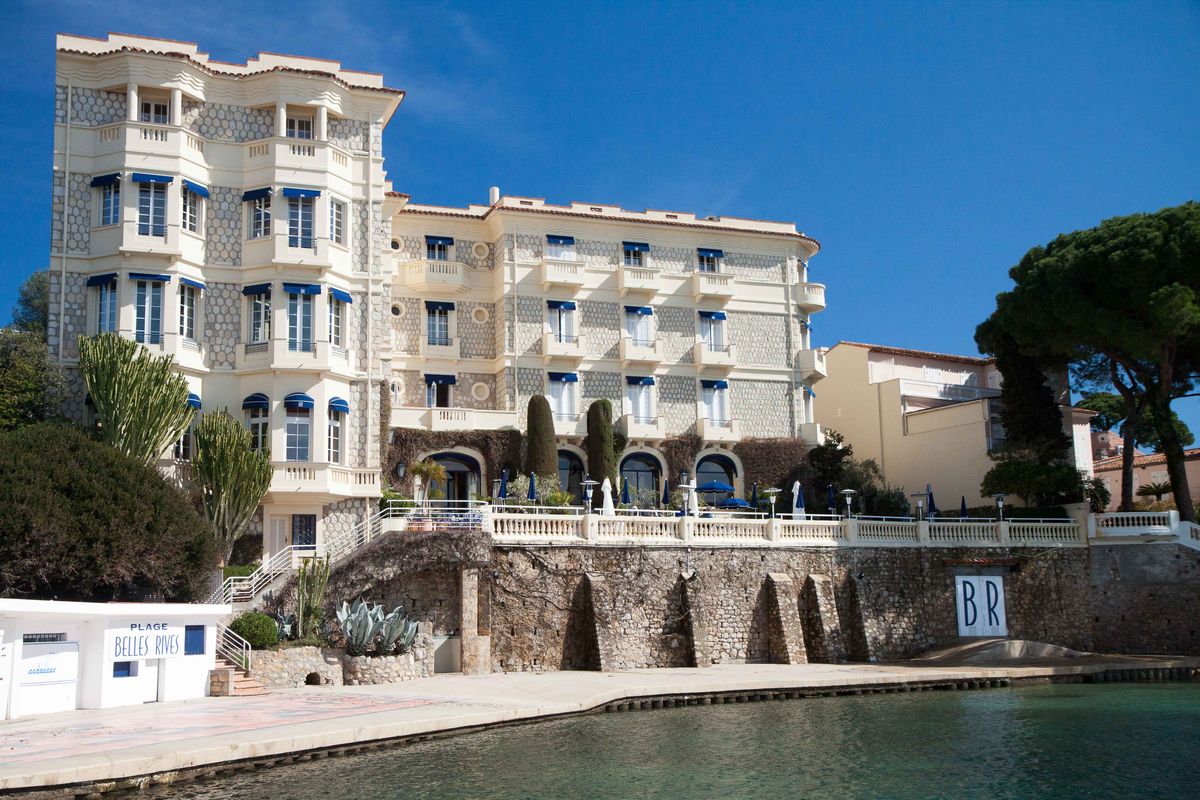
On 14 May 2026 the navy Burberry check went up on the sun loungers, parasols and deck chairs of the Hôtel Belles Rives in Juan-les-Pins, signage reading “Burberry Cap d’Antibes” screwed to the jetty, and the fashion hotel takeovers 2026 calendar acquired its loudest summer chapter. Daniel Lee, chief creative officer at Burberry since September 2022, is the named author; the Estène-Chauvin family, who have run the 43-room Art Deco hotel since Boma and Simone Estène bought Villa Saint-Louis in 1929 and opened it as Hôtel Belles Rives in 1930, are the hosts. The residency runs to 30 September 2026 and arrives in a year already crowded with houses moving into hospitality real estate: Loro Piana’s Casa Brera in Milan, Tom Dixon’s Mua Mua at Mulino Estate, Hermès at Capella Kyoto, and the Chanel Cruise show at Casino Municipal de Biarritz. The pattern is not a coincidence.
Burberry at Hôtel Belles Rives, Cap d’Antibes
Hôtel Belles Rives sits at 33 Boulevard Edouard Baudoin, 06160 Antibes, on the lip of the Mediterranean where Juan-les-Pins meets the rocks of Cap d’Antibes. The building was Villa Saint-Louis before it was a hotel. F. Scott Fitzgerald rented Villa Saint-Louis from 1925 through 1926 and wrote significant portions of Tender Is the Night on its terrace; the hotel still operates Bar Fitzgerald off the lobby and the Michelin-starred La Passagère as its waterfront restaurant. The 1929 acquisition by Boma and Simone Estène converted the villa into a 43-room hotel, and the property has stayed in the family for four generations; the current operator is the Estène-Chauvin line. Belles Rives is a member of Small Luxury Hotels of the World, not a chain property — there is one of it, and it has 43 keys and a 1920s lift.
What Burberry has done is a wrap rather than a renovation. The house has clad the beach club’s sun loungers, parasols, towels and deck chairs in the navy variant of the Burberry check; the wooden boards of the terrace and the lacquered planks of the jetty carry the same pattern in painted strips; the brass-gated Art Deco lift inside the hotel has been re-skinned in check fabric; and the entrance signage along the boulevard has been swapped to read “Burberry Cap d’Antibes” in the house’s serif. The 43 rooms remain the hotel’s own — Burberry has not skinned guest interiors — but the public-facing geometry of the property, from the sea-side approach by boat through the beach club to the lobby bar, now reads as a single piece of Burberry choreography for the four-month window between May and the end of September.
The campaign that anchors the residency is the High Summer 2026 advertising work by Ryan McGinley, shot on the property and on Cap d’Antibes more broadly, paired with a swimwear capsule produced in collaboration with Hunza G — the British brand whose crinkle-textured stretch fabric has been the lido staple of the last decade. Lee’s gloss for the project is on the record: “A lido holds a particular kind of nostalgia for the British. The moment the sun comes out, we make the most of the weather.” The line is doing several jobs at once. It claims a British vernacular for the lido — a borrowed Italian word — and it claims, on behalf of the brand, the right to inhabit a Côte d’Azur property whose mythology is American (Fitzgerald) and Italian-French (the inter-war Riviera) rather than British. The Burberry argument is that the lido is now an English idiom because Burberry has decided it is.
The strategic context: Burberry was founded in 1856 in Basingstoke by Thomas Burberry, has been listed on the LSE since 2002, and appointed Joshua Schulman as chief executive in July 2024 after the brand’s revenue and share price stumbled through 2023–2024. Lee, who ran Bottega Veneta from 2018 to 2021 and arrived at Burberry in September 2022, is now the longest-tenured creative director of any of the four major British listed luxury houses. The Belles Rives residency is the largest single piece of brand real-estate Lee has signed his name to, and it is positioned not in London or Manchester but on the Mediterranean, at a hotel whose existing clientele — old French Riviera, Italian, increasingly American and Gulf — is exactly the customer Schulman’s turnaround plan needs to convert.
Loro Piana’s Casa Brera as Precedent
The Belles Rives takeover does not read as an invention if you have spent any time inside Casa Brera, the Loro Piana project that opened during Milan Design Week 2026 at Via Solferino 11. The address is a four-floor 19th-century townhouse a block north of the Pinacoteca di Brera, restored over three years by the Genoese architect Vincenzo De Cotiis, with cultural programming directed by Federica Sala. Loro Piana opened Casa Brera as the brand’s permanent Milan house — not a flagship store, not a pop-up, but a residence in the literal sense, with private dining rooms, a library, ground-floor retail integrated as a domestic interior rather than a sales floor, and rotating exhibitions of textile and craft commissions assembled by Sala.
The precedent matters because Casa Brera proves out the operational thesis the Belles Rives residency is testing at a larger scale. Loro Piana’s bet is that the house’s textiles — vicuña, baby cashmere, the heavy Pecora Nera wools — read more credibly in a domestic context than on a retail rack, that the customer who buys a 12,000-euro overcoat wants to encounter the fabric on a sofa and a wall before they encounter it on a hanger. De Cotiis’s restoration leans into this: rough lime plaster, oxidised brass, the brand’s own fabrics used as wall covering in two of the upper-floor rooms, no logos visible from the street. The townhouse opened to coincide with MDW 2026 but is now a permanent piece of the brand’s Milan footprint, and the new chief executive — Frédéric Arnault, installed at Loro Piana in 2026 — has signalled that the Casa Brera template will be replicated in two further cities over the next eighteen months.
The Burberry move at Belles Rives is the temporary, summer-only, leased version of the Casa Brera argument. Loro Piana bought the townhouse and renovated it; Burberry has rented a hotel and applied a check. The economics are different by an order of magnitude — a four-month residency at a 43-room hotel costs a fraction of a three-year heritage renovation in central Milan — but the strategic logic is identical: place the brand inside a hospitality envelope, let the architecture and the existing clientele do half the work of communicating quality, and avoid the diminishing returns of conventional advertising.
Tom Dixon’s Mua Mua and the Twelve-Room Showroom
The third move of the fashion hotel takeovers 2026 season was Tom Dixon’s Mua Mua Hotel, a twelve-room installation staged at Mulino Estate during Milan Design Week 2026 and now transitioning to a permanent property. Mulino Estate is the rural compound a short drive north of Milan whose buildings are signed by Piero Portaluppi (1929) and Gio Ponti — two of the most over-determined names in 20th-century Italian architecture, and a context that Dixon’s industrial-rough-luxe vocabulary should, on paper, fight against. It did not fight. The Mua Mua installation occupied all twelve guest rooms, plus the main dining hall and the courtyard, and dressed them with Dixon’s own fixtures and a roster of manufacturing collaborators: Vispring for the beds, Coalesse for the lounge seating, VitrA for the bathrooms, Ege Carpets on the floors, and Prolicht handling architectural lighting.
The Mua Mua thesis differs sharply from Loro Piana’s and Burberry’s. Tom Dixon is not a fashion brand wearing a hospitality skin — it is a furniture and lighting house that has decided the hotel is the natural showroom for objects that the trade does not buy from a catalogue. The twelve rooms are not for sale as a hotel experience first; they are a demonstration that the lamp, the bed, the carpet, the sink and the chair can hold together at the scale of a complete room. Dixon’s bet, and the bet of the collaborators who underwrote it, is that contract buyers — the developers and operators who specify hotel interiors — will commission the rooms more readily after sleeping in them than after seeing them in a stand at Salone. The Mulino Estate property is now transitioning to permanent hotel operation, which means the showroom never has to be struck.
Read against Burberry, Mua Mua is the inverse case. Dixon’s brand sells objects designed to be installed; Burberry’s sells objects designed to be worn. Dixon needs the hotel to be a sustained, ongoing demonstration; Burberry needs the hotel for the duration of a campaign cycle and a holiday season. Both, however, are using the hospitality envelope to do what the conventional showroom and the conventional store cannot: place the product inside a built context that the customer reads as habitable rather than commercial.
Hermès, Capella Kyoto, and the Kuma Detail
The Hermès position in the fashion hotel takeovers 2026 conversation is more oblique. Capella Kyoto opened in spring 2026 at 130 Komatsucho in the Higashiyama ward, in the geisha district of Miyagawa-cho, with 89 rooms; architecture by Kengo Kuma & Associates, interiors by Brewin Design Office. The hotel is operated by Capella Hotels and Resorts. Hermès is not the owner; Hermès is the long-form tenant, with a programme of pop-up exhibitions, in-room textiles and accessories, and a curatorial relationship with the property that is closer to a residency than a sponsorship. The house’s silk, leather and porcelain collections have been integrated into select suites; the Petit h workshop has supplied bespoke objects for the common areas; and the partnership extends to a programme of events tied to the Hermès Japan calendar.
The Kuma detail is the load-bearing element. The Capella Kyoto building uses charred cedar (yakisugi) cladding, deep slatted timber screens, and a sequence of internal courtyards that pull the Higashiyama urban grain inside the hotel. The architecture reads as Kuma’s Japanese vocabulary at full intensity — closer to the GC Prostho Museum Research Center than to the more international Kuma projects. Hermès’s intervention is precisely calibrated to the Kuma envelope: the brand has not applied its orange, has not introduced any element that fights the cedar and the timber. The house’s argument is that its leather and its silk speak the same craft language that Kuma’s joinery speaks, and that the appropriate display environment for the goods is one in which the brand makes the smallest possible identification claim.
The Capella Kyoto move is, in this sense, the quietest of the four. Burberry has put the check on the parasols; Loro Piana has put its fabrics on the walls; Dixon has filled twelve rooms with his lamps. Hermès has put silk in a suite and stepped back. The difference is partly structural — Capella is owned and operated by Capella, not Hermès — and partly philosophical. Hermès does not need to claim authorship of the architecture; the architecture is doing the brand’s argument for it.
Why Fashion Hotel Takeovers 2026 Look Different
The conventional explanation for fashion hotel takeovers 2026 — that brands have run out of media inventory and are buying hospitality as a substitute for advertising — is half right and badly insufficient. The deeper drivers are three. First: a four-month seafront residency tied to a campaign with a named photographer and a co-branded swimwear capsule produces a volume of magazine and broadsheet coverage — first-day photographs running across the design and fashion press in May — that a comparable spend on conventional paid media would not buy. The takeover collapses three line items (media production, hospitality activation, retail event) into one.
Second: the customer is not at the runway. The luxury customer who spends 50,000 euros and up per year on apparel and accessories is not attending Paris Fashion Week. They are at the Riviera in June, in Kyoto in October, in Milan during Salone. The houses have noticed. The hotel is where the customer already is, and the takeover is the brand’s argument that it will go to the customer rather than ask the customer to come to a flagship store.
Third: the architecture is doing work the brand cannot do alone. The Hôtel Belles Rives’s Fitzgerald association, the Casa Brera townhouse’s 19th-century bones and De Cotiis restoration, Capella Kyoto’s Kuma joinery, Mulino Estate’s Portaluppi-Ponti pedigree — these are not backdrops, they are arguments. They establish a quality floor that the brand can stand on without having to spend the years and the capital that the original building took to acquire. The brand pays a four-month lease and inherits a hundred years of architectural and cultural credibility.
This is also where the Chanel Cruise 2026/27 show at Casino Municipal de Biarritz on 28 April 2026 — Matthieu Blazy’s debut as Chanel’s creative director, 79 looks across two shows for over 900 guests — belongs in the conversation. The Biarritz casino is not a hotel and the event was not a residency, but the underlying logic is the same: lease a heritage building with an established cultural pedigree (Chanel’s first boutique opened in Biarritz in 1915), use the architecture to do half the staging work, and avoid the diminishing returns of conventional runway environments.
| Brand / House | Hotel / Venue | City | Architect / Interior Designer | Open / Run dates | Room count |
|---|---|---|---|---|---|
| Burberry | Hôtel Belles Rives | Juan-les-Pins / Cap d’Antibes | Original Art Deco (1929–30); 2026 residency by Daniel Lee | 14 May – 30 September 2026 | 43 |
| Loro Piana | Casa Brera, Via Solferino 11 | Milan | Vincenzo De Cotiis (restoration); programming by Federica Sala | Opened MDW 2026 (permanent) | n/a (townhouse) |
| Tom Dixon | Mua Mua Hotel at Mulino Estate | Milan (Mulino Estate, outskirts) | Piero Portaluppi (1929) + Gio Ponti; interiors by Tom Dixon Studio | MDW 2026, transitioning to permanent | 12 |
| Hermès | Capella Kyoto, 130 Komatsucho | Kyoto (Higashiyama / Miyagawa-cho) | Kengo Kuma & Associates; interiors by Brewin Design Office | Opened spring 2026 (permanent) | 89 |
What Daniel Lee Got Right
The Belles Rives residency works because Lee chose a building whose existing identity is already specific enough to absorb the Burberry intervention without being effaced by it. The Hôtel Belles Rives is not a generic luxury hotel; it is a 43-room Art Deco property with a Fitzgerald association, a Michelin-starred restaurant called La Passagère, a 1920s lift, and a beach club whose geometry — the wooden jetty, the rocky frontage, the slatted parasols — was designed in 1930 and has not been substantially altered. The Burberry check, applied to the parasols and loungers and signage, reads as a temporary skin on a body that will reassert itself on 1 October when the check comes down. The check is loud, but it is loud against a quiet building, and the contrast is the point. A residency at a property with less specificity — a new five-star in a new building — would have collapsed into ordinary advertising.
The second thing Lee got right is the dose. Burberry has not put the check on guest-room linens. It has not painted the lobby. It has not renamed the restaurant. The intervention sits on the public-facing, sea-side perimeter — the beach club, the terrace, the jetty, the entrance signage — where guests and passers-by encounter the brand. The hotel’s interior, where the 43 rooms are sold and slept in, remains the Estène-Chauvin family’s hotel. This is the operational distinction between a takeover and a rebrand. A takeover is a layer; a rebrand is a replacement. Lee has done a layer.
The third thing is the partner choice. Hunza G is a British brand, founded in the textile-mill heritage of the north of England, whose crinkle-fabric swimwear is the lido staple that Lee’s quote claimed for Burberry. Pairing the residency with a Hunza G capsule rather than producing the swimwear in-house is a recognition that the lido-Britain argument is more credible when two British brands are making it together than when one is making it alone. The McGinley campaign is the third leg: McGinley’s photographic vocabulary — sun, water, half-clothed bodies, the colour-saturated Americana that he established with the 2003 Sun and Health portfolio — is precisely the visual register that the residency needs, and it is a register Burberry’s recent campaign work had not previously occupied.
What remains to be seen, between now and 30 September, is whether the residency converts. Burberry’s third-quarter trading update, due in October, will be the first read on whether the Belles Rives investment has moved revenue in the soft-luxury categories — outerwear, scarves, the Knight-emblem leather goods — that the brand’s turnaround depends on. The earned-media value is already substantial; the harder metric is the foot traffic at the Burberry stores in Cannes, Monaco, Nice and Milan during the four-month window, and the share of those customers who are first-time Burberry buyers. If the residency converts, the fashion hotel takeovers 2026 season will read in retrospect as the moment the British house found its missing customer-acquisition channel. If it doesn’t, it will read as a beautifully art-directed Riviera summer with no economic tail.
Coda
The pattern the season has established is durable independent of the Burberry Q3 number. Loro Piana has bought its townhouse. Tom Dixon is converting the Mulino Estate showroom into a permanent operation. Hermès’s Capella Kyoto residency is structured as a long-form tenancy, not a four-month wrap. The houses that have moved into hospitality with capital and lease length on the table are not retreating, and the houses that are watching — Bottega Veneta with Casa Bottega Veneta, Kering with the Florence strategy, the Armani group through its existing hotel operation — are not slowing down. The fashion hotel takeovers 2026 season is the load-bearing evidence for a structural shift in luxury-brand real-estate strategy that began at Casa Brera in April and reached its summer-season climax on the wooden jetty of the Hôtel Belles Rives on 14 May. The next test is the autumn re-opening of the Capella Kyoto suites in October and the announcement, expected before year-end, of the second Loro Piana townhouse city. The check comes down on 30 September. The pattern does not.