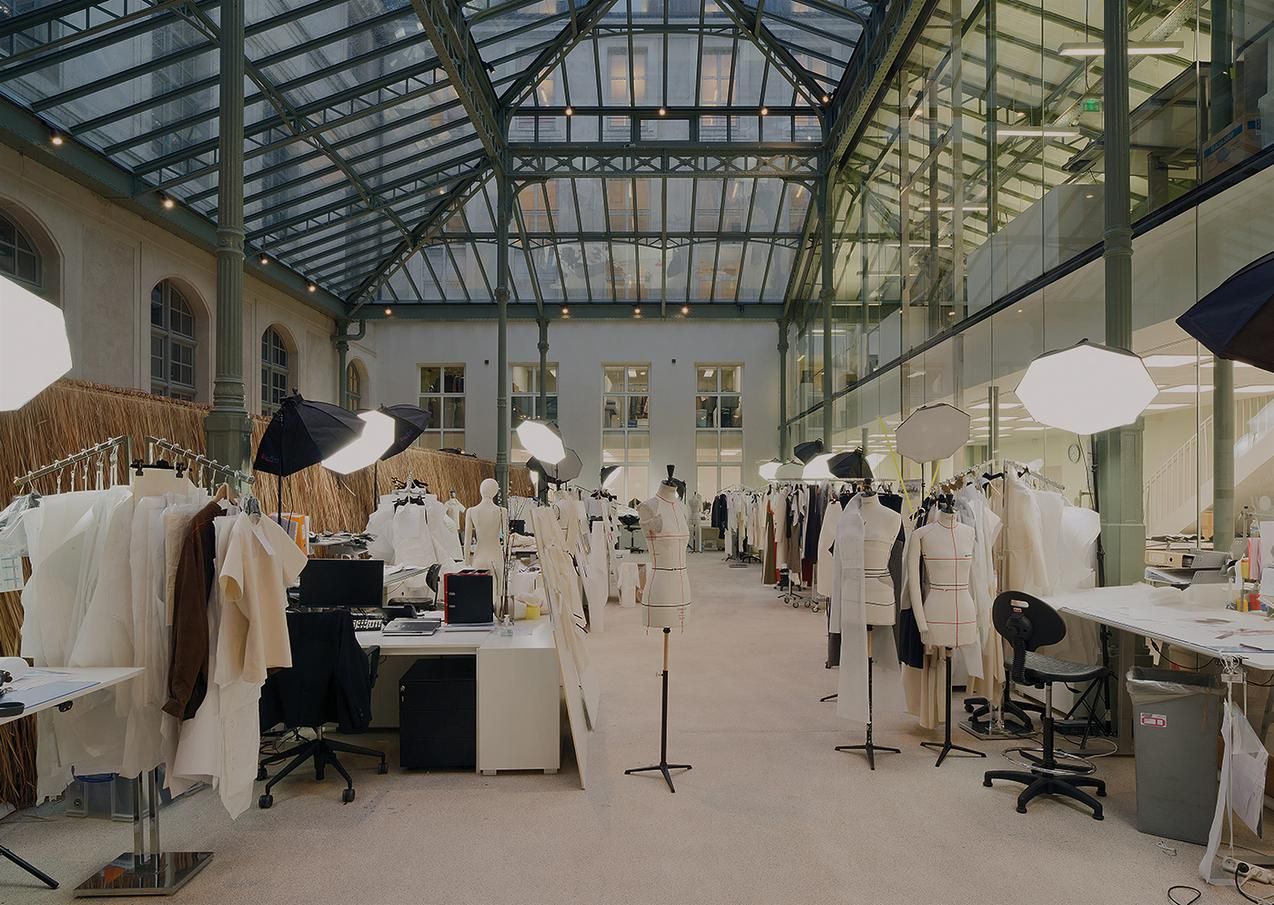
Kai Nesselrath is the eleventh designer to control Carven’s studio since Marie-Louise opened the house at the Rond-Point des Champs-Élysées in 1945 — and the first hired since Kering took a minority stake in ICCF Group two months earlier. The 8 June 2026 announcement, which arrived through Business of Fashion the morning after the Trooping the Colour and three weeks before the Paris haute couture week, gave Nesselrath until October 2026 to deliver a Spring 2027 ready-to-wear collection inside a house that had run through five creative directors and one founder in the eight years since its 2018 bankruptcy. The list of Carven creative directors, read end-to-end from Marie-Louise Carven in 1945 to Kai Nesselrath in 2026, is the most discontinuous lineage in any surviving Paris house of comparable vintage. It is also, since the ICCF Group’s 2020 constitution and Kering’s April 2026 stake, the lineage most actively being rewritten in public.
This piece reconstructs that lineage as a sequence and asks the only question worth asking on the morning of Nesselrath’s announcement: what does a Saint Laurent-trained womenswear head designer, hired by a Franco-Chinese parent in which Kering now holds equity, inherit from a house that opened in 1945 with an idea about dressing women under five-foot-three? Very little of the silhouette, and almost all of the brand-recognition problem.
Marie-Louise Carven (1945–1993): the petite-couture founder
Carmen de Tommaso was born in Châtellerault on 31 August 1909 and died, having outlived three of her successors’ tenures, on 8 June 2015. She opened the maison in 1945, having merged her first name’s diminutive (Marie) with her mother’s maiden name (Carven), on the operational premise that she was five-foot-one and the Paris couture of the 1940s did not cut for women like her. The first show produced a green-and-white striped cotton dress called Ma Griffe, which the house then released as a perfume in 1946. Both are the only Marie-Louise inventions still in commercial production at any scale.
From 1945 to 1993 — forty-eight years — Marie-Louise cut, fitted and signed every Carven collection, ran the house as a private couture business, and built the tertiary network of perfume, accessories and licensing deals that funded the atelier. She sold the maison in 1993, at eighty-four, and the house entered a five-year licensing dormancy in which the Carven name circulated on goods she had not approved. She lived another twenty-two years and never returned to the studio.
The founder’s silhouette — fitted bodice, full skirt, knee hem, juvenile collar, scaled for a body under 160 cm — is the only design vocabulary in the Carven archive that predates the 1998 reset. Every subsequent creative director has had to decide what to do with it. Most have ignored it. Guillaume Henry, alone among them, treated it as a brief.
Daniel Harlant and Pascal Millet (1998–2008): the perfume-businessman reset
Daniel Harlant, a French perfume executive, acquired Carven in 1998. The acquisition was a perfume play: the Ma Griffe license was the asset Harlant wanted. The couture house was an attached liability. For the first three years, Carven shipped no ready-to-wear and no haute couture — only perfume, scarves and licensed accessories.
In 2001, Harlant installed Pascal Millet — a French couturier with prior years at Givenchy and Carolina Herrera — as artistic director, with a brief to revive the couture line. Millet held the title from 2001 to 2008, longer than any post-founder appointee until Guillaume Henry. He showed couture collections under Harlant’s ownership, but the press attention was thin and the commercial returns thinner. By 2008 Harlant’s perfume-licensing model had failed to scale the couture house, and the maison was again on the block. The 2008–2009 transition passed through several intermediate hands.
Guillaume Henry (2009–2014): the contemporary-RTW pivot
Guillaume Henry — French, with prior tenures at Givenchy under Riccardo Tisci and at Paule Ka — was named creative director of Carven in 2009. His brief was to convert Carven from a perfume-licensing shell into a contemporary ready-to-wear house at a price-point between the high-street and the luxury market: roughly the slot Maje, Sandro and The Kooples were beginning to occupy.
Henry’s five-year tenure is the most commercially successful in the post-Marie-Louise register and remains the only post-founder run with a coherent silhouette. He took the founder’s juvenile-collar, knee-length, fitted-bodice vocabulary and re-cut it for a contemporary client: A-line dresses in neoprene and double-faced cotton, Peter Pan collars on cropped jackets, jewel-button cardigans, ankle-strap kitten heels. The Spring 2012 collection produced the contrast-collar shift dress that the house re-issued under three subsequent directors and that remains the only post-founder Carven garment with continuous archive status.
Henry left in October 2014 for Nina Ricci, where he held the creative-director title from 2014 to 2018, then moved to Patou. He is, in 2026, the only post-founder Carven creative director who has subsequently held two further creative-director chairs at named Paris houses. His Carven run is the benchmark every subsequent appointment has fallen short of.
Alexis Martial and Adrien Caillaudaud (2014–c. 2017): the co-directorate
Henry’s exit produced the first co-creative-director appointment in the house’s history. Alexis Martial and Adrien Caillaudaud — both French, both formerly members of Henry’s own studio — were promoted internally and named co-creative directors of womenswear in late 2014. The decision to promote internally was cheap and continuity-preserving.
The Martial-Caillaudaud collections, running from Spring 2015 through roughly 2017, maintained the Henry silhouette without extending it. The trade treated the appointments as a placeholder. The collections retained the contrast-collar shift, the kitten heel and the cotton A-line, but introduced no new garment vocabulary, and the commercial line did not grow at Henry’s rate. By 2017 the ownership was looking for a name appointment from outside the studio. The co-directorate is the only entry in the lineage that exited without a public farewell collection.
Serge Ruffieux (February 2017 – November 2018): Dior-interim into the bankruptcy
Serge Ruffieux — Swiss, formerly a Dior studio designer — arrived in February 2017 with the strongest CV of any post-Henry appointment. He had served as interim co-creative director of Dior womenswear with Lucie Meier between Raf Simons’s 2015 exit and Maria Grazia Chiuri’s 2016 arrival. The Dior-interim line on his CV was the credential Carven’s then-ownership was buying.
Ruffieux’s twenty-one-month run produced four ready-to-wear collections — Fall 2017 through Fall 2018. The silhouette pivoted away from Henry’s contemporary-juvenile vocabulary toward a more architectural, draped register that read as a softened transposition of his Dior work. The collections were respectfully received and commercially soft. Carven filed for bankruptcy in May 2018 and entered an auction process. Shanghai-based Icicle Fashion Group — founded 1997 by Ye Shouzeng and Tao Xiaoma — acquired the maison in October 2018 for €4.2 million. Ruffieux’s contract was explicitly excluded from the asset purchase. The Fall 2018 show was his last and the last Carven runway for five and a half years.
The ICCF interregnum (November 2018 – February 2023): the no-runway years
Between Ruffieux’s November 2018 exit and Louise Trotter’s February 2023 appointment, Carven was the property of a Shanghai parent rebuilding the house’s distribution before it rebuilt its design directorate. The Franco-Chinese parent was formally constituted as ICCF Group — Icicle-Carven China France — in 2020 (some sources date 2021), headquartered in Paris but capitalised from Shanghai.
The four-year interregnum produced look-book collections, pre-collections and licensing pushes, but no named creative director and no Paris runway. The label remained on shelves in selected European and East Asian markets, but the brand’s editorial profile in Paris collapsed. By late 2022, Carven had been off the official Paris fashion week calendar longer than any of the other houses founded between 1945 and 1955 that remained nominally in operation.
Louise Trotter (February 2023 – January 2025): the runway return
Louise Trotter — British, born 1969, prior creative-director tenures at Joseph and at Lacoste — was announced as Carven’s creative director in February 2023. Her four years at Lacoste, repositioning the polo-shirt house’s ready-to-wear into a sportswear-adjacent silhouette, were the credential ICCF was buying. Her brief was the one ICCF had deferred for four years: bring the house back onto the official Paris fashion week schedule.
She did it in seven months. The Spring 2024 collection, presented in Paris in September 2023, was the first Carven runway since Fall 2018 — five and a half years between shows, the longest gap in the lineage. The silhouette was Trotter’s reading of the Marie-Louise founder vocabulary at scale: A-line, knee-length, fitted bodice, sportswear-derived outerwear, a deliberate refusal of the Henry-era juvenile collar. The trade read it as the first Carven collection since 2014 that had a defensible reason to be on the Paris schedule.
Trotter ran two further seasons — Fall 2024 and Spring 2025 — before her January 2025 exit. Her departure was the inverse of every other Carven exit: she was not let go and the house was not on the block. Louise Trotter was hired away to succeed Matthieu Blazy at Bottega Veneta in 2025, after Blazy moved to Chanel. The Carven exit is a Kering-poach line on Trotter’s CV. ICCF’s response — to promote internally — followed the same operational logic that had produced the Martial-Caillaudaud co-directorate eleven years earlier.
Mark Thomas (March 2025 – April 2026): the head-of-sartorial promotion
Mark Howard Thomas — British, Central Saint Martins-trained, with prior senior design roles at Lacoste, Helmut Lang, Joseph, Givenchy and Neil Barrett — had joined Carven in 2023, simultaneously with Trotter’s arrival, as head of sartorial. When Trotter exited in January 2025, ICCF Group promoted Thomas to design director in March 2025.
The Thomas appointment was the second internal promotion in the lineage and the first to carry the design-director title rather than the creative-director title — a legible signal that ICCF was reorganising the studio’s reporting line away from the externally-imported, signature-driven model. Thomas presented Fall 2025, Spring 2026 and Fall 2026, which the trade read as the cleanest tailoring run the house had produced since the Henry years. The silhouette was sharper than Trotter’s, more structured at the shoulder; the colour palette narrowed to cream, charcoal and oxblood.
Thomas exited in April 2026, eleven months into the design-director title. The departure coincided, within weeks, with the announcement of Kering’s minority stake in ICCF Group via Kering’s House of Wonders initiative — and the Thomas exit and the Kering deal are, in the financial-press reading, two halves of the same transition. The next Carven creative director would be hired by a parent in which Kering held equity.
Kai Nesselrath (June 2026 – ): the Saint Laurent studio graduate
Kai Nesselrath — Italian of German descent, trained at Polimoda, the Accademia di Belle Arti di Roma and Central Saint Martins — was announced as design director of Carven on 8 June 2026. He had briefly worked at Chanel before joining Anthony Vaccarello’s studio at Saint Laurent in 2016, where he had risen, over a decade, to head designer of womenswear. His debut runway is set for the Spring 2027 collection, to be presented in Paris in October 2026.
The appointment is legible in three frames. First, it is the latest entry in the Vaccarello-studio alumni register: ten years inside the avenue George V studio, a head-designer line on the CV, a creative-director chair at another house. Second, it is the first Carven appointment hired under an ownership structure in which Kering holds equity, and the first to carry the design-director title under that structure. Third, it is the first appointment in the post-Marie-Louise lineage whose predecessor’s silhouette (Thomas’s structured tailoring) and predecessor’s predecessor’s silhouette (Trotter’s A-line sportswear) are both commercially defensible inheritances rather than legacies to be repudiated.
The brief is to extend the structured-tailoring register Thomas had begun, against the founder’s petite-couture archive, with a Saint Laurent-trained eye for evening and ready-to-wear continuity. The Spring 2027 collection will be the first Carven runway under the Kering-ICCF capital structure and the first Saint Laurent-trained directorate in the house’s eighty-one-year history. The Vaccarello-studio vocabulary — high-waisted, sharp-shouldered, monochrome eveningwear with a tailoring spine — is the closest reference point the trade has for what the collection is likely to look like.
Carven creative directors, 1945–2026
| Designer | Years | Provenance | What they shipped |
|---|---|---|---|
| Marie-Louise Carven (Carmen de Tommaso) | 1945–1993 | Founder; Châtellerault, born 1909 | Ma Griffe dress (1945) and perfume (1946); the petite-couture silhouette; forty-eight years of in-house couture; the licensing network |
| (Licensing dormancy) | 1993–2001 | Corporate buyer (1993); Daniel Harlant acquires 1998 | No named director; perfume and accessories licensing only |
| Pascal Millet | 2001–2008 | French couturier; Givenchy and Carolina Herrera alumnus; installed by Harlant | Couture revival collections under Harlant ownership; thin press attention; no contemporary RTW line |
| Guillaume Henry | 2009–2014 | French; Institut Français de la Mode; Givenchy under Tisci; Paule Ka | The contemporary-RTW pivot; contrast-collar shift dress; A-line in neoprene; Peter Pan collar; kitten heel; the only post-founder silhouette with continuous archive status |
| Alexis Martial + Adrien Caillaudaud | 2014–c.2017 | Promoted from Henry’s studio; internal continuity hires | Henry-silhouette continuation; no new garment vocabulary; no public farewell collection |
| Serge Ruffieux | Feb 2017 – Nov 2018 | Swiss; ECAL; Dior interim co-creative director with Lucie Meier (2015–2016) | Four RTW collections (Fall 2017 – Fall 2018); architectural-draped pivot; contract excluded from Icicle’s October 2018 €4.2m acquisition |
| (ICCF interregnum) | Nov 2018 – Feb 2023 | Unnamed internal studio under ICCF Group (constituted 2020/2021) | Look-books, pre-collections, no Paris runway; the longest no-runway gap in the lineage |
| Louise Trotter | Feb 2023 – Jan 2025 | British, b.1969; Joseph; four years at Lacoste | Spring 2024 RTW (Sept 2023) — first Carven runway since Fall 2018; A-line sportswear-adjacent silhouette; three runway seasons; exited to Bottega Veneta |
| Mark Thomas | Mar 2025 – Apr 2026 | British; Central Saint Martins; Lacoste, Helmut Lang, Joseph, Givenchy, Neil Barrett; joined Carven 2023 as head of sartorial | Three runway seasons (Fall 2025, Spring 2026, Fall 2026); structured-tailoring sharpening; the first design-director title in the lineage |
| Kai Nesselrath | Jun 2026 – | Italian of German descent; Polimoda, Accademia di Belle Arti di Roma, Central Saint Martins; brief Chanel stint; Saint Laurent under Vaccarello (2016–2026), womenswear head designer | Debut runway: Spring 2027 collection, Paris Fashion Week, October 2026 |
The Marie-Louise problem, ICCF version
Every successor in this lineage has had to negotiate the same archive question: the founder was a couturier, the brand is named after her, and the silhouette she invented is the only design vocabulary in the archive that predates the corporate reset. The gap between the founder’s exit and the next coherent appointment was sixteen years (1993 to Guillaume Henry’s 2009 arrival), and the corporate reset has happened twice — first under Harlant in 1998, then under Icicle and ICCF Group in 2018. Marie-Louise lived to see the first reset and died in June 2015, eight months after Henry’s exit.
The ICCF reset is structurally different from the Harlant reset. Harlant treated Carven as a perfume licence with a couture liability attached. ICCF has treated it as a ready-to-wear brand that needs Paris runway placement, a head-of-sartorial bench, and (since April 2026) a luxury-conglomerate partner with the distribution muscle to scale the wholesale book. Kering’s minority stake is the first time in Carven’s eighty-one-year history that the house has been capitalised by a Paris luxury conglomerate. The Nesselrath appointment is the first creative-director hire under that capital structure.
The Marie-Louise silhouette has not, since Henry’s 2014 exit, been treated as a working brief by any of the four subsequent appointees. Trotter softened it into sportswear; Thomas sharpened it into tailoring; Nesselrath is likely to translate it into the Saint Laurent monochrome-evening register he learned under Vaccarello. None of these readings restores the founder’s vocabulary the way Sarah Burton’s Bettina-blouse reissue restored Hubert’s at Givenchy. The Carven archive, in 2026, is less a brief than a brand-recognition asset.
What carries forward into Spring 2027
Three elements have survived all ten post-founder transitions: the Ma Griffe perfume line, continuous since 1946; the Carven name itself, which no subsequent owner has altered; and the Rond-Point des Champs-Élysées address as the founder’s reference point. Everything else — the silhouette, the colour palette, the bag, the show venue, the price-point, the parent company’s nationality — has been reset on a roughly six-to-eight-year cycle since 1993. The 2026 reset under Kering-ICCF is the seventh.
Carven is the Paris house most often described in the trade as “discontinuous.” Read across eighty-one years and ten directors, that is the right word. Every appointment since 1993 has been a reset rather than an extension; every silhouette since 2014 has been built against the previous one rather than out of the founder’s archive; every parent since 1998 has had a different operational thesis. Nesselrath, hired by an ICCF Group in which Kering now holds equity, is the first directorate in the lineage to inherit a defensible silhouette from his predecessor and a defensible capital structure from his parent. Whether he extends what Thomas and Trotter began or resets the house again — for the seventh time since Marie-Louise’s 1993 exit — will be visible on the Paris runway in October 2026. The eleventh entry on the lineage has eighteen weeks to draw a collection.