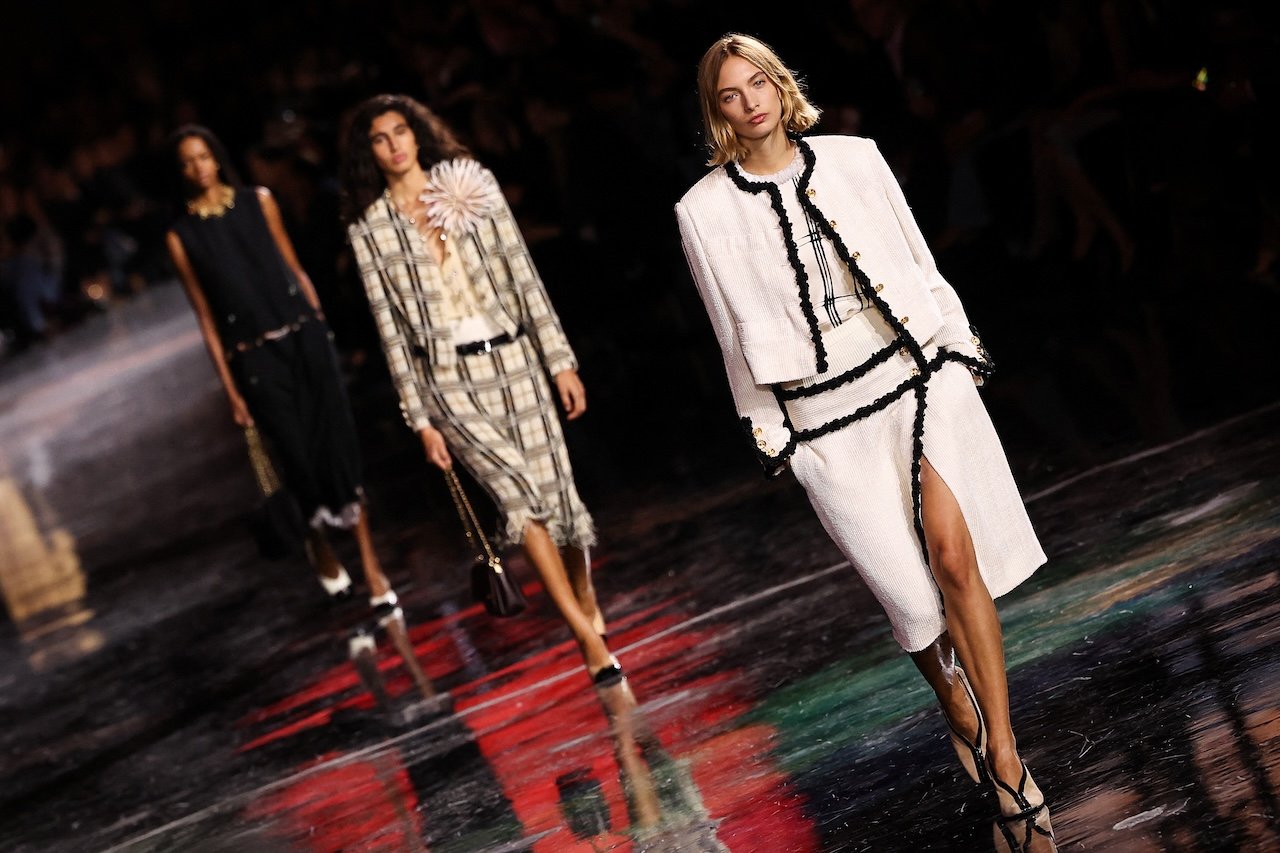
Matthieu Blazy’s eighteen-month walk from Bottega Veneta to Chanel produced a USD 19.3 billion house’s first “high single-digit” growth quarter — and three Margiela-Margiela-Simons stops on a single CV that Leena Nair calls “one of the most talented designers in the world.” The Matthieu Blazy career, traced strictly by appointment date, runs through six houses in nineteen years: Raf Simons’s independent label in 2007, Maison Margiela couture from 2010, Celine under Phoebe Philo from 2014, Calvin Klein 205W39NYC under Simons again from 2016, Bottega Veneta from 2020, and Chanel from December 2024. The pattern matters because almost no other working creative director has been inside that many of the houses now defining 2026 womenswear — and none of them sits, today, on Chanel’s revenue.
This is the chronology, with reporting lines, signature outputs, and the calendar that produced “Blazymania” — Business of Fashion’s label for the March 2026 product cycle that pushed Chanel to #1 on the Lyst Index Q1 2026.
Margiela twice and Raf Simons in between, 2007–2014
Blazy was born on 27 June 1984 in Paris. His father is French, his mother Belgian; he was raised between the two countries and graduated from La Cambre in Brussels in 2007. The graduate collection was built around the Franco-Spanish astronaut Claudie Haigneré, the first European woman to visit the Mir space station. Raf Simons sat on the La Cambre jury that year, and the hire happened in the room: Blazy joined Simons’s independent menswear label in 2007 and stayed until 2009.
That first stop matters because it set the apprenticeship pattern. Simons in the late 2000s was running a Belgian-Antwerp-trained design studio that took graduates from La Cambre and Antwerp’s Royal Academy and ran them through a menswear-first program in which the studio fitted, cut, and toiled garments at couture intensity. Blazy was inside that studio at the exact moment Simons was being courted by Jil Sander — Simons would take the Jil Sander creative directorship in 2005 and run it through 2012 — and so the work environment Blazy spent his first two professional years inside was effectively a couture-trained menswear studio that doubled as the Jil Sander women’s pre-collection room.
In 2010 he moved to Maison Margiela in Paris. The role was unusual: he was put on the Artisanal couture line — Margiela’s haute couture-equivalent program — and on the women’s ready-to-wear pre-collections. The Artisanal line under Margiela had no named designer; the studio had been anonymous since the brand’s founding in 1988, and Martin Margiela himself had stepped back in 2009. Blazy’s identity inside the studio was not made public until 2014, when Suzy Menkes named him in Vogue in July of that year. By that point he had spent four years building Artisanal couture pieces — reconstructed leather jackets, glove dresses, deadstock-fabric one-offs — under the studio’s collective anonymity.
The Margiela stop is the most important formal training of the Matthieu Blazy career. Three things came out of it. The first was the Artisanal vocabulary of trompe-l’oeil construction: garments that read as one thing and were materially another — a sweater that was actually a dress, a tailored jacket built from a single piece of saddle leather, a t-shirt printed and seamed to read as a denim shirt. The second was a leather discipline learned across couture-intensity glove and jacket work that the Margiela studio had inherited from its founder, including the deadstock-fabric reconstructions that defined Artisanal across the Renzo Rosso ownership period after OTB acquired the brand in 2002. The third was the production rhythm of a studio that ran couture and pre-collections in parallel, which would become his operating model at Bottega Veneta a decade later. None of this work was credited to him at the time; the Margiela house style was collective anonymity until John Galliano took over the women’s line in October 2014 and began signing his Artisanal collections under his own name.
Celine under Phoebe Philo, 2014–2016
In November 2014, four months after the Menkes piece, Blazy joined Celine in Paris as a senior designer on the pre-collections under Phoebe Philo. He was 30 years old. The Philo Celine of 2014–2016 was, at that moment, the most influential women’s ready-to-wear studio in the LVMH portfolio: a six-collection-a-year operation built around a pared, masculine, materially-luxe vocabulary that had begun in 2008 and would continue until Philo’s October 2017 exit.
What Blazy worked on at Celine is harder to source precisely than the Margiela period — pre-collections at LVMH-owned houses are not credited individually — but the work environment is well documented. The Philo studio at Celine ran fittings on the designer’s body, kept silhouette decisions late into the calendar, and was built around a small senior-designer cohort with disproportionate influence over the resort and pre-fall deliveries that drove most of the brand’s wholesale revenue. Blazy spent two years inside that operating model.
He left Celine in 2016. Philo would stay through October 2017, when she exited the house and LVMH announced Hedi Slimane as her successor — a transition that effectively closed the 2008–2017 Celine that Blazy had been part of. Slimane’s Celine erased the accent, renamed the house “Celine” with no diacritic, and rebuilt the brand around a different silhouette vocabulary entirely. The two years Blazy spent inside Philo’s Celine are now a finite, archived period — and one of the only working studios from that era to have produced a generation of senior creative directors.
Calvin Klein 205W39NYC, 2016–2018
In August 2016, Blazy reunited with Raf Simons in New York. Simons had been named chief creative officer of Calvin Klein on 2 August 2016, and rebranded the collection line as Calvin Klein 205W39NYC after the brand’s Seventh Avenue headquarters. Blazy was hired as design director of women’s ready-to-wear, reporting to Simons. The studio also pulled in Pieter Mulier as creative director and a handful of Antwerp-trained designers around the senior team.
Calvin Klein 205W39NYC, from its September 2017 debut through its December 2018 closure, was the most explicit Americana project in modern luxury ready-to-wear. The collections quoted Andy Warhol — Simons had signed a multi-collection agreement with the Warhol Foundation in 2017 — drew on cowboy and small-town-prom iconography, and used the Sterling Ruby–designed runway space at 205 West 39th Street as a fixed scenographic frame. The collection won the CFDA’s Womenswear and Menswear Designer of the Year prizes simultaneously in 2018, the first time a single label had taken both in one cycle.
It also lost money. Calvin Klein’s parent PVH took roughly $35 million in restructuring charges in 2018 and announced the collection’s shutdown in December 2018. Simons left, Mulier left with him, and Blazy left the house. The 205W39NYC studio, in two and a half years, had produced four runway collections and one continuous Americana-as-couture argument — and PVH closed the experiment when wholesale buyers stopped writing orders.
For Blazy specifically, the Calvin Klein period closed a Simons cycle that had started in 2007. He had now worked under Simons twice — once in Antwerp as a graduate menswear designer, once in New York as a women’s RTW design director — across an eleven-year span. He did not work under Simons again. (Simons would go on to co-direct Prada women’s with Miuccia Prada from April 2020 onward, in a parallel reporting structure unique to Prada.)
Bottega Veneta, 2020–2024: the trompe-l’oeil thesis
Blazy joined Bottega Veneta in 2020 as ready-to-wear design director under Daniel Lee. Lee had been the house’s creative director since June 2018, succeeding Tomas Maier, and had rebuilt Bottega around a small set of redesigned leather pieces — the Pouch clutch, the Cassette bag, square-toe footwear — and a green-on-green identity that drove three years of double-digit growth at Kering. Blazy spent roughly eighteen months inside that operating model as Lee’s RTW lead.
In November 2021, Kering announced Lee’s exit and named Blazy creative director of Bottega Veneta. Lee moved to Burberry on 3 October 2022 as chief creative officer, succeeding Riccardo Tisci. The Bottega succession was the cleanest internal handoff in recent luxury memory: Blazy already knew the studio, the supply chain, and the Vicenza leather workshops, and Kering moved the appointment with minimal interim period.
Blazy’s first runway show, FW22, ran on 27 February 2022 at the Palazzina San Fedele in Milan, an industrial space the studio had built out as a black-floored runway. The show opened with a look that became the thesis statement of his entire Bottega tenure: a pair of “jeans” that were not denim. The trousers were nappa leather, hand-printed and stitched to read as washed indigo five-pocket denim from twenty feet away, and as soft Vicenza-grade leather from arm’s length. Roughly 70 looks followed in the same register. The press wrote it up as “Margiela’s trompe-l’oeil grammar arriving inside a Kering-owned leather house” — which is exactly what it was.
The signature designs accumulated quickly. The Andiamo bag launched in Spring/Summer 2023 — a soft Intrecciato top-handle that became the studio’s first new bag silhouette under Blazy. The Cabat, a Tomas Maier-era smooth-leather tote first introduced in 2001, was revived in Fall/Winter 2024 in heavier, hand-cut leather panels. The Hop and the Liberta followed. None of these were logo bags; all of them were leather-construction arguments. The Intrecciato weave was reintroduced across the studio’s full leather output, including footwear and small leather goods.
The commercial result inside Kering’s accounts was the cleanest performer in the group during a difficult cycle for Gucci and Saint Laurent. Bottega did not break out single-brand revenue in Kering’s reporting structure, but the segment that contained it grew through 2022–2024 against falling group revenue overall, and analyst notes through 2024 named Bottega specifically as Kering’s “structurally healthy” brand. The Andiamo bag’s introduction in early 2023 anchored what the trade press began calling the “quiet luxury” cycle that summer — though Blazy’s own register at Bottega was never strictly quiet so much as materially overbuilt, with leather pieces priced at the top of the segment and casting that included Tilda Swinton in the FW23 campaign images. Wholesale buyers reported Bottega’s RTW sell-through as the highest of any Kering brand across the 2023–2024 fiscal cycles.
In December 2024, Chanel announced Blazy as creative director. In January 2025, Kering named Louise Trotter — then at Carven, having previously run Joseph and Lacoste — as his Bottega successor. Trotter exited Carven on 24 January 2025 and her first Bottega show ran on 27 September 2025 in Milan, debuting Spring/Summer 2026. (The handoff sits in the broader creative-director carousel of 2025–26, alongside the Demna and Piccioli moves.)
Chanel, 2024–: what Leena Nair bought
The Chanel announcement came in December 2024, eight months after Virginie Viard’s June 2024 exit. Viard had run the house’s creative output for five years following Karl Lagerfeld’s death on 19 February 2019. The 2024 transition closed a 36-year period in which the house had been run by exactly two people — Lagerfeld from 1983 and Virginie Viard from 2019 — and opened a new era under an outside hire from a Kering-owned competitor. Chanel had never before recruited a creative director from outside its own house in the modern era. (Lagerfeld himself had been hired from Chloé in 1983, but that predates the modern conglomerate hire pattern.)
The corporate context for the hire is documented in detail elsewhere — see the Biarritz cruise debut piece for the April 2026 first show and the 23 Rue Cambon real-estate move that paralleled it. What matters here is the reporting line and the calendar.
Blazy reports to CEO Leena Nair, who joined Chanel on 31 January 2022 from Unilever, where she had been chief human resources officer from 2016 to 2022. Nair holds an MBA from XLRI Jamshedpur, where she was the gold medallist of her 1992 class. She was appointed CBE in 2025. She is the first luxury CEO of Indian origin. Chief financial officer Philippe Blondiaux has held the role since 2014. The Chanel that Blazy walked into is privately held by the Wertheimer family, with no debt, no public-market quarterly reporting, and one of the deepest cash reserves in luxury.
The first ready-to-wear show ran on 6 October 2025 at the Grand Palais in Paris — Spring/Summer 2026, 77 looks, approximately nine months of preparation between the December 2024 appointment and the October 2025 runway. The collection led directly into the March 2026 product drop that Business of Fashion would label “Blazymania.”
The May 2026 Chanel earnings disclosure put numbers on what that meant. 2025 revenue: USD 19.3 billion / EUR 16.6 billion, with comparable growth of 1.8% (3% at reported rates) and operating profit of USD 4.7 billion. Nair and Blondiaux cited a “high single-digit” growth trajectory for 2026 following the March product hit. Chanel ranked #1 on the Lyst Index Q1 2026 — the first appearance of the house on that ranking. 41 stores were added in 2025; 30 more are planned for 2026.
Nair’s public framing of Blazy has been disciplined. She has called him “one of the most talented designers in the world” while simultaneously cautioning, “We are a 110-year-old brand. We try not to be too distracted by the hype or frenzy.” The two sentences read together describe the operating posture: a privately-held house with a generational creative-director hire, refusing to price the hire as a stock-style event, while booking the revenue it produces.
Matthieu Blazy career, 2007–2025
| Year(s) | House | Role | Reporting To | Signature output |
|---|---|---|---|---|
| 2007–2009 | Raf Simons (independent label, Antwerp) | Menswear designer | Raf Simons | First professional menswear collections post-La Cambre |
| 2010–2013 | Maison Martin Margiela (Paris) | Designer, Artisanal couture and women’s RTW pre-collections | Margiela studio (anonymous) | Artisanal couture pieces, glove dresses, reconstructed leather; identity revealed by Suzy Menkes, Vogue, July 2014 |
| Nov 2014–2016 | Celine (Paris, LVMH) | Senior designer, pre-collections | Phoebe Philo | Pre-collection ready-to-wear inside the 2008–2017 Philo studio |
| Aug 2016–Dec 2018 | Calvin Klein 205W39NYC (New York, PVH) | Design director, women’s ready-to-wear | Raf Simons | Americana RTW collections; CFDA Womenswear and Menswear Designer of the Year, 2018 |
| 2020–Nov 2021 | Bottega Veneta (Milan, Kering) | Design director, ready-to-wear | Daniel Lee | RTW direction during the late Lee era |
| Nov 2021–Dec 2024 | Bottega Veneta (Milan, Kering) | Creative director | Kering executive committee | Trompe-l’oeil leather “jeans” FW22; Andiamo SS23; Cabat revival FW24; Hop, Liberta |
| Dec 2024– | Chanel (Paris, Wertheimer family) | Creative director | Leena Nair (CEO) | SS26 RTW debut at the Grand Palais, 6 October 2025, 77 looks; Biarritz cruise April 2026; “Blazymania” March 2026 product cycle |
Coda
The Matthieu Blazy career is, read end-to-end, a single eighteen-year argument about how a couture-trained ready-to-wear designer should be built: Antwerp-graduate menswear under Simons, anonymous Artisanal couture at Margiela, two years of pre-collection discipline under Philo at Celine, a women’s RTW design directorship inside Simons’s Americana experiment at Calvin Klein, four years of leather-construction authorship at Bottega, and a debt-free privately-held house that has just booked its first “high single-digit” growth trajectory on the back of his March 2026 deliveries. Six houses, three of them now closed chapters in luxury history (205W39NYC, Philo’s Celine, the Lagerfeld–Viard Chanel), and one of them — Chanel under Nair and Blazy — the most expensive single creative bet in the room. The CV reads, in 2026, like a piece of fashion strategy that was assembled deliberately, one stop at a time.