Hiroshi Fujiwara’s 3 June 2026 Bang & Olufsen capsule is the 22nd named Fragment Design collaboration in 22 years — and the first to push the double lightning-bolt cabinet from a USD 36 Pikachu keychain and a USD 150 Air Jordan 1 Low all the way to a GBP 53,000 made-to-order Beosystem 9000c. Reading the Fragment Design collaborations as one cabinet, from the 2002 HTM Air Force 1 to a Struer-built stereo cabinet in 2026, is the cleanest way to see how a Tokyo graphic studio has spent two decades acting as the single most prolific co-sign engine in global product culture.
This piece is an inventory by category, not a profile. It counts the named co-signs across footwear, fashion, audio and objects, and reads them against the labels Fujiwara ran before Fragment existed — the 1988 Tokyo record label Major Force and the 1990 streetwear label Goodenough — that supplied the language Fragment now applies elsewhere.
Before Fragment: Major Force 1988, Goodenough 1990
The Fragment cabinet does not begin in 2003. It begins in 1988, when Fujiwara — then twenty-four, returned from London and the Malcolm McLaren orbit — co-founded Major Force in Tokyo with Toshio Nakanishi, K.U.D.O., Gota Yashiki and Kan Takagi. Major Force is consistently described as the first Japanese hip-hop label. Its catalogue handled the basic engineering work that Fragment would later apply to other categories: taking an imported visual and sonic vocabulary, redrawing it through Tokyo distribution, and reselling it back to the audience that had supplied the source.
In 1990 Fujiwara launched Goodenough, his first streetwear label, sold initially through Nowhere — the Harajuku shop he co-ran with Nigo and Jun Takahashi. Goodenough’s T-shirt-and-jacket programme established the visual restraint that would later become Fragment’s house tone: black, white, navy; one logo position; minimal text; a graphic that reads at fifteen metres. Fragment Design was incorporated in Tokyo in 2003 as a separate vehicle for the work Fujiwara was doing outside Goodenough — the brand-to-brand commissions that did not fit a streetwear shop’s shelf. The double lightning bolt followed.
Footwear: HTM and the Air Jordan 1 Fragment
Fujiwara’s footwear work with Nike predates Fragment Design as a registered brand. HTM, launched at Nike in 2002, takes its name from the initials of its three principals: Hiroshi (Fujiwara), Tinker (Hatfield, the Air Jordan designer), and Mark (Parker, then Nike’s brand president and later CEO). The brief was simple: take a Nike silhouette already in the catalogue, upgrade the materials and the construction to a level Nike’s mainline manufacturing could not justify at scale, and release the result in deliberately small numbers.
The HTM debut in 2002 was a premium-leather Air Force 1 — the same silhouette Nike had been selling since 1982, rebuilt in tumbled hides and stitched in lower volumes. HTM then ran across a string of upgraded models: an HTM Air Jordan 3 in 2003, HTM Air Woven, HTM Footscape, and, more recently, the HTM Flyknit Trainer that previewed the Flyknit construction Nike then pushed across its running line. HTM was the proof of concept that a Tokyo collaborator could reach into the Beaverton catalogue.
The market-defining Fragment object is the Air Jordan 1 Retro High OG “Fragment”, released in 2014: a black-and-white Air Jordan 1 with a royal-blue Swoosh and toe panel, the double-lightning-bolt logo on the heel, and a small Fragment hit on the tongue. The shoe priced as a normal Air Jordan 1 retail at release; the resale market re-priced it almost immediately and has held that re-pricing for more than a decade. It is the model the rest of the Fragment Jordan catalogue is measured against.
The next inflection was Travis Scott. The Travis Scott x Fragment x Air Jordan 1 dropped in two stages in 2021: the High via SNKRS raffle on 29 July 2021, then the Low at USD 150 via SNKRS on 13 August 2021. The colourway grafted Travis Scott’s reverse-Swoosh signature onto the Fragment lightning-bolt language and split into two palettes — a military-blue High and a black-toe Low. The drop established that Fragment’s Nike cabinet could absorb a second co-sign on top of itself without thinning the brand.
Beyond Jordan, the Nike work has run across Air Max 1 Fragment editions, the Zoom Spiridon “Black” of 2017, multiple Free TR / Free Flyknit colourways, and small-numbers HTM upgrades that act as the cabinet’s seasonal pulse. The economics across the Nike pillar are consistent: Nike supplies the silhouette and the factory; Fragment supplies the restraint and the graphic.
Fashion: Louis Vuitton, Moncler Genius, Sacai
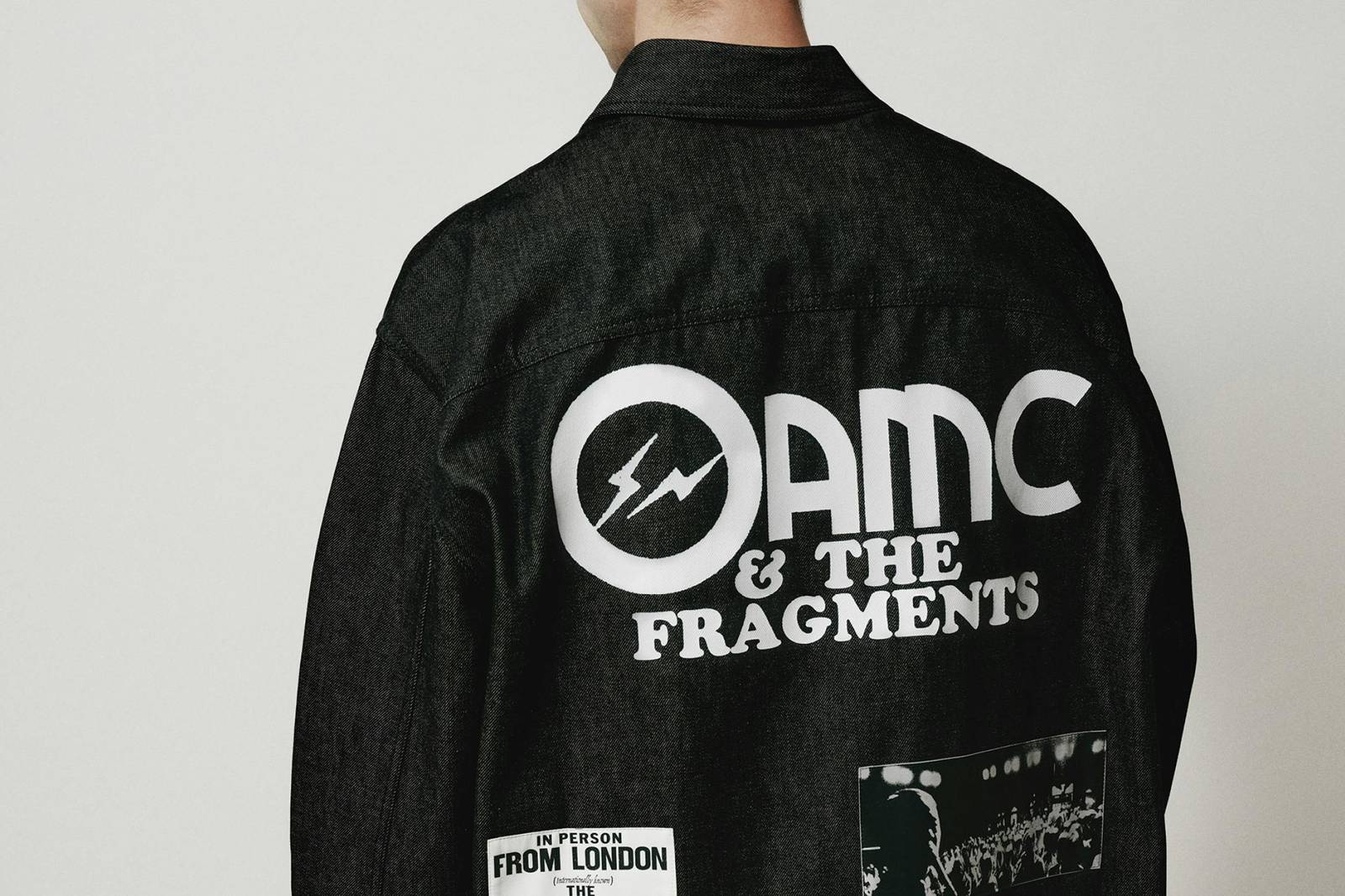
Fragment’s fashion cabinet runs through three named European houses. The first is Louis Vuitton. The Louis Vuitton x Fragment Design capsule, designed under Kim Jones as menswear artistic director, was presented as Vuitton’s pre-fall 2017 menswear delivery. The brief was unusually theatrical: the collection was themed around a fictional band, “Louis V and the Fragments”, with the lookbook staged as concert imagery and the Tokyo pop-up at the Omotesando store running 21 April to 5 May 2017. Pricing ran from USD 297 for the smallest leather goods up to USD 3,063 for the headline outerwear. The product mix bracketed every Vuitton category that mattered to a Tokyo streetwear audience: monogram canvas re-graphed with the lightning bolt, varsity outerwear, leather goods, a backpack programme and a small run of trunks.
The second is Moncler. On 20 February 2018, at Milan Fashion Week, Moncler launched Moncler Genius — its designer-by-designer reset of the house’s collaboration model — and the inaugural Genius capsule under the new framework was 7 Moncler Fragment Hiroshi Fujiwara. Fragment did not occupy a line on a wider grid; Fragment opened the grid. The line ran across down outerwear, technical knitwear and accessories, and was the test case that proved the Genius format could sustain a designer signature without diluting the parent house. Fragment has continued to deliver under the 7 numeral across subsequent Genius cycles.
The third house is Sacai, Chitose Abe’s Tokyo label. The Sacai x Fragment Design capsule of 2015 paired Abe’s hybrid construction logic with Fragment’s graphic restraint: varsity jackets, MA-1 flight jackets, graphic T-shirts and a small accessories run. The capsule mattered structurally as much as commercially — it was a Tokyo-to-Tokyo collaboration handled across two studios that share a city and a calendar but rarely share a shelf, and it pre-figured the way Sacai would later open its own collaboration cabinet to Nike, Carhartt and KAWS.
Below the named-house tier, the fashion programme runs through Levi’s — the long-running Levi’s Fenom x Fragment line, which carries Fragment-branded denim through Tokyo distribution and has produced enough denim that resale pricing tracks vintage Levi’s pricing rather than current-season — and through The Conran Shop, whose Daikanyama store reopening in 2022 launched with a Conran x Fragment homewares capsule.
Audio and Objects: Bang & Olufsen, TAG Heuer, Pokemon
The audio cabinet is new. The Fragment x Bang & Olufsen capsule was announced for a Tokyo pop-up at Isetan Shinjuku opening 20 May 2026, with a global retail release on 3 June 2026. The four-object product list runs across the B&O cabinet: the Beoplay H100 over-ear headphone at GBP 1,700; the Beosound A1 third-generation portable speaker at GBP 350; the Beosound Shape modular wall system at GBP 5,300; and, Japan-exclusive, a made-to-order Beosystem 9000c integrated audio piece priced from GBP 53,000. All four objects ship in monochrome with hand-polished anodized aluminum and the Fragment lightning bolt etched on the metalwork. The 2026 launch is also the file under which Fragment first commissions a European industrial-craft house outright rather than co-signing a sneaker or a jacket — a structural inversion already discussed in the Japanese craft x western designers 2018–2026 inventory.
The watch line is TAG Heuer. The TAG Heuer Formula 1 x Fragment Design, released in 2020, is a monochrome 43-millimetre quartz chronograph in black with the Fragment lightning bolt at six o’clock and a Hiroshi Fujiwara signature on the case back. The piece slotted into the Formula 1 line at a deliberately accessible price point; the Fragment-marked version sold through immediately at the Tokyo distribution points.
The character-IP line runs through Pokemon. The Thunderbolt Project by FRGMT and Pokemon was set up in 2018, taking its name from the Japanese “Inazuma” lightning motif that connects the Pokemon Pikachu silhouette to the Fragment double-bolt logo. The most replicable single drop is the Pikachu plush keychain released on 22 January 2022 at USD 36 — the cheapest object in the Fragment cabinet, and the one that has produced the most resale velocity per dollar of retail.
The food-and-beverage tier is Starbucks Reserve Roastery Tokyo. The Nakameguro Reserve Roastery opened in 2019 in a Kengo Kuma–designed four-storey timber-and-concrete building on the Meguro River cherry-blossom corridor; Fragment supplied the launch merchandise — totes, ceramics, glassware — that carried the lightning bolt against the Starbucks Reserve mark.
Fragment Design collaborations, 2002–2026 (selected)
| Year | Partner | Project | Notes |
|---|---|---|---|
| 2002 | Nike (HTM) | Premium-leather Air Force 1 | HTM debut; Fujiwara + Hatfield + Parker |
| 2003 | Nike (HTM) | HTM Air Jordan 3 | Second HTM, expanding HTM into Jordan |
| 2014 | Nike (Jordan) | Air Jordan 1 Retro High OG “Fragment” | Black/white with royal-blue Swoosh; market-defining |
| 2015 | Sacai | Sacai x Fragment Design capsule | Chitose Abe varsity, MA-1, graphic tees |
| 2017 | Louis Vuitton | LV x Fragment pre-fall 2017 menswear | Kim Jones; “Louis V and the Fragments”; Tokyo pop-up 21 Apr–5 May 2017 |
| 2018 | Moncler Genius | 7 Moncler Fragment Hiroshi Fujiwara | Inaugural Genius capsule, Milan Fashion Week 20 Feb 2018 |
| 2018 | Pokemon | Thunderbolt Project by FRGMT & Pokemon launches | “Inazuma” lightning motif programme |
| 2019 | Starbucks Reserve Roastery Tokyo | Nakameguro opening merchandise | Kengo Kuma–designed roastery on Meguro River |
| 2020 | TAG Heuer | Formula 1 x Fragment Design chronograph | Monochrome 43mm; lightning bolt at 6 o’clock |
| 2021 | Nike (Jordan) / Travis Scott | Travis Scott x Fragment x Air Jordan 1 High and Low | High raffle 29 Jul 2021; Low USD 150 SNKRS 13 Aug 2021 |
| 2022 | Pokemon | Thunderbolt Project Pikachu plush keychain | USD 36, drop 22 Jan 2022 |
| 2022 | The Conran Shop Tokyo | Conran x Fragment homewares | Daikanyama store reopening capsule |
| 2026 | Bang & Olufsen | Fragment x B&O four-object capsule | Beoplay H100, Beosound A1, Beosound Shape, Beosystem 9000c (GBP 1,700–53,000+) |
Reading the cabinet: pricing, restraint, calendar
Three patterns repeat across the cabinet. The first is pricing range. The Fragment co-sign sits comfortably from USD 36 (the 2022 Pikachu plush keychain) to GBP 53,000 (the 2026 Beosystem 9000c, made to order). No other single contemporary streetwear brand routinely operates across that three-and-a-half-order-of-magnitude spread on the same logo. The logo holds because the restraint holds.
The second is the restraint itself. Fragment graphics are almost always monochrome — black-on-white or white-on-black — with the double lightning bolt as the only mark that has to read at distance. Where colour appears, it is single-colour and load-bearing: the royal-blue Swoosh on the 2014 Jordan 1, the military blue on the 2021 Travis Scott High. The Bang & Olufsen capsule’s hand-polished anodized aluminum is the same logic applied to metalwork: one finish, one mark, no decoration.
The third is calendar. Fujiwara releases on his own schedule, not Tokyo Fashion Week’s and not Paris’s. The Louis Vuitton capsule opened in a Tokyo pop-up before the global rollout. The Moncler Genius capsule used Milan but used it on Fragment’s terms — opening the grid rather than slotting into it. The Bang & Olufsen capsule launches at Isetan Shinjuku ten days before its global retail date. The pattern is consistent: Tokyo is the launch surface, and the rest of the world is the second window.
What the 2026 B&O capsule does to the cabinet
The Bang & Olufsen capsule is the first Fragment object whose unit economics depend on industrial-grade European craft rather than Asian streetwear manufacturing. The Beosystem 9000c is built in Struer; the cabinet metalwork is finished by hand; the GBP 53,000-plus price is closer to a piece of collectible audio engineering than to a sneaker resale comp. It signals that the Fragment cabinet has reached the point at which Fujiwara is the buyer, not the supplier — a Tokyo studio commissioning a hundred-year-old Danish house to apply its own finish vocabulary to the lightning-bolt brief.
The capsule also closes a loop on the timeline. The earliest Fragment Design work in 2002 — the HTM Air Force 1 — was a Tokyo designer being trusted to upgrade a Nike silhouette. The 2026 Fragment x B&O capsule is the same Tokyo designer being trusted to commission a European industrial-craft house outright. Twenty-four years separate the two; the brief is the same. Take a catalogue object, upgrade the materials, stamp the bolt, drop in Tokyo first.
That is the entire cabinet, twenty-two named co-signs in twenty-two years, from a USD 36 Pikachu keychain to a GBP 53,000 stereo: a single Tokyo graphic studio acting as the calendar’s most disciplined upgrader, the restraint holding because the restraint is the product.