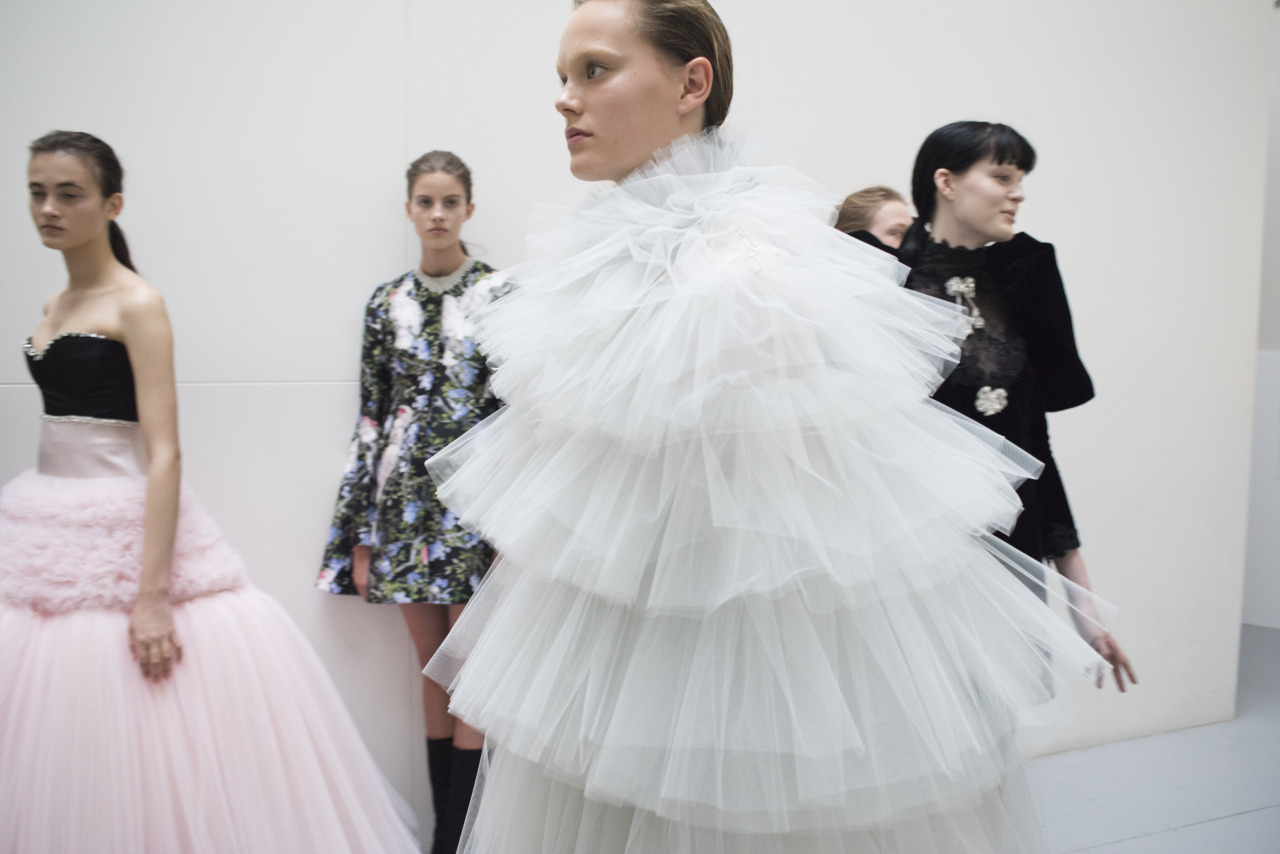
Giambattista Valli’s 20 May 2026 designer buyback from Artémis is the third clean designer reclamation since 2018 — and the first to expose how loud the difference is between a family holding (Pinault’s Artémis) and a listed luxury group (Pinault’s Kering). The three cases that actually qualify — Valli in May 2026, Stella McCartney twice (March 2018 from Kering, January 2025 from LVMH), and Phoebe Philo as a permanent founder-majority structure since October 2023 — do not form a wave. They form a small, specific pattern that gets misread every time a designer leaves a group.
This piece is the inventory. It walks the three reclamation cases, separates them from the JW Anderson non-case, and clarifies the line between Artémis the family holding and Kering the listed group that gets blurred in almost every report on the Valli transaction.
Giambattista Valli, May 2026: reading Artémis’s exit
Giambattista Valli announced the full reacquisition of his eponymous house, Giambattista Valli, from Artémis on 20 May 2026. Financial terms were not disclosed. Rothschild & Co. ran the sale for Artémis. The transaction closes a nine-year sequence that began in 2017, when Artémis — the Pinault family’s private holding controlled by François-Henri Pinault — took a minority stake. By 2021, Artémis held the majority. By May 2026, it held nothing.
The official Artémis line was that the divestment was part of “thorough reflection on the organisation of its activities,” language that signals an efficiency drive rather than a creative dispute. Valli’s own quote was sharper: the reacquisition “enables me to fully regain control of my brand.” There is no version of that sentence that is not about creative authority returning to the founder.
The signals that something was coming had already arrived. Valli cancelled his couture show in January 2026 and skipped the Fall 2026 ready-to-wear calendar. Both decisions are unusual for a couture-anchored house whose business runs on the haute couture press cycle and the related private-client diary. Neither was framed as a permanent retreat at the time. In retrospect, both look like the calendar being cleared so that the deal could close without a public-facing collection in the middle of negotiation.
The mechanism is the cleanest of the three reclamation cases. Artémis sold its full position back to the founder. There is no residual stake, no licensing tail, no minority partner held over. Valli’s house is again 100% Valli. The financial structure behind the buyback — debt, family capital, outside minority investor — has not been disclosed, and Valli’s team has declined to characterise it. Until the next filing surfaces, the public-facing fact is the same as the press release: full sale, founder back in control.
The strategic question is why Artémis was willing to sell at all. The house had been a useful diversifier alongside Christie’s and Château Latour, the two other names usually cited in Artémis’s direct portfolio. But it had also been the only fashion house in that portfolio that did not benefit from the Kering operating apparatus. Artémis kept Valli at arm’s length from Kering precisely so the latter could remain the conglomerate vehicle and Artémis could remain the private holding. By 2026, with Kering already restructuring around the Florence operational hub and the jewellery division consolidation, running a separate couture asset inside Artémis looked less like a hedge and more like overhead.
The Rothschild & Co. mandate is also informative. Artémis ran a structured sale process — banker-led, with the founder as the named counterparty — rather than a quiet hand-back. That suggests Artémis tested the market before settling on the founder bid, which in turn suggests the sale price was anchored to an external benchmark even though it was never disclosed. Founder buybacks that run through investment banks tend to land at lower headline multiples than third-party sales would have produced, on the logic that the founder is also the only credible buyer for a couture-led house whose value sits in the designer’s name. Valli’s willingness to engage that process at all says he had committed financing in place before Artémis opened the data room.
Stella McCartney, twice: 2018 from Kering, 2025 from LVMH
Stella McCartney has the only two-stage designer buyback in the modern record. Both stages were full buyouts of conglomerate minority partners. Neither is the same transaction.
Stella McCartney was founded in 2001 as a 50/50 joint venture with the Gucci Group, which became Kering. The structure was unusual at launch: a designer-led brand with a listed conglomerate as equal partner. It ran for seventeen years. In March 2018, McCartney bought back Kering’s 50%, leaving the brand fully independent for the first time. The split was framed as amicable and the rationale was straightforward — McCartney wanted to take the brand into sustainable luxury at a pace and with a capital structure that did not fit a JV with a multibrand owner.
Sixteen months later, in July 2019, she sold a minority position to LVMH. The deal was announced with a separate role for McCartney as Bernard Arnault’s personal advisor on sustainability across the LVMH portfolio. The brand became, in effect, an LVMH-affiliated independent house: founder-majority, conglomerate-minority, with a sustainability remit that ran across the group rather than across the brand.
On 27 January 2025, McCartney bought back the LVMH minority stake. Financial terms were not disclosed. The brand is again fully independent. McCartney remains LVMH’s global sustainability ambassador — a role explicitly separated from the equity question. That separation is the most interesting structural fact of the 2025 buyback: the ambassadorship is portable, the equity is not, and the two were unbundled in the same press release.
What the McCartney sequence demonstrates is that designer buybacks do not have to be one-shot transactions. They can be staged across conglomerate partners, with the founder retaining majority control throughout and using the minority slots to fund different phases of the brand’s growth. McCartney’s case is the cleanest precedent for that staged independence — Kering JV for the first seventeen years, LVMH minority for the next six, full independence from January 2025 onward — and it is the only one in the database that involved both Paris groups.
The other detail worth recording about the 2018 transaction is the brand’s growth posture immediately afterward. Within twelve months of the Kering buyback, Stella McCartney expanded into menswear, accelerated the vegan-leather Mylo and Mirum supply programmes, and reorganised the wholesale book toward fewer, larger accounts. None of those moves would have been impossible inside the Kering JV, but all of them were easier outside it. The same pattern shows up in the 2025 LVMH buyback: McCartney closed the transaction in January, restaged the runway calendar around a smaller, tighter Paris show in March, and used the autumn to relaunch the e-commerce stack on a founder-controlled platform. Buybacks tend to be followed by operational changes that were waiting for the equity structure to clear; both McCartney transactions fit that template precisely.
Phoebe Philo, never sold: independence from day one
Phoebe Philo’s case is the structural counter-example. Her house was never sold to a conglomerate in the first place, so there is nothing to buy back. It is included in this inventory because it sets the template the buyback cases are converging on: founder-majority, conglomerate-minority, direct-to-consumer.
Phoebe Philo launched her eponymous house in October 2023 with collection A1. The investment structure: an undisclosed LVMH minority position, with Philo and her husband Max Wigram as majority owners. The house is London-based, with no runway show. It has dropped A1 in October 2023, A2 in 2024 and A3 in 2025, all direct-to-consumer through phoebephilo.com with a selective wholesale partner network.
The first FORMA piece on the house, Phoebe Philo’s first object, focused on the bronze mirror that opened the first drop and what it signalled about how the brand would behave outside the runway calendar. The model is the closest thing in current fashion to what Philo did at Celine without the Phoebe Philo brand ever sitting inside the conglomerate that funded its launch. LVMH put capital in. It did not put the brand on its org chart.
This is the structure the McCartney post-2025 brand and the Valli post-2026 brand can be measured against. Founder majority. No reporting line into a group calendar. Conglomerate relationships, if any, held as minority capital or sustainability ambassadorship rather than as a parent company relationship. The Philo house was born there. McCartney returned there in 2025. Valli arrived there in May 2026.
The Philo distribution model also clarifies what founder-majority independence looks like in practice. There is no flagship in the obvious city. There is no resort show. There is no fragrance license. Each drop is announced through the house’s own channels and shipped through its own platform, with a tightly held set of wholesale doors for visibility rather than volume. Because LVMH’s minority position is purely capital, none of those decisions have to be defended at a brand strategy meeting inside the group. The Philo team can move at whatever pace the founder wants, which in practice has been roughly one collection per year with no runway. The buyback cases inherit that licence the moment the founder reclaims the equity.
JW Anderson is not a buyback case
The most common error in coverage of the Valli transaction is the assumption that Jonathan Anderson’s situation is comparable. It is not. LVMH took a 46% stake in JW Anderson in September 2013, the same month Anderson was appointed creative director of Loewe. Anderson has retained majority control of JW Anderson throughout. Talks with Fast Retailing were reported and then denied in 2024. The LVMH stake remains in place.
What changed in 2025 was not the JW Anderson ownership but Anderson’s own creative portfolio inside LVMH. He was named Dior menswear artistic director in April 2025 and Dior womenswear and haute couture artistic director in June 2025 — the consolidation chronicled across the Jonathan Anderson LVMH trajectory piece and the Dior Cruise 2027 LA show. Dior is now Anderson’s primary creative seat. JW Anderson continues to operate under his majority ownership with an LVMH minority partner.
That is a different shape from a buyback. Anderson did not reclaim equity from LVMH. He never lost equity in the first place. His independence from the group on the JW Anderson side is structural — he has kept creative control and ownership control separate from the start — rather than ownership-based the way Valli’s, McCartney’s and (counterfactually) Philo’s are. The distinction matters because it means the JW Anderson model is closer to the Philo model than to the Valli model: an independent house with conglomerate capital, not an independent house that returned from inside a conglomerate.
What also does not qualify, while we are clearing the desk: Helmut Lang, Jil Sander, Maison Margiela, Ann Demeulemeester and Dries Van Noten are not buyback cases. Lang’s brand passed from Prada in 1999 to Link Theory and then Fast Retailing in 2006 and 2009; he had no role in any of those transactions. Demeulemeester was sold to Anne Chapelle’s BVBA32 in 2013 and Demeulemeester retired in 2014. Van Noten sold to Puig in 2018 and retired in 2024. These are designer exits, not designer reclamations. The fact that they are routinely grouped with McCartney and Valli in industry coverage is precisely the confusion this piece is trying to remove.
Designer buyback cases, 2018–2026
| Designer | Brand | Held By | Year In | Year Out | Mechanism |
|---|---|---|---|---|---|
| Stella McCartney | Stella McCartney | Kering (50% JV) | 2001 | 2018 | Full sale: founder repurchased Kering’s 50% |
| Stella McCartney | Stella McCartney | LVMH (minority) | 2019 | 2025 | Full sale: founder repurchased LVMH minority |
| Phoebe Philo | Phoebe Philo | LVMH (minority) | 2023 | — | Never sold: founder-majority from launch |
| Giambattista Valli | Giambattista Valli | Artémis (majority) | 2017 / 2021 | 2026 | Full sale: founder repurchased Artémis position |
| Jonathan Anderson | JW Anderson | LVMH (46% minority) | 2013 | — | Not a buyback: LVMH minority still in place |
The table is the version to copy. The three actual reclamation rows — McCartney 2018, McCartney 2025, Valli 2026 — share the same mechanism (full sale to founder), the same disclosure pattern (terms not disclosed), and the same outcome (no residual conglomerate equity). The two non-buyback rows — Philo and JW Anderson — share the founder-majority structure with conglomerate-minority capital that the buyback cases end up converging toward.
Why the difference between Artémis and Kering matters
Almost every report on the Valli transaction collapses Artémis and Kering into the same entity. They are not. Artémis is the Pinault family’s private holding company. Kering is the publicly traded luxury group that Artémis controls. Both are vehicles for the same family’s capital, but they operate on different reporting cycles, with different scrutiny, and — crucially for this transaction — with different fashion portfolios.
Kering owns Gucci, Saint Laurent, Bottega Veneta, Balenciaga, Alexander McQueen and Brioni, plus the eyewear and beauty businesses spun out from those houses. Artémis owns Christie’s, Château Latour, the Pinault art collection, Stade Rennais FC, and — until 20 May 2026 — Giambattista Valli. Artémis also holds the controlling stake in Kering itself, which is what makes the two vehicles read as a single block in the press. The economic interest is shared. The corporate envelope is not.
The reason this matters for the Valli buyback is straightforward. If Valli had been a Kering brand, a divestment would have triggered a public-company disclosure cycle: an analyst-day mention, an annual report line item, an investor question at the next results call. Because Valli was an Artémis brand, the transaction was disclosed only through the founder’s announcement and a brief Artémis statement. The discipline of public-market reporting did not apply. Rothschild & Co. ran the sale process; the proceeds disappear into a private holding’s balance sheet rather than into a listed group’s segment reporting.
The strategic question this raises for the rest of the Pinault portfolio is whether more direct-Artémis brands will follow Valli out. The list is short — there are not many designer-led fashion houses sitting inside Artémis the way Valli did — but the precedent now exists. Artémis is willing to exit a fashion asset to its founder at a moment when Kering is restructuring around the Florence hub and divesting non-core eyewear and beauty positions. The two vehicles are running parallel cleanup operations on different timelines.
Across the Place Vendôme, LVMH has been running its own portfolio rotation. The 2026 Marc Jacobs divestment closed out a thirty-year LVMH-controlled brand. The group’s overall position — with Anderson at Dior, Loewe under a new creative team, Philo and (formerly) McCartney as independent partners with capital relationships — is now noticeably less reliant on owning every brand it works with than it was a decade ago. Read against the broader luxury Q1 2026 numbers versus design spend, the two groups are converging on a structure where conglomerate equity and creative control are easier to unbundle than they used to be.
Coda
The 2018–2026 designer buyback record contains three real reclamations and one structural counter-example. The thing they share is that the founder either ended up with — or never relinquished — majority control, and that the conglomerate relationship, where it persisted, was held as minority capital or as an ambassadorial role rather than as a parent-company position. Valli’s May 2026 exit from Artémis is the cleanest single instance of that pattern, and it is the first to make the Artémis-versus-Kering distinction unavoidable. The next data point to watch is not whether more designers leave LVMH or Kering, but whether any other Artémis-held fashion asset follows Valli through Rothschild’s door.