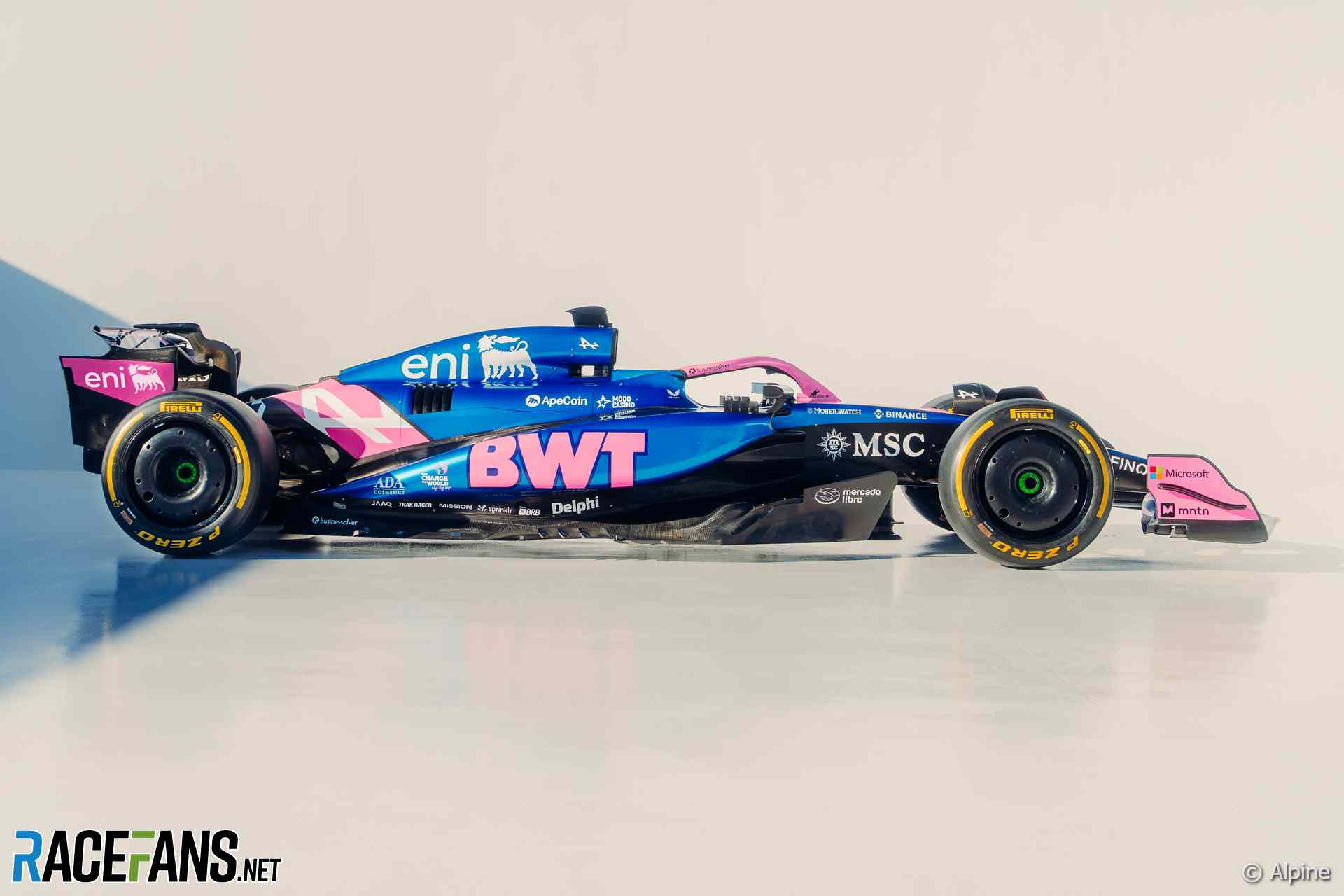
Gucci becomes the first luxury fashion house to title-sponsor a Formula 1 team on 27 May 2026, the Luca de Meo era at Kering announcing itself with a 130-character renaming of the Enstone-based constructor to the Gucci Racing Alpine Formula One Team from the 2027 season. The deal answers a question that has hung over luxury for thirty-five years — would a fashion house ever own the topline of a Grand Prix car the way Marlboro and West and Vodafone once did — and it answers in red, green and gold rather than the BWT pink and blue Alpine has worn since 2021. Gucci President and CEO Francesca Bellettini’s statement, “Gucci becomes the first luxury fashion house to serve as Title Partner in Formula 1,” is the screenshottable line. The harder question is what every other house has done in the paddock since 1969, and why none of them did this.
The shape of the answer is that fashion’s relationship with Formula 1 has, for fifty-seven years, been a watch-and-leather-goods relationship — TAG Heuer’s chronographs on McLaren, Louis Vuitton’s trophy trunks on the podium, Hugo Boss on Lewis Hamilton’s race suit, Tommy Hilfiger on a Ferrari. The ready-to-wear houses themselves have stayed off the cars. Gucci puts the monogram on the sidepod and the engine cover, and it does so in the same month LVMH is operating year two of its ten-year, group-wide F1 partnership. Below, the deal, the man who made it, every fashion-house F1 activation we can document since Jack Heuer signed Jo Siffert in 1969, and what changes when an Italian house with a 1921 founding date races a French constructor with a Mercedes power unit.
Gucci Alpine F1: the Deal Sheet
The Renault-owned Alpine Formula 1 team announced on 27 May 2026 — two days after the Monaco Grand Prix weekend and three days before the Spanish Grand Prix — that Gucci had signed a multi-year title-partnership deal effective from the 2027 season. On-track activation begins with the 2027 car launch; the 2026 season finishes under the existing BWT title. The team’s full constructor name from 2027 will be “Gucci Racing Alpine Formula One Team,” with the constructor’s championship entered under that string. The livery moves from BWT’s blue-and-pink palette to a Gucci red, green and gold scheme carrying an interlocking-double-G “Racing” mark on the sidepod, engine cover and rear wing endplates. Race-suit, garage-wall and pit-lane signage all flip to the new identity.
The trio of statements published with the announcement frames the rationale. Bellettini’s “first luxury fashion house to serve as Title Partner in Formula 1” anchors the bragging-rights claim. Renault CEO François Provost framed the deal as a way to “reach new audiences and young generations,” which is the language Renault has been using since the Drive to Survive Netflix series rebuilt F1’s North American demographic. Alpine’s executive advisor Flavio Briatore, back at Enstone in May 2025 as de facto team principal after Oliver Oakes resigned, made the on-track case: a luxury topline of this scale closes the financial gap to the front of the grid.
The 2026 season Alpine is contesting under the existing name is, on the timesheets, the team’s best in four years. The 2025 campaign ended with Alpine tenth in the constructors’ championship on 22 points, a low for the Enstone factory that traces back through Lotus and Renault and Benetton. The early 2026 standings — through the first eight rounds — show Alpine fifth, the Mercedes customer power unit having delivered the step change the team’s previous Renault works engine could not. The driver pairing is Pierre Gasly and Franco Colapinto, the latter Argentine and the former Norman, both 2026 holdovers under contracts that extend into the Gucci era.
Flavio Briatore, Enstone, and the Constructor Lineage
The Enstone factory in Oxfordshire, England, is the operative noun. Alpine the brand is French; Alpine the F1 team is English. The site has been a Grand Prix base since 1981, when Toleman entered Formula 1 with a Hart engine and an unknown Brazilian named Ayrton Senna who would arrive three seasons later. Benetton bought Toleman in 1986 and renamed it Benetton Formula. Renault bought Benetton in 2000, branded it Renault from 2002, won back-to-back drivers’ and constructors’ titles with Fernando Alonso in 2005 and 2006, and exited as a works entry after 2011. Genii Capital ran the site as Lotus from 2012 to 2015. Renault returned as a works team from 2016 to 2020, then rebranded the constructor as Alpine for 2021 — the Renault Group’s first F1 entry under the Alpine performance sub-brand.
Briatore is the through-line that makes the Gucci deal legible. He ran Benetton from 1989 onward, signed Michael Schumacher in 1991, and presided over Schumacher’s 1994 and 1995 drivers’ titles and the 1995 constructors’ championship — the only constructors’ title the Enstone factory has ever won. He returned to Renault in the 2000s and ran the team through the Alonso era and its two championships. He left under the 2008 Crashgate sanction, returned to Alpine in 2024 as executive advisor, and assumed effective team-principal duties in May 2025 when Oliver Oakes stepped down. The Briatore signature on the Gucci deal is the same signature on Benetton’s 1986 takeover of Toleman: bring a non-motorsport brand inside a Grand Prix team and let it run the topline.
The technical substrate for 2027 sits underneath all of this. Alpine switches from Renault works engines to customer Mercedes power units from the 2026 season, ending the only French-engine-in-an-F1-car project on the grid. The 2026 regulations introduce the new 50/50 internal-combustion-and-electric power split and the active-aero floor; the 2027 car will be the second iteration of that platform, the first year of the Gucci livery, and the first year of the Briatore-Bellettini joint project at scale. The constructor’s name is registered with the FIA under the new string before the 2027 season-entry deadline.
Luca de Meo: the Renault Man Who Runs Kering
The connective tissue between Gucci and Alpine is one biography. Luca de Meo was CEO of Renault Group from 2020 to mid-2025, the executive who led the post-Carlos-Ghosn turnaround and who oversaw Alpine’s rebrand from Renault Sport. He was appointed CEO of Kering on 15 September 2025 — the first non-Pinault outsider to lead the group, and the date the Kering board separated the chairman and CEO roles for the first time since 2005. François-Henri Pinault remains chairman; de Meo runs the company. The pay package — €20 million sign-on, €2.2 million fixed, €1.21 million variable for the partial 2025 year — is the most expensive hire in Kering’s history.
The Gucci × Alpine deal is, in effect, the first major sports project of the de Meo era at Kering, and it is impossible to read it as anything other than a deal de Meo had been circling since his Renault years. Briatore returned to Alpine in 2024 while de Meo was still Renault CEO; the two men knew each other across the boardroom. When de Meo left Renault for Kering in September 2025, the conditions were in place — an Alpine team needing a topline title sponsor, a Kering CEO with the brief to grow Gucci’s awareness outside core fashion, a Briatore intermediary who had run the Benetton-as-title-sponsor playbook in the 1990s. The deal closed in May 2026, eight months into de Meo’s tenure, and was announced before the Florence Capital Markets Day’s 2026 commitments matured into 2027 deliverables.
The strategic context is the ReconKering portfolio refresh unveiled at the Florence Capital Markets Day on 16 April 2026. ReconKering organises the next four years into Reset (end-2026), Rebuild (end-2028) and Lead (end-2030), with explicit doubling targets for Gucci boutique sales density, top-tier client volumes and group recurring operating margin. The Alpine deal does not move any of those KPIs directly in 2026, but it loads the awareness side of the funnel in 2027 — the season the Reset phase ends and the Rebuild phase opens. The math is the same math Benetton ran on itself in the late 1980s: title-sponsor a Formula 1 team and the brand line of every household with a television set widens.
The Demna signature on Gucci’s design side completes the alignment. Demna Gvasalia took the artistic-director seat at Gucci in July 2025, two months before de Meo arrived at Kering. His first design statement at the house was Gucci Memoria at Milan Design Week 2026, twelve distressed-archive objects installed in the Basilica di San Simpliciano. His second was the Demna Gucci Cruise 2027 Times Square show on 16 May 2026, eleven days before the Alpine announcement. Whether the Cruise show’s tone — Tom Ford-era 1990s archive references, peacoat-and-pencil-skirt foundationalism, fifty-skyscraper-screen takeover — predicted the Alpine deal is a closed question now: both projects come out of the same de Meo brief to make Gucci legible at the scale of mass culture.
LVMH, F1, and the Counter-Strategy
The deal lands eighteen months into LVMH’s own ten-year F1 partnership, which is the relevant comparison. LVMH announced its agreement with Formula 1 at the 2025 Australian Grand Prix in March 2025 — a group-wide deal worth, by reporting at the time, roughly $1 billion across the contract term. The activations split across three houses. Louis Vuitton is the title partner of the Monaco Grand Prix from 2025 and is the trophy-trunk maker for all 24 rounds of the 2026 calendar, expanding from the Monaco-only trophy-trunk role it has held since 2021 under the slogan “Victory travels in Louis Vuitton.” TAG Heuer is the official timekeeper of Formula 1 from the 2025 season, the role it last held from 1992 to 2003 before Rolex took it. Moët Hennessy is the supplier of podium champagne from 2025, displacing Ferrari Trento.
The LVMH approach is the inverse of the Kering approach. LVMH is sponsoring the championship itself and supplying the rituals — timekeeping, podium, Monaco trophy — that recur every weekend. Kering is sponsoring one constructor and putting its monogram on the car. Neither approach pre-empts the other; both are visible at every Grand Prix in 2027. The LVMH deal generates impressions across all ten teams; the Kering deal generates one identity for one team that the cameras have to find on track. The relevant question for Jonathan Anderson’s LVMH trajectory and for the Dior side of the group is whether Anderson will introduce a Dior activation on top of the existing Louis Vuitton-TAG Heuer-Moët stack; the answer through May 2026 is that he has not.
The deeper LVMH backstory matters here. TAG Heuer’s Formula 1 history runs longer than any other house in luxury — Jack Heuer signed Swiss driver Jo Siffert in 1969, putting the Heuer logo on Siffert’s race suit at the Mexico Grand Prix and beginning the watch industry’s documented F1 era. Heuer was the official timekeeper of Formula 1 from 1971; the logo went on the McLaren chassis in 1985 — the year Alain Prost won his first drivers’ title — and stayed there in various forms through 2016 across Prost’s 1986 championship, the Senna 1988, 1990 and 1991 titles, and the entire McLaren-Honda dominance. TAG Heuer reissued its Formula 1 chronograph in monochrome with Fragment Design in 2020. The 2025 return to official-timekeeper status closes a loop the brand began in 1969.
Every Luxury Fashion House in Formula 1, 1969–2026
The single most useful artifact in this article is the inventory. The table below lists every luxury fashion, jewellery and leather-goods house with a documented Formula 1 activation we can verify, ordered by the year the relationship began. The criterion is direct participation — title sponsor, team partner, official supplier, on-car logo, on-suit logo, or championship-level sponsorship — not generic luxury-paddock hospitality. The point of the table is to make Gucci’s claim falsifiable: every other house that has run an F1 activation, and what kind.
| House | F1 partner | Role | Year started |
|---|---|---|---|
| TAG Heuer (then Heuer) | Jo Siffert / privateer | Personal sponsor; logo on race suit | 1969 |
| Heuer / TAG Heuer | Formula 1 (championship) | Official timekeeper (first stint) | 1971 |
| TAG Heuer | McLaren | On-car logo through 2016 | 1985 |
| Hugo Boss | McLaren | Team apparel partner; on-suit logo | 1981 |
| Hugo Boss | Mercedes-AMG Petronas | Driver and team apparel partner | 2015 |
| Tommy Hilfiger | Ferrari | Team apparel partner (Michael Schumacher era) | 1998 |
| Tommy Hilfiger | Mercedes-AMG Petronas | Global apparel partner (Lewis Hamilton) | 2018 |
| Tommy Hilfiger | Mercedes-AMG Petronas | Title sponsor of Mercedes apparel line | 2018 |
| Hublot | Ferrari | Official timekeeper / on-car logo | 2012 |
| Richard Mille | McLaren | Team partner; on-car logo | 2016 |
| IWC Schaffhausen | Mercedes-AMG Petronas | Engineering partner; on-car logo | 2013 |
| Bell & Ross | Renault F1 / Alpine | Official watch partner | 2016 |
| Roger Dubuis | Pirelli | F1 tyre partner co-branding | 2017 |
| Tudor | Visa Cash App RB / Racing Bulls | Title-naming partner (Tudor Visa RB) | 2024 |
| Louis Vuitton | Formula 1 (Monaco GP) | Title partner of the Monaco Grand Prix | 2025 |
| Louis Vuitton | Formula 1 (championship) | Trophy trunks for all 24 rounds | 2026 |
| TAG Heuer | Formula 1 (championship) | Official timekeeper (second stint) | 2025 |
| Moët Hennessy | Formula 1 (championship) | Podium champagne supplier | 2025 |
| Gucci | Alpine F1 Team | Title sponsor (first luxury fashion house) | 2027 |
The pattern reads in three blocks. The first block is watches: Heuer-then-TAG-Heuer from 1969, Hublot from 2012, IWC from 2013, Richard Mille from 2016, Tudor from 2024. Watches earned their F1 place through timekeeping, chronography and the technical alibi of motorsport’s engineering culture. The second block is apparel: Hugo Boss from 1981 on McLaren and from 2015 on Mercedes, Tommy Hilfiger on Ferrari from 1998 and Mercedes from 2018. Apparel arrived through the race suit and the team uniform, not through the car. The third block is the LVMH-and-Gucci 2025-2027 wave — Louis Vuitton’s Monaco-then-championship deal, Moët Hennessy’s podium, TAG Heuer’s second timekeeping stint, and Gucci’s Alpine title. The third block is the first to put fashion-house monograms onto the chassis itself, not just onto the suit or the watch on the driver’s wrist.
The absences are as legible as the presences. Hermès is the most conspicuous abstention — the house has no Formula 1 activation in any era, consistent with a family-controlled French house that has historically refused televised sponsorship of any kind. Chanel has no F1 activation. Prada has none. Bottega Veneta has none. Saint Laurent has none. Loewe has none. Among watchmakers Rolex was the championship timekeeper from 2013 to 2024, but Rolex’s place in this table is contested — it is a watch house first and a luxury house second — and the LVMH 2025 deal displaced it. Patek Philippe and Audemars Piguet have no F1 sponsorships of consequence; their luxury logic is that sponsorship is the opposite of scarcity.
Aldo Gucci’s Cadillac and the Fiat 500 by Gucci
Gucci’s documented automotive history before Alpine is short and not motorsport. The first chapter is Aldo Gucci’s Cadillac Seville Gucci Edition of 1978, unveiled at the Fontainebleau Hotel in Miami Beach in a small run of approximately 200 units. The collaboration with General Motors was a quiet co-branding: GG-monogrammed leather upholstery, a Gucci-stripe paint detail, monogrammed wheel covers and matching luggage. The Cadillac Seville Gucci was a luxury-saloon edition aimed at the same Florida and New York clientele Aldo had cultivated through the Fifth Avenue store. It is the original Gucci-on-a-car artefact, and it is the reason the 2027 livery has documented precedent.
The second chapter is the Fiat 500 by Gucci, produced from 2011 through 2012 under Frida Giannini’s creative direction. Fiat had relaunched the 500 in 2007 as a nostalgic city car; the Gucci edition added the green-red-green Web stripe along the flank, GG monogram seat panels, Gucci-branded floor mats and a chromed Gucci script on the rear. The car was previewed at the 2011 Geneva Motor Show and was on sale through Fiat dealers in Europe. The Fiat 500 by Gucci was a fashion collaboration with an automaker rather than a motorsport project — the car never raced, and the partnership never extended into competition. Both Aldo’s Cadillac and Giannini’s Fiat 500 are saloons-and-city-cars, not Grand Prix cars.
The 2027 Alpine deal is the first Gucci project in any era to put the monogram on a competition car. The closest analogue across luxury is the Benetton-on-Toleman move in 1986, when Benetton bought the team outright and named it after the brand. Gucci does not own Alpine; Renault does. The structure is a title-sponsorship deal, not a constructor takeover. But the visual outcome — a luxury fashion house’s name on the constructor’s championship table — is the same outcome Benetton produced in the 1990s, when Schumacher and Briatore and the green-and-yellow car were on every Grand Prix grid.
What Changes at Enstone in 2027
The factory does not move. The Enstone site stays in Oxfordshire, England, with its 800-plus employees and its Mercedes power-unit supply contract. The drivers do not change — Gasly and Colapinto are under multi-year deals that carry into 2027. What changes is the topline of every fixed element on the car: the chassis name, the team principal’s polo shirt, the garage wall, the pit-board signage, the team transporter, the merchandise stack at the trackside store. Every BWT pink panel becomes a Gucci red-or-green panel. Every team-radio handshake before the lights goes through to “Gucci Racing Alpine.”
The 2027 Monaco Grand Prix is the date to mark. Louis Vuitton remains the title partner of the Monaco Grand Prix itself under the LVMH ten-year deal; Gucci races as the title partner of the Alpine entry. For one weekend in May 2027, the Monaco paddock will carry both the LVMH Monaco-GP signage and the Gucci-on-Alpine identity inside the same trackside television frame. The Briatore signature on the deal will read against the Bernard Arnault signature on the LVMH deal as the two-house luxury split made visible in twenty-four hours of broadcast. For the audience the Drive to Survive cohort delivered to F1 — the North American, sub-thirty, fashion-literate viewer who arrived after 2019 — the picture is the first time both top European luxury holdings have race-day visibility at the same Grand Prix.
The risk on the Alpine side is the one Kering has been managing since the start of the de Meo era: a luxury topline does not change the lap time. Alpine in 2027 will be quick if the Mercedes power unit and the second-generation 2026-rules car carry the form they showed in the first half of 2026, and slow if they do not. A Gucci-liveried car at the back of the grid is the loss case the deal has to absorb; a Gucci-liveried car on the podium is the win case the de Meo brief was written for. Briatore’s record at Benetton suggests he can deliver podiums; Briatore’s record at Renault after 2008 suggests he can also miss. The 2027 Australian Grand Prix in March is the first race that will tell us which case is live.
The risk on the Gucci side is the dilution case. Putting a luxury monogram on the floor of a racing car is, by 1985-McLaren standards, a high-saturation move. Demna’s Gucci has been engineering toward saturation since the Times Square show, and the Alpine livery is consistent with that direction. Whether the boutique-density doubling target survives the saturation is a question the Lead phase of ReconKering — the 2030 endpoint — has to answer. The Alpine deal does not have to be right in 2027 to justify itself; it has to be right in 2030, when Kering’s recurring operating margin target lands.
Gucci on Alpine in 2027 reads as the most aggressive single move in luxury sponsorship since LVMH bought the title partnership of the Monaco Grand Prix in 2025, and it reads as the most aggressive single move in fashion-house motorsport since Benetton bought Toleman in 1986. The story since 1969 has been watches on suits and apparel on drivers; the story from 2027 onward is monograms on cars. Bellettini’s “first luxury fashion house” line will be a brittle claim the moment a second house signs a second title deal — and the second house, if the broadcast numbers in 2027 land where Renault’s François Provost wants them, is already being modelled in a Paris or a Milan corner office. The Enstone factory, fifty-eight years after Heuer signed Siffert at Mexico, becomes the new address where luxury enters Formula 1 not by the wrist or the chest patch but by the engine cover. The de Meo deal is the door he came through it carrying.