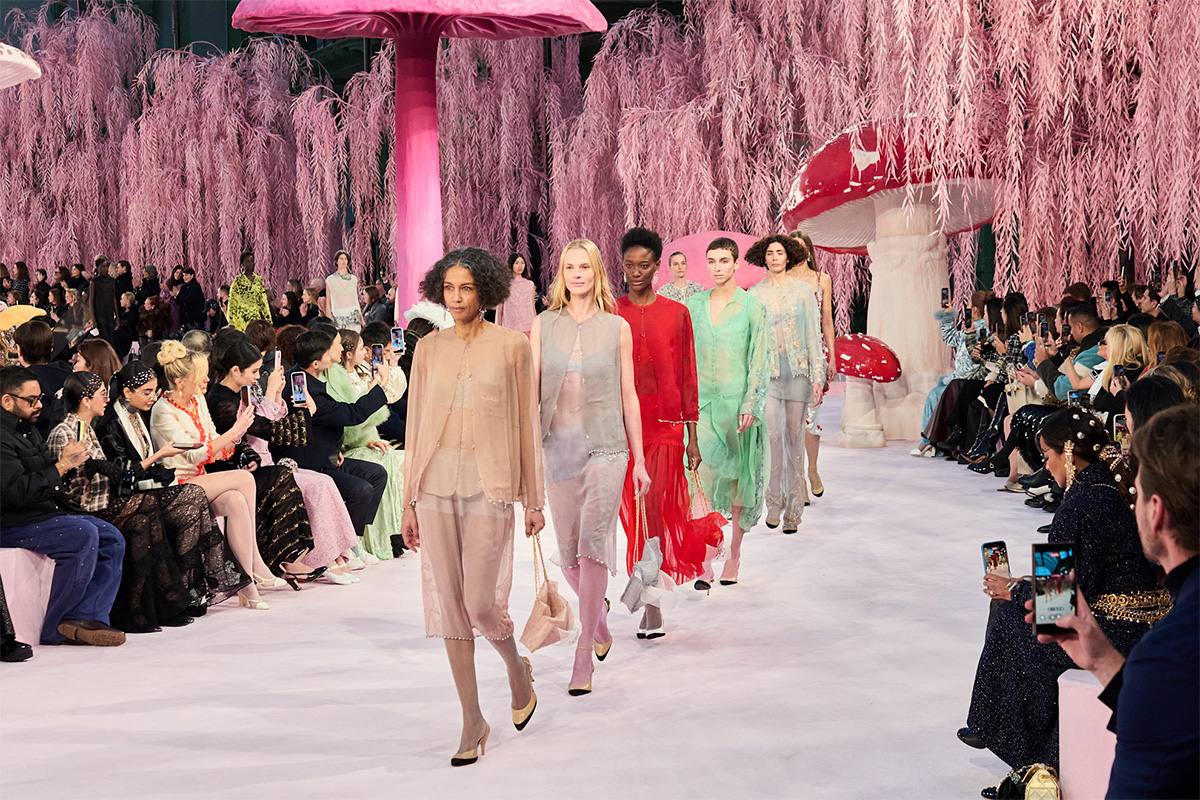
Matthieu Blazy’s Chanel debut on the Grande Plage in Biarritz on 28 April 2026 was the first cruise show in the Lagerfeld-era format to refuse a global destination — and one week later the house entered the Lyst Index at #1, the first time in the ranking’s history Chanel had appeared on it at all. Read in isolation, the blazy chanel biarritz collection is a 79-look show staged at the 1929 Casino Municipal for two audiences totalling more than 900 guests, with Nicole Kidman in the front row and A$AP Rocky performing at the after-party. Read together with the September 2025 acquisition of 23 Rue Cambon for €118 million ($133 million) and the Q1 2026 Lyst recalibration, it is something else: the most coherent brand-strategy moment any European fashion house has produced in this cycle, and the clearest argument yet that Chanel — privately held, debt-free, and unconstrained by the quarterly drumbeat that governs LVMH and Kering — intends to spend the next decade behaving differently from the conglomerates around it.
The Biarritz choice is the tell. Karl Lagerfeld’s cruise destinations in the 36 years he ran the house ran through Antibes, Versailles, Singapore, Dubai, Seoul and Havana — a spectacle of geographic acquisition that became the blueprint every conglomerate-owned house copied. Blazy went the other direction. Biarritz is where Gabrielle Chanel opened her first couture house at Villa Larralde in 1915, steps from the Casino site, employing 300 women within a year. The new artistic director’s first public gesture as the head of the house was to pull the cruise show back to its 111-year-old origin point, on a stretch of Atlantic coast Empress Eugénie had turned into a Belle Époque resort with the Hôtel du Palais in 1854. The debut was not a destination. It was a deed of provenance.
This post sits between three earlier FORMA reads: the Q1 2026 luxury-results map that laid out the LVMH-Kering-Hermès-Prada Group divergence, the organisational chart of 2025–26 fashion-debut appointments where Blazy’s name first surfaced, and Bottega Veneta Casa, the long read on the era he just left. Together they explain why a single 79-look cruise show in a French seaside town has been the most-discussed fashion event of the spring, and why the brand-strategy lesson is not in the clothes.
Blazy chanel biarritz: what actually happened on 28 April
The mechanics first. Chanel staged Cruise 2026/27 on Tuesday 28 April 2026, inside and outside the Casino Municipal de Biarritz on the Grande Plage. Two shows back-to-back totalled 79 looks for over 900 guests — the largest cruise audience the house has hosted in years. Nicole Kidman, a Chanel ambassador since 2003, sat front row at the first show. A$AP Rocky performed at the after-party in a beach pavilion erected for the night. Penélope Cruz, Tilda Swinton and Margaret Qualley were photographed on the Casino’s seafront terrace before the second show began.
The set was Blazy’s first chance to declare a visual register distinct from Virginie Viard’s seven cruise collections. Beige deep-pile carpet covered the Casino’s interiors — a deliberate inversion of the black-and-white binary Lagerfeld weaponised for three decades. Mirrored columns doubled the natural Atlantic light flooding through the seafront windows. Acid-bright floral arrangements — coral, chartreuse, cobalt — sat on every table at the after-party, the only chromatic register that broke the beige. The photographs read, deliberately, like a Bottega Veneta show — and that read is the point.
The clothes themselves did two things at once. They reinterpreted the 1926 Little Black Dress — the Vogue-anointed “Ford” of fashion that turned 100 this year — across at least seven looks, the longest of which fell to mid-calf in a hammered silk crepe. And they used the Double C monogram as a construction element, not a print. Several pieces had the interlocking Cs cut as cloqué relief into the fabric itself; a beach coat had the monogram laser-perforated through three layers of bonded linen so the negative space formed the pattern. Blazy explained the choice to Vogue France with the line that has since been quoted in every review: “I used to work at Bottega. No logo. I got familiar with the idea of a logo here, and I love a logo.” It is the most precise public statement any new creative director has made about the gap between his last house and his current one.
The succession: Gabrielle to Karl to Virginie to Matthieu
To understand why a 79-look cruise show in Biarritz reset the conversation, the succession matters. Chanel has had four artistic directors in 116 years, and only four. The line is shorter than Dior’s, shorter than Saint Laurent’s, far shorter than Gucci’s. Each handover has been a long event, not a punctual one — and the gap between handovers has tended to stretch.
| Director | Tenure | Years | Format inherited |
|---|---|---|---|
| Gabrielle “Coco” Chanel | 1910 – 1971 (with 1939–54 interruption) | ~46 active | Founded the house, the codes, the No. 5 |
| Karl Lagerfeld | 1983 – Feb 2019 | 36 | Inherited a dormant house; built the spectacle cruise format |
| Virginie Viard | Feb 2019 – June 2024 | 5 | Inherited the spectacle; quietened it |
| Matthieu Blazy | Dec 2024 (announce) – April 2026 (debut) | TBD | Inherited a quieted house; reactivated it on the founder’s territory |
Lagerfeld arrived in 1983 to a house dormant since Coco’s 1971 death; his job was to invent the modern Chanel show as a global format. Viard, his lieutenant of 30 years, took over in February 2019 and spent five years easing the house out of Lagerfeld-scale spectacle into something quieter and more product-led — the Maxi Flap Bag redesign and the 19 bag both date to her tenure. Her June 2024 exit gave Chanel six months of negotiating room. Blazy was announced in December 2024, a 16-month gap before his first show — the longest debut runway in modern Chanel history.
That 16 months has been the entire strategic question. Other houses with new creative directors in the same cycle moved faster: Pieter Mulier at Versace showed within four months, Jonathan Anderson at Dior within six. Chanel let Blazy take a year and four months. The Biarritz choice is the partial answer to why.
Bottega to Chanel: what Blazy actually brings
Blazy was born in 1984, French-Belgian, trained at La Cambre in Brussels. His CV before Chanel is the cleanest in the cohort of 2025–26 fashion debuts: Maison Margiela in 2011, Calvin Klein under Raf Simons from August 2016 to 2019, Bottega Veneta as design director from 2020, then creative director from November 2021 to December 2024. He is 41 years old and has done one and a half public creative-director jobs before this one.
The Bottega years are the relevant precedent — and Bottega Veneta Casa covers them in detail. The short version is that Blazy turned a quiet Italian leather house, valued chiefly for its woven intrecciato, into the most-talked-about ready-to-wear brand at Kering between 2022 and 2024. He did it with the opposite of logo strategy: no monogram, no recognisable print, and shows that leaned on craft signatures — the trompe-l’oeil leather “denim” jeans, the pony-hair coats, the parakeet bag — that read as luxury through technique rather than identification.
The December 2024 announcement that Blazy had signed with Chanel was the first time a Kering-trained creative director had moved directly to a privately-held competitor at a senior level in a decade. Kering under CEO de Meo has had to absorb Bottega’s creative reset under Louise Trotter at the same moment as a Gucci reset under Demna.
What Blazy brings to Chanel is not a logo aesthetic — it is the inversion. A discipline learned at Bottega in not depending on a logo, applied to a house whose mark is the most recognised in luxury after the LV monogram. His Vogue France quote — “I love a logo” — is a recognition that the Double C is not a logo in the Bottega sense. It is a structural code that predates the modern logo era by 50 years, and Blazy is the first Chanel director since Lagerfeld to treat it as construction grammar rather than as a print to be applied.
The €118 million deed: 23 Rue Cambon and what it signals
The second half of the brand-strategy moment is the property. In September 2025 — eight months before the Biarritz show, and three months after Viard’s exit — Chanel acquired the building at 23 Rue Cambon, Paris, for €118 million ($133 million at the prevailing rate). The seller was a French institutional investor. The building sits adjacent to 31 Rue Cambon, the house’s flagship since 1910 and the address Coco lived above for the second half of her life. Chanel now controls a contiguous block of Rue Cambon real estate larger than any other Paris luxury house controls on a single street, with the exception of LVMH on Avenue Montaigne.
The price matters less than the timing. The deed was signed before Blazy had shown a single garment for the house. Chanel’s leadership — Leena Nair as CEO since 2022, Bruno Pavlovsky as president of fashion since 1995, and the Wertheimer brothers as ultimate owners — committed $133 million to a property purchase between artistic directors, a move no listed conglomerate would make at that point in a creative succession. They were buying optionality: more flagship space, more couture-atelier capacity, more on-stage room for whatever Blazy decided the house needed to become. It was a vote of capital before a vote of clothes.
The Wertheimer ownership structure is the point most international coverage misses. Alain and Gérard Wertheimer hold Chanel privately through Chanel Limited, the Cayman Islands holding company restructured in 2018. The brothers, grandsons of Pierre Wertheimer who partnered with Coco on the No. 5 launch in 1924, have never floated the company. The structural difference between Chanel and its peers is the strategic difference, and the table below is the fastest way to see it.
LVMH, Kering, Chanel: three ownership models compared
| House group | Ownership | Listed? | Quarterly reporting | 2025 strategic constraint |
|---|---|---|---|---|
| LVMH | Arnault family via Christian Dior SE / Groupe Arnault, ~48% economic | Yes (Euronext Paris) | Yes | Margin defence at Louis Vuitton and Dior; segment volatility at Tiffany and Sephora |
| Kering | Pinault family via Artémis, ~42% economic | Yes (Euronext Paris) | Yes | Gucci reset under Demna; debt servicing post-Valentino and Creed |
| Chanel | Wertheimer family via Chanel Limited, 100% | No | No (voluntary annual report only) | None imposed by capital markets |
| Hermès | Hermès family pool ~67% via H51 | Yes (Euronext Paris) | Yes | Family lock-up; growth through capacity, not acquisition |
| Prada Group | Prada family ~80% via Prada Holding | Yes (Hong Kong) | Yes | Versace integration under Mulier; Miu Miu paradox |
Read across the table, Chanel is the only house at the top of luxury with no market-imposed quarterly clock. That is the structural reason a $133 million Paris property purchase can be timed between creative directors without anyone needing to defend the spend on an earnings call. It is also the structural reason a debut cruise show could be staged in Biarritz — a town with a regional airport, no tax-free shopping infrastructure, and zero strategic value as an Asian or Middle Eastern client market — instead of, say, Seoul or Riyadh. The decision did not need to optimise for next-quarter retail conversion. It optimised for narrative ownership of the founder’s biography.
The contrast with LVMH and Kering’s Q1 2026 results sharpens the point. Both groups spent the quarter explaining margin compression at their flagship houses (Louis Vuitton at LVMH; Gucci at Kering) to investors who wanted to see headcount and SG&A discipline. Chanel spent the same quarter writing a $133 million cheque for a Rue Cambon building, paying for two cruise show productions, and not telling anyone what their FY2025 numbers looked like. The annual report will land in June. By then the Lyst #1 will have been priced into the brand for two months.
The Lyst Index Q1 2026 recalibration
The Lyst Index Q1 2026 is the third leg of the moment, and the one most fashion-trade publications got right. Chanel debuted at #1 — the first time the house had appeared on the index at all. Saint Laurent was #2. Dior, in Jonathan Anderson’s first measured quarter, was #3. Miu Miu was #4. Gucci, in Demna’s first measured quarter as creative director, jumped four positions to #5. Bottega Veneta, the house Blazy left, dropped out of the top 10.
The methodology change matters. Lyst recalibrated the index for Q1 2026 across three dimensions: desire (proxied by search and saved-item data on the Lyst platform), demand (sales velocity across 17,000 partner retailers), and discovery (a new dimension capturing first-time-search rate, which heavily weights momentum over installed base). The recalibration was Lyst’s response to a recurring criticism that the prior methodology over-weighted established product velocity and missed creative-director debuts. Chanel’s #1 ranking is a function of all three dimensions, but the discovery weighting is what made the debut possible — Blazy’s appointment, the Cambon deed, and the Biarritz preview imagery generated more first-time-Chanel searches in Q1 than any house had ever generated as a first-time entrant.
Two specific products carried the desire and demand metrics inside the ranking. The first was the crocodile-effect leather pumps Blazy showed in three previews from his February 2026 atelier visits, before the cruise show, in beige and oxblood. The second was the redesigned Maxi Flap Bag in smooth quilted leather, a product Viard initiated and Blazy refined for the cruise launch. Both items appeared in Lyst’s Q1 hottest-products list — the only house in the ranking to place two items in the top 10 hottest products. The Maxi Flap had been on the wait-list at the brand’s flagship retailers since January.
The implication of the Lyst result — that Blazy has carried client interest with him from Kering to a privately-held competitor — is the headline most internal Kering memos this quarter have had to reckon with.
Why Biarritz, not Antibes or Versailles
Lagerfeld went to Biarritz once in his 36 years, for a 1990 photoshoot, never for a cruise. His cruise destinations were optimised for client geography (Singapore for Asia, Dubai for the Gulf, Havana for the Latin American press hook) or for art-direction spectacle (Versailles, Antibes). Biarritz fits neither rubric. It sits on the Atlantic in the French Basque Country, four hours by TGV from Paris, with a regional airport that does not host long-haul flights from Asia or the US. No client base of strategic size lives within 200 kilometres. The town’s permanent population is 25,000.
What Biarritz has is biography. Empress Eugénie de Montijo, wife of Napoleon III, built the Hôtel du Palais on the beach in 1854 as a summer residence, and the construction project turned a Basque fishing village into a Belle Époque resort within a decade. By the 1900s, Biarritz was the second French resort after Deauville for the European aristocracy. Coco Chanel arrived in July 1915 with her then-partner Boy Capel, opened a couture house at Villa Larralde a few hundred metres from the Casino Municipal site, and by year-end was employing 300 women — her first business at scale. The Biarritz house preceded both the 31 Rue Cambon Paris flagship (1910 was the millinery; the couture moved in fully later) as a fully-staffed couture operation, and is where Chanel’s modern business began.
Blazy’s choice to debut on the Grande Plage steps from Villa Larralde, in a 1929 Casino Municipal that the house has now had structurally surveyed for a possible repeat use, is a narrative move that no listed competitor can easily counter. Louis Vuitton has Asnières, the family workshop, which Pietro Beccari has activated several times. Hermès has Faubourg Saint-Honoré 24 and the Pantin atelier. Saint Laurent has Marrakech. None of them have a Biarritz — a single town in which the founder built her first business at scale, with a buildable cruise venue still standing and the house still alone in claiming the territory. Blazy and Pavlovsky have, with one show, taken Biarritz off the board for any other house.
The contrast with LVMH’s recent cruise programming is instructive. Vuitton went to Cairo, Dior to Rome — venues with no biographical content for either house, chosen because they photograph well for a global Instagram audience. Chanel’s Biarritz show photographs well too. But it is the only one of the three that the house’s founder could have walked into.
Where this puts Chanel against the field
Read against the organisational chart of 2025–26 fashion debuts — Demna at Gucci, Anderson at Dior, Mulier at Versace, Trotter at Bottega, Sarah Burton at Givenchy, and Blazy at Chanel — the Biarritz show is the debut that has set the highest bar on three measures simultaneously: collection coherence, narrative ownership, and immediate commercial signal (the Lyst #1). None of the other debuts has cleared all three.
Demna at Gucci (Q1 2026 Lyst #5, +4 positions) has the commercial signal but is still being read against his Balenciaga decade — the narrative ownership is contested. Anderson at Dior (#3) has critical coherence but the Dior commercial machinery dilutes the personal-narrative story. Mulier at Versace, reset under the Prada Group acquisition, is six months ahead of Blazy on debut date but is rebuilding a brand from a much lower base. Trotter at Bottega — Blazy’s successor — is the inverse problem: she inherited a house that the previous director made #2 in the world and has to defend it.
Blazy at Chanel inherited a quieted house, was given 16 months and $133 million in property capital before being asked to deliver, and then debuted on the founder’s territory with an audience of 900 and a soundtrack from one of the most-streamed rappers of the year. The structural advantage was given. He delivered into it.
The Wertheimer-funded version of brand strategy is, on this evidence, harder to compete with than the listed-conglomerate version. A privately-held house can spend 16 months between directors. A listed house, under analyst pressure, cannot. A privately-held house can buy a $133 million Paris building between directors. A listed house has to defend that spend on a quarterly call. A privately-held house can stage a debut in a town with no client base because the show is a narrative asset, not a sales channel. A listed house cannot.
That asymmetry is the brand-strategy lesson the rest of luxury will be metabolising for the rest of 2026. It is also the asymmetry Bernard Arnault and François-Henri Pinault have spent two decades arguing does not exist — that scale and listing advantages outweigh family-private flexibility. Chanel’s Q1 has reopened that argument with the loudest possible counter-evidence.
The coda: the founder’s town, the founder’s logo, the founder’s house
The Biarritz show closes a 111-year loop. Coco Chanel opened her first couture house at Villa Larralde in July 1915, employing 300 women within months. On 28 April 2026, her fourth artistic director showed his first Chanel collection a few hundred metres from the same site, on the same beach, in a 1929 building that had not existed when she opened her atelier. He did it with a Double C used as construction, not as print. He did it with a Little Black Dress that turned 100 the same year. He did it for an audience that included a Chanel ambassador of 23 years’ standing and the most-streamed rapper of the spring. And he did it inside a corporate structure that, alone among the houses at his level, did not need to defend the spend or the geography or the timing to anyone outside the family.
The blazy chanel biarritz debut is not, on its own, the strategic event. The strategic event is the alignment of the debut, the deed, and the Lyst ranking — three signals timed across nine months that together state, with more clarity than any house has stated it in this cycle, that Chanel intends to be the brand that owns its own founder’s biography, its own street in Paris, and its own commercial momentum. The next four cruise destinations will tell us whether the Biarritz move was a one-time opening statement or the new format. The Wertheimers, on current evidence, can afford for it to be either.