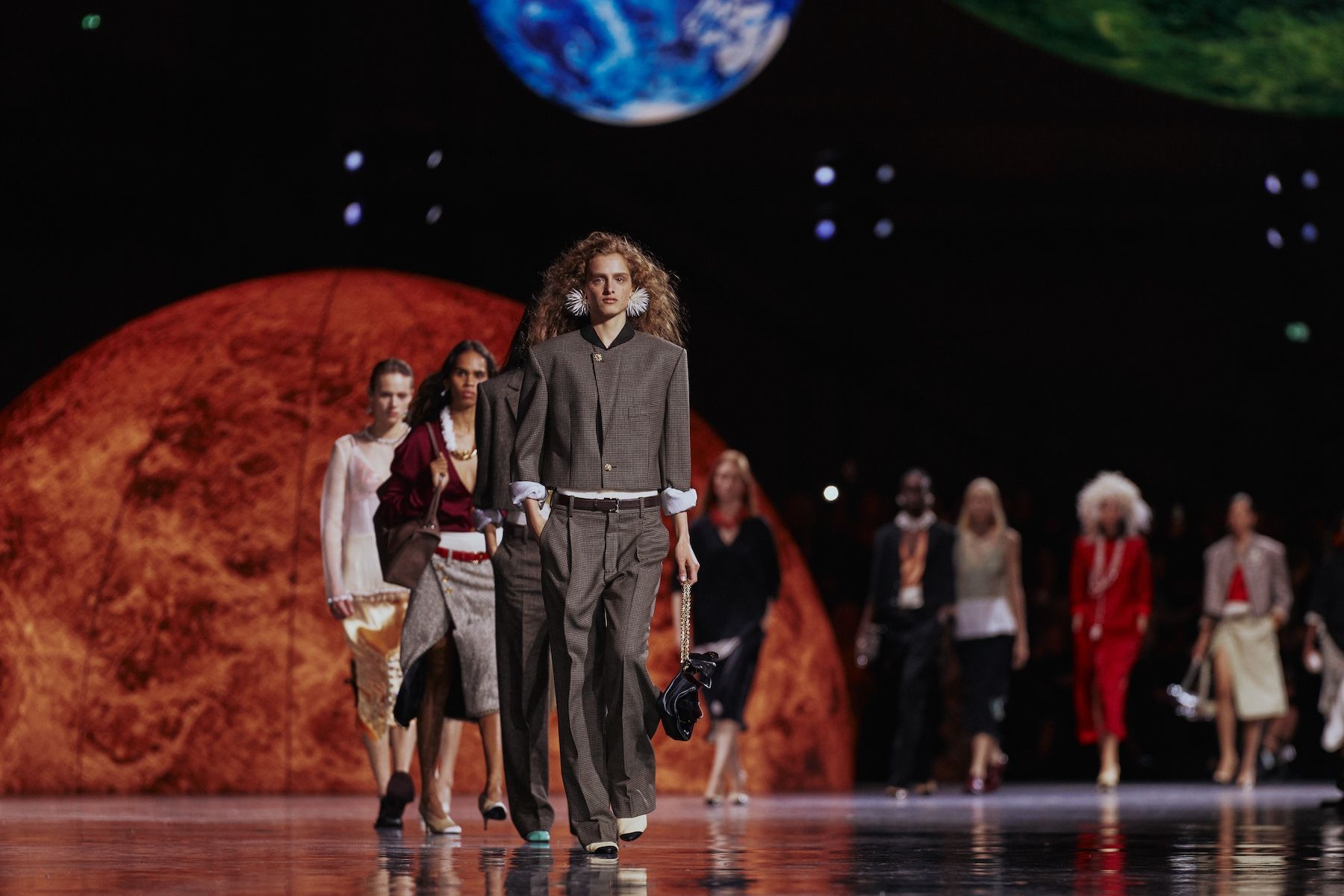
Eleven major fashion houses debut new creative directors between January 2025 and October 2026, the most concentrated changeover in luxury since Tom Ford left Gucci in April 2004. The fashion designer debuts 2026 wave touches every European holding company that matters — LVMH and Kering on the top of the chart, OTB, Puig and Clarins underneath, and a Prada Group that just spent $1.375 billion on Versace and is currently running it without a creative director at all. The roll call: Matthieu Blazy at Chanel, Jonathan Anderson at Dior, Jack McCollough and Lazaro Hernandez at Loewe, Louise Trotter at Bottega Veneta, Demna Gvasalia at Gucci, Pierpaolo Piccioli at Balenciaga, Glenn Martens at Maison Margiela, Simone Bellotti at Jil Sander, Miguel Castro Freitas at Mugler, Duran Lantink at Jean Paul Gaultier, and a Versace seat that opens for Pieter Mulier on 1 July 2026.
Imran Amed at BoF has been calling this “The Great Fashion Reset.” The phrase is right. What it does not capture is that the reset is owned, house by house, by six holding companies whose sequencing strategies are visibly different from each other. This piece is the holding-company map.
What the comparison table makes visible
Before the analysis, the data. Every house in the wave, with its new creative director, the predecessor, the holding company that owns the appointment, and the debut date as currently reported.
| House | New CD | Predecessor | Holding | Debut date / status |
|---|---|---|---|---|
| Chanel | Matthieu Blazy | Virginie Viard | Independent (Wertheimer) | PFW October 2026 |
| Dior | Jonathan Anderson | Maria Grazia Chiuri / Kim Jones | LVMH | Menswear SS26 June 2025; womenswear & couture added late 2025 |
| Loewe | Jack McCollough & Lazaro Hernandez | Jonathan Anderson | LVMH | 2025 |
| Bottega Veneta | Louise Trotter | Matthieu Blazy | Kering | January 2025 |
| Gucci | Demna Gvasalia | Sabato De Sarno | Kering | Announced March 2025; “La Famiglia” campaign early 2026 |
| Balenciaga | Pierpaolo Piccioli | Demna Gvasalia | Kering | Mid-2025 |
| Maison Margiela | Glenn Martens | John Galliano | OTB | January 2025 (continues at Diesel) |
| Jil Sander | Simone Bellotti | Lucie & Luke Meier | OTB | 2025 |
| Mugler | Miguel Castro Freitas | Casey Cadwallader | Groupe Clarins | March 2025 |
| Jean Paul Gaultier | Duran Lantink | Rotating guest designers | Puig | April 2025 |
| Versace | Vacant after Dario Vitale dismissal (12 Dec 2025); Pieter Mulier effective 1 July 2026 | Donatella Versace (1997–2025) | Prada Group (since 2 Dec 2025) | TBA |
Read the holding column down. LVMH = 2 (Dior, Loewe). Kering = 3 (Gucci, Balenciaga, Bottega Veneta). OTB = 2 (Maison Margiela, Jil Sander). Puig = 1 (Jean Paul Gaultier). Prada Group = 1 (Versace, currently vacant). Clarins = 1 (Mugler). Independent = 1 (Chanel). Total: 11 houses across 7 ownership categories. There is no holding of meaningful size on this map that has not made at least one move.
The debut-date column tells a second story underneath. Most of the announcements happened inside a six-month window between January and June 2025. Most of the actual runway debuts are clustering in 2026, with the long tail running into the autumn. Chanel — the largest single appointment in the table, and the only one inside an independent house — is also the latest, with Blazy’s first collection scheduled for Paris Fashion Week in October 2026. The timing is, in other words, deliberately asynchronous: the announcements are stacked, but the deliveries are spread.
What the table makes harder to miss, once it is in front of you, is the lateral movement. Matthieu Blazy left Bottega Veneta to go to Chanel; Louise Trotter took his Bottega seat. Jonathan Anderson left Loewe to go to Dior; Jack McCollough and Lazaro Hernandez closed Proenza Schouler to take his Loewe seat. Demna Gvasalia left Balenciaga to go to Gucci; Pierpaolo Piccioli left Valentino in 2024 and took the Balenciaga seat that Demna vacated. Glenn Martens added Maison Margiela on top of Diesel and Y/Project. Pieter Mulier left Alaïa, owned by Richemont, to go to Versace, owned by Prada Group. Almost every move on the chart is a designer leaving one house to take another, and almost every receiving house was vacated by another designer in the same wave. The market is not absorbing eleven new careers; it is rearranging the same forty or so creative directors across the same forty or so houses, at higher velocity than usual.
Kering’s three-house bet
Kering is the most exposed holding in the chart. Three of its four largest houses — Gucci, Bottega Veneta and Balenciaga — change creative director inside the same eighteen-month window, on top of a Q1 2026 print that, as covered in Luxury Q1 2026 vs design spend, saw group revenue fall 6.2% to €3.57 billion and Gucci alone drop 14.3% reported to €1.35 billion. CEO Luca de Meo announced his ReconKering plan in Florence on 16 April 2026, and the plan reads, in part, as the financial scaffolding under three simultaneous creative-director onboardings.
Demna at Gucci is the most discussed appointment in the cruise 2026 turnaround cohort. Sabato De Sarno was named Gucci creative director in January 2023 and showed his first collection that September; his tenure produced two and a half years of restrained, single-note collections that did not move the wholesale book. Kering announced his exit and Demna’s appointment in March 2025. Demna’s first published Gucci output was the “La Famiglia” campaign in early 2026 — a static campaign, photographed by inner-circle Demna collaborators, featuring Gucci employees and family members, deliberately positioned away from celebrity casting. The first runway is promised for later in 2026, and Gucci’s Memoria installation at the Basilica di San Simpliciano during Milan Design Week 2026 was the first physical statement of the Demna-era sensibility. Both signal the same thing: Demna is reading the Gucci archive rather than importing the Vetements–Balenciaga vocabulary wholesale.
Pierpaolo Piccioli at Balenciaga is the inverse appointment. Piccioli ran Valentino from 2008 (initially with Maria Grazia Chiuri, then alone from 2016) until his March 2024 exit, where he produced what most of the press treated as the most coherent couture practice of the decade. Kering placed him at Balenciaga in mid-2025, replacing Demna in a designer-for-designer trade. The bet is legible: Demna ran Balenciaga from October 2015 for nearly a decade and pushed it from couture-leaning heritage into a streetwear-adjacent provocation engine. Piccioli’s job is to walk the brand back toward the couture identity the founder’s name supports, without losing the volume Demna built.
Bottega Veneta is the third Kering changeover and arguably the most consequential for the long arc of the holding. Matthieu Blazy was named Bottega CD in November 2021 and showed his first collection in February 2022; over four years he produced what most observers regarded as the most editorially-secure creative directorship at any Kering house, anchored by intrecciato and an Italian craft-led visual register. He left in early 2025 for Chanel, and Louise Trotter was named his replacement in January 2025. Trotter’s pedigree is unusual: trained at Newcastle and Central Saint Martins, she ran Joseph from 2009 to 2018, Lacoste from 2018 to 2023, and most recently Carven. She is the only one of Kering’s three new creative directors who arrives without a celebrity-designer brand of her own.
Kering is testing three different succession theories at once. At Gucci, Demna is the named-celebrity hire expected to drive narrative and turn around volume. At Balenciaga, Piccioli is the senior couture operator expected to stabilise margin without growing it. At Bottega Veneta, Trotter is the operator-designer expected to extend an existing creative line without rewriting it. Three appointments, three bets, one Q1, one ReconKering frame. As covered in Kering at Milan Design Week 2026, the holding has already started letting the houses argue different aesthetic positions in public, declining for now to choose between them.
LVMH’s quieter rotation
LVMH has fewer moves on the chart than Kering — two against three — but the two it has are larger in symbolic weight. Jonathan Anderson at Dior is the headline. McCollough and Hernandez at Loewe is the consequence.
Anderson ran Loewe from September 2013 for eleven years — by industry consensus the most editorially decorated creative directorship in the LVMH portfolio in the last decade, anchored on the Loewe Craft Prize he founded in 2016. He left in early 2025. LVMH announced his Dior menswear appointment that year, and his first menswear collection — Spring/Summer 2026 — showed in Paris in June 2025. Womenswear and haute couture responsibilities were added later in 2025, consolidating Anderson as Dior’s single creative director across all three categories — a structure Dior has not had in a decade, with Maria Grazia Chiuri holding womenswear since 2016 and Kim Jones running menswear from 2018.
The Loewe seat went to Jack McCollough and Lazaro Hernandez, founder-designers of New York’s Proenza Schouler since 2002. The pairing is the only co-creative-director appointment on the chart. Proenza Schouler effectively ceased independent operation as a result. The brief — picking up Loewe’s craft-led, Anderson-era visual practice without simply continuing it — is the more difficult of the two LVMH moves, because the predecessor’s signature was both strong and recent.
LVMH is doing what it has done for thirty years: moving creative directors across its houses faster than its competitors, and treating the talent layer as a portfolio resource rather than a series of long-tenure marriages. Anderson moves from Loewe to Dior; the Loewe seat is filled with a duo from outside the portfolio; Phoebe Philo, who exited Celine in 2017, sits on LVMH’s books as a structural minority position rather than a creative directorship — a different category of bet covered in Philo and Van Noten’s exits. Compared with Kering’s three near-simultaneous reshuffles, LVMH’s two debuts are lower velocity, more consolidated, and — on the evidence of Anderson’s all-three-categories expansion at Dior — directed at concentrating creative authority rather than splitting it.
OTB’s double-CD gambit
OTB — Only The Brave, the Renzo Rosso-founded Italian holding that owns Maison Margiela, Jil Sander, Marni, Diesel, Y/Project and Viktor & Rolf — has the most operationally interesting move on the chart. Glenn Martens, who has run Diesel since 2020 and Y/Project since 2013, was named creative director of Maison Margiela in January 2025, succeeding John Galliano. Crucially, he kept his Diesel role. The double-CD arrangement at a single holding is rare in modern luxury, and Martens’s two-house mandate is the cleanest test on the chart of how far a single creative director’s bandwidth can be stretched at scale.
Galliano had been Margiela creative director since October 2014, and his Artisanal couture collection in January 2024 — the muddied, theatrical Pont Alexandre III show — was treated as the high point of his tenure. He left in late 2024. Martens’s first Margiela collection read in continuity with the Galliano-era tension between the house’s anonymous, craft-focused founding logic and a more performative runway practice. His Diesel work, by comparison, has been deliberately commercial — denim-anchored, brand-graphic-heavy, priced for volume. Holding both desks is the bet that the Margiela-Diesel tonal range can be operated by the same hand without bleeding either way.
The other OTB move is at Jil Sander. Lucie and Luke Meier, the husband-wife co-creative directors who had run the house since 2017, exited in 2024. Simone Bellotti — formerly design director at Bally, and previously at Bottega Veneta and Gucci — was named in 2025. Bellotti’s brief is to extend the Meiers’ minimal register without disrupting it. The two appointments together — a high-profile Belgian operator at Margiela and a less-publicly-known Italian operator at Jil Sander — give OTB a portfolio that sits squarely in the design-conscious tier of the market without a single celebrity-designer hire.
OTB is doing the opposite of LVMH and Kering. Where LVMH consolidates and Kering reshuffles, OTB shares creative resource across houses (Martens at Margiela and Diesel) and hires quiet operators rather than narrative talent (Bellotti at Jil Sander). The two appointments together cost the holding less in salary, less in publicity infrastructure, and less in disruption than the equivalent moves at Kering or LVMH. OTB’s bet is that the design-led tier of luxury can be run by senior operators who do not need to be celebrities themselves.
Puig’s single move and the Mugler outlier
Puig, the Barcelona family-owned holding behind Jean Paul Gaultier (since 2011) and Paco Rabanne (since 1968), made a single appointment in the wave: Duran Lantink as creative director of Jean Paul Gaultier ready-to-wear, announced in April 2025. The Gaultier RTW desk has been operated since 2020 as a rotating guest-designer programme — Sacai, Glenn Martens, Olivier Rousteing, Haider Ackermann, Simone Rocha, Nicolas Di Felice, Julien Dossena and Ludovic de Saint Sernin each took single-collection turns. Lantink, the Dutch designer best known for upcycled, gender-fluid runway work and his 2019 Vogue/LVMH Prize win, is the first single named CD the house has had since Gaultier himself stepped down in January 2020. The appointment ends six years of rotational casting and asks Lantink to construct a continuous Gaultier signature for the first time since the founder’s exit.
Puig’s parallel move outside this chart is its 2018 acquisition of Dries Van Noten, whose post-Van Noten succession to Julian Klausner was covered in Philo and Van Noten’s exits. Read together, Puig’s posture is one of the slowest-velocity in the wave: one new CD here, one continuity hire recently, no portfolio-wide reset.
The Mugler appointment sits in a holding most fashion readers do not associate with luxury at all. Mugler, founded by Thierry Mugler in Paris in 1973, has been owned since 1997 by Groupe Clarins, the French family-owned beauty company, primarily for the strength of the perfume franchise (Angel, A*Men, Alien). Casey Cadwallader, creative director since 2017, exited in late 2024. Miguel Castro Freitas — Portuguese, formerly at Sportmax, Salvatore Ferragamo and Dries Van Noten — was named in March 2025. The appointment is the smallest on the chart by holding-company revenue, but it is the only one this year at a fashion house owned by a beauty group: the persistence of a credible runway practice at Mugler is, structurally, a marketing investment in the perfume line. Castro Freitas has been hired to make Mugler legible to a fashion press the parent group does not otherwise need to court.
Prada Group’s Versace vacuum
Prada Group sits on the chart in an unusual posture: a holding that owns one of the most recognisable luxury houses in the world and is currently running it without a creative director. The history is recent and worth getting right.
Donatella Versace ran Versace as chief creative officer for nearly twenty-eight years, from her brother Gianni’s murder in 1997 until March 2025. The house was inside Capri Holdings (formerly Michael Kors) from 2018, after Capri’s $2.1 billion acquisition. Donatella stepped down as CCO in March 2025 and now serves as Chief Brand Ambassador. Her replacement, Dario Vitale — Italian, with prior tenures at Miu Miu, Bottega Veneta, Gucci and Prada — was named CCO in March 2025, while Versace was still inside Capri. He showed his first Versace collection on 26 September 2025 in Milan. On 10 April 2025, Prada Group announced the Versace acquisition at an enterprise value of approximately €1.25 billion; the transaction closed on 2 December 2025 for $1.375 billion in cash. Vitale was dismissed on 12 December 2025, ten days after closing.
Pieter Mulier was announced as Versace Chief Creative Officer on 5 February 2026, effective 1 July 2026. Between 12 December 2025 and 1 July 2026 — a six-month-and-three-week interval — Versace operates without a single named creative authority. That is the vacuum. It is the longest publicly-acknowledged gap at any of the eleven houses on this chart, and the only one inside a holding company simultaneously operating two other creative-director arrangements (Miuccia Prada solo at Miu Miu, Miuccia Prada and Raf Simons in co-direction at Prada). Mulier’s first Versace runway could take place as soon as Milan Fashion Week September 2026.
Prada Group is the only player on the chart whose 2026 debut is the result of an ownership change rather than a creative-director cycle. Capri hired Vitale; Prada Group removed him and rehired the seat under its own logic. The Versace vacancy is the residue of a $1.375 billion acquisition closing in the middle of a creative succession. Of the eleven houses, it is the only one where the holding company itself was the variable that changed.
Chanel: the independent outlier
The eleventh house is the largest and the only independent. Chanel, still owned by the Wertheimer family — Alain and Gérard, grandsons of Pierre Wertheimer who took control of the perfume business in 1924 and the full house in 1954 — is the largest privately-held luxury house in the world, with 2024 reported revenues above $19 billion. Virginie Viard succeeded Karl Lagerfeld in February 2019 and ran the house for five years before stepping down in mid-2024.
Matthieu Blazy was announced as Chanel creative director in late 2024, after his Bottega Veneta exit. His first Chanel collection is scheduled for Paris Fashion Week in October 2026 — the latest scheduled debut on the chart. The interval between announcement and runway is roughly twenty-one months, the longest in the wave by some distance. It is defensible: Chanel is the only house on the chart that operates a haute couture programme of comparable scale to Dior, and taking over women’s ready-to-wear, haute couture, Métiers d’Art and cruise calendars at once requires a long ramp-up. The Wertheimers, who do not report to public-market quarterly cycles, appear willing to fund it.
The holding-level point is structural. Chanel has no holding company in the LVMH/Kering/OTB sense. It has the Wertheimers, who run the company through the Mousse Partners family office in New York. The decision to give Blazy nearly two years of preparation before his first runway is much harder to make inside a publicly-traded conglomerate, where the cost of a quiet seat is paid against quarterly comparables. Chanel is the only house on the chart that can take that cost privately.
What the fashion designer debuts 2026 wave means read together
Read down the chart again with the holding analysis attached, and the wave starts to look less like coincidence and more like a synchronised reset of the talent layer the holding companies have been assembling since the late 1990s. The Bernard Arnault era at LVMH, the Pinault era at Kering, the Renzo Rosso era at OTB, the Bertelli era at Prada Group: all of those holdings are now thirty-plus years into their portfolios, and almost all of them are simultaneously turning over the creative directors those portfolios were built around.
Three patterns sit underneath. First, lateral movement: most receiving houses were vacated by another designer in the same wave, and most new creative directors arrived from another house on the same chart. This is not new talent entering the industry. It is the same talent recombined faster.
Second, holding-level differentiation. Kering is reshuffling three houses simultaneously and letting them argue against each other. LVMH is consolidating authority into fewer hands (Anderson now runs all three Dior categories). OTB is sharing one designer across two houses (Martens at Margiela and Diesel) and hiring quiet operators (Bellotti at Jil Sander). Puig is making one move at a time. Prada Group is operating a vacancy. Clarins is funding a fashion practice that supports a perfume franchise. Chanel is taking nearly two years to ramp because it does not answer to public markets. Six strategies, eleven appointments, one wave.
Third, the absence of new founders. Of the eleven new creative directors, exactly two — Jack McCollough and Lazaro Hernandez — arrive having founded and run a brand of their own (Proenza Schouler, 2002–2025), and that brand effectively closed for them to take the Loewe seat. The other nine are senior operators inside the existing holding-company creative class. The wave is, structurally, a rearrangement of the existing pool, not an injection of new entrants. The holding-company-trained creative director — the operator who has worked inside the LVMH or Kering or OTB system for ten to fifteen years before getting their own seat — is now the dominant career path for top-tier appointments, and the founder-designer route that produced Margiela, Galliano, McQueen, Phoebe Philo’s eponymous label and Proenza Schouler itself is, for the moment, paused.
The 2026 chart is the picture of a system that has finished training its next generation of creative directors and is now placing them, simultaneously, into the eleven seats it most needs to fill. The holding companies are not improvising. They are running, eleven times in eighteen months, the same play they spent the last fifteen years preparing for. Whether the play works is what every collection from Paris in October 2026 onward — Blazy’s Chanel, Anderson’s Dior, McCollough and Hernandez’s Loewe, Trotter’s Bottega, Demna’s Gucci, Piccioli’s Balenciaga, Martens’s Margiela, Bellotti’s Jil Sander, Castro Freitas’s Mugler, Lantink’s Gaultier and Mulier’s Versace — will, season by season, answer.