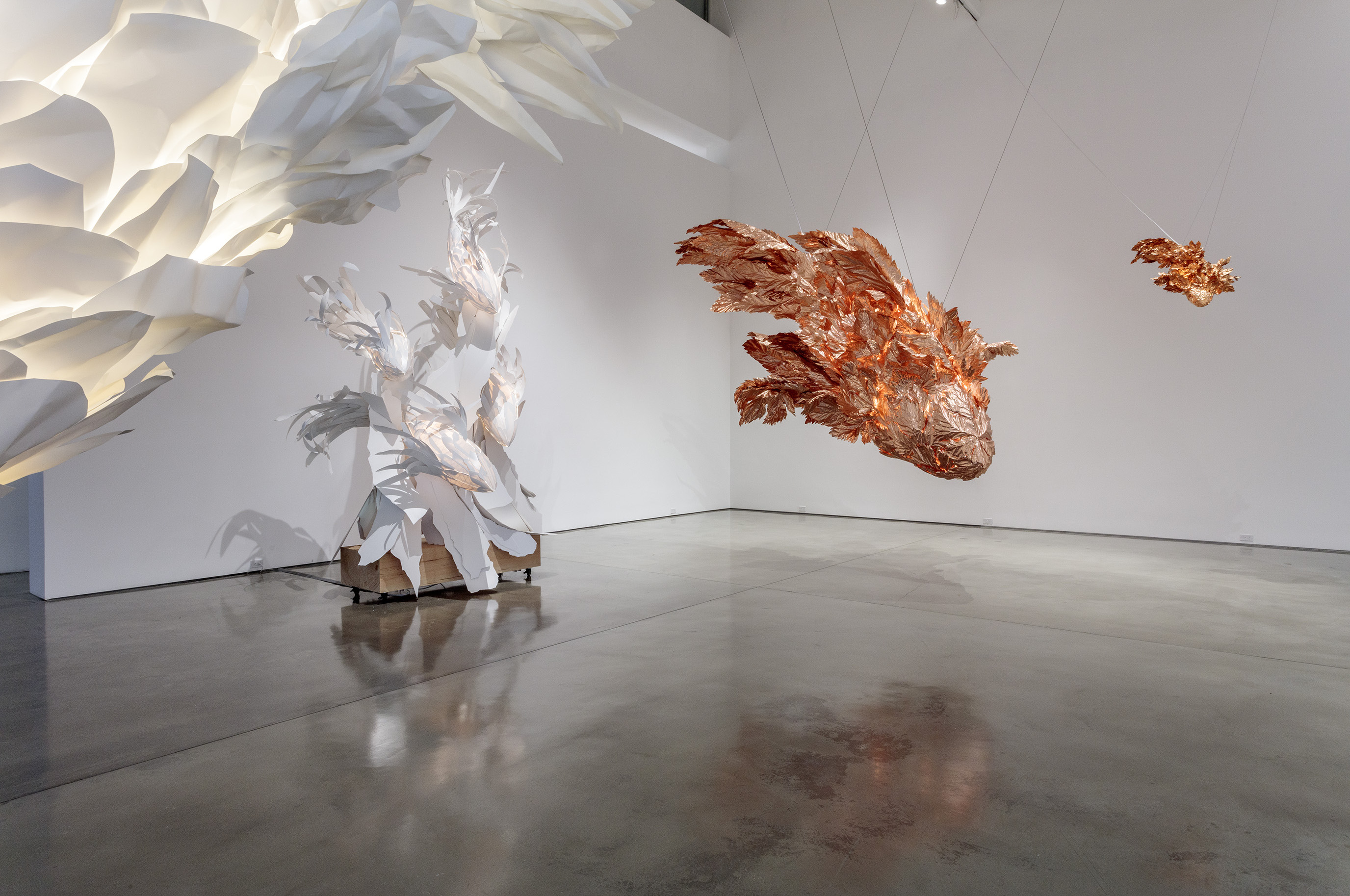
Frank Gehry’s first posthumous exhibition opens on 14 May 2026 at Gagosian Beverly Hills, six months after his death at 96, and it is — pointedly — not a building show. The four sculptures and ten fish drawings hung at 456 North Camden Drive collapse fifty-four years of Frank Gehry object design, from 1972’s Easy Edges cardboard chairs to 2023’s copper Fish on Fire, into one room. Titled simply “Frank Gehry” and running until 27 June 2026, the show was organised by Gagosian with the Gehry family and designed by his own studio in the months before his death.
Death at 96, Then a Show About Objects
Frank Owen Gehry died at his home in Santa Monica on 5 December 2025, of complications from a brief respiratory illness. He was 96 years old, born Frank Owen Goldberg in Toronto on 28 February 1929, and had worked continuously since the late 1950s — from the moment he settled in Los Angeles as a 26-year-old apprentice in Victor Gruen’s office through to the 2025 reviews of the LUMA tower in Arles and the rebuilt Eisenhower Memorial in Washington. The reading of his career that filled the obituary pages in early December was, predictably, the architecture: the chain-link fence and unfinished plywood of the 1978 Gehry Residence on 22nd Street in Santa Monica, the titanium scales of the 1997 Guggenheim Bilbao, the billowing stainless steel of Walt Disney Concert Hall in 2003, the LUMA tower with its 11,000 angled panels in Arles in 2021.
The first major posthumous show, by contrast, is about furniture and lamps and fish. That choice is the curatorial argument of the exhibition. Gehry maintained a parallel object-design career across six decades, conducted in roughly the same studio premises as the buildings and with several of the same hands — Berta Gehry’s brother Gabe Aguilera, longtime fabricator Tomas Osinski, the Formica development team in Cincinnati — and the Camden Drive presentation refuses the standard hierarchy that treats the lamps and chairs as recreations between commissions. The four sculptures here are read as primary work: Bear with Us (2014), a life-size stainless-steel bear; Untitled (Black Crocodile New York) (2023), built in ColorCore Formica and silicone; Fish on Fire (2023), a copper fish that is the last of Gehry’s fish sculptures executed in that metal; and A Pair of Snake Lamps (1989), papier-mâché armatures painted with gouache. Ten works on paper depicting fish in motion — ink, watercolour and acrylic, undated but bracketing the 1980s into the 2020s — line the back wall.
Why Frank Gehry Object Design Was Never Secondary
The Beverly Hills room runs on the premise that Frank Gehry object design has been load-bearing in the practice since 1969, not a sideline. The first commercial object Gehry put into production was a cardboard chair, three years before he began drawing the studio addition that would become his own house on 22nd Street and twenty years before the Vitra Design Museum in Weil am Rhein gave him an institutional commission outside Los Angeles. The chronology is upside down from the canonical reading. The objects came first, shaped the formal vocabulary, and were then run back through the buildings — the cardboard lamination of Easy Edges (1972) into the gridded plywood of the Gehry Residence (1978), the laminate-shard cladding of the Fish Lamps (1984) into the scaled titanium of Bilbao (1997), the bentwood loops of the Cross Check Chair (1992) into the wood ribbons of the Walt Disney Concert Hall foyer (2003).
The Gagosian show is in this sense a corrective. Gehry’s gallerist of three decades, Larry Gagosian, opened his first space at 936 North Camden Drive in 1980 and the current location across the road in 1995. The Beverly Hills gallery had shown Gehry objects three times before — in 2009 (“Frank Gehry: Fish Lamps”), in 2013 (a second Fish Lamps cycle) and in 2020 (“Spinning Tales,” with Tomas Osinski) — but each previous outing was framed as a one-room experiment alongside the main architectural practice. The 2026 show closes the parenthesis. The objects are the work; the buildings are the larger object.
Easy Edges, 1972: The Cardboard Year
The Easy Edges line, designed between 1969 and 1973 and commercialised in 1972 through the Easy Edges Inc. workshop at 1520 Cloverfield Boulevard in Santa Monica, was Frank Gehry’s first commercial design product. The premise was structural: corrugated cardboard, layered in alternating directions and glued under press, behaves like a rigid laminate with a strength-to-weight ratio that allowed full-scale seating to be cut from a single block. Gehry produced seventeen models in the first year, of which the Wiggle Side Chair — a ribbon of cardboard that folds back on itself five times to form seat, back and base — became the canonical object.
Gehry pulled the line from the market in early 1973, three months after Bloomingdale’s in New York placed the chairs in its window. The reasons were not commercial failure: Easy Edges had sold roughly 10,000 pieces in twelve months. They were authorial. Gehry told Esquire in March 1973 that the cardboard furniture was about to make him “a furniture designer to be packaged and sold” and that he wanted to remain an architect. The line was discontinued. The press dies were destroyed. Three years later, in 1976, the smaller and more sculptural Experimental Edges series replaced it — heavier corrugated panels glued into rougher block forms, sold through a single Los Angeles dealer and never produced at scale.
The Wiggle Side Chair was reissued in 1986 by Vitra, the family-owned Swiss manufacturer based at Weil am Rhein, under a licence that Rolf Fehlbaum negotiated with Gehry on the same trip that secured the Vitra Design Museum commission. The chair has been in continuous Vitra production since then, sold from the VitraHaus shop and the Vitra Design Museum bookstore and treated as one of the foundational objects of the late-twentieth-century cardboard-furniture canon alongside Peter Murdoch’s Polka Dot Chair (1964) and Peter Raacke’s Otto Chair (1968). The Easy Edges pieces in the Gagosian show — two early Wiggle chairs and one 1972 Contour Lounge from Gehry’s personal collection — are presented on a low riser at the gallery entrance, against an unpainted plywood wall.
Fish Lamps, 1984–1986: Formica ColorCore as Architectural Skin
The Fish Lamps grew out of a 1983 commission from the Formica Corporation in Cincinnati. Formica had developed a new through-coloured laminate, ColorCore, whose pigment ran through the full thickness of the sheet rather than being printed onto the top surface. The company offered material to a small group of architects and designers — Stanley Tigerman, SITE, Robert Venturi, Gehry — and asked for objects that would showcase the new product. Most of the recipients made tables. Gehry shattered a sheet of ColorCore with a hammer in the back room of his Santa Monica studio, saw the shards on the floor as fish scales, and built the first Fish Lamp in late 1983 out of a wire armature wrapped in laminate fragments lit from inside.
The lamps were exhibited at New City Editions, the Venice, California gallery run by Peter and Shelly Shire, between 1984 and 1986, in a series of unique pieces — never editioned — that ranged from table-top fish under fifty centimetres long to ceiling-suspended specimens at full Pacific halibut scale. Each piece was hand-built in the studio with a different combination of ColorCore tones, transparent acrylic, white and amber glass, and copper armature. Roughly 50 Fish Lamps and a smaller number of Snake Lamps were produced through New City Editions before Gehry suspended the series in 1986 to concentrate on the Frederick R. Weisman House in Beverly Hills and the early planning for the Vitra Design Museum.
The lamps are the formal hinge of Gehry’s career. The shard-clad fish armature of 1984 is the prototype of the titanium-scaled volumes Gehry began producing in CATIA in the mid-1990s, and the surface he eventually executed in Bilbao is, at the level of construction logic, an inflated Fish Lamp. The 2009 and 2013 Gagosian shows — both in Beverly Hills — sold the Fish Lamps for between $300,000 and $750,000 apiece; by 2024 the secondary market had carried full-scale specimens past $1.4 million at Phillips and Sotheby’s. None of the original 1984–86 lamps are in the current show. What is on Camden Drive instead is the 1989 pair of Snake Lamps — the smaller, slower-selling siblings that Gehry produced in papier-mâché rather than ColorCore — and the 2023 copper Fish on Fire, the last fish sculpture Gehry executed before his death and the first to use solid copper rather than laminate shards.
The Snake Lamps of 1989
The Snake Lamps in the Gagosian show — A Pair of Snake Lamps, 1989, papier-mâché painted with gouache — sit between the Fish Lamps and the late copper work as a third register. Gehry began the snakes as a counter-form to the fish in 1984, at the same New City Editions table, but produced them in much smaller numbers and pulled them back into the studio for further work in the late 1980s. The 1989 pair on display were made in the upstairs room of the Santa Monica studio, using newspaper and wheatpaste over a coiled wire armature, then sealed with shellac and painted with watery gouache in greens, ochres and blacks. They were never sold through New City Editions. Both pieces remained in Gehry’s personal collection until the family loaned them to Gagosian for the 2026 show.
The snakes are the most fragile work in the exhibition and the most autobiographical. Gehry returned to fish and snake forms throughout the next thirty-five years — the 1992 fish on the Vila Olímpica in Barcelona, the 1998 fish-scale stainless steel of the Walt Disney Concert Hall foyer, the 2023 Fish on Fire on Camden Drive — and the snake form re-emerged repeatedly in his sketches but rarely in fabrication. The 1989 pair are the only finished sculptural snakes from Gehry’s hand that have entered public view.
Pito Kettle, 1992: Stainless Steel and a Whistling Fish
The Pito Kettle, designed in 1988 and produced from 1992 by Alessi at its Crusinallo factory on Lake Orta in Piedmont, is the object that brought Gehry into the European household. Alberto Alessi had run the firm’s Tea & Coffee Piazza project in 1983 with eleven invited architects, commissioning prototype silver services from, among others, Aldo Rossi, Robert Venturi, Charles Jencks, Hans Hollein, Michael Graves, Paolo Portoghesi and Gehry himself. Gehry’s contribution was a fish-shaped silver coffee service. The Pito Kettle followed five years later as a production object: mirror-polished stainless steel, mahogany handle, with a leaping copper fish in place of the conventional steam whistle.
The kettle has been in continuous Alessi production since 1992 and remains, along with Michael Graves’s 9093 Bird Kettle (1985) and Aldo Rossi’s La Cupola (1990), one of the three signature kitchen objects of the firm’s postmodern decade. The leaping-fish whistle is the smallest and most reproduced of Gehry’s fish forms — a piece of household typology in which the formal vocabulary of the Fish Lamps is condensed to a single soldered copper element no larger than a thumb. The Camden Drive show does not include the Pito Kettle; it sits inside the chronology on the printed wall timeline, alongside the Knoll bentwood chairs of the same year.
Cross Check, 1992: Bentwood Maple at MoMA
The Knoll bentwood furniture, designed 1989–1991 and launched in 1992 in the MoMA New York exhibition “Frank Gehry: New Bentwood Furniture Prototypes,” is the second of Gehry’s two major furniture systems. Gehry developed the line over three years at the Knoll Research and Development Center in East Greenville, Pennsylvania, working with the firm’s bentwood team to strip the chair down to woven maple veneer strips wound into a self-supporting structure without internal frame or screws. The MoMA show, organised by Christopher Mount of the museum’s Department of Architecture and Design, ran in spring 1992 in the third-floor Philip L. Goodwin Galleries and presented six prototypes — Cross Check, Power Play, High Sticking, Hat Trick, Off Side and the Face Off table — each named for ice-hockey terminology in a nod to Gehry’s Toronto childhood.
The Cross Check armchair is the canonical piece. A flat ribbon of maple veneer, two inches wide and one-eighth of an inch thick, is laminated and wound through itself five times to form seat, arms and back without a hidden internal armature. The chair weighs less than ten pounds, supports an adult, flexes slightly under load and uses the same lamination logic Gehry developed for Easy Edges twenty years earlier — corrugated cardboard substituted with thin maple veneer. The Knoll bentwood collection has been in continuous production since 1992 and is the only Gehry furniture system besides the Vitra Wiggle Chair to remain commercially available three decades after launch. The Cross Check is not in the Gagosian show but is the unspoken hinge of the chronology: the moment Gehry’s object-design vocabulary moved from cardboard to wood lamination, three years before the move from sheet titanium to scaled titanium at Bilbao.
Bear with Us, 2014: 316L Stainless Steel at Life Size
Bear with Us, 2014, is the largest sculpture in the Camden Drive show and the most architecturally legible. A life-size bear standing on its hind legs, executed in 316L marine-grade stainless steel sheet over a welded armature, the piece is on loan from the Gehry family and has not been publicly exhibited since a single appearance at the 2015 Louis Vuitton Foundation opening week in the Bois de Boulogne. Gehry produced the bear in his Playa Vista fabrication studio with Tomas Osinski and a four-person welding team, using the same steel grade and surface finish as the LUMA tower then under construction in Arles.
The bear stands roughly 2.4 metres tall on its rear paws. The stainless-steel sheets are scaled in overlapping panels of varying size — larger across the chest and rear, smaller around the muzzle and paws — and pinned to the welded armature with the same fastener detail as the Bilbao titanium. Under the Camden Drive ceiling lights the surface flashes between cool grey and warm gold, the way the LUMA tower flashes between silver and Provençal ochre depending on time of day. Bear with Us is, in this sense, a domestic-scale rehearsal of the LUMA Arles tower: same alloy, same scaling logic, same skin behaviour, executed in a room rather than at fourteen floors.
Fish on Fire and Black Crocodile, 2023: The Last Year of Work
The two 2023 pieces in the show — Fish on Fire and Untitled (Black Crocodile New York) — are the last sculptural objects Gehry signed off on before his health declined in early 2025. Fish on Fire is the most autobiographically loaded work in the room. A copper fish roughly 1.8 metres long, executed in hammered and patinated copper plates over a welded steel armature, it returns to the 1984 Fish Lamp vocabulary in a metal that Gehry had used only in fragments since the Pito Kettle whistle of 1992. The fish is mounted on a low concrete plinth, lit from below, and reads as a single oxidised volume rather than a clad armature. Gehry described it in a 2024 studio interview, with characteristic compression, as “the last fish.”
Untitled (Black Crocodile New York), executed in ColorCore Formica and silicone over a steel armature, is the formal counterpart. The crocodile — roughly 2.2 metres long, jaws open — returns to the 1984 ColorCore vocabulary but in a darker palette: matte-black laminate shards, occasional translucent silicone insertions where the lamps had used coloured glass, no internal lighting. The piece is the only Gehry sculpture in which Formica ColorCore is used at full predator-scale, and it functions in the room as the dark anti-twin to the copper Fish on Fire. Together the two 2023 works close the arc that the 1984 Fish Lamps opened. Same material logic. Same hand. Forty years of compression.
The ten works on paper that line the back wall — ink, watercolour and acrylic depictions of fish in motion, none editioned, none publicly exhibited before — are the supporting drawings. They are the gestural source for every sculpture in the room and the demonstration that Gehry’s late practice was, like Hadid’s, painted before it was built.
Frank Gehry Object and Furniture Design, 1972–2023
- 1972 — Easy Edges (Wiggle Side Chair, Contour Lounge): corrugated cardboard, layered and cross-laminated; produced by Easy Edges Inc., Santa Monica; ~10,000 pieces sold before Gehry pulled the line in 1973.
- 1976 — Experimental Edges: rougher corrugated cardboard blocks, heavier scale; produced through a single Los Angeles dealer.
- 1983 — Tea & Coffee Piazza fish service: silver coffee service shaped as a fish; prototype for Alessi, Crusinallo.
- 1984–1986 — Fish Lamps and Snake Lamps: wire armatures clad in shards of Formica ColorCore laminate, lit from within; unique pieces produced with New City Editions, Venice, California. ~50 fish lamps, fewer snakes.
- 1986 — Wiggle Side Chair reissue: licensed to Vitra by Rolf Fehlbaum; in continuous production at Weil am Rhein since.
- 1989 — A Pair of Snake Lamps: papier-mâché armatures painted with gouache; produced in the Santa Monica studio, never sold through New City Editions; in the Gagosian 2026 show.
- 1992 — Pito Kettle: mirror-polished stainless steel kettle with mahogany handle and leaping-fish copper whistle; for Alessi, Crusinallo. In continuous production.
- 1992 — Knoll bentwood collection (Cross Check, Power Play, High Sticking, Hat Trick, Off Side, Face Off): woven maple veneer strips, no internal frame; debuted at MoMA New York and produced by Knoll, East Greenville, Pennsylvania. In continuous production.
- 2004 — Tiffany & Co. Frank Gehry Collection: jewellery in silver, gold, wood and stone; produced by Tiffany & Co., New York.
- 2009 — Fish Lamps cycle (Gagosian Paris): second-generation Fish Lamps in ColorCore Formica, produced with Tomas Osinski; Gagosian Paris, then Beverly Hills 2013.
- 2014 — Bear with Us: life-size bear in 316L stainless steel sheet over welded armature; produced in the Playa Vista studio; on loan to Gagosian 2026 from the Gehry family.
- 2020 — Spinning Tales (Gagosian Beverly Hills): collaborative sculptural works with Tomas Osinski.
- 2023 — Fish on Fire: hammered and patinated copper plates over steel armature; the last fish Gehry produced in copper.
- 2023 — Untitled (Black Crocodile New York): ColorCore Formica and silicone over steel armature; the largest Formica predator in the Gehry catalogue.
Camden Drive as a Reading Frame
The Gagosian Beverly Hills space at 456 North Camden Drive was designed by Richard Meier and opened in 1995 as Larry Gagosian’s second Los Angeles location, replacing the 936 North Camden Drive room across the street. The gallery is a single-volume white-cube space with a 6.5-metre clear ceiling, north-lit through a longitudinal clerestory, and a polished concrete floor. The 2026 Gehry hang reads as a deliberate counter-staging of that envelope. The four sculptures are placed in a loose diagonal across the room rather than on a central axis; Bear with Us anchors the northwest corner, Fish on Fire the centre, Black Crocodile the southeast, Snake Lamps near the entrance. The ten works on paper run along the long east wall, framed in plain white maple, hung low.
The decision to design the show in-house — Gehry Partners’ exhibition team led the layout in early 2025, before Gehry’s death — accounts for the absence of vitrines, plinths above 30 centimetres or didactic panels. There are six wall labels for sixteen objects. The catalogue, published by Gagosian to coincide with the opening and edited by the Gehry studio with Mark Francis, runs to 160 pages and is the first comprehensive object catalogue Gehry signed off on in his lifetime. It is also the first to treat Easy Edges, the Fish Lamps and the late copper and Formica work as a single continuous output rather than as three separate episodes.
The Architectural Parallels That Are Not in the Room
What is excluded from Camden Drive is as deliberate as what is shown. There are no models of the Vitra Design Museum (1989), no Bilbao titanium samples, no Walt Disney Concert Hall plywood mock-ups, no LUMA Arles steel panels. The 1978 Gehry Residence at 1002 22nd Street in Santa Monica appears in the catalogue only as a single photograph, illustrating the chain-link-and-plywood backdrop against which the Easy Edges chairs were initially shot in 1972. The Sirmai-Peterson House in Thousand Oaks (designed 1984, completed 1988) and the unbuilt Lewis Residence (1989–1995) are mentioned in two sentences each.
The show argues that the buildings are now sufficiently canonical that they do not need to be in the room with the objects. They are in the room with the objects in the sense that every visitor walks in already knowing them. What the Camden Drive hang asks is the reverse question: did the objects make the buildings? Easy Edges as the source for the laminated wood structures of the 1978 House. Fish Lamps as the source for the scaled titanium of Bilbao. Knoll bentwood as the source for the Disney foyer ribbons. Bear with Us as a 2.4-metre rehearsal of the LUMA tower.
Pritzker, 1989: The Year the Frame Shifted
Gehry’s 1989 Pritzker Architecture Prize — awarded in May of that year by the Hyatt Foundation, with the citation read at the Todai-ji temple in Nara, Japan — is the institutional pivot that turned a Los Angeles object-and-house architect into a global signature practice. The prize arrived in the same calendar year as the completion of the Vitra Design Museum at Weil am Rhein, Gehry’s first significant building outside the United States, and four years before the Bilbao competition win in 1991. The 1989 Snake Lamps now at Gagosian were produced in the months around the Pritzker announcement; the New City Editions Fish Lamps cycle had just closed; the Knoll bentwood prototypes were three years from launch at MoMA. The Pritzker is therefore not the structural caesura it is sometimes painted as. The object work continued through it — Pito Kettle, Cross Check, the Tiffany jewellery line of 2004, the Fish Lamps cycles at Gagosian — and the architecture, after 1989, increasingly read as object work scaled up.
Coda
What closes on Camden Drive on 27 June 2026 is the first full reading, in Gehry’s own studio’s hands, of the parallel object practice. The bear, the crocodile, the copper fish and the papier-mâché snakes are not the chairs and lamps that filled the previous Gagosian Fish Lamps cycles. They are heavier, slower, more autobiographical. They are also the last objects Gehry signed off on. The hang reads as a self-edited retrospective made under no commercial pressure — six months after the architect’s death, in a gallery he had used since 1980, with material the family controlled rather than the market. The argument the show makes is that Frank Gehry object design was never the warm-up. It was the same work, at a different scale, in different materials, for fifty-four years.