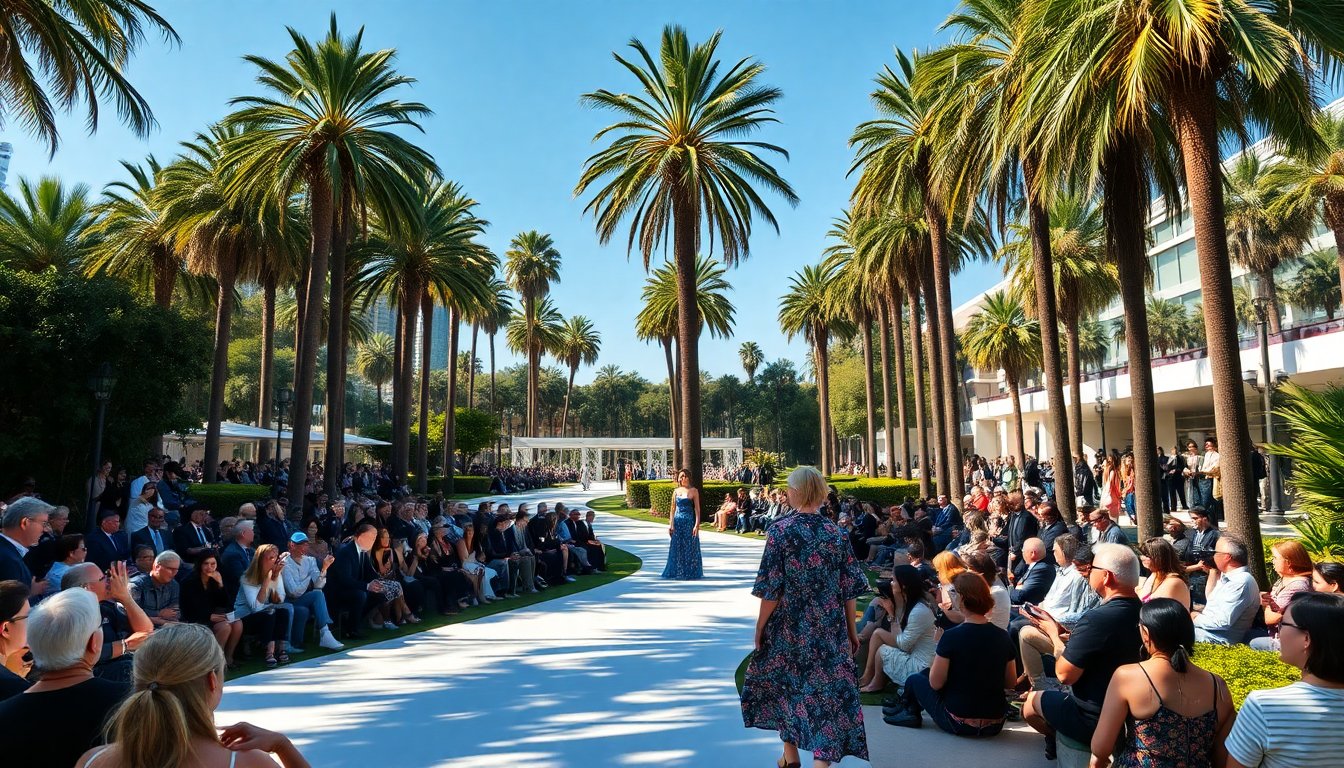
Jonathan Anderson’s Dior Cruise 2027, staged inside Peter Zumthor’s still-warm David Geffen Galleries at LACMA on 13 May 2026, is the first Dior cruise show in Los Angeles since Maria Grazia Chiuri’s 2018 collection in the Upper Las Virgenes Canyon and the first ever directed by a creative director who simultaneously runs Dior menswear, womenswear and haute couture. The Jonathan Anderson Dior Cruise debut closed a thirteen-year arc that began at Loewe in September 2013 and routed, in just over twelve months, through three Dior appointments, the dissolution of the Chiuri-Kim Jones two-house structure, and the handover of the Loewe Foundation Craft Prize to a new pair of artistic directors at Madrid.
This is not a review. It is a chronology — every Dior cruise destination since 2015, the directors who built them, and what the 13 May 2026 LACMA show changed about how the house’s resort calendar functions inside LVMH.
The Geffen Galleries: Peter Zumthor’s 220,000-square-foot stage
The David Geffen Galleries at LACMA had only been open to members for twenty-four days when Dior took possession of the floor. Designed by Peter Zumthor and opened on 19 April 2026 after more than a decade of contested planning, the building is a single, uninterrupted, 220,000-square-foot concrete level that arcs over Wilshire Boulevard on seven splayed supports. There are no internal walls in the curatorial sense — only forty-odd glass-walled “vitrine rooms” set inside the floor plate like islands. The galleries’ interior height, the unbroken sightlines from end to end of the slab, and the daylight admitted through perimeter glazing made it, on paper, the largest unbroken interior any cruise show has ever used.
Anderson’s team built a runway that ran the full length of the floor — a single straight line, no turn, no platform — and seated 1,100 guests on backless wood benches arranged in two parallel rows along the route. The vitrine rooms were left intact and lit from within during the show, so each pair of guests watched the collection pass against a moving backdrop of Asian sculpture, Pre-Columbian gold, Islamic ceramics and post-1945 California painting. No set was built. No screen was installed. The architecture was the set.
This was Anderson’s first piece of public direction at Dior since his 17 April 2025 appointment as creative director of Dior Men and his 2 June 2025 expansion to womenswear and haute couture — the first designer to lead all three Dior divisions since Christian Dior himself between 1947 and 1957. Choosing the Zumthor building meant accepting that nothing he placed inside it would dominate the structure. The decision read as a thesis statement.
Dior Cruise 2016–2026 under Chiuri (and one Raf Simons opening)
Before reading the LACMA show, it helps to read the eleven cruise destinations that preceded it. The Dior cruise calendar — known internally as the “Croisière” — was reinstated as a major travelling show by Raf Simons in May 2015 and turned, under Maria Grazia Chiuri, into the house’s most reliable annual set-piece outside the Paris ready-to-wear calendar. Chiuri did ten cruises in nine years; the only gap was the COVID-displaced Lecce show, which slipped from May to July 2020.
Dior Cruise destinations, 2016–2027
| Cruise | Show date | City | Venue | Designer |
|---|---|---|---|---|
| 2016 | 11 May 2015 | Théoule-sur-Mer | Palais Bulles | Raf Simons |
| 2017 | 31 May 2016 | Oxfordshire | Blenheim Palace | Dior studio (Serge Ruffieux, Lucie Meier) |
| 2018 | 11 May 2017 | Calabasas, CA | Upper Las Virgenes Canyon | Maria Grazia Chiuri |
| 2019 | 25 May 2018 | Chantilly | Domaine de Chantilly, Great Stables | Maria Grazia Chiuri |
| 2020 | 29 April 2019 | Marrakech | El Badi Palace | Maria Grazia Chiuri |
| 2021 | 22 July 2020 | Lecce | Piazza del Duomo | Maria Grazia Chiuri |
| 2022 | 17 June 2021 | Athens | Panathenaic Stadium | Maria Grazia Chiuri |
| 2023 | 16 June 2022 | Seville | Plaza de España | Maria Grazia Chiuri |
| 2024 | 18 May 2023 | Mexico City | Colegio de San Ildefonso | Maria Grazia Chiuri |
| 2025 | 3 June 2024 | Perthshire | Drummond Castle Gardens | Maria Grazia Chiuri |
| 2026 | 27 May 2025 | Rome | Villa Albani Torlonia | Maria Grazia Chiuri |
| 2027 | 13 May 2026 | Los Angeles | David Geffen Galleries, LACMA | Jonathan Anderson |
Three things are visible across that table.
First, the cruise calendar started as a destination experiment under Simons and an interim continuity exercise under the studio, and only became a sustained authored series under Chiuri from 2017 onward. The Palais Bulles in 2015 was a Pierre Cardin commission completed in 1989, chosen by Simons for its rotund, Mediterranean optimism; Blenheim in 2016 was a Dior-studio bridging show during the long search for Chiuri’s appointment.
Second, Chiuri’s destinations form a coherent argument. Calabasas was a Western landscape read through Native American craft (and was the cruise that drew accusations of cultural appropriation that subsequently shaped Dior’s collaborative-craft protocols). Chantilly was equestrian Europe. Marrakech was the El Badi Palace’s red-earth amphitheatre. Lecce was Apulian lace and pizzica. Athens was the Panathenaic Stadium, the only surviving stadium of antiquity built entirely of marble. Seville and Mexico City completed a Spanish-speaking diptych. Drummond Castle Gardens delivered tartan reread against tribal Scottish textiles. Villa Albani Torlonia in Rome — Chiuri’s hometown finale — staged her “Beautiful Confusion” collection inside the Torlonia family’s private antiquities collection, with a Federico Fellini frame she narrated as a coda to her tenure. Departure was confirmed two days after that show, on 29 May 2025.
Third, the directors rotate but the format hardens. By 2024 a Dior cruise is a roughly 100-look co-ed show staged in a single landmark venue, opened on a weekday in May or June, paired with a long-form patronage gesture in the host city (textile workshops, garden restoration, ateliers funded). The format is now an instrument of the house, not the director.
The Chiuri exit and the three Anderson appointments
To understand why Anderson is doing Dior Cruise 2027 in May 2026 and not May 2027, you have to read the sequence of LVMH announcements between January 2025 and June 2025.
On 31 January 2025, Dior confirmed Kim Jones’s departure from Dior Men after his FW25 show. Jones had been artistic director of Dior Men since March 2018, debuting with the SS19 collection in Paris (and a Pre-Fall SS19 staged in Tokyo) and developing the Stones (Daniel Arsham), KAWS, Hajime Sorayama and Otani Workshop collaborations that defined the house’s menswear vocabulary across his seven-year run.
On 9 March 2025, Anderson announced his exit from Loewe after his FW25 womenswear show — eleven and a half years after his September 2013 appointment by Delphine Arnault and Pierre-Yves Roussel. He was succeeded at Loewe by Proenza Schouler founders Jack McCollough and Lazaro Hernandez, effective 7 April 2025.
On 17 April 2025, Dior named Anderson creative director of Dior Men.
On 29 May 2025, the house confirmed Chiuri’s departure, two days after the Villa Albani Torlonia cruise show.
On 2 June 2025, Anderson’s remit was expanded to Dior womenswear and haute couture — making him the first designer to direct all three Dior divisions since Christian Dior himself. Delphine Arnault, who has chaired Christian Dior Couture since February 2023, made the appointment.
In one twelve-month window LVMH dissolved the menswear/womenswear/couture three-direction structure that had organised Dior since John Galliano’s Belle Époque, reduced the house to a single creative authority, and asked that authority to deliver his first major non-runway show — a cruise — inside thirteen months. Anderson chose Los Angeles. He chose Zumthor. He chose 13 May 2026, slotted ahead of the wider cruise-2027 calendar that will see Matthieu Blazy’s Chanel debut in Biarritz and Pierpaolo Piccioli’s Balenciaga arrive later in the year.
The collection: 75 looks, co-ed, and the reinvention of the Bar jacket
Anderson sent 75 looks down the Geffen floor. The collection was co-ed — menswear and womenswear in a single sequence, which Dior under Chiuri and Jones had only attempted twice (the Marrakech 2019 cruise being the most notable). This was the first time a Dior cruise had been authored co-ed from inception.
The structural surprise was the Bar jacket. Christian Dior’s 1947 silhouette — wasp waist, padded hip, sloping shoulder, knee-skirt — has been the house’s load-bearing reference for seventy-nine years. Chiuri tended to interpret it through softened tailoring and revisited fabrics; Galliano had operated through historical pastiche. Anderson cut the Bar jacket to mid-thigh, retained the hip flare, and fringed the entire hem in dense, hand-knotted thread — a transposition of the trimming language he had refined at Loewe over a decade. The fringed Bar jacket appeared in eleven looks, in oyster, oxblood, ecru and a particular dust pink that read as a Ruscha gradient under the gallery lighting.
The denim programme was the second structural move. Working with an unnamed Japanese mill, Anderson developed a heavyweight selvedge embroidered with fine silver chains, which appear from a distance as a stitched line but which clink quietly in motion. Cargo trousers, A-line skirts and a chore coat were cut from the embroidered cloth. The chains were applied in the mill, not the atelier — a manufacturing decision that locates technical authorship outside Paris in a way Dior womenswear has not previously done at scale.
The third move was the collaborations. Ed Ruscha produced four shirts — large-scale word paintings translated to silk twill (HONEY, BLISS, OOF, NOISE, in the artist’s signature typography). Philip Treacy supplied feathered headpieces for fifteen exits, a Treacy-Dior pairing that picked up where Galliano’s Treacy commissions of the late 1990s and early 2000s had left off. The Ruscha shirts and Treacy hats anchored the “on-screen, off-screen” narrative Anderson had described in the show notes — Old Hollywood costume read as still-photograph and as moving-image at once.
Finer details: a series of duchesse satin slip dresses cut from a single seam, lace fragments salvaged from a Calais archive and applied as dorsal panels, hammered-silver hardware on the new “Diorama” bag (a soft, structured shoulder bag that replaces the Lady Dior reference in the runway looks), and a strict 1940s glove discipline — every look wore leather gloves to the wrist or above.
Anderson’s Loewe-era craft transposition
What Anderson moved from Loewe to Dior is not a silhouette but a method. At Loewe between 2013 and 2025, he organised the house around four operating commitments: a craft prize, a permanent collaboration cadence, a leather logic that began with the puzzle bag in 2014, and an exhibition practice that treated runway shows as installations.
He founded the Loewe Foundation Craft Prize in 2016. The winners since — Ernst Gamperl (2017), Jennifer Lee (2018), Genta Ishizuka (2019), Fanglu Lin (2021, after the 2020 cancellation), Eun-Mee Chung (2022), Eriko Inazaki (2023), Andrés Anza (2024), Kunimasa Aoki (2025) and Jongjin Park (2026) — define a particular taxonomy of contemporary craft: turned wood, hand-coiled clay, textile sculpture, lacquer-and-charcoal hybrids. The prize is the most visible single act of patronage in luxury fashion and is now the canonical reference for how craft is staged inside a brand.
Anderson’s collaboration cadence at Loewe ran from Studio Ghibli to William De Morgan tiles to Suna Fujita ceramics to On running shoes. None of these were marketing exercises. Each was a one-collection partnership with the production handled, where possible, in the partner’s own workshop.
What Dior Cruise 2027 in Los Angeles inherited from this practice is visible in three places. First, the Ed Ruscha collaboration is a transposition of the Loewe-Studio-Ghibli model: a single visual artist, four products, in-collection rather than capsule-format. Second, the Japanese embroidered denim is a transposition of the Loewe craft-prize logic — a non-Parisian supplier given technical authorship of a key fabric. Third, the show’s restraint — no built set, no screen, no spectacle — is the Loewe runway logic carried over. Loewe shows under Anderson rarely built structures. They placed clothes into existing rooms and let the rooms do the work.
The unresolved question, which Cruise 2027 does not yet answer, is whether Anderson will found a Dior equivalent of the Loewe Foundation Craft Prize, and if so, where it will sit relative to the existing Dior haute couture ateliers and the Petit Trianon residency at Versailles.
Why Los Angeles, and why now
Los Angeles as a cruise destination reads as a deliberate choice, not a default. Chiuri’s 2018 cruise — staged in the Upper Las Virgenes Canyon outside Calabasas — was the only previous LA Dior show, and the cultural-appropriation criticisms that followed it had made the city a difficult return for the house. Anderson’s response was not to avoid the city but to relocate the show from the canyon to the most recently opened public-art building on the West Coast and to programme the city in three additional ways.
The first was a Dior-funded textile workshop announced on the morning of the show, in partnership with the LACMA conservation department, supporting two Indigenous Californian weavers in a one-year studio residency. This was framed explicitly as a response to the 2018 collection and the conversations that followed it.
The second was a private dinner the night before at the Sirmai-Peterson House — Frank Gehry’s 1986–88 Thousand Oaks residence — for which Anderson had personally requested the location after the property’s recent transfer to the Vitra Design Foundation. (Vitra owns the house through a 2025 donation and is in the early stages of a long-term conservation programme.) The dinner sat 80 guests including Delphine Arnault, Bernard Arnault, Pharrell Williams, Tilda Swinton and Greta Gerwig.
The third was the show date itself. By staging 13 May 2026 — a Wednesday, fixed weeks before Chanel’s Biarritz cruise (3 June 2026) and Louis Vuitton’s still-unannounced summer show — Anderson positioned Dior as the opening salvo of the cruise-2027 cycle. The LVMH calendar logic is straightforward: Dior moves first, Vuitton follows, the cycle is bracketed by haute couture in early July. Going first signals the house’s confidence in its new direction and gives every subsequent cruise show in the cycle a Dior reference point.
How the Anderson cruise format diverges from Chiuri’s
Comparing 13 May 2026 LACMA with 27 May 2025 Villa Albani Torlonia gives a clean diagnostic of how the format has shifted.
Chiuri’s Rome show was 102 looks (Anderson’s was 75), womenswear-only (Anderson’s was co-ed), staged inside a private aristocratic collection with rooms walked through in sequence (Anderson’s was a single straight runway), accompanied by a Roberto Bolle dance commission and a Fellini-inspired short film (Anderson built no programme around the show, only the workshop announcement and the Gehry-house dinner), and oriented toward a narrative of national homecoming (Anderson’s was oriented toward an institution still finding its public language).
The cumulative effect is a reduction. Anderson’s cruise is shorter, quieter, more architectural, and presented with fewer ancillary objects. The press materials totalled eight pages including credits. The post-show film, released at 06:00 LA time on 14 May, ran 4 minutes 12 seconds and was directed by Tyler Mitchell.
Whether this becomes the new format or whether Cruise 2028 reintroduces some of the Chiuri-era scale is the most useful open question about Anderson’s Dior. The cruise calendar is the house’s most malleable platform — it sits outside the Paris schedule, outside the couture week, and can be sized to whatever the director needs it to be. Anderson has signalled, in his first attempt, that the format itself is one of the variables.
The wider 2025–26 luxury chessboard
Cruise 2027 lands inside a fashion year that has already absorbed the largest concentration of creative-director changes in luxury since the late 1990s. Anderson at Dior is one of eleven major house appointments in the cycle that also includes Matthieu Blazy at Chanel, Pierpaolo Piccioli at Balenciaga, Demna Gvasalia at Gucci, Glenn Martens at Maison Margiela, Louise Trotter at Bottega Veneta, Jack McCollough and Lazaro Hernandez at Loewe, Simone Bellotti at Jil Sander, Miguel Castro Freitas at Mugler, Duran Lantink at Jean Paul Gaultier and Dario Vitale at Versace (now inside the Prada Group following the April 2025 acquisition). Three of those — Anderson, Blazy and Piccioli — will deliver inaugural cruise shows within twelve months of each other. Two of those three, Anderson and Blazy, are co-ed.
What the Anderson Dior Cruise 2027 establishes for the rest of the cycle is a benchmark: a short, architecturally led, single-venue, co-ed show that treats the destination as collaborator rather than backdrop. Whether Blazy answers it from the Casino Municipal in Biarritz on 3 June, and whether Piccioli answers it from wherever Balenciaga lands its 2027 cruise, will set the terms of the cycle.
Coda
There is a tendency in cruise coverage to treat the destination as the story. With Anderson, the destination is the argument. LACMA’s David Geffen Galleries reopened the Wilshire campus after thirteen years of construction and a generation of debate about whether Zumthor’s single-storey concrete bridge would work as a museum at all. Choosing it twenty-four days into its public life — when its acoustics, its sightlines, its lighting and its crowd behaviour were still being measured by its own curators — was a gesture of trust in a building that had been doubted for a decade. Anderson did not test the architecture. He let it test the clothes. Dior Cruise 2027 was the result.