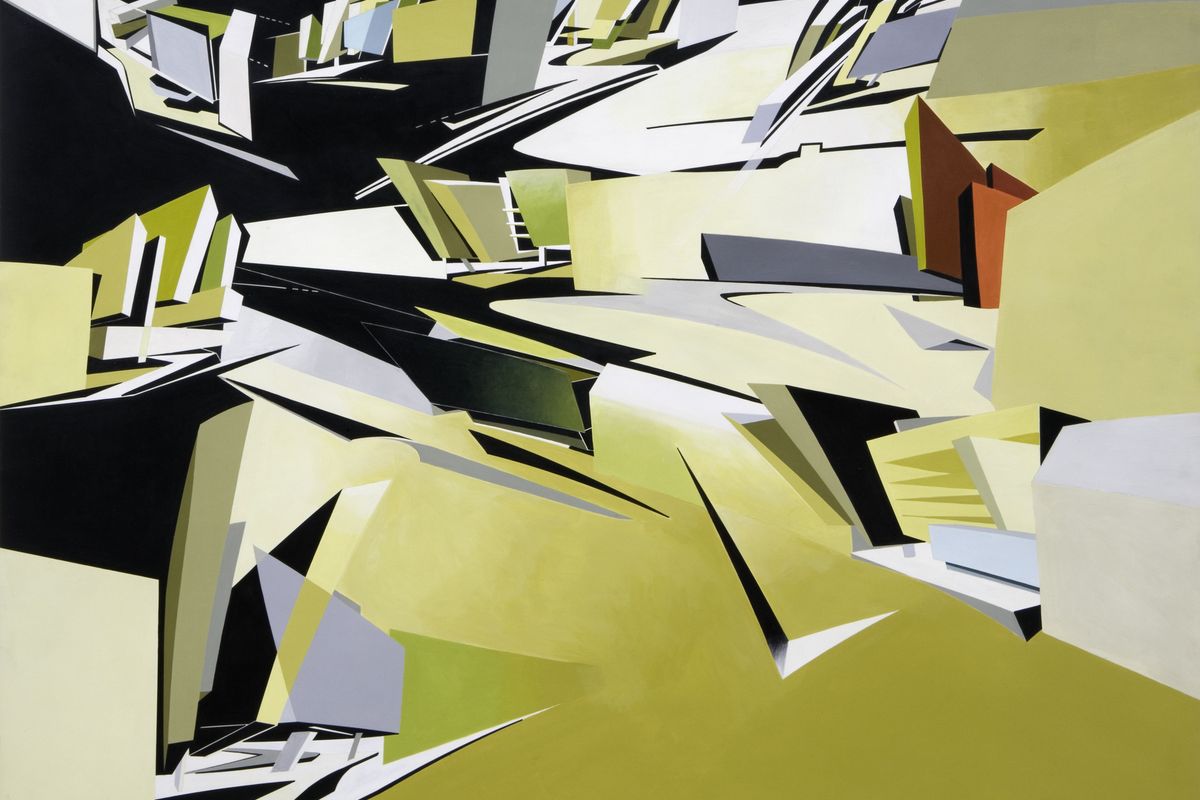
On 1 May 2026, “Zaha Hadid: I Think There Should Be No End to Experimentation” opens at LUMA Arles in the Parc des Ateliers, Arles, France, running until Spring 2027. The zaha hadid paintings luma arles survey, curated by Hans Ulrich Obrist with Arthur Fouray and Lucas Jacques-Witz and produced with the Zaha Hadid Foundation, occupies The Tower, Archives Gallery and Cherry Tree Gallery inside Frank Gehry’s 56-metre stainless-steel pile and reframes every acrylic, ink wash and competition perspective Hadid produced between her 1977 AA thesis and the 2012 Heydar Aliyev Center as the operative drawings of her architecture, not its decoration.
LUMA Arles and Hans Ulrich Obrist’s Sixth Archive Chapter
LUMA Arles was founded in 2013 by Maja Hoffmann (b. 1956), the Basel-born Hoffmann-La Roche heir who established the LUMA Foundation in 2004 to anchor her family’s holdings to a single arts campus on the disused SNCF railway workshops south of the Roman amphitheatre. The 15,000-square-metre Frank Gehry tower opened in June 2021, its 11,000 angled stainless-steel panels cited by Gehry as a deliberate echo of Vincent van Gogh’s Starry Night, painted in Arles in 1889 during the artist’s twelve-month stay at the Yellow House on Place Lamartine. The tower’s three primary exhibition floors — The Tower (Level 7), the Archives Gallery (Level 3) and the Cherry Tree Gallery (ground) — are deployed here for a single architect for the first time since the building opened.
The exhibition is the sixth chapter of the Hans Ulrich Obrist Archives project, the long-running curatorial format in which Obrist, artistic director of the Serpentine Galleries in London since 2016, opens his recorded-interview and ephemera collection around one practitioner per cycle. Previous chapters have foregrounded Édouard Glissant, Étel Adnan and Cedric Price; the Hadid instalment is the first to take an architect whose primary archive is paintings rather than letters or recordings. Among the unbuilt materials on view are the unpublished Obrist–Hadid interview tapes recorded between 2001 and 2013, played in a dedicated listening room inside the Cherry Tree Gallery alongside the 2012 perspective painting Hadid produced for the Serpentine North Gallery (opened by Hadid’s office on the north bank of the Serpentine, Kensington Gardens, in September 2013).
The decision to host the survey in Arles rather than the Design Museum in Kensington or the MAXXI in Rome is curatorially deliberate. Obrist has framed Hadid (born 31 October 1950, Baghdad; died 31 March 2016, Miami) as a painter who became an architect, and the LUMA tower — a single Gehry envelope wrapping nine exhibition levels — allows the paintings to be shown at the scale of the buildings they predicted rather than reduced to vitrine-sized portfolio sheets. The Zaha Hadid Foundation, established in London in 2013 to steward the founder’s personal archive and continue her philanthropic work, has loaned roughly 250 works on paper, three reconstructed perspective models and the entire run of Hadid’s 1976–77 AA notebooks.
Malevich’s Tektonik, 1977: The First Hadid Painting
The chronological anchor of the exhibition is “Malevich’s Tektonik,” Hadid’s 1977 graduation thesis from the Architectural Association School of Architecture, 36 Bedford Square, London. The thesis, supervised by Rem Koolhaas and Elia Zenghelis in Unit 9, proposed a 14-level hotel cantilevered over the Hungerford Bridge, the Charing Cross railway crossing of the Thames between Embankment and Waterloo. The thesis sheet — exhibited in The Tower at LUMA in a horizontal vitrine alongside Hadid’s Suprematist source plates by Kazimir Malevich (1879–1935) — is an acrylic painting on board, not an orthographic projection. The hotel is rendered as a stack of canted black, red and grey rectangles drifting over the river, in direct citation of Malevich’s “Architekton” sculptures of 1923–27.
The work is the foundational document of Hadid’s career: the moment painting was declared the primary tool of spatial invention rather than its representation. After graduating in 1977 Hadid moved to Rotterdam to join the Office for Metropolitan Architecture under Koolhaas and Zenghelis, leaving in 1980 to open her own London practice at 10 Bowling Green Lane, Clerkenwell, which became Zaha Hadid Architects with the arrival of Patrik Schumacher in 1988. The Malevich thesis remained the rosetta stone for everything that followed: Schumacher’s later codification of parametricism as the firm’s house style begins, structurally, with the 1977 hotel-as-painting.
LUMA shows the thesis alongside three Hadid-painted variants of the Hungerford scheme produced between 1977 and 1979, none of which has been exhibited publicly since the 1983 Architectural Association show “Planetary Architecture” mounted by Alvin Boyarsky. The acrylic surfaces are unstretched, taped to mounts as Hadid worked them in her Clerkenwell studio.
The Peak Hong Kong, 1982–83: Fragmented Isometric Acrylics
Two floors below, the Archives Gallery is given entirely to The Peak Leisure Club, the first-prize-winning unbuilt competition of 1982–83 for a private members’ club on Victoria Peak overlooking Hong Kong harbour. The brief, issued by the Hong Kong developer Eduard Ho, asked for a 10,000-square-metre clubhouse on a sloping site at 552 metres altitude; Hadid, then 32 and working from Bowling Green Lane with five staff, responded with a suite of fragmented isometric acrylic paintings showing four cantilevered slabs splayed across the slope as if dropped from above.
The Peak paintings — six large canvases and roughly 40 supporting studies — are the works that brought Hadid international attention, exhibited at MoMA in the 1988 “Deconstructivist Architecture” show curated by Philip Johnson and Mark Wigley alongside Frank Gehry, Rem Koolhaas, Peter Eisenman, Daniel Libeskind, Bernard Tschumi and Coop Himmelb(l)au. MoMA retains the canonical “confetti” painting in its design collection (accession 1985.85.a-b); LUMA has secured the loan for the full eighteen-month run, plus four preparatory paintings from the Zaha Hadid Foundation never previously shown.
The Peak was not built — the developer withdrew funding before construction — but the paintings codified what is now called Hadid’s deconstructivist 1980s: a world in which buildings are seen from impossible aerial angles, fragmented into planar shards and rendered in saturated acrylics that read more as Suprematist canvases than as architectural drawings. Every formal move in the later Audi origin sculpture at Milan Design Week 2026 — the slip of mass, the canted volume, the absence of a stable horizon — traces directly to a Peak study mounted six floors above the Audi piece’s manufacturing brief.
Cardiff Bay Opera House, 1994: “Do They Want Nothing But Mediocrity?”
The third major project room, on Level 5 of the Tower, reconstructs the Cardiff Bay Opera House competition of 1994. Hadid’s office won the two-stage competition for a 1,900-seat opera house on the Cardiff waterfront, judged by a panel chaired by Lord Crickhowell; the funding body, the Millennium Commission of the UK National Lottery, declined to release the £45 million capital award and the building was cancelled in late 1995. Hadid’s recorded response — “Do they want nothing but mediocrity?” — is reproduced on the wall in 40-point Univers, citing a December 1995 letter to the project’s funding body.
The Cardiff room is the densest in the exhibition. Hadid produced over 200 paintings, ink wash sketches and gouache studies for the scheme, of which LUMA shows roughly 90. The opera house was conceived as a “jewel inset in a necklace” of public terraces ringing an inner harbour, and Hadid worked the project in oblique aerial perspectives painted in cobalt blue and rust acrylic, the dock framed by chevroned bands of pier and quay. The rejection is now read by most architectural historians as the moment a British public client lost the option to commission Hadid; the next two decades of her major commissions ran almost entirely outside the UK, from Innsbruck to Guangzhou to Baku.
In the corner of the room, a separate vitrine shows the 1990 unbuilt scheme for the Berlin Kurfürstendamm, the 1991 Düsseldorf Art and Media Centre and the 1992 Cincinnati Rosenthal Center competition — the run of European and North American unbuilt projects that bracket Cardiff and that establish painting as Hadid’s working medium across an entire decade.
From Painted Vitra Fire Station to Built Heydar Aliyev
The Cherry Tree Gallery on the ground floor closes the chronological arc by pairing two buildings. The first is the Vitra Fire Station at Weil am Rhein, Germany, designed 1990–91 and completed 1993 on the Vitra Campus alongside Tadao Ando’s conference pavilion and Frank Gehry’s Vitra Design Museum (the wider context of which is mapped in the Vitra Campus 2026 preview and Gehry’s Sirmai-Peterson archive). The Fire Station — Hadid’s first completed building, a raw concrete wedge of sharp diagonals slicing past the Vitra production halls — is reconstructed at LUMA through the original 1990 acrylic painting and its later as-built photographs, hung at identical scale.
The second is the Heydar Aliyev Center, the cultural centre opened in May 2012 in central Baku, Azerbaijan, on the former parade ground east of Heydar Aliyev Prospekti. The 57,500-square-metre building, designed by Zaha Hadid Architects with Patrik Schumacher as principal and completed eleven years after the firm’s parametric turn, is the mature work the paintings predicted. LUMA presents the building through three large perspective paintings produced by the office in 2007 — surfaces of folded white acrylic flowing into a single uninterrupted plane — alongside the construction photographs taken between 2009 and 2012.
The pairing is the curatorial argument of the show: the 1990 Vitra painting and the 1993 building share the same vocabulary. The 2007 Heydar Aliyev paintings and the 2012 building share the same vocabulary. The paintings precede the buildings by two to five years, and they are the design — not its illustration.
Hadid Painting Timeline: Image to Built Work
- 1977 — Malevich’s Tektonik (AA thesis): acrylic painting of a 14-level hotel cantilevered over London’s Hungerford Bridge, after Kazimir Malevich. Never built. The founding document.
- 1979–80 — Hungerford Bridge variants: three further acrylics extending the thesis, produced in Hadid’s first OMA Rotterdam year and after.
- 1982–83 — The Peak Leisure Club, Hong Kong: first-prize-winning competition, fragmented isometric acrylics. Unbuilt; canonical painting in MoMA collection.
- 1988 — MoMA “Deconstructivist Architecture”: Peak paintings exhibited in New York alongside Gehry, Koolhaas, Eisenman, Libeskind, Tschumi, Coop Himmelb(l)au.
- 1990 — Vitra Fire Station drawings: acrylic perspective paintings of the Weil am Rhein commission for Rolf Fehlbaum.
- 1993 — Vitra Fire Station completed: Hadid’s first built work; raw concrete wedge on the Vitra Campus.
- 1994 — Cardiff Bay Opera House: competition won, scheme cancelled by the Millennium Commission. ~200 paintings produced; the rejection severs Hadid from UK public commissions for a decade.
- 2003 — Rosenthal Center for Contemporary Art, Cincinnati: first completed US museum.
- 2004 — Pritzker Prize: Hadid the first woman to receive it; awarded in St Petersburg by the Hyatt Foundation.
- 2007 — Heydar Aliyev Center paintings: folded-surface perspectives of the Baku commission produced by Zaha Hadid Architects under Patrik Schumacher.
- 2012 — Heydar Aliyev Center opens: mature parametric work, 57,500 sqm in central Baku. The painted surface becomes built.
- 2012 — Serpentine North Gallery perspective painting: the work shown at LUMA from Hadid’s final perspective campaign for a London building.
- 31 March 2016 — Hadid’s death: aged 65, in Miami, of a heart attack while being treated for bronchitis. Patrik Schumacher continues Zaha Hadid Architects.
Why Zaha Hadid Paintings at LUMA Arles Matter Now
The zaha hadid paintings luma arles survey arrives at a particular moment in the reception of her work. Ten years after Hadid’s death, the architectural conversation around her practice has separated cleanly into two camps. The first reads the buildings as the work and the paintings as preparatory; the second, advanced by Patrik Schumacher in his 2010 essay “Parametricism: A New Global Style for Architecture and Urban Design,” reads the buildings as the computational outcome of a digital project that began with parametric scripts in the late 1990s. Both readings sideline the paintings.
Hans Ulrich Obrist’s argument at LUMA is that both are wrong. The paintings are not preparatory and they are not pre-digital. They are the design, and the digital tools of the 2000s — Maya, then Rhino, then the in-house ZHA scripting environment — were imported into the office to chase what was already painted on canvas in 1977 and 1983. The exhibition presents the parametric Heydar Aliyev Center not as the culmination of a computational project but as the eventual buildability of a Malevich-derived painting practice.
For the architect or curator working in 2026, the LUMA show is the most complete public access to Hadid’s primary archive ever offered, and the first in which the paintings are exhibited at building scale inside a Gehry envelope that itself answered Van Gogh in Arles. It runs through Spring 2027; the catalogue, edited by Obrist with Schumacher’s office, is published by JRP|Editions in October 2026.
Hadid said, in the September 2003 Obrist interview now playing in the Cherry Tree listening room: “I think there should be no end to experimentation.” LUMA has made the sentence the title and the thesis. On the Parc des Ateliers, between Gehry’s tower and the disused SNCF sheds, the paintings finally arrive at the scale of the buildings they always were.