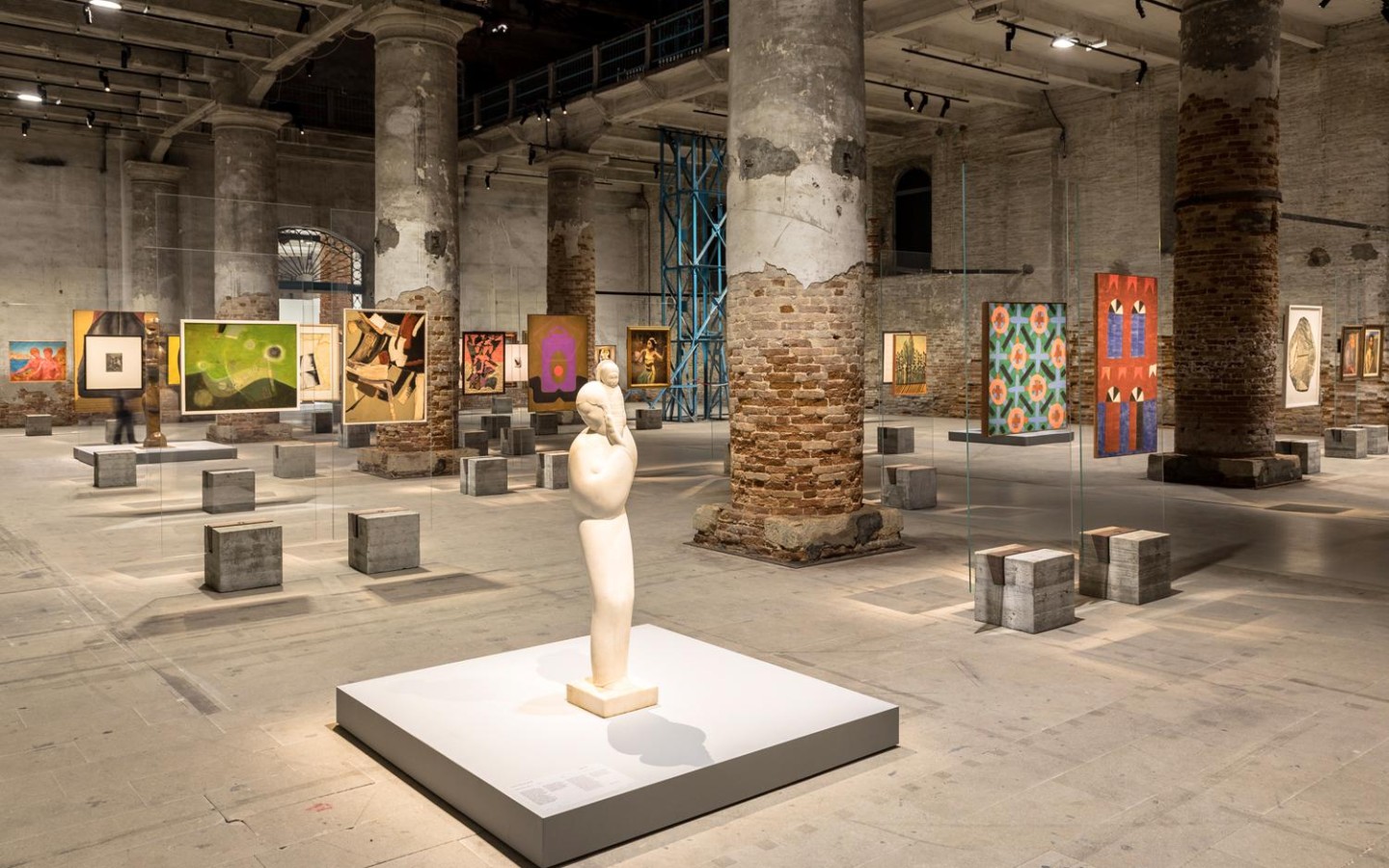
Eight painter and sculptor collateral shows fan out across Venice’s palazzi this spring, and the question this piece answers is which palazzo holds which painter — and which of those painter-palazzo pairings carries the weight of the edition. The painters-by-palazzo question is rarely answered properly because the answer is geographic, not alphabetical, and because the heaviest pairing on the list — Marina Abramović staged against Titian’s Pietà of 1575–76 inside the Gallerie dell’Accademia — is the one the alphabetical surveys bury. The painter-and-sculptor collaterali opened on a staggered calendar between 25 April and 9 May, which means the city has been absorbing them one palazzo at a time. Hernan Bas at Ca’ Pesaro, Anish Kapoor at Palazzo Manfrin, Georg Baselitz at the Fondazione Giorgio Cini, Marina Abramović at the Gallerie dell’Accademia, Nalini Malani at the Magazzini del Sale, Sanya Kantarovsky at Palazzo Loredan, Barry X Ball inside Palladio’s basilica on San Giorgio Maggiore, and Fondazione Dries Van Noten at Palazzo Pisani Moretta — that is the painter-by-palazzo list, and it does not move.
The question the city keeps asking is which of them holds the most weight. Our answer, argued below, is Abramović at the Accademia — because she is the only one of the eight allowed to compete with Titian on his own walls, and because that confrontation is the cleanest test of what a Biennale collaterale is actually for.
Venice Biennale 2026 painters, by palazzo: the topology
The 2026 collaterali form a topology before they form a programme. Walk the line from Cannaregio in the north (Kapoor at Manfrin) down through San Marco (Kantarovsky at Loredan) and over the Accademia bridge into Dorsoduro (Abramović at the Gallerie, Malani at the Magazzini del Sale, with Van Noten’s Palazzo Pisani Moretta one vaporetto stop east on the Grand Canal in San Polo), then take the boat across to San Giorgio Maggiore for the densest pairing of the edition: Baselitz inside the Fondazione Cini’s Palladio-and-Longhena monastery, Barry X Ball inside the Basilica of San Giorgio itself, a five-minute walk apart. Ca’ Pesaro sits in Santa Croce on the Grand Canal, holding Bas. Then the lagoon hops north — Sandretto’s new pavilion on Isola di San Giacomo in Paludo, Fondazione Prada’s “Helter Skelter” at Ca’ Corner della Regina — for the cross-cluster picture this piece argues against treating as part of the painter list, even though the city sells them together.
This is the survey the press releases refuse to draw. The Biennale catalogue lists collaterali by curator and date; the maps in the satellite app sort by sestiere; the Italian dailies sort by ticket price. None of those orderings tell you what the shows are doing to each other. The topology does. Baselitz reads differently because Barry X Ball is fifty metres away. Abramović reads differently because the room she is invading is Titian’s. Bas reads differently because Ca’ Pesaro is already, on its permanent walls, the gallery of nineteenth- and early-twentieth-century moderns — Klimt, Bonnard, Boccioni — and his tourists are walking into that company. The palazzo is part of the work in every case. This is the survey by palazzo.
For context on the architectural pavilions running parallel to these shows, see our companion piece on the 2026 architecture pavilions and the broader palazzo-takeover map for the edition.
The eight shows, in one table
This is the original asset of the piece. Every show in the painter-and-sculptor collateral set, by venue and medium, in one place.
| Artist / Foundation | Show title | Palazzo / Venue | Sestiere | Dates | Medium |
|---|---|---|---|---|---|
| Hernan Bas | The Visitors | Ca’ Pesaro – International Gallery of Modern Art | Santa Croce | 7 May – 30 Aug 2026 | painting |
| Georg Baselitz | Eroi d’Oro | Fondazione Giorgio Cini, San Giorgio Maggiore | island | 5 May – 27 Sep 2026 | painting (posthumous) |
| Anish Kapoor | Anish Kapoor at Palazzo Manfrin | Palazzo Manfrin | Cannaregio | 6 May – 8 Aug 2026 | sculpture, models, mixed media |
| Nalini Malani | Of Woman Born | Magazzini del Sale n. 5 | Dorsoduro | 9 May – 22 Nov 2026 | 67-channel video installation |
| Sanya Kantarovsky | Basic Failure | Palazzo Loredan (Istituto Veneto) | San Marco | 6 May – 22 Nov 2026 | painting, ceramics, Murano glass |
| Marina Abramović | Transforming Energy | Gallerie dell’Accademia | Dorsoduro | 6 May – 18 Oct 2026 | performance, video, installation |
| Barry X Ball | The Shape of Time | Basilica of San Giorgio Maggiore | island | 9 May – 22 Nov 2026 | marble and metal sculpture |
| Fondazione Dries Van Noten | The Only True Protest Is Beauty | Palazzo Pisani Moretta | San Polo | 25 Apr – 4 Oct 2026 | mixed media (fashion, sculpture, ceramics, glass, photography) |
Three closing dates align on 22 November — Malani, Kantarovsky, Barry X Ball — running the full Biennale calendar. Bas and Kapoor close earliest, in August. Van Noten opened earliest, two weeks before the Biennale’s vernissage week. Baselitz, posthumous, runs to 27 September. Abramović closes 18 October, one month before the rest. This is what a staggered calendar buys: at no point in seven months are all eight shows simultaneously open.
San Giorgio Maggiore: Baselitz and Barry X Ball, the island cluster
The 2026 collaterali have a centre of gravity, and it is Palladio’s island. Two of the eight shows are walking distance from the San Giorgio Maggiore vaporetto stop. They are not a pairing curated by anyone — they are a coincidence of bookings — but the coincidence is the news.
Georg Baselitz’s Eroi d’Oro opened at the Fondazione Giorgio Cini on 5 May 2026, five days after Baselitz’s death on 30 April. The show, curated by Luca Massimo Barbero with Galerie Thaddaeus Ropac, was conceived as a living retrospective and became, on opening day, a posthumous one. The works are large-format recent paintings: fragile nude figures inverted in the Baselitz manner against gilded grounds, the gold worked as a single field rather than as ornament. Baselitz described the body of work, before he died, as a possible synthesis of his sixty-year practice — which is what a painter says when he is ninety, but which now reads as obituary. The Cini hosts the show inside the Palladio-and-Longhena former Benedictine monastery, in a cloister, which is itself a fact: gold-ground figures inside white plaster, inside a sixteenth-century cloister, inside a Palladian island. The framing does most of the curatorial work.
A four-minute walk away — across the small courtyard separating the Cini complex from the basilica — Barry X Ball’s The Shape of Time stages 23 marble and metal sculptures inside Palladio’s nave from 9 May to 22 November. Ball’s project, for a decade, has been the technical reworking of historical sculpture: scanned, milled, polished into stones — Belgian Black, Iranian Pink Onyx, Mexican Onyx — that the originals never had. Putting those works inside the Basilica of San Giorgio Maggiore, completed in 1610, is the most aggressive contextual move on any 2026 collateral show: the sculptures are not staged against Palladio but underneath him. The nave is white. The marbles are not.
The island cluster is the densest topological fact of the edition. Baselitz’s gold reads as cathedral light; Ball’s marbles read as cathedral stone; the cathedral is, in the Cini’s case, a refectory, and in Ball’s case, an actual cathedral. No other sestiere produces this kind of doubled reading. The lagoon trip is the trip.
Cannaregio: Anish Kapoor at Palazzo Manfrin
Kapoor’s Manfrin is the only collaterale of the 2026 set staged inside a palazzo owned by the artist. He acquired the sixteenth-century Cannaregio building in 2018; the Anish Kapoor Foundation’s headquarters and his Venetian studio are inside it. The 2026 show, Anish Kapoor at Palazzo Manfrin (6 May – 8 August), is only the second time the palazzo has opened to the public since the acquisition. That fact, more than the work, is the news.
Inside: roughly one hundred architectural models from five decades, shown alongside large-scale works in stainless steel, pigment, cement, silicone and Vantablack. The Cloud Gate maquette, the Ark Nova inflatable concert-hall study, the Sant’Angelo metro-station model commissioned for the Naples Toledo line — all in the rooms that, before Kapoor, were the Manfrin family picture gallery (visited by Canova, Byron, Ruskin and Manet between the late eighteenth and late nineteenth centuries). The history of the palazzo is not incidental. Manfrin was, between 1788 and the mid-nineteenth century, one of the most important public picture galleries in Venice; Kapoor’s choice to reopen it as a studio rather than as a gallery — and then to show, once every several years, models rather than finished works — is the curatorial position.
The Vantablack pigment, exclusive to Kapoor and notoriously unphotographable, is a separate negotiation. It absorbs roughly 99.965% of incident light. In the Cannaregio palazzo’s low rooms, a Vantablack form becomes a hole. The pigment is not the gimmick the headlines insist; it is the most precise contradiction to a Venetian palazzo’s white-stuccoed light. The architectural models — pyrite, brass, painted wood — soften the Vantablack reading and make the show legible as a working studio.
Kapoor’s show is doing one thing Bas and Kantarovsky cannot do, and Baselitz cannot do posthumously: it is operating as the living artist’s own house. The palazzo is the work.
Dorsoduro and Castello: Bas, Malani, Abramović, Kantarovsky
The Dorsoduro corridor — Magazzini del Sale on the Zattere, Gallerie dell’Accademia at Campo della Carità, and the Accademia bridge connecting north to Palazzo Loredan in San Marco — is the densest concentration of painter-and-installation work in the edition. Add Hernan Bas at Ca’ Pesaro across the Grand Canal, and four of the eight shows are within a twenty-minute walk.
Hernan Bas, “The Visitors” — Ca’ Pesaro, Santa Croce
Bas’s show at Ca’ Pesaro (7 May – 30 August) presents 40 paintings of figures at tourist landmarks — the Trevi Fountain, Chernobyl, sites that are at once instantly recognisable and structurally hostile to the people standing in them. Bas’s work has always read as queer-romantic, lushly painted, slightly literary; the tourist conceit converts that romanticism into something colder. The painting at the Trevi is not a painting about the Trevi; it is a painting about the visitor at the Trevi, which is a different problem. Ca’ Pesaro is Venice’s International Gallery of Modern Art — Boccioni, Bonnard, Klimt’s Judith II — and Bas’s tourists are being installed into that lineage, which is the cleverest curatorial move at his level of the programme.
Nalini Malani, “Of Woman Born” — Magazzini del Sale n. 5, Dorsoduro 262
Malani’s installation at the Magazzini del Sale (9 May – 22 November) is a 67-channel multimedia work — animations and soundscapes — reinterpreting the Greek myth of Orestes through the lens of patriarchal violence and accountability. Sixty-seven channels is not a number you can absorb in a single viewing; the installation is structured for return visits across the seven months of the Biennale. The Magazzini, restored 2007–2009 by Renzo Piano for the Fondazione Vedova, are former salt warehouses built between the fourteenth and nineteenth centuries on the Zattere — long, low brick rooms, originally for the storage of the commodity that paid for medieval Venice. Putting a 67-channel video work about gendered violence inside a salt warehouse is a deliberate scale move: Malani is using the building’s industrial geometry to refuse the white-cube reading.
Marina Abramović, “Transforming Energy” — Gallerie dell’Accademia
This is the heaviest show on the list, and the reason is in the wall labels. Transforming Energy (6 May – 18 October), curated by Shai Baitel, is the first solo by a living female artist at the Gallerie dell’Accademia in the institution’s history. Abramović’s performances, videos and installations are not staged in a temporary exhibition gallery — they are diffused across the permanent collection. That includes a direct confrontation between Abramović and Ulay’s Pietà (1983), in which Abramović holds Ulay’s body in the iconic mourning pose, and Titian’s Pietà (1575–76), the master’s final, unfinished work, in which the Virgin holds the dead Christ. The two works are staged in conversation.
This is the move that earns Abramović the weight of the edition. Every other collateral show on the list is, ultimately, a guest in a palazzo. The Accademia has allowed Abramović to use the institution itself as a medium. To put a 1983 performance photograph in dialogue with an unfinished 1576 panel painting — and to be backed institutionally in that move — is not a courtesy. It is a structural claim that Abramović belongs in the Accademia’s collection. That claim will outlast the closing date.
Sanya Kantarovsky, “Basic Failure” — Palazzo Loredan, San Marco
Kantarovsky’s Basic Failure at Palazzo Loredan (6 May – 22 November), the seat of the Istituto Veneto di Scienze, Lettere ed Arti since 1891, is the quietest of the eight shows and probably the most coherent as a single artist’s exhibition. Paintings, ceramics and a Murano glass sculpture collaboration are installed inside a sixteenth-century palazzo on Campo Santo Stefano. The Murano work matters: Kantarovsky’s paintings have always carried a tightly composed sense of inherited material — early Soviet illustration, mid-century European figuration — and asking a Murano glasshouse to extend that vocabulary into blown form is precisely the kind of move a Venetian collateral should make. The show is not the loudest. It will probably be the most cited by other painters in two years.
Palazzo Pisani Moretta: Dries Van Noten’s mixed-media counter-thesis
The eighth show is the outlier of the list, which is why it has to be on it. The Fondazione Dries Van Noten’s The Only True Protest Is Beauty at Palazzo Pisani Moretta (25 April – 4 October) is not a single-artist exhibition. It is twenty rooms across the ground floor and piano nobile of a Gothic-rococo Grand Canal palazzo, holding more than 200 objects. Fourteen Comme des Garçons pieces. Christian Lacroix haute couture. Sculpture, ceramics, glass, photography. The selection is by Dries Van Noten and Geert Bruloot — the Belgian retailer who organised the Antwerp Six’s 1986 London breakthrough and co-founded the Flanders Fashion Institute and ModeNatie. The title is a Phil Ochs lyric.
The show is included in this survey, against the temptation to treat it as a fashion event, because Van Noten and Bruloot’s selection puts sculpture and ceramics on equal footing with the clothing. The Pisani Moretta — acquired in 2025 by Van Noten and his partner Patrick Vangheluwe from the Sammartini family — was bought to be a working foundation, not a private house, and the inaugural show is structured as a counter-thesis to the single-artist palazzo takeover. It is the only show on the list that argues, formally, that a 2026 collateral should be polyphonic. (FORMA covered the foundation’s arrival in our earlier piece on the Van Noten Venice move and in the larger 2026 palazzo-takeover survey.)
Van Noten’s position is the one we disagree with most directly. The strongest 2026 collaterali — Abramović at the Accademia, Kapoor at Manfrin, Baselitz at the Cini — are bets on a single artistic intelligence imposing itself on a building. Van Noten’s bet is the opposite: that 200 objects in twenty rooms cohere when filtered through one taste. The bet works because Van Noten is, in fact, a curator of objects at the level of Bruloot’s retail discipline. It would not work if anyone else were running it. The show is the exception that confirms the rule.
Cross-cluster: Sandretto on San Giacomo, Prada at Ca’ Corner della Regina
The 2026 Biennale press cycle keeps trying to fold two other openings into the painter-and-sculptor list, and they do not belong, but they belong adjacent. Both opened in the same window. Both are doing something that comments on the eight.
Fondazione Sandretto Re Rebaudengo on Isola di San Giacomo in Paludo is the new permanent venue of Patrizia Sandretto Re Rebaudengo’s Turin-based foundation, on a small lagoon island between Murano and Madonna del Monte. The inaugural commission is a Matt Copson installation, Fanfare/Lament, curated by Hans Ulrich Obrist of the Serpentine. The Sandretto opening is, structurally, the inverse of Kapoor at Manfrin: where Kapoor turned a Cannaregio palazzo into an artist-owned studio, Sandretto has turned a former Napoleonic powder magazine into a foundation pavilion. FORMA covered the move in our earlier piece on the Sandretto San Giacomo opening.
Fondazione Prada’s “Helter Skelter” at Ca’ Corner della Regina (9 May – 23 November) is the image-appropriation counterweight to the painter list. Curated by Nancy Spector, former chief curator of the Solomon R. Guggenheim, the show pairs Arthur Jafa and Richard Prince — a Black filmmaker-artist working with found-footage video and a white photographer working with rephotographed images of other people’s pictures. The pairing is the work. Spector’s argument is that the two practices, kept separate by the politics of the past decade, in fact illuminate each other; the show is staged inside Domenico Rossi’s eighteenth-century Grand Canal palazzo, leased by Prada since 2011. “Helter Skelter” is not on the painter-and-sculptor list because neither Jafa nor Prince makes painting or sculpture in the medium-specific sense. It is the image-appropriation chapter the painter list does not contain.
The two cross-cluster shows function as the boundary of the survey. Sandretto sets the limit on the foundation-pavilion side (a single new venue, a single commissioned artist); Prada sets the limit on the post-medium side (two artists, one curator, no painting). The eight painter-and-sculptor shows sit between those limits.
Where the weight sits
The question that follows from a topological survey is which show holds the most weight. The honest answer requires separating three measures: institutional weight, market weight, and what we will call posterity weight — the chance the show will be cited in two decades.
Institutional weight is Abramović’s. The Gallerie dell’Accademia does not let living artists into its permanent rooms unless it intends to alter the reading of the collection. The Titian confrontation is not a stunt; it is a statement that the Accademia recognises performance as continuous with sixteenth-century painting. No other show on the 2026 list approaches that level of institutional commitment.
Market weight is Baselitz’s. Galerie Thaddaeus Ropac is the most aggressive producer of painter monographs in the European market, and Baselitz’s death five days before the opening converted the Cini show from a late-career retrospective into a posthumous one in the most valuable artist-estate negotiation of the year. The Eroi d’Oro paintings will be priced and placed against a new ceiling.
Posterity weight is harder. It is probably Kantarovsky’s, because Basic Failure is the only show on the list that quietly extends a painter’s vocabulary into a new material without making the extension the headline. The Murano glass sculpture collaboration is the kind of move that, in twenty years, becomes the example other painters cite when they extend into glass. Kapoor’s models will be cited by architects, not painters; Bas’s tourists will be cited as a body of work, not as a show; Malani’s 67 channels will be cited as installation, not painting; Abramović’s Titian will be cited as institutional history.
This is the topology answered. Eight shows, eight palazzi, three weights. Two of the eight share an island; one of the eight is inside an artist-owned palazzo; one is inside the Accademia’s permanent rooms; one is staged inside a salt warehouse on the Zattere; one is doing twenty rooms with two hundred objects. The reading of the Venice Biennale 2026 painters is not the press release’s reading. It is the lagoon’s.
For adjacent 2026 reading, see our pieces on the architectural pavilions of the 2026 Biennale, on the year’s palazzo takeovers across Venice, on Zaha Hadid’s paintings at LUMA Arles, and on Frank Gehry’s Gagosian objects show — the same season’s reckoning with architects and sculptors who paint.