Vitra in 2026 placed two answers to the same brand question on opposite ends of the Vitra Campus 2026 brief: Junya Ishigami’s 280-square-metre transparent pavilion held up by 47 needle-thin steel columns of 16–31 millimetre diameter, and Konstantin Grcic’s Scout, a five-piece modular workplace family launched on 19–20 March 2026 from a tubular-steel kit assembled by hand. One is architecture-as-statement, sited in Weil am Rhein and engineered with Jun Sato Structural Engineers; the other is product-as-statement, a workspace system shipped in flat-pack pieces and tightened with mechanical tilts and no firmware. Read together, they describe how Vitra now wants to be understood — as a company that argues with both buildings and chairs, and that no longer treats one of those as the warm-up act for the other.
The split is not accidental. Ishigami’s pavilion sits in a 37-year lineage of authored architecture on the Vitra Campus that began with Frank Gehry’s 1989 Vitra Design Museum and runs through Tadao Ando, Zaha Hadid, Herzog & de Meuron and SANAA — six positions, six theories of what a building does. Scout sits inside a parallel lineage of authored product: Grcic’s Panorama solo show at the Vitra Design Museum (22 March – 14 September 2014), the Hack flat-pack OSB office system (2016), the cable-suspended Citizen lounge chair (2020), and now Scout. The two lineages have always existed at Vitra. What is new in 2026 is the brand staging them as a pair: a translucent thing on the lawn and a tubular thing in the showroom, each making the same argument by opposite means.
Two Statements, One Brand: Reading Vitra Campus 2026
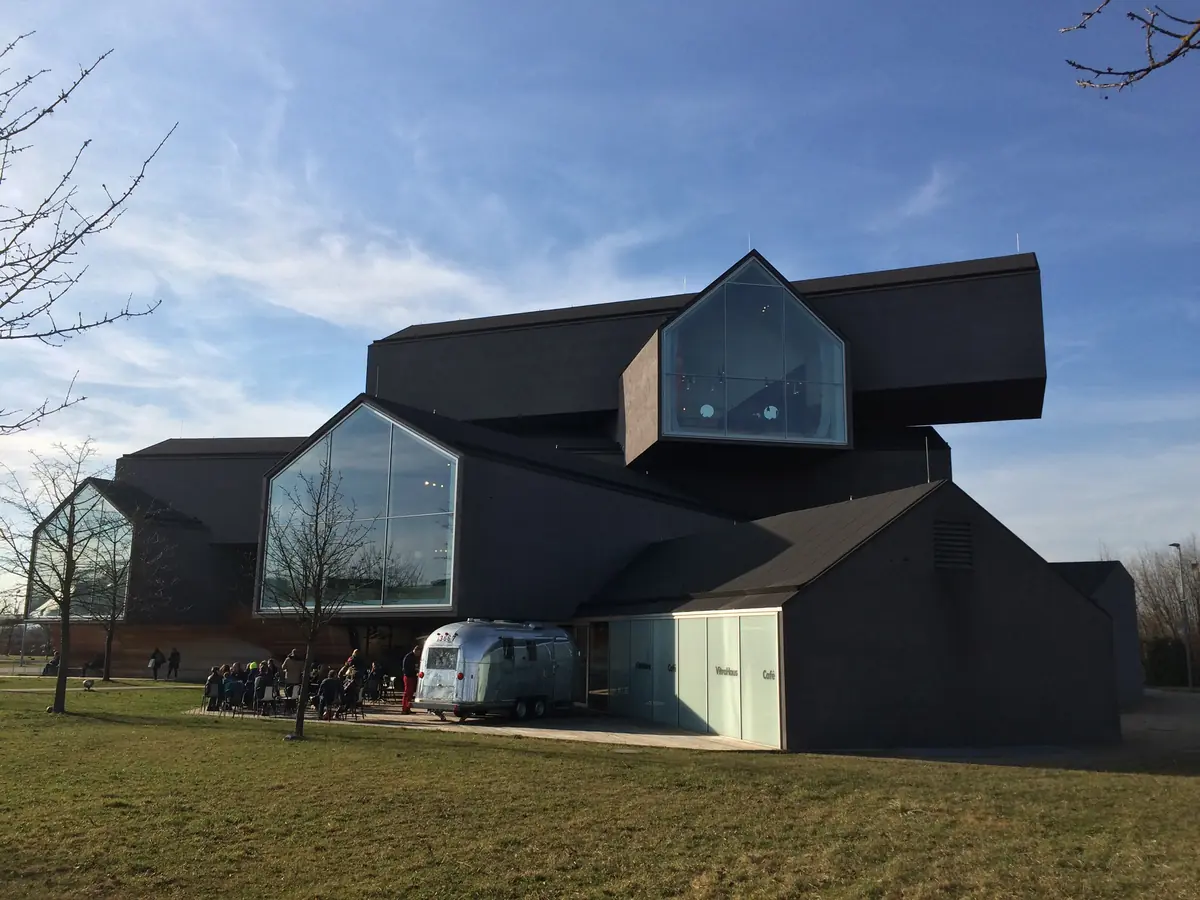
The Vitra Campus has, since the late 1980s, been the most concentrated piece of architectural patronage in European furniture. Gehry’s white deconstructivist Design Museum opened in 1989, several years before Bilbao made that language unavoidable. Hadid’s Fire Station — her first completed building anywhere — was finished in 1993, all sharp concrete planes pointing where buildings did not usually point. Ando’s Conference Pavilion answered in the opposite register: a low concrete volume aligned to a row of cherry trees, the kind of restraint that looks easy and is not. Herzog & de Meuron’s VitraHaus stacked twelve archetypal pitched-roof “houses” into a single retail object in 2010. SANAA dissolved the production hall into a curved white skin. Each commission was a representative work of its author at the moment of commission; each one read, at completion, as a small argument about what architecture should be doing in that decade.
Ishigami’s pavilion enters that sequence as the sixth position, and the most extreme. Where the previous five all argued for presence — sculptural, monumental, expressive — Ishigami argues for near-absence. The pavilion is the smallest building on the Campus by floor area and the densest in intellectual content per square metre. The 47 columns range in diameter from 16 to 31 millimetres, thinner than the structural minimum a conventional engineer would specify for a roof of that scale. The roof is laminated glass with a pale ceramic frit, the walls are full-height glass with steel frames thin enough to disappear at certain angles, and the whole thing was engineered by Jun Sato Structural Engineers using a redundancy logic in which the field as a whole is robust even where any single column is not. It is the same intellectual move Sato and Ishigami made at the KAIT Workshop in Kanagawa with 305 columns; here they have refined it into 47.
That is the architectural answer to the brand question. The product answer arrived eight weeks before the pavilion, on 19–20 March 2026, when Vitra launched its “Beta” workspace project. Beta packaged two new systems together: Grcic’s Scout and Stephan Hürlemann’s Reset. Reset is a modular three-component platform-and-cushion arrangement on a cross-shaped base — stackable, designed to convert dead corners of a workplace into stepped seating, a stage, or a sofa. Scout is the heavier-duty proposition: a five-piece modular workplace family — Scout Work, Scout Work Mobile, Scout Sprint, Scout Summit, Scout Meet — built around a tubular-steel frame that doubles as both structural support and accessory rail. Hooks, pinboards and shelves clip onto the same tube that holds the desk up. Height adjustment and tilting are entirely mechanical. There is no motor, no app, no firmware, no software update. In a market where every competitor has spent four years pushing sit-stand desks with Bluetooth presets and proprietary apps, this is a polemic.
Ishigami’s Pavilion as Architecture-as-Statement
The pavilion is the latest move in a Campus that has always treated architecture as the primary medium for saying what Vitra is. Vitra’s architectural commissions are not signage and they are not merchandising; they are arguments, and they have generally been arguments at the level the discipline takes seriously. Gehry-1989 was an argument about sculptural form before sculptural form became an airport idiom. Hadid-1993 was an argument about angular dynamism that her later, smoother parametricist work would partly walk back. Ando’s pavilion was an argument about silence. VitraHaus was an argument about the archetype of the pitched-roof house at the exact moment it was being most heavily exploited as a commercial logo. SANAA’s factory was an argument about how little envelope a building needs.
Ishigami in 2026 is arguing about thresholds — the line between building and not-building, between roof and shadow, between column and reed. The 280 square metres are programmed as a flexible exhibition pavilion that can show small shows when a show is on and read as a quiet object in the landscape when one is not. From the upper floors of VitraHaus the frit roof reads as a horizontal whisper at the edge of vision, more reflection than object; from inside, the columns are too thin to register as structure, the walls too transparent to register as enclosure, and the experience of being inside is almost entirely one of slightly muffled sound, slightly warmer air, slightly filtered light. The architecture is felt rather than seen.
This places Ishigami in conversation with a particular Japanese argument about presence — the longer lineage that runs through Toyo Ito’s Sendai Mediatheque and into the present, the same argument Toshiko Mori’s 2026 AIA Gold Medal honoured at the institutional level, and the one Kengo Kuma made at Capella Kyoto in hospitality form. It also folds into the broader Japanese contingent at Milan Design Week 2026, which spent the spring re-arguing the case for restraint at multiple scales. What distinguishes the Vitra commission is that the argument is being made on a site that is, by accumulation, the loudest collection of late-modern architecture in Europe. Ishigami is not whispering in a forest. He is whispering between Gehry, Hadid, Ando, Herzog & de Meuron and SANAA. The choice of voice is the entire content of the work.
The pavilion also clarifies what Vitra is buying when it commissions architecture. It is not buying a venue, exactly — the programming is light, the floor area is small, the building will not host a flagship show. It is buying a position. The Campus needs a 2026 entry that speaks credibly to architects, curators and the architectural press, and Ishigami is the position that the discipline takes most seriously among living architects under 55. The commission reads as patronage in the older sense: the patron pays for the work; the work, by being good, does the brand-building back. Frank Gehry’s 1989 building did that for Vitra in the late twentieth century. Ishigami’s 2026 pavilion is the equivalent commission for the late twenty-twenties.
Grcic’s Scout as Product-as-Statement
Scout makes the opposite argument by exactly the same procedure. It is a piece of authored product — designed by a designer the discipline takes seriously, in a long relationship with a brand that has commissioned him repeatedly — that says what Vitra is by being good at what it does. The five pieces are differentiated by use case rather than by silhouette. Scout Work is the desk. Scout Work Mobile is the mobile cart. Scout Sprint is the lower, faster station. Scout Summit is the higher meeting surface. Scout Meet is the collaborative table. The shared vocabulary is the tubular-steel frame, which is doing two things at once: holding the work surface up and serving as a continuous accessory rail along which the user can clip hooks, pinboards, screens and shelving without specifying any of those at purchase.
Grcic, in the launch text, framed the system this way: “The aim is not to replace what already exists. Rather, the system is an extension or complementary offering that responds to different levels and styles of work.” That is a careful sentence. It describes Scout as additive rather than competitive — the system is a layer over an existing workplace rather than a replacement for it — and it positions Vitra against the prevailing logic of office furniture, which has spent the post-pandemic cycle trying to sell complete refits with proprietary platforms. Scout is sold as kit, as components, as a tube and a set of brackets that the buyer extends over time.
The mechanical-only specification is the polemical edge. There are no motors in the height-adjustment columns, no apps, no firmware, no presets that need updating, no charging cables. The desk goes up and down because the user turns a crank or releases a clamp. The tilt is a hand mechanism. Compared with the Bluetooth sit-stand category that has dominated office furniture marketing since around 2021, Scout is a deliberate step backward — or, depending on how one reads it, a deliberate step out of a category that was always going to age badly. Mechanical adjustment does not become incompatible with a phone OS update three years from now. It does not require a service plan. It can be repaired with hand tools. The argument is that the right scale of intelligence in a desk is mechanical, and that the wrong scale is software.
This sits naturally in Grcic’s longer arc at Vitra. The Panorama exhibition at the Vitra Design Museum (22 March – 14 September 2014) was a survey-as-position-statement, organised across three rooms that argued for a particular kind of clean industrial logic. Hack, in 2016, was an OSB-and-bracket flat-pack desk system — a polemic against the executive desk in the year start-up culture was buying executive desks. Citizen, in 2020, was a lounge chair whose seat hung from cables on a swivel base, an argument that comfort could be achieved by suspension rather than upholstery. Scout in 2026 is the workplace-system iteration of the same disposition: reduce, expose the structure, let the structure carry both load and accessory, refuse the soft-tech overlay.
What Vitra Is Saying By Saying Both
The interesting fact about Vitra Campus 2026 is not that the company commissioned a pavilion or that it launched a workplace system; it is that it commissioned and launched both, eight weeks apart, and let them define the year together. That decision rejects a familiar split in the design industry, in which architecture is the prestige medium and product is the revenue medium, and the prestige work exists to elevate the revenue work. At Vitra in 2026, both are operating as prestige work. Both are authored. Both are arguing.
What they are arguing is the same proposition by inverted means. Ishigami subtracts to arrive at presence; Scout subtracts to arrive at function. The pavilion strips the building down until only the columns and the glass remain, and the result is a structure that reads as almost nothing and yet holds the air still. Scout strips the desk down until only the tube and the bracket remain, and the result is a system that reads as almost nothing and yet holds a workplace together. Both projects refuse the additive logic — sculptural form for the building, soft-tech and proprietary platform for the desk — that their respective categories have spent the past decade getting fat on. Both projects are confident enough to make their argument by removing rather than adding.
This is also a brand position about how Vitra wants to be heard against its peers. Cassina, Moroso and Effe at Milan Design Week 2026 leaned into authorship and historical depth in different registers; the Italian luxury houses spent the season pushing scale and spectacle. Vitra’s 2026 answer is to keep its argument tight and its means austere, on both the architectural and the product fronts at once. The Beta workspace programme — Scout plus Reset — is a workplace launch with deliberately quiet hardware. The Ishigami pavilion is a building that is barely there. The unifying brand instruction is restraint, executed by two designers who are very good at it.
Ishigami Pavilion vs Scout: The Comparison
| Axis | Ishigami Pavilion | Grcic Scout |
|---|---|---|
| Typology | Single-storey exhibition pavilion | Five-piece modular workplace family |
| Year | 2026 | 2026 (launched 19–20 March) |
| Designer | Junya Ishigami + Jun Sato Structural Engineers | Konstantin Grcic |
| Location | Vitra Campus, Weil am Rhein | Vitra “Beta” workspace programme (global rollout) |
| Materials | 47 steel columns (16–31 mm diameter), full-height glass walls, ceramic-fritted laminated-glass roof | Tubular-steel frame doubling as accessory rail, mechanical hardware |
| Scale / dimensions | 280 sqm footprint, single storey | Five pieces: Scout Work, Work Mobile, Sprint, Summit, Meet |
| Key constraint | Column diameter below conventional structural minimum; redundancy distributed across the field | No motors, no app, no firmware — adjustment and tilt are entirely mechanical |
| Argument | Architecture-as-statement: presence achieved by subtraction | Product-as-statement: function achieved by subtraction |
Vitra Campus Architects, 1989–2026
| Year | Architect | Building |
|---|---|---|
| 1989 | Frank Gehry | Vitra Design Museum (Gehry’s mature deconstructivist language, several years before Bilbao) |
| 1993 | Zaha Hadid | Vitra Fire Station (Hadid’s first completed building anywhere) |
| — | Tadao Ando | Vitra Conference Pavilion (low concrete volume aligned to cherry trees) |
| 2010 | Herzog & de Meuron | VitraHaus (twelve stacked archetypal pitched-roof houses) |
| — | SANAA | Factory building (round white production hall, dissolved skin) |
| 2026 | Junya Ishigami | Pavilion (280 sqm; 47 steel columns; engineered with Jun Sato) |
What the Pair Will Be Read As, Five Years Out
The most useful test for any brand year is how it reads from a distance. Five years from 2026, the Vitra Campus will, with very high probability, be talked about as the moment Ishigami’s pavilion entered the canon of Campus buildings, alongside Gehry’s museum and Hadid’s fire station. The pavilion has the formal radicality, the engineering pedigree (Jun Sato has now been the structural collaborator on enough Ishigami projects that the partnership reads as a position rather than a commission), and the discipline-level seriousness that Campus buildings need to have to last. It will be photographed for thirty years. It will be visited by students. It will appear in monographs on Ishigami and on Vitra in roughly equal frequency.
Scout’s five-year reading is harder to predict but more interesting. Mechanical-only workplace hardware, sold as a kit-of-parts with a tubular-steel frame doubling as accessory rail, is a category bet. If the soft-tech sit-stand desk continues to age badly — firmware lock-in, dead Bluetooth, abandoned apps, service-plan dependency — Scout will read as the system that called the moment correctly, the way Hack in 2016 called the moment that flat-pack honest-material office furniture would matter to a generation that distrusted the executive desk. If, instead, the market settles into a software-mediated workplace and Scout is read as a holdout, it will still survive on the strength of Grcic’s authorship, the same way Citizen has survived as a lounge chair people specify even when they are not specifying his other work.
The point is that Vitra has placed both bets. The pavilion is the architectural bet; Scout is the product bet. They sit on opposite sides of the brand’s 2026 brief, and the brand looks bigger because both are present and both are confident. A company that commissions only architecture is selling prestige; a company that ships only product is selling utility. Vitra in 2026 is doing both at the same scale of seriousness, and asking to be read in both registers at once. The Ishigami pavilion does not exist in order to sell more Scouts, and Scout does not exist to underwrite the pavilion. They exist because both are arguments the brand wants to be making in 2026, and because Vitra is one of the few companies in the European design industry that still trusts authorship — architectural or product — to do the brand-building on its own terms.
The view from VitraHaus in late spring captures the pair almost diagrammatically. Look down through Herzog & de Meuron’s stacked houses and the ceramic-frit roof of the Ishigami pavilion is a faint horizontal at the edge of vision. Walk through the showroom on the way back to the car park and the Scout tubular-steel frame is a parallel horizontal at desk height, holding up a work surface and a clipped-on pinboard. Two horizontals, eight weeks apart, both made by subtraction, both made by designers Vitra has been arguing with for years. The campus has rarely said its position more clearly. More on Vitra’s broader programme via vitra.com.