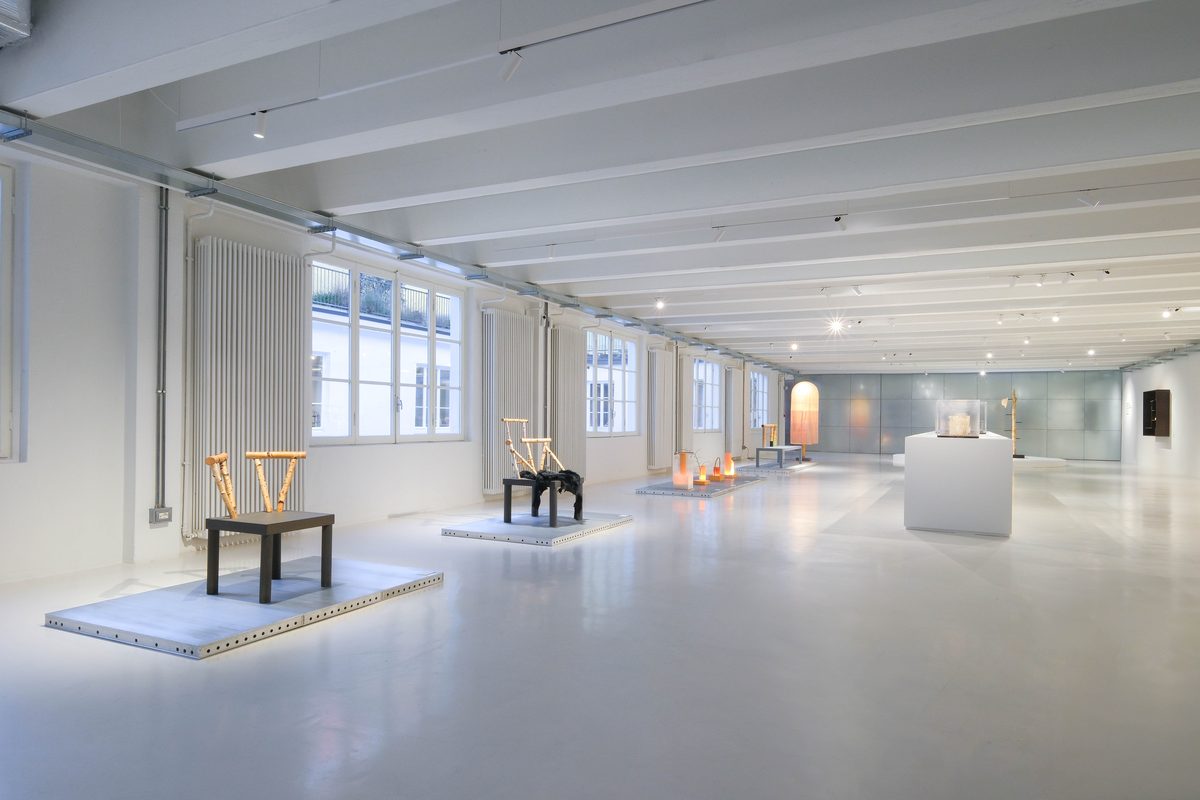
Toyo Ito’s retrospective of Andrea Branzi opened at Triennale Milano on 19 March 2026 with a 1:1 reconstruction of Archizoom’s No-Stop City and a thesis Branzi spent fifty-seven years arguing — that Italian radical design was never an avant-garde, it was a continuous present. The exhibition, “Andrea Branzi by Toyo Ito. Continuous Present,” runs to 4 October 2026 in the Palazzo dell’Arte at Viale Alemagna 6, gathers more than 400 drawings, models, objects, viewing devices, environments, videos and archival materials across 11 thematic sections, and was developed with the Fondation Cartier pour l’art contemporain. It is the largest Branzi retrospective ever staged. It is also the keystone of the city’s wider 2026 archive turn — the same week as the Common Archive / Notte Bianca at Salone, the same season as Cassina’s Le Corbusier Inédits, the same calendar as Armani/Archivio — but the only one of those projects whose subject is the operating system, not a single oeuvre.
The argument of this article is narrow. Continuous Present is not a memorial. Branzi died in Milan in 2023 at 85, and a memorial show would have been the obvious move; Triennale, which has held a permanent Italian design collection since 2007, could have built one in a season. What Ito and Triennale built instead is a working diagram. The 11 sections — Superarchitettura, No-Stop City, Central Plan Houses, Theoretical Metropolises, Gazebo, Ellipse, Hybrid Object, and four others — are not a chronology. They are a thesis structure, and the thesis is that the radical-Italian lineage from Archizoom (1966) through Memphis (1980) to the contemporary archive activations of 2026 is one continuous argument about what design is for. Ito, who won the Pritzker in 2013 for buildings like the Sendai Mediatheque and the National Taichung Theater, is the right curator for that argument because his own practice has spent forty years asking the same question in a different language. The retrospective is, in that sense, two careers in one room.
Why Andrea Branzi at Triennale matters in 2026
Triennale Milano sits inside Giovanni Muzio’s Palazzo dell’Arte, completed in 1933, and the building is itself an argument about the relationship between Italian modernism and the institution. Muzio’s Novecento façade was already a kind of archive when it opened — a curated reading of Milanese rationalism in travertine and brick. The institution’s permanent Italian design collection, established in 2007, is the only state-scale archive of post-war Italian design in continuous public display. Continuous Present is not a guest in that building; it is the building’s logic made explicit. Branzi spent his entire career — from his Florence architecture degree in 1966 through his cultural directorship of the Domus Academy from its 1982 founding to his two Compasso d’Oro awards in 1979 and 2005 — arguing that Italian design should be understood as a system of ideas, not a sequence of objects. To stage that argument inside Muzio’s Palazzo, in the year Milan’s other archives go public on the same week, is the strongest possible curatorial position.
The wider 2026 context matters. On 24 April 2026, Salone del Mobile’s Common Archive / Notte Bianca opened more than 50 Milan archives for a single night, including the Aulenti and Gio Ponti home-studios — the first time most of those rooms had ever been accessible to a non-academic public. The same fortnight, Cassina staged the Le Corbusier Inédits at Salone with six previously unproduced 1928–1952 pieces drawn from the FLC archive. The same season, Armani/Archivio reissued 13 looks from the maison’s 200-plus-collection archive, the first archival reopening of the Armani holdings under Giorgio Armani’s heirs. Each of those projects is an archive activation — taking material that was inert in storage and making it commercial, public or both. Branzi’s retrospective is the theoretical companion to all three. It explains why archive activation is the dominant register of Milanese design culture in 2026: because Italian design has always treated its own past as a working library, and the institutions are finally catching up to the practitioners.
Andrea Branzi’s lineage, 1966–2026
A timeline, because the names compress badly in prose.
- 1966 — Florence. Branzi takes his architecture degree from the University of Florence and co-founds Archizoom Associati with Gilberto Corretti, Paolo Deganello and Massimo Morozzi. Dario and Lucia Bartolini join in 1968. The studio takes its name from the British group Archigram and the comic strip Zoom.
- 1966 — Superarchitettura. Archizoom co-organises the Superarchitettura exhibition in Pistoia with Superstudio. The show is a manifesto: “the architecture of superproduction, of superconsumption, of superinduction to consumption, of the supermarket, of the superman and of super gasoline.” It is the founding gesture of Italian radical design.
- 1967–1972 — No-Stop City. Archizoom develops the No-Stop City project, a theoretical metropolis without architecture — an infinite air-conditioned interior, a city as supermarket, a city as factory floor. It is the most influential anti-utopian project of post-war Italian architecture. The 1:1 reconstruction is the centrepiece of Continuous Present.
- 1968 — Superonda. Archizoom designs the Superonda sofa for Poltronova — a single block of polyurethane carved into a sine wave, the first foam furniture without a wooden frame. It is still in production.
- 1974 — Archizoom dissolves. The studio closes after eight years.
- 1976 — Studio Alchimia. Branzi joins Alessandro Mendini, Ettore Sottsass and others at Studio Alchimia in Milan, the bridge between Archizoom and Memphis.
- 1980 — Memphis. Sottsass founds the Memphis Group in Milan on 11 December 1980. Branzi is a contributor. Sottsass’s Carlton bookcase (1981) becomes the emblematic object. Memphis runs to 1987 and reframes Italian design for the international market.
- 1982 — Domus Academy. Branzi becomes cultural director of the newly founded Domus Academy in Milan, the first private postgraduate design school in Italy. He holds the role through the 1980s and shapes a generation of Italian designers.
- 1979 and 2005 — Compasso d’Oro. Branzi wins the Compasso d’Oro twice, including the 2005 lifetime achievement award.
- 2008 — Grandi Legni. Branzi begins the Grandi Legni series with Nilufar — totemic wood-and-metal sculptures that consolidate his late position on the hybrid object.
- 2023 — Milan. Branzi dies in Milan, aged 85.
- 19 March 2026 — Triennale. “Andrea Branzi by Toyo Ito. Continuous Present” opens. It runs to 4 October 2026.
The timeline is not decorative. The point of staging it is that every section of Continuous Present maps to one or more of these moments, and the curatorial decision to ask Toyo Ito — not an Italian architect, not an Archizoom contemporary, not a Domus Academy alumnus — to design the show is the move that makes the lineage legible as something other than national heritage.
Toyo Ito as curator: the Japanese-Italian axis
Ito was born in 1941, three years after Branzi. The two careers ran parallel for half a century without quite intersecting. Ito’s arc from White U (1976) through Sendai to the Pritzker is the longer frame; the Sendai Mediatheque (2001) — the seven-storey Sendai library where steel tubes replace columns and the floor plates appear to float on a school of vertical reeds — is the closest built equivalent to the No-Stop City idea: an interior continuous enough to dissolve the distinction between rooms, an architecture that wants to be infrastructure. Ito’s National Taichung Theater (2014) takes the same logic into a curved, cave-like topology where the walls are also the structure. The Pritzker citation in 2013 named Ito’s “conceptual sophistication” and the way his buildings “extend the possibilities of architecture.” It is the same vocabulary Branzi used about Archizoom in the 1970s.
Ito’s exhibition design for Continuous Present makes the parallel explicit without ever stating it. The 11 sections are arranged in a loose ring through the Palazzo dell’Arte’s first-floor galleries, with the No-Stop City reconstruction occupying the largest single room. The viewing devices — Ito’s own contribution, custom-built for this show — are a series of low, white-laminated plinths and angled vitrines that frame Branzi’s drawings the way Ito frames his own buildings: at the threshold between object and field. The lighting is flat and even; there is no theatrical staging. The argument is that Branzi’s drawings — many of them in graph-paper notebooks, many in the Fondation Cartier holdings since their 2008 Branzi retrospective in Paris — are not relics. They are working documents.
That curatorial decision is what separates Continuous Present from the Branzi retrospectives that preceded it. The 2014 Centre Pompidou-Metz show “Une seconde modernité” was built around objects. The 2008 Fondation Cartier show “Open Enclosures” was built around the Grandi Legni sculptures. The 2010 Triennale show “Andrea Branzi: Pleased to Meet You — 50 Years of Creation” was a chronology. Continuous Present is a thesis. Its central claim is that Branzi was always doing the same thing, and the proof is that you can read No-Stop City (1967) and the Hybrid Object section (work from the 2010s) as continuous moves in a single argument about how design relates to consumption, urbanism and the body. Ito’s job was to make that legibility spatial, and he has.
The opening lecture — Toyo Ito speaking at Triennale on 20 April 2026, the Monday of Milan Design Week — anchors a public programme that runs from April to October 2026. The programme is structured around the 11 sections rather than around Branzi’s biography, which is the right call. It signals that Triennale is treating Continuous Present as a research event, not a memorial cycle.
The 11 sections: a working diagram
The exhibition organises Branzi’s archive into 11 thematic sections, each named for a project or a concept rather than a decade. The full list, in the order presented in the Triennale wall texts:
- Superarchitettura — the 1966 Pistoia manifesto and its theoretical scaffolding, including Archizoom’s contributions and the parallel Superstudio material.
- No-Stop City — the 1:1 reconstruction. Mirrored walls extend the gridded plan to a visual infinity; Branzi’s original 1967–1972 drawings line the perimeter.
- Central Plan Houses — Branzi’s 1980s and 1990s domestic projects, including the Domestic Animals series with Nicoletta Branzi.
- Theoretical Metropolises — the post-Archizoom urban studies, including Agronica (1995) and Master Plan for Strijp Philips (1999).
- Gazebo — the 1980s Memphis-adjacent work and the small-pavilion typology.
- Ellipse — Branzi’s late drawings of curved enclosures, mostly unbuilt.
- Hybrid Object — the Grandi Legni series and the related work for Nilufar from 2008 onward.
- Four further sections, including a room dedicated to Branzi’s Domus Academy teaching materials and a room that documents his collaboration with Cassina, Memphis and Poltronova.
The decision to give the No-Stop City reconstruction the largest single room is the curatorial heart of the show. No-Stop City was never built. It existed for fifty-four years as drawings, models and a 1971 photographic montage. To build it 1:1 — even partially, even as a mirrored projection — is to argue that an unbuilt project from 1967 is the most important Italian architectural work of the 1960s. That is a strong claim. Continuous Present makes it.
Memphis, Sottsass and the Milanese 1980s
Branzi’s relationship to Memphis is the part of the lineage that the exhibition treats most carefully. Sottsass founded Memphis in Milan on 11 December 1980, three months after Branzi had taken the Domus Academy directorship. The Memphis founding meeting is famous for the Bob Dylan track — “Stuck Inside of Mobile with the Memphis Blues Again” — that gave the group its name. Branzi was at the meeting. He contributed objects to the first Memphis collection in 1981, the year Sottsass’s Carlton bookcase debuted. He was not, formally, a Memphis founder; he was the bridge between Archizoom’s theoretical work and Memphis’s commercial-postmodern register.
The Continuous Present treatment of Memphis is to refuse the standard reading — Memphis as a coherent movement — and to present Branzi’s Memphis-era objects as a continuation of the No-Stop City project by other means. The argument is that the laminate-and-pattern aesthetic Memphis is remembered for was always, for Branzi, a way of making objects that refused to settle into their categories. The Hybrid Object section is the pay-off: late wood-and-metal sculptures that occupy the same conceptual space as the Memphis objects of forty years earlier. The line is continuous.
This matters for the wider Milanese moment because Memphis is the Italian design archive most aggressively activated by the contemporary market. Memphis Milano, the company that holds the licences, has reissued most of the original collection; auction prices for original 1981–1987 pieces have tripled in the last decade. Continuous Present positions Branzi as the theorist of the Memphis archive without ever using the word “theorist.” It does so by hanging his Memphis-era contributions next to his Archizoom drawings in the same room, and trusting the visitor to do the connecting.
The 2026 archive moment: Common Archive, Cassina, Armani
The Branzi retrospective is one of four major Milanese archive activations in spring 2026. Read together, they form a coherent cultural argument about how Italian design is processing its own history.
The Common Archive / Notte Bianca on 24 April 2026 was Salone del Mobile’s largest-ever public-facing initiative. More than 50 Milan archives — including the Gae Aulenti home-studio at Piazza San Marco, the Gio Ponti rooms at Via Dezza 49, the Achille Castiglioni studio on Piazza Castello, and the Vico Magistretti foundation on Via Conservatorio — opened their doors for a single night. The architects’ guide to the week catalogues the route. The point of Common Archive was not access to objects; most of those archives have been visitable by appointment for years. The point was the simultaneity. Fifty archives open at once is a different proposition from fifty archives open serially. It argues that the Milanese design archive is a network, not a set of monuments.
Cassina’s Le Corbusier Inédits at Salone was the commercial counterpart. Six previously unproduced pieces from the FLC archive — drawn from Le Corbusier’s 1928–1952 sketches and never put into production in his lifetime — went on sale for the first time, all six designed before Cassina even held the LC licence. The Inédits operate as a proof that the archive is not closed; that the Le Corbusier corpus, which Cassina has been in production with since 1965, still has unbuilt objects in it. The Cassina archive piece reads it as a claim that the Le Corbusier estate is not a fixed canon but a working library.
Armani/Archivio, the third project, took the same logic into fashion. Thirteen reissue looks from the Armani archive — drawn from a holding of 200-plus collections, the first major opening of the Armani archive under the family ownership that took control after Giorgio Armani’s death — were shown in spring 2026. Like Cassina’s Inédits, the Armani reissues argue that the archive is not a museum; it is a manufacturing instruction set.
Continuous Present is the theoretical underpinning of all three. Branzi’s entire career was an argument that the design archive is an active, working substrate — that drawings from 1967 are not historical documents but live propositions that you can build today, in a Milanese palazzo, at 1:1 scale. To stage that argument in 2026, the year Milan’s commercial archives are activating in parallel, is the most legible curatorial position imaginable. Triennale is not following the archive turn. Triennale is explaining it.
The Japanese architecture lineage: Ito, Ishigami, Kuma
The decision to ask Toyo Ito to curate also threads Continuous Present into a second 2026 lineage: the Japanese architecture corpus on Italian and European display this year. Junya Ishigami’s Vitra pavilion opened on the Vitra Campus in Weil am Rhein in spring 2026 — a permanent structure from the Ishigami practice, who was Ito’s collaborator on the Sendai Mediatheque before going independent. Kengo Kuma’s Capella Kyoto opened the same season. The three projects — Ito at Triennale, Ishigami at Vitra, Kuma at Capella — are not coordinated, but they form a corpus. They argue, collectively, that the Japanese architectural sensibility that ran from Kenzo Tange through Toyo Ito to Ishigami and Kuma is in a kind of consolidating moment, with major institutional commissions across three European and Asian sites in a single year.
The Branzi retrospective sits inside that corpus because Ito’s curatorial register — restrained, white, even-lit, low-plinth, framing-as-method — is the visual language of the Japanese architectural archive. It is the same register Ishigami uses at Vitra and Kuma uses at Capella. To present Italian radical design through a Japanese curatorial register is the gesture that makes Continuous Present feel like an archive activation rather than a national retrospective. It frames Branzi the way Toshiko Mori was framed in the AIA Gold Medal coverage — as a global figure operating in a transnational lineage rather than a national-school protagonist.
The choice is not without precedent. Triennale has worked with Japanese curators before — Kazuyo Sejima curated the 2025 Triennale architecture event, and the institution’s collaboration with Tokyo’s National Art Center goes back to 2010. But the Branzi-Ito pairing is the most theoretically ambitious version of the partnership Triennale has staged. It is also, in a quiet way, a generational statement. Ito at 84 curating Branzi posthumously is a signal that the post-war architectural generation is doing its own succession planning, in public, while it still can.
Continuous Present and the public programme
The exhibition’s public programme runs from April to October 2026 and is the part of Continuous Present that will have the longest tail. The opening lecture by Toyo Ito at Triennale on 20 April 2026 — the Monday of Milan Design Week 2026 — was the largest single ticketed lecture Triennale has staged in five years. The programme that follows is structured as a series of conversations between contemporary practitioners and the 11 sections. Each section gets a guest respondent — architects, designers, critics, curators — who is asked to read the section as a working proposition rather than as a historical document. The list of respondents has not been published in full; the institution has confirmed that the programme will run through to the closing weekend in October, with at least one event per fortnight.
The implication is that Continuous Present is being staged as a research event, not a memorial cycle. Triennale is using the seven-month run to extract from the archive the propositions that are still live — the parts of Branzi’s argument that contemporary practitioners can still operate. That is a different curatorial economy from the typical retrospective, which treats the archive as a closed set. It is also the right curatorial economy for 2026, when every Milanese archive is being asked to do more than store.
What the show closes with
The final section of the exhibition is the Hybrid Object room, which holds the Grandi Legni sculptures and the late drawings. The Hybrid Object is Branzi’s term for an object that refuses to settle into a category — neither furniture nor sculpture, neither functional nor purely aesthetic, neither industrial nor craft. The Grandi Legni series, started in 2008 with Nilufar, is the clearest expression of the idea: large totemic structures of wood and metal that occupy a domestic-scale footprint but propose no domestic function.
The decision to close with the Hybrid Object rather than with a chronological terminus — a “late Branzi” room, or a memorial to his 2023 death — is the show’s final argument. It is the move that makes the title literal. Continuous Present means that the exhibition does not have an end-point. The last room is not an elegy; it is a brief. The implicit question — the one the seven-month public programme is built to answer — is what working designers in 2026 are supposed to do with a body of work that argues the archive is the operating system. The exhibition does not answer that question. It declines to. The decline is the curatorial position.
Coda
Andrea Branzi spent fifty-seven years arguing that the categories Italian design culture had inherited — architecture, furniture, urbanism, object, drawing, theory — were the wrong categories. He proposed, in their place, a continuous field. Continuous Present is the first exhibition that has staged that field as a spatial argument rather than as a chronological narrative, and it is the first that has trusted a non-Italian curator to make the case. That Toyo Ito accepted the brief, and that Triennale Milano gave him the Palazzo dell’Arte’s first floor and seven months to make it land, is the signal worth recording. The 2026 archive moment in Milan has many entries. This is the one that explains the others.