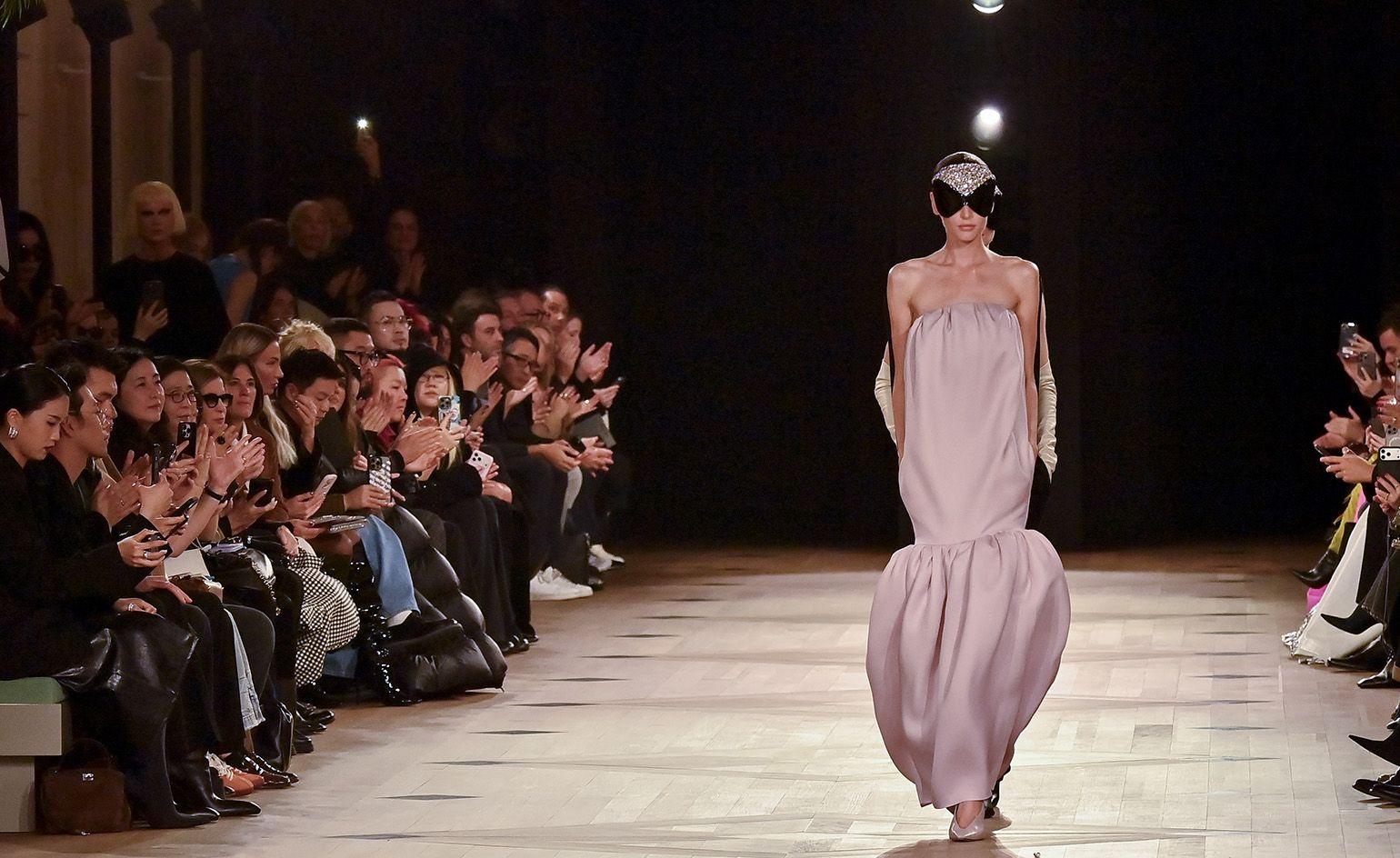
Pierpaolo Piccioli’s first Balenciaga collection, presented in Paris in October 2025, is the first time in 28 years that the house’s silhouette has retreated rather than advanced — the Ghesquière-to-Wang-to-Demna line, unbroken since 1997, ended on a runway that looked back to Cristóbal’s 1950s. The piccioli balenciaga debut is the most-watched test of Kering’s ReconKering plan because it is the only one of the group’s three creative-director changes where the new designer arrives without a brief to reset the brand’s commercial spine, only its image. CEO Gianfranco Gianangeli, in post since November 2024, and Deputy CEO Nathalie Raynaud, promoted in 2026, have already done the spine work: the Cagole, the Rodeo, the Bel Air, and the Le City revival did most of the un-streetwearing of Balenciaga before Piccioli arrived. What he inherits is a house whose leather goods are working and whose image needs a new sentence.
The shape of the answer matters. This is not a turnaround story in the Gucci sense, where Demna himself is now expected to fix a -14.3% Q1 print. Balenciaga, inside Kering, was named a “resilience pocket” in the same Florence presentation that called Gucci a problem. The piccioli balenciaga move is therefore a re-positioning, not a rescue, and the entity diagram around it — Gianangeli on operations, Raynaud on product, Piccioli on image, Luca de Meo on capital — is the cleanest division-of-labour Kering has assembled around any of its houses since the Tom Ford Gucci era. This piece reads the debut against the org chart, the lineage, and the comparable Kering and Prada Group resets running in parallel.
Why Piccioli, why now
Pierpaolo Piccioli was appointed creative director of Balenciaga in July 2025, sixteen months after exiting Valentino in March 2024. Born 29 August 1967 in Rome and raised in Nettuno on the coast south of the city, Piccioli is sixty when he takes the Balenciaga seat — the oldest debut creative director on the entire 2025–2026 wave that we mapped in Fashion Designer Debuts 2026: A Holding-Company Map. He joined Valentino in 1999 with Maria Grazia Chiuri to run accessories, became co-creative director with her in 2008, took the house solo in 2016 when Chiuri left for Dior, and exited at the end of March 2024 after a 25-year tenure. He co-created the Rockstud in Spring/Summer 2011, which is, after the Bag, the most identifiable single product Valentino has shipped in the modern era. He won Designer of the Year at The Fashion Awards twice, in 2018 and 2022 — a count matched by very few of his peers.
Read against Demna Gvasalia, the contrast is total. Demna was 34 when he arrived at Balenciaga in 2015, came out of the Vetements collective and a brief Maison Margiela tenure, and built a vocabulary on irony, scale distortion, hoodie-as-ballgown, sneakers, and the deliberate ugly. Piccioli is 60, comes out of a couture-trained Roman atelier, has spent his career on the chiffon side of the chiffon-versus-jersey divide, and won his Designer of the Year prizes for couture collections that staged Black models in pastel volumes against Roman backdrops. Putting Piccioli where Demna stood for ten years is the most pronounced creative pivot in the entire 2025–2026 wave. It is more pronounced than Jonathan Anderson going to Dior, more than Matthieu Blazy going to Chanel, and more than Demna himself moving across Place Vendôme to Gucci.
The “why now” answer sits in the same paragraph as the Kering Q1. Group revenue fell 6.2% to €3.57 billion in Q1 2026. Gucci fell 14.3% reported and -8% organic. Balenciaga, by contrast, was named in the resilience-pocket cluster alongside Saint Laurent, Bottega Veneta and Brioni. The decision to put Piccioli at Balenciaga in mid-2025 — before the Q1 print, before the Florence Capital Markets Day on 16 April 2026, and before Luca de Meo had even fully taken over as Kering CEO in September 2025 — was therefore not a defensive crisis appointment. It was a planned succession from a house that had reached the natural end of a ten-year creative arc. Demna did Balenciaga from 2015 to 2025. Ten years is the half-life of any creative direction in the modern luxury cycle. The handover was scheduled.
Cristóbal Balenciaga and the lineage Piccioli walks into
Cristóbal Balenciaga was born 21 January 1895 in Getaria, a fishing village on the Basque coast. He opened his first house in San Sebastián in 1919, a second in Madrid in 1933, and the Paris couture house at 10 avenue George V in August 1937, after the Spanish Civil War made working in Spain impossible. He closed the Paris and Madrid houses on 1 July 1968 and died in 1972, having made no public attempt to designate a successor. Christian Dior called him “the master of us all,” a quote that survived because Dior, who was no slouch, was being precise rather than polite: Balenciaga was the rare twentieth-century couturier who cut, sewed and constructed his own garments. The 1957 sack dress, the 1958 baby doll, the 1959 empire line, and the 1967 envelope dress are his.
The lineage Piccioli now joins is short and uneven. The house was dormant from 1968 to 1986. The licensing-era house under Jacques Bogart bought the trademark and reopened a ready-to-wear line. Michel Goma was the first re-launch designer, from 1987 to 1992. Josephus Thimister followed, from 1992 to 1997. The modern Balenciaga begins with Nicolas Ghesquière in 1997 — fifteen years of futurist tailoring that turned the house from a dormant couture name into a defining brand of the 2000s, including the introduction of the original City bag in 2001. Alexander Wang arrived in 2013 for a two-year sportswear-leaning interlude. Demna Gvasalia took over in 2015 and ran the longest single tenure since Cristóbal himself.
Read the timeline below as the original asset for this piece — every Balenciaga creative director from Cristóbal in 1937 through to Piccioli in 2025, with date ranges and Kering ownership marked from 2001.
| Years | Creative director | Notes | Ownership |
|---|---|---|---|
| 1937–1968 | Cristóbal Balenciaga | Founder. Paris house at 10 avenue George V opened August 1937; closed 1 July 1968. | Independent (Cristóbal Balenciaga) |
| 1968–1986 | (House dormant) | No couture or RTW production; trademark in licensing-era limbo. | Independent / licensing |
| 1987–1992 | Michel Goma | First re-launch designer under Jacques Bogart’s RTW reopening. | Jacques Bogart SA |
| 1992–1997 | Josephus Thimister | Belgian designer; rebuilt a couture-adjacent vocabulary. | Jacques Bogart SA |
| 1997–2012 | Nicolas Ghesquière | 15-year tenure; introduced the City bag in 2001; defined modern Balenciaga. | Jacques Bogart SA → Gucci Group / PPR (from 2001) |
| 2013–2015 | Alexander Wang | American sportswear interlude after Ghesquière’s exit. | PPR / Kering (from 2013) |
| 2015–2025 | Demna Gvasalia | 10-year tenure; pivoted house to streetwear, sneakers, scale distortion; left for Gucci March 2025. | Kering |
| 2025– | Pierpaolo Piccioli | Appointed July 2025; Spring/Summer 2026 RTW debut, Paris Fashion Week, October 2025. | Kering |
Two structural facts are worth reading off the table. First, the average Balenciaga tenure since 1997 has been about eight years (Ghesquière 15, Wang 2, Demna 10), which means the Piccioli appointment is being underwritten on the assumption of a similarly long arc, not a one-collection trial. Second, Balenciaga has been a Kering (originally PPR / Gucci Group) house since 2001 — a 25-year ownership horizon that puts it inside the same holding company across three of its four most consequential designers.
The piccioli balenciaga debut on the runway
The piccioli balenciaga debut was the Spring/Summer 2026 ready-to-wear collection at Paris Fashion Week in October 2025. It was the most-anticipated single collection of the season and the most legible exit from the Demna era anyone could have engineered without rebranding the house. Piccioli did not arrive with a Vetements-style new vocabulary. He arrived with a couture vocabulary — Roman, restrained, colour-blocked, and explicitly indebted to Cristóbal’s late-1950s and 1960s silhouettes. The collection was not a tribute show. It was a re-anchoring of the house’s reference grammar from the post-Demna street to the founder’s atelier.
The hierarchy of decisions in the debut is worth naming directly. The silhouette retreated. After a decade of oversized, the proportions tightened. After a decade of hoodies, sneakers, and scale-distorted denim, tailoring returned as the primary register. The bag offer leaned on the leather-goods architecture Raynaud had already built — Cagole, Rodeo, Bel Air, the revived Le City — rather than introducing a new icon, which is the right move when the carry-bag spine is already producing. Casting and styling moved away from the deliberately confrontational Demna register into something closer to Piccioli’s Valentino legibility: a Roman couture sentence rather than a Tbilisi joke. The show notes did not perform irony.
Most importantly, the runway did not chase virality. The Demna-era Balenciaga had been a virality-first house — the Triple S sneaker, the IKEA-bag tote, the Crocs collaborations, the destroyed sneakers — and that orientation, while it produced the cultural Q-score that drove the brand’s mid-2010s growth, eventually became a liability for a Kering house that needed to convert cultural noise into bag sales. Piccioli’s debut traded virality for legibility. The early commercial read on the order book, on the limited reporting available before Q2 2026 numbers print, was that the leather-goods orders held and the RTW orders rotated toward more wearable categories — exactly the rotation Raynaud had been engineering on the product side since 2023.
Gianfranco Gianangeli and the operating spine
The piccioli balenciaga story is, on the operations side, a Gianangeli story. Gianfranco Gianangeli was appointed CEO of Balenciaga in November 2024, eight months before Piccioli was named creative director. The sequencing matters: Kering installed the operator first, the designer second. Gianangeli came into a house that had spent two years absorbing the fallout of the November 2022 Christmas campaign controversy and that needed both a reputational reset and a commercial recalibration. His first twelve months were spent stabilising the wholesale base, tightening the store estate, and — crucially — backing Nathalie Raynaud’s product-side rotation away from streetwear and toward leather goods.
The decision to bring Piccioli was, on the public record, an alignment between Kering group leadership and Gianangeli, sequenced before Luca de Meo took over as Kering CEO in September 2025. De Meo therefore inherits the appointment rather than originating it. That distinction is important because it means the piccioli balenciaga bet is one of the few major Kering creative decisions of the 2025–2026 wave that is not de Meo’s own — Demna at Gucci was set in motion under the previous Kering leadership and confirmed in March 2025; Bottega Veneta’s Louise Trotter appointment was made in late 2024; Balenciaga’s Piccioli appointment was made mid-2025, just before the de Meo handover. ReconKering in Florence on 16 April 2026 was therefore the first capital-markets framing of an appointment de Meo did not make, and the framing was supportive: Balenciaga sat in the resilience-pocket cluster, not in the problem cluster.
Gianangeli’s brief, read against the ReconKering targets — structural fix by end-2026, rebuild to growth by end-2028, “Next Luxury” leadership by end-2030 — places him on a four-year clock. Year one is the debut and the wholesale book stabilisation. Year two is the proof of category mix, particularly RTW recovering as a share of revenue against leather goods. Year three is the store estate and the re-platforming of the brand image around Piccioli’s couture grammar. Year four is the consolidation. The clock is the same clock running at Gucci under Demna and Stefano Cantino, but the starting position is materially better.
Nathalie Raynaud and the leather-goods spine
The piccioli balenciaga handover only works because the leather-goods spine was already rebuilt, and the person who rebuilt it is Nathalie Raynaud. Raynaud joined Balenciaga in 2021 as head of leather goods, was promoted to Chief Product Officer in 2023, and was promoted again to Deputy CEO in 2026 — a three-step internal escalation in five years that signals how central her remit became to the house’s balance sheet during the late-Demna and early-Piccioli transition.
The product programme she ran is the visible evidence. The Cagole was launched as a re-reading of the early-2000s City silhouette. The Rodeo introduced a softer, more travel-oriented carry. The Bel Air added a structured top-handle. And, most importantly, Le City — the Ghesquière-era 2001 icon that had been retired from the active line — was revived. Read together, those four launches did the work of moving Balenciaga’s bag offer away from the Demna-era logo-and-graphic register and toward a quieter, more iconic, less-of-the-moment leather-goods architecture. The commercial effect was to reduce the house’s reliance on streetwear and sneakers — the categories that had driven the mid-2010s revenue but that were exposed to category fatigue by the early 2020s.
Raynaud’s promotion to Deputy CEO in 2026 is, in that context, the formal recognition that the product spine she built is now load-bearing for the house. It also creates the cleanest division of labour any Kering house has between operator (Gianangeli), product (Raynaud) and image (Piccioli) — three senior posts, three explicit remits, no overlap. Compare that to Gucci, where Demna is asked to do creative direction and to lead the cultural reset of a brand that fell -14.3% in Q1, with Stefano Cantino as CEO managing the financials. The Balenciaga structure is sharper.
Demna at Gucci, Piccioli at Balenciaga, and the Kering swap
The two appointments are paired. Demna left Balenciaga in March 2025 to succeed Sabato De Sarno at Gucci, and Piccioli was named at Balenciaga in July 2025 to succeed Demna. The swap is, in Kering portfolio terms, a re-allocation of two of the group’s most identifiable creative voices to the two houses where their respective vocabularies are most needed: Demna’s scale-distorted, ironic, image-driven approach to a Gucci that had lost its identity under De Sarno, and Piccioli’s couture-trained, legibility-first approach to a Balenciaga that needed to come down from a decade of irony.
Read against the holding-company map of the 2026 debuts, the Kering swap is one of three direct intra-group lateral moves on the chart, alongside Matthieu Blazy leaving Bottega Veneta to go to Chanel (which then required Louise Trotter to be brought in for Bottega) and Jonathan Anderson leaving Loewe to go to Dior (which then required Jack McCollough and Lazaro Hernandez to be brought in for Loewe). What is unusual about the Kering swap is that it is intra-holding: both Demna’s exit from Balenciaga and his arrival at Gucci stayed inside Kering, which means the group did not lose either designer to a competitor. The same is not true at LVMH, where Anderson moving to Dior required Loewe to look outside the house’s previous design office, or at Chanel, where Blazy’s arrival was a Bottega-to-Chanel move that crossed holding lines.
The Kering swap is also, in a quieter way, a hedge. If Piccioli’s couture-back vocabulary fails to convert into commercial RTW at Balenciaga, the leather-goods spine continues to ship. If Demna’s image-led reset at Gucci fails to lift the brand’s revenue, Piccioli’s success at Balenciaga still produces resilience-pocket numbers in the same group P&L. The two appointments hedge each other inside one holding’s segment results.
How the Balenciaga reset compares to the Prada Group’s Versace move
The closest comparable in the 2025–2026 wave is the Prada Group’s acquisition of Versace, which closed 2 December 2025 for $1.375 billion and which placed Pieter Mulier in the Versace creative-director seat effective 1 July 2026. Both moves are post-controversy, post-irony resets of houses with strong leather-goods or accessories spines and image problems on the runway. Both moves install a designer trained in a couture-adjacent atelier — Mulier at Alaïa under Azzedine Alaïa and as Raf Simons’ studio director, Piccioli at Valentino — into a house whose previous creative direction was image-led and confrontational.
The differences are structural. The Prada Group’s move is an acquisition; Balenciaga has been a Kering house since 2001. Mulier inherits a house whose category mix is heavily skewed to RTW and accessories with a relatively underdeveloped leather-goods spine; Piccioli inherits a house whose leather-goods spine has just been rebuilt by Raynaud. Mulier reports into a Prada Group structure where Miuccia Prada and Lorenzo Bertelli sit at the top of the house and where the Miu Miu / Prada paradox is currently absorbing most of the group’s strategic attention; Piccioli reports into a Balenciaga structure where Gianangeli and Raynaud already own operations and product respectively.
Read together, the two moves indicate that the post-virality phase of luxury is being run by couture-trained image makers operating inside houses where the commercial spine has already been or is being independently rebuilt by operators and product chiefs. That division of labour — designer for image, CEO for operations, CPO for product — is the structural template of the 2025–2026 wave. Balenciaga is the cleanest version of it.
Luca de Meo, ReconKering, and the four-year clock
The piccioli balenciaga bet sits inside Luca de Meo’s ReconKering plan on a four-year clock. De Meo took over as Kering CEO in September 2025, succeeding François-Henri Pinault in the operational role. His Florence Capital Markets Day on 16 April 2026 sequenced the group’s priorities: structural fix by end-2026 (margin, capital, inventory, store estate), rebuild to growth by end-2028, “Next Luxury” leadership by end-2030. Balenciaga is named in the resilience-pocket cluster, alongside Saint Laurent, Bottega Veneta and Brioni — which means de Meo is not depending on Piccioli to fix the group’s Q1 print. He is depending on Piccioli to hold and grow a house that is already healthy.
That is a structurally different ask than Demna at Gucci. Demna at Gucci is being asked, with Stefano Cantino as CEO, to reverse a -14.3% Q1 decline at a brand that produces roughly half of Kering’s revenue. Piccioli at Balenciaga is being asked to evolve a brand that the group already counts as resilient. The asymmetry between the two asks is the most under-appreciated fact about Kering’s 2025–2026 creative-direction wave. The press has read the swap as symmetrical — two designers exchanging seats inside one holding — but the briefs are not symmetrical. Gucci is a turnaround; Balenciaga is a re-positioning.
The implication for the four-year clock is that Piccioli has more rope. Demna has to show top-line at Gucci before Q4 2026 prints, because the de Meo plan needs proof-of-fix by end-2026 and Gucci is the headline number. Piccioli’s number — Balenciaga inside the resilience-pocket cluster — has further to run before it is judged. The first commercial read will be Q2 and Q3 2026, when the SS26 collection ships into wholesale and stores. The second will be FW26, when Piccioli’s first full women’s-wear cycle posts. The third will be the F/W 2027 campaign, by which point the image transition should be complete enough to evaluate.
The four-year clock also means the L’Oréal Kering Beauté close on 21 April 2026 — $4.6 billion in cash to Kering, with L’Oréal taking a 50-year exclusive licence on Balenciaga, Bottega Veneta and Brioni beauty — directly funds the operational programme around the Piccioli era. The Balenciaga beauty licence sits inside that deal. Whatever beauty extension Piccioli’s image work produces over the next four years will be executed by L’Oréal under licence, not by Kering Beauté, which means the creative director’s image work and the beauty business’s product work are now operating across two different P&Ls.
What the piccioli balenciaga debut tells us about the 2025–2026 wave
The post-Demna recalibration of Balenciaga is the cleanest single example of what the 2025–2026 fashion-director wave actually is: a generational handover from the image-led, virality-first direction of the 2010s to a couture-trained, legibility-first direction by designers who came up inside Roman, Belgian or Parisian ateliers in the late 1990s and 2000s. Piccioli at Balenciaga is the most pronounced version. Mulier at Versace is the second. Anderson at Dior is the third. Blazy at Chanel will be the fourth.
Common to all four is a structural division of labour with a CEO and a product chief who own the commercial spine, leaving the designer to own the image. Common to all four is an explicit reach back into the founding atelier of the house — Cristóbal at Balenciaga, Gianni Versace’s archive at Versace, Christian Dior’s silhouettes at Dior, Coco Chanel and Karl Lagerfeld’s most enduring codes at Chanel — and a deliberate retreat from the irony and scale distortion of the 2010s. Common to all four is an arrival inside a holding company that has spent the last two years rebuilding the operational infrastructure around the role.
The piccioli balenciaga debut, in October 2025, was the first runway evidence that the wave is real and that the houses are actually executing the pivot rather than just announcing it. The collection retreated; the leather-goods spine held; the org chart of Gianangeli, Raynaud and Piccioli looked, on paper and in practice, like the cleanest configuration any of the eleven houses on the 2026 debut chart has assembled. Whether the Q2 2026 numbers ratify that read will be the first hard test. The Florence Capital Markets Day in April 2026 already ratified it as Kering’s working assumption.
What Pierpaolo Piccioli walked into, in July 2025 and onto a Paris runway in October, was a house whose founder cut his own jackets in the Basque country in 1919, whose modern revival was engineered by Nicolas Ghesquière in 1997, whose decade under Demna ended in 2025 having pushed the silhouette and the cultural Q-score about as far as either could go, and whose operations and product had been independently rebuilt for him by Gianangeli and Raynaud before he arrived. The brief was not to invent a new Balenciaga. It was to put the founder’s grammar back on the runway and let the spine do the rest. On the evidence of one collection and one quarter of follow-through, that is what is happening.