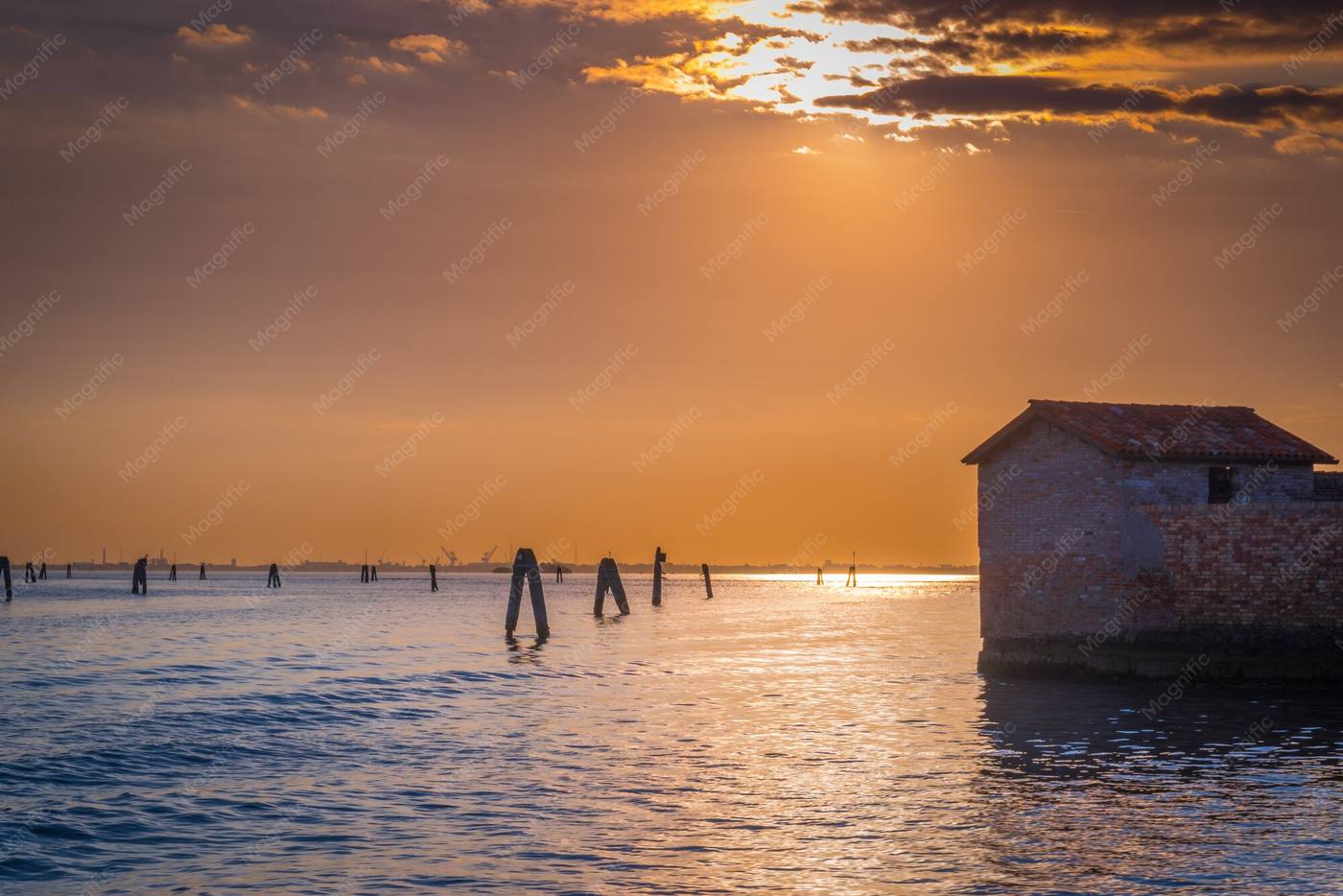
Patrizia Sandretto Re Rebaudengo opened a whole abandoned Venetian island to the public on 7 May 2026 — and ran it without a single connection to the city’s electricity, gas or water grid. The sandretto san giacomo venice project is the only patron-foundation venue in the lagoon that is an island rather than a palazzo, and it is the only one whose mechanical services live entirely inside its own perimeter. That single combination — a whole-island scope and a fully off-grid envelope — is the reason this addition to Venice’s foundation map is not interchangeable with the others, and the reason it changes the comparator set rather than simply extending it.
The thesis of this piece is narrow. Venice has, in 2026, four foreign-to-Venice patron foundations operating at scale: Fondazione Prada at Ca’ Corner della Regina, the Anish Kapoor Foundation at Palazzo Manfrin, the Fondazione Dries Van Noten at Palazzo Pisani Moretta, and now Fondazione Sandretto Re Rebaudengo on Isola di San Giacomo in Paludo. Three are palazzo conversions on the historic centre’s water network. One is a 9,000-square-metre island in the northern lagoon with no public utilities whatsoever. The shape of the answer this article gives is that San Giacomo is not Venice’s fifth Pinault-style takeover but a different category — a self-sufficient outpost that uses the lagoon as the venue rather than the palazzo, and reads its restraint as architectural argument.
Patrizia Sandretto Re Rebaudengo and the foundation behind the island
Fondazione Sandretto Re Rebaudengo was founded in 1995 in Guarene, in Piedmont’s Roero hills above Alba, by Patrizia Sandretto Re Rebaudengo, born in Turin on 24 April 1959, an economics and commerce graduate who began collecting contemporary art in her late twenties. The foundation’s first home was the family’s eighteenth-century palace at Guarene; its Turin headquarters opened in 2002 at Via Modane 16, in a 3,500-square-metre building designed by Claudio Silvestrin — the Italian-British minimalist architect, born in Milan in 1954 and based in London — and it has since become the Italian institution most consistently associated with international emerging art and with curatorial residencies for younger curators.
Two facts from this thirty-year backstory are load-bearing for what happened on San Giacomo. First, the 2002 Silvestrin building established the foundation’s architectural register: stone, light, controlled volumes, no ornament. Anyone who has stood in the Via Modane atrium has seen what the Sandretto programme expects of a building. Second, the foundation has always been a married enterprise. Patrizia’s husband Agostino Re Rebaudengo founded Asja Ambiente Italia, the renewable-energy company now known as Asja Group, which builds and runs biogas, biomethane and solar plants across Italy and several other countries. Asja’s engineering competence is not a footnote on this project; it is the project’s structural premise.
In 2018 the couple bought Isola di San Giacomo in Paludo, a 9,000-square-metre island in the northern Venice lagoon between Murano and Madonna del Monte. The island had been abandoned since 1961. It had no jetty in regular use, no functioning utilities, no roof that did not leak. Eight years later, on 7 May 2026, the foundation opened it as its third venue, after Guarene and Turin. The opening week coincided with the previews of the 61st Venice Art Biennale and with the broader cluster of Venice 2026 patron pavilions that has reframed how the city’s foundation map is read.
The island itself: nine hundred and eighty years of San Giacomo in Paludo
The case for treating San Giacomo as a Venetian project begins with the island’s biography, which is older than most palazzi on the Grand Canal and far stranger.
| Year | Event |
|---|---|
| 1046 | Doge Orso Badoer II donates the island for a monastery dedicated to St James |
| 1456 | Briefly used as a quarantine island during a plague scare |
| Late 1400s–1769 | Passes through several monastic orders before suppression in 1769 |
| Early 19th c. | Converted by Napoleonic forces into a powder magazine (“polveriera”) |
| Mid–late 19th c. | Austrian and then Italian military continue the magazine use |
| 1961 | Italian military exits; the island is abandoned and falls into ruin |
| 2018 | Patrizia Sandretto Re Rebaudengo and Agostino Re Rebaudengo purchase the island |
| 7 May 2026 | Reopens to the public as Fondazione Sandretto Re Rebaudengo’s third venue |
Three things are visible on this timeline before any wall text. First, the island’s longest single use was military, not religious — the powder magazine occupied roughly 150 years of its life, the monastic communities a fragmented seven hundred. Second, every regime change in the lagoon’s modern history (Republic, Napoleonic, Austrian, Italian) used the island for something the centre of Venice did not want too close to itself: gunpowder, quarantine, monks. Third, the abandonment was recent. Sixty-five years between the 1961 military exit and the 2026 reopening is short enough that the brick fabric, the watchtower silhouette and the boundary walls survived in a recoverable state. Had the gap been a hundred years, the project would have been new construction in historicist drag. As it is, what reopened in May is largely the building that the Italian military left behind.
The two surviving Napoleonic powder magazines were stabilised and re-roofed; the watchtower was restored; the vineyard areas inside the perimeter walls were replanted. The interventions read, deliberately, as a layer added to a long stack rather than as a single new gesture overwriting the rest.
The Asja Energy restoration: reversible, off-grid, brick-by-brick
The restoration was designed and engineered by Asja Energy — the same Asja Group that Agostino Re Rebaudengo founded as a renewable-energy operator. That an energy company led the restoration of an art venue is the joke and the seriousness of the project simultaneously. The decision shows up in three places.
First, the structural insertions are reversible. New steel and timber elements sit on micropiles rather than on continuous foundations cast into the lagoon mud, so that a future occupant could in principle remove them and recover the nineteenth-century plan. This is the same logic Renzo Piano applied at the Magazzini del Sale on the Zattere in 2007–2009 — restoration as a re-removable layer — and it is the technical opposite of the Pinault-era Tadao Ando interventions at Punta della Dogana, which are deliberately permanent.
Second, the brickwork was reused rather than replaced. Approximately 30,000 original bricks from the powder magazines and the boundary walls were taken down by hand, manually cleaned, and rebuilt into the restored fabric. A figure of 30,000 sounds rhetorical until you do the work of imagining one mason’s hand on each brick twice — once down, once up. It is the kind of decision that costs more in labour than a fresh brick order would have cost in materials, and the kind of decision a foundation with a thirty-year track record in restraint can defend.
Third, the island is off-grid. There is no public electricity connection, no gas connection, and no water main from the city or from Murano. The energy supply is an integrated photovoltaic system — distributed across roofs that read, from the lagoon, as continuous nineteenth-century terracotta — backed by a battery storage system sized for a museum-grade load profile. The water supply combines a restored military-era well, drawn from the island’s freshwater lens, with rainwater collection and on-site management. Planting around the visitor circuit is native lagoon vegetation, chosen to need no irrigation beyond the rainwater system. This is what “off-grid” means here: not a marketing label, but a closed loop on a 9,000-square-metre footprint, engineered by the same firm that builds biomethane plants for Italian agriculture.
The architectural lesson is unfashionable and worth saying plainly. The most ambitious sustainability claim in Venice’s 2026 foundation map is being made by the project that did the least new building. Restraint, here, is not aesthetic; it is metered.
The inaugural programme: Matt Copson, Hans Ulrich Obrist and the collection
The 7 May 2026 opening fielded three exhibitions in parallel, which is a more substantial programme than any of the comparator foundations launched their Venice venues with.
The headline show is Matt Copson’s “Fanfare/Lament”, curated by Hans Ulrich Obrist, the artistic director of the Serpentine Galleries in London and the most-cited curator of his generation. Copson — a British artist working in laser projection, sculpture and operatic sound — is an unusual first commission for an island venue. His work depends on darkness, electricity and very precise sequencing; an off-grid building with battery storage is, in principle, the worst possible host for a lasers-and-soundtrack show, which is presumably why the foundation chose it. The argument the building makes about technical restraint is then immediately tested by a programme that runs to the edge of what the storage can deliver. Obrist’s involvement signals where the foundation wants the show read: not as a regional Italian initiative, but as a continuation of the same circuit that programmes the Serpentine Pavilion and the Marathon series in Hyde Park.
The second exhibition is “Don’t have hope, be hope!”, a collection show drawn from the Sandretto Re Rebaudengo Collection itself. Thirty years of collecting reads here as an institutional argument about why a private foundation has standing to programme contemporary art at this scale at all. The collection is the credential.
The third is a documentation show by the photographers Giovanna Silva and Antonio Fortugno, recording the island’s restoration. Silva is the founder of the publisher Humboldt Books, with a deep practice in architectural photography of disused industrial sites; Fortugno’s portfolio runs through Italian post-industrial landscape. Putting their record of the works inside the works is a small but pointed gesture: the building is the third exhibition, and it is being shown by photographers whose subject is usually buildings other people have abandoned.
Permanent installations sit alongside the temporary programme. Claire Fontaine’s “Patriarchy = CO2” — a neon work whose equation is the show’s thesis in three letters — is mounted on one of the restored magazine façades. Goshka Macuga’s “GONOGO”, a sculptural piece whose title borrows the language of mission control at Cape Canaveral, sits in the courtyard. Hugh Hayden’s inclined chapel — a small timber room set deliberately off-vertical — is mounted near the watchtower. Pamela Rosenkranz’s “Old Tree (Pink Seas)” answers the lagoon water with its own register of pink. Thomas Schütte’s “Nixe” — a bronze water-spirit figure from the artist’s long catalogue of female-form works — is sited at the island’s edge, facing the water that the work names. The permanent pieces are, by design, the part of the programme that does not change between opening and the eventual closing.
Sandretto san giacomo venice in the lagoon’s foundation map
To see what San Giacomo adds, set it against the comparator that already exists.
| Foundation | Venue | Neighbourhood / sestiere | Building type | Off-grid |
|---|---|---|---|---|
| Fondazione Sandretto Re Rebaudengo | Isola di San Giacomo in Paludo | Northern lagoon (Murano–Madonna del Monte) | Whole island, 19th-c. military magazine + watchtower | Yes |
| Anish Kapoor Foundation | Palazzo Manfrin | Cannaregio | 18th-c. palazzo (acquired 1788 by Count Manfrin) | No |
| Fondazione Dries Van Noten | Palazzo Pisani Moretta | San Polo (Grand Canal) | 15th-c. Gothic palazzo with rococo interiors | No |
| Fondazione Prada | Ca’ Corner della Regina | Santa Croce (Grand Canal) | 18th-c. palazzo by Domenico Rossi (1724–1728) | No |
| Fondazione Giorgio Cini | San Giorgio Maggiore | Island opposite San Marco | Benedictine monastic complex with Palladio basilica | No |
Four of the five sit on the city’s water-and-power network and three of them sit directly on the Grand Canal. Sandretto’s island is the only entry that is a whole island rather than a single building, the only entry whose primary architectural inheritance is military rather than aristocratic or monastic, and the only entry that is fully off-grid.
The Cini comparison is the most instructive of the five, because Cini is also on an island and has been programming on San Giorgio Maggiore since 1951. But Cini is connected to mainland services, sits inside a Palladio-anchored monastic complex with a programme that extends across music, manuscript studies and architecture, and is run as a public-facing cultural institution rather than as a private patron foundation. The two operations are not equivalents. Sandretto’s island is smaller, more recent, more programmatically focused on contemporary art, and architecturally argues for self-sufficiency rather than for monastic-civic continuity.
The Kapoor Foundation at Palazzo Manfrin in Cannaregio is the closest funding-model comparator: a single-artist patron operation, in a building bought in 2018 (the same year Sandretto bought San Giacomo), opened to the public for the first time during the 2026 Biennale season. Both foundations spent eight years on their restorations and both opened to the public for the same Biennale. The contrast is the venue type. Kapoor’s building is a Cannaregio palazzo with documented eighteenth-century picture-gallery use; Sandretto’s is a powder magazine on an abandoned island. Two foundations bought into Venice in the same calendar year and made opposite architectural bets.
The Van Noten foundation at Palazzo Pisani Moretta and the Prada foundation at Ca’ Corner della Regina are the palazzo-on-the-Grand-Canal answer to the question Sandretto’s island declines to answer. Van Noten opened on 25 April 2026, Liberation Day; Prada has been at Ca’ Corner since 2011 and continues its programme through the Biennale’s run. Both depend, structurally and programmatically, on Grand Canal address. Sandretto’s island depends on the opposite — on being far enough from the centre that the boat ride is part of the visit.
The patronage logic, then, splits cleanly. Three foundations bought into the historic centre and inherited the constraints of Venetian palazzo restoration: the magistracies for cultural heritage, the limits on intervention, the expectation that the building shows through the programme. One foundation bought outside the centre and inherited a different set of constraints: no utilities, no road access, no neighbours, no inherited interior plan beyond what the army left. The first three projects argue for restraint inside the city. The fourth argues for restraint by leaving the city.
What the off-grid premise means for the patronage map
Two consequences follow from the engineering choice, and they are worth naming because they will reshape the comparator set as the next generation of foundations look for Venice venues.
The first is that San Giacomo is operationally cheap to run and operationally fragile to programme. With no utility connections and a battery-storage envelope, the venue can sustain a museum-grade load only by making programmatic decisions inside the energy budget. A laser-and-sound show by Matt Copson, with Hans Ulrich Obrist directing, signals that the foundation is prepared to spend the budget on the headline; the permanent installations, which mostly do not require live power, signal that the foundation knows the budget cannot be spent twice. This is a different operating model from any of the palazzo foundations, all of which can plug into Venice’s grid and forget about kilowatt-hours.
The second is that the project is repeatable. Venice has roughly forty inhabited and uninhabited islands inside its lagoon, several of them abandoned military or quarantine sites in conditions structurally similar to San Giacomo’s pre-2018 state. Until 7 May 2026, the question of whether a private foundation could programme one of them was open. After 7 May, it has been answered. A patron with the engineering competence Asja brought, the collection depth Sandretto brought, and the programmatic relationships the Obrist booking demonstrates can take an abandoned lagoon island, restore it reversibly, energise it photovoltaically and open it to the public for a Biennale season. The template is now legible to the next foundation that wants to make the same bet.
That second consequence is the one to watch. The palazzo-takeover model is bounded by the supply of available Grand Canal palazzi, which is small and shrinking, and by the price of those palazzi, which the late-2025 Pisani Moretta sale put somewhere in the €30–70 million range. The island-takeover model is bounded by a different supply curve — one with more units available, more architectural variety, and a restoration cost dominated by engineering choices rather than by the cost of working inside a UNESCO-protected piano nobile. If the next generation of patron foundations decides that an island makes more sense than a palazzo, they will be following the route Sandretto opened on 7 May 2026.
Patrizia Sandretto Re Rebaudengo and Agostino Re Rebaudengo did not buy a Grand Canal palazzo when they bought into Venice in 2018. They bought a powder magazine on an island that had been empty for fifty-seven years, and they hired their own renewable-energy company to re-engineer it from the seabed up. The opening-day programme — Copson with Obrist, the collection show, the Silva and Fortugno documentation, the permanent installations from Claire Fontaine to Thomas Schütte — is the visible part of what the foundation is doing in Venice. The off-grid envelope, the 30,000 hand-cleaned bricks and the reversible micropile foundations are the invisible part, and they are the part that will outlast the inaugural year. Sandretto’s island is not Venice’s fifth palazzo foundation. It is the lagoon’s first off-grid one, and it has just made the patron-foundation map a category larger than it was on 6 May.