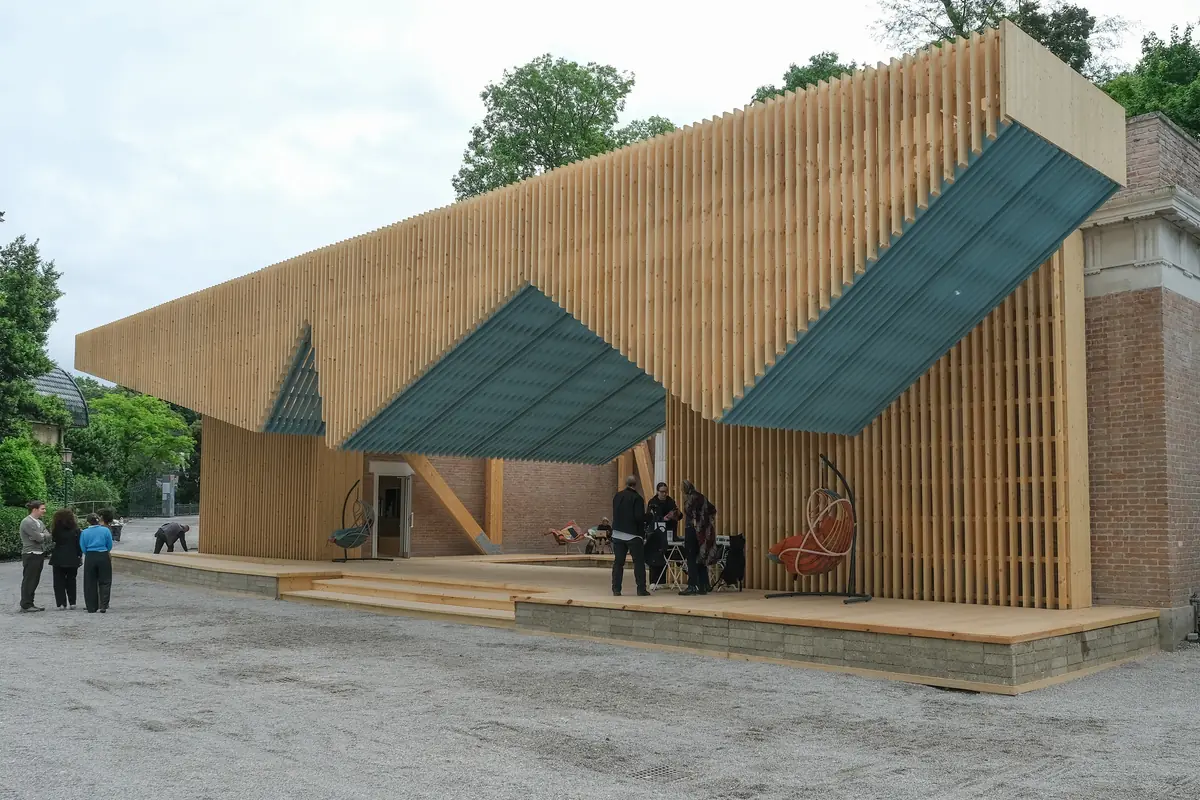
Labics’s restoration of the Central Pavilion at the Giardini is the architectural news of the 2026 pavilions circuit — the first updated architectural backbone the Giardini has had since the 1948–1956 Carlo Scarpa interventions, and the building that sets the rhythm for a pavilion-by-pavilion reading that runs from Anish Kapoor’s Palazzo Manfrin in Cannaregio to Palladio’s Basilica of San Giorgio Maggiore. This is the architecture-first read of the 2026 edition: pavilions, palazzi and restorations parsed as buildings before they are parsed as shows. Koyo Kouoh’s “In Minor Keys” — the framework she signed off before her unexpected death in May 2025, and which her appointed team has realised posthumously — opens to the public on 9 May 2026 as a constellation of restored architecture rather than a single building. Read the venues first and the works second, and the curatorial argument is already legible in stone, brick, fresco and steel before any painting goes on a wall.
This is the angle that gets lost in most Biennale coverage. The shows are reported as content; the buildings as backdrop. But every Venice show this spring has chosen, or inherited, an address whose architectural history is doing real curatorial work — Palladio’s basilica behind Barry X Ball’s marbles; Longhena’s Ca’ Pesaro for Hernan Bas; the Renzo Piano-restored Magazzini del Sale for Nalini Malani; the Galileo Chini-frescoed octagon at the heart of Labics’s reopened pavilion. The circuit is the show, and the painter-side reading of the same circuit — Bas, Baselitz, Kantarovsky, Malani inside Manfrin, Ca’ Pesaro, Loredan and the Magazzini — confirms it from the other direction.
Reading the Venice Biennale 2026 through architecture
“In Minor Keys” was Kouoh’s last public gesture as a curator. Cameroonian-born, founder of RAW Material Company in Dakar in 2008 and executive director of Zeitz MOCAA in Cape Town from 2019, she was the first African woman appointed to lead the Venice Art Biennale when the announcement came in December 2024. She died in May 2025, before the title was even publicly announced. The team she chose has carried the framework forward; the 9 May – 22 November 2026 run, with previews 6–8 May, is hers in concept and theirs in execution.
The decision not to scrap the framework is itself a curatorial argument. “In Minor Keys” pushes against the major-key bombast of recent editions — the spectacle pavilion, the mega-installation, the artist as franchise. A minor key is a register, not a volume control: it admits doubt, slowness, the unresolved. It is a brief that rewards architecture you can sit inside rather than architecture you photograph from across a canal. Which is why the building decisions matter more than usual this year. The major venue has been quietly rewired for accessibility and daylight; the satellite venues have been chosen, in almost every case, for buildings that were already saying something the works can answer.
The shape of the answer, across the seven principal venues outside the Giardini and Arsenale, is a circuit that can be walked in three days and read in four centuries. Palladio (1566) at San Giorgio Maggiore. Longhena (from 1659) at Ca’ Pesaro. Domenico Rossi (1724–1728) at Ca’ Corner della Regina. The 14th-to-19th-century Magazzini del Sale, restored by Renzo Piano in 2007–2009. The 16th-century Palazzo Loredan on Campo Santo Stefano. The 15th-century Gothic-rococo Palazzo Pisani Moretta on the Grand Canal. The Cannaregio palazzo Count Girolamo Manfrin acquired in 1788 and Anish Kapoor acquired in 2018. Each building stages a different argument about what minor-key art can do inside Venetian space.
Labics at the Central Pavilion: the spine of the Giardini
The Central Pavilion is the spine of the Giardini, and the building had been limping for a decade. Originally Palazzo Pro Arte, built 1894–1895 to host the first International Art Exhibition, with Galileo Chini’s frescoed entrance-hall dome added 1907–1909 and Duilio Torres’s stripped-classical facade imposed in 1932, the pavilion was last seriously rethought when Carlo Scarpa was working at the Giardini between 1948 and 1956 — the renovations to the Italian Pavilion, the 1952 internal courtyard, the Giardino delle Sculture, the 1956 Venezuelan Pavilion. Seventy years is a long time for a building of this footfall to go without an architectural update.
Labics — the Rome-based studio founded in 2002 by Maria Claudia Clemente and Francesco Isidori, known for MAST in Bologna (2006–2013) and Città del Sole in Rome (2007–2016) — has used €31 million of PNRR funding to reopen the pavilion in May 2026 as a fully accessible building for the first time in its history. The headline gesture, and the right one, is the Galileo Chini octagon. The frescoed hall has been reconfigured as a central distribution hub — the room you arrive in, the room you leave from, the room you cross to move between wings. Chini’s 1907–1909 frescoes are no longer a passage; they are the place from which the visit is organised.
The other interventions are quieter and more telling. Carlo Scarpa’s window fixtures have been restored rather than replaced — the Scarpa detail kept legible against the new fabric. Two timber altane have been added on the roof, one for the café and one for multipurpose programming, in the Venetian rooftop-terrace tradition that San Marco roofs have used for centuries. The new skylights are photovoltaic, targeting LEED Gold; the daylight inside the galleries is therefore generated by glass that is also generating power. Labics has done what good restoration architects do, which is let the building’s previous architects keep speaking. Pro Arte (1894–1895), Chini (1907–1909), Torres (1932), Scarpa (1948–1956), Labics (2026): five layers, all visible, none hidden.
This matters for “In Minor Keys” because the Central Pavilion is where the curatorial argument begins. A more spectacular reopening — a Bjarke Ingels glass cube, a Diller Scofidio extrusion — would have set the wrong key. Labics’s restraint is itself the first work in the show.
Palazzo Manfrin and Anish Kapoor’s second public opening
Across the lagoon in Cannaregio, Anish Kapoor has opened Palazzo Manfrin to the public for only the second time since he acquired it in 2018. The 6 May – 8 August 2026 show is therefore architectural news as much as artistic news: the building is the rarer object on view.
Palazzo Manfrin sits on the Cannaregio Canal. Count Girolamo Manfrin, a tobacco merchant, acquired it in 1788 and turned the piano nobile into a public picture gallery — Canova, Byron, Ruskin and Manet are all on the visitor list. Kapoor bought the building in 2018 and made it the headquarters of the Anish Kapoor Foundation. For most of the seven years since, it has been closed to the public. The 2026 Biennale opening is the second time the doors have been open in any sustained way.
What is inside is unusually architectural for a Kapoor presentation. Roughly 100 architectural models from five decades — the Cloud Gate maquette (the 2006 Chicago bean in study scale), Ark Nova (the inflatable concert hall), the Sant’Angelo metro-station model for Naples — are shown alongside large-scale works in stainless steel, pigment, cement, silicone and Vantablack, the carbon-nanotube black to which Kapoor holds exclusive artistic rights. Kapoor — born 12 March 1954 in Mumbai, trained at Hornsey College of Art and Chelsea School of Art, Turner Prize 1991, knighthood 2013, author of the ArcelorMittal Orbit (London, 2012) and Sky Mirror — is one of the few sculptors of his generation whose practice has had a continuous architectural register. To see five decades of his models inside Manfrin’s late-eighteenth-century gallery rooms is to see a private architectural archive lit by the building it is housed in.
The Manfrin opening also reframes the Cannaregio leg of the circuit. Cannaregio has historically been the sestiere visitors skip during the Biennale; the show pulls a serious volume of foot traffic north of the train station for the first time in years.
Georg Baselitz at the Fondazione Giorgio Cini
The Fondazione Giorgio Cini occupies the former Benedictine monastery on San Giorgio Maggiore — an island visible from the Piazzetta, with cloisters by Andrea Palladio and Baldassarre Longhena and a foundation history that begins in 1951, when Vittorio Cini established it in memory of his son. The monastery is one of the great architectural compounds in the lagoon: Palladio’s late-Renaissance cloister opens onto Longhena’s seventeenth-century library, and the whole complex sits in the shadow of Palladio’s basilica next door.
“Eroi d’Oro” — 5 May – 27 September 2026 — is the first major Venice presentation of Georg Baselitz since his death on 30 April 2026. Baselitz, born Hans-Georg Bruno Kern on 23 January 1938 in Deutschbaselitz, Saxony, had painted his subjects inverted since 1969 — the formal device that defined his late career and, by the end, the way most viewers identified his work at a glance. The show is curated by Luca Massimo Barbero, who runs the Modern Art Collection at the Fondazione, with Galerie Thaddaeus Ropac, and was originally programmed as a living-artist mid-career re-examination. It opens five days after Baselitz’s death as a posthumous tribute — a calendar accident that nobody wanted but that the architecture of the venue absorbs unusually well.
Cini’s combination of Palladio and Longhena — restraint and exuberance, classical proportion and Baroque movement — is exactly the register Baselitz’s late inverted figures need. The Palladian cloister gives the looking room; the Longhena interior gives the rhetorical lift. There are few buildings in Italy where a posthumous show of this scale could have opened on a week’s notice without losing its dignity. San Giorgio is one of them.
Marina Abramović at the Gallerie dell’Accademia
The Gallerie dell’Accademia is the Palladian complex at the foot of the Accademia bridge, formerly the Scuola Grande di Santa Maria della Carità, established as a museum in 1750 to hold pre-19th-century Venetian painting and now home to, among other things, Leonardo’s Vitruvian Man. “Transforming Energy” — 6 May – 19 October 2026 — is the first solo exhibition by a living female artist the Accademia has ever staged. (Note for the record: this 6 May – 19 October run is sometimes wrongly cited as the dates of the Biennale itself; it is not. The Biennale runs 9 May – 22 November.)
The show is curated by Shai Baitel and turns on a single architectural-art collision: Marina Abramović’s Pietà (with Ulay) of 1983 placed in direct confrontation with Titian’s Pietà of 1575–76. Two Pietàs, four centuries apart, in a building whose own galleries were laid out for sixteenth-century Venetian painting. The programme also features Rhythm 0 (1974) and Balkan Baroque (1997). Abramović is the right artist for this venue precisely because the Accademia’s architecture cannot be neutralised — its galleries were built around their paintings — and her work has always operated as confrontation rather than installation. The building wins, in a sense, every time, but only by being seriously contested.
The Accademia opening one day before the Biennale’s general public opening (6 May vs. 9 May) is part of the architectural choreography of the week. It pulls press attention west toward Dorsoduro before the Giardini-Arsenale current pulls everyone east.
Dries Van Noten at Palazzo Pisani Moretta
Palazzo Pisani Moretta is the fifteenth-century Gothic-rococo palazzo on the Grand Canal, with the canal-side loggias and pointed-arch fenestration that mark the late-Gothic Venetian residential type, that Dries Van Noten and Patrick Vangheluwe acquired from the Sammartini family in 2025. “The Only True Protest Is Beauty” — 25 April – 4 October 2026, opened two weeks before the Biennale itself — is the first public exhibition organised by the Fondazione Dries Van Noten, with over 200 objects across 20 rooms, co-curated by Van Noten and Geert Bruloot. The acquisition and the show together are a meaningful entry into the Venice patron-pavilion conversation that has been reshaping the city’s exhibition map for a decade, and one of the more legible cases in the broader run of fashion-designer second acts that 2026 has produced.
The Gothic-rococo combination at Pisani Moretta is unusual and loaded. The palazzo’s bones are fifteenth-century; the interior interventions are eighteenth. Van Noten’s exhibition is not a single-period restoration — the palazzo will continue to read as an accumulation, the way most lived-in Venetian palazzi do — and the choice to open it without erasing the Sammartini-era surfaces is an architectural decision that the show’s title underwrites.
Barry X Ball inside Palladio’s Basilica of San Giorgio Maggiore
Andrea Palladio designed the Basilica of San Giorgio Maggiore from 1566; it was completed in 1610. To put 23 marble and metal sculptures inside it — Barry X Ball’s “The Shape of Time”, 9 May – 22 November 2026 — is to enter into a direct material conversation with one of the most architecturally consequential interior volumes in Western architecture. Ball’s practice, which uses contemporary CNC techniques to recut classical and Renaissance sculptural forms in exotic stones and polished metals, is one of the few sculptural practices of the last twenty years that can survive Palladian whiteness.
The argument the venue makes, before any work is unwrapped, is that contemporary stone-cutting is continuous with — not alien to — Renaissance stone-cutting. Palladio’s white interior, with its colossal Corinthian half-columns and the long sightline to the apse, was always a frame. Twenty-three new pieces are not enough to fill it; that is the point. Ball’s work measures itself against the volume rather than competing for it.
Hernan Bas at Ca’ Pesaro
Ca’ Pesaro is the Baroque palazzo on the Grand Canal in Santa Croce, designed by Baldassarre Longhena from 1659 and completed in 1710 by Antonio Gaspari, that has housed Venice’s International Gallery of Modern Art since 1902. Hernan Bas’s “The Visitors” — 30+ paintings, 7 May – 30 August 2026 — is hung inside Longhena’s first major Grand Canal palazzo commission, the building that established the Baroque palazzo type that Ca’ Rezzonico would later refine.
Bas’s work — figurative, narrative, often pitched at adolescence and the gothic — is unusually well-served by Ca’ Pesaro’s interior. The building’s gallery rooms have the dimensions of late-seventeenth-century domestic display; they are smaller than the museum-standard white cube and demand paintings that can hold their own at conversational distance. Longhena built rooms for storytelling; Bas paints stories. The match is closer than it looks on paper.
Arthur Jafa and Richard Prince at Ca’ Corner della Regina
Ca’ Corner della Regina is the Baroque palazzo on the Grand Canal designed by Domenico Rossi 1724–1728 on the site of the Corner family house where Caterina Cornaro — the last queen of Cyprus — was born. Fondazione Prada has leased the building since 2011 and has used it as one of the most architecturally articulate contemporary-art venues in Italy. “Helter Skelter” — Arthur Jafa and Richard Prince, curated by Nancy Spector, 9 May – 23 November 2026 — runs almost the full length of the Biennale.
Domenico Rossi’s interior at Ca’ Corner della Regina is high Baroque in a particular Venetian register: tall piano nobile rooms with deep stuccoed cornices, an interior staircase that announces the piano nobile before the visitor reaches it, and a sequence of enfilade galleries that Fondazione Prada has, on the whole, left legible. Jafa’s video work and Prince’s appropriated photographic and painted material are both kinds of visual collision, and the Domenico Rossi sequence — room into room into room — is what gives them the architectural cadence to land.
Nalini Malani at the Magazzini del Sale
The Magazzini del Sale are the former salt warehouses on the Zattere in Dorsoduro, fourteenth-to-nineteenth-century industrial buildings that Renzo Piano restored in 2007–2009 for the Fondazione Vedova. The Piano restoration is a piece of architectural restraint as significant in its way as Labics at the Central Pavilion: long brick volumes, exposed timber roof structures, a continuous floor and the new sliding picture-rail system Piano designed for the Vedova works.
Nalini Malani’s “Of Woman Born” — a 67-channel video installation, 9 May – 22 November 2026 — is the most architecturally ambitious satellite show in the 2026 circuit. Sixty-seven channels demand wall area, ceiling area and total darkness; the Magazzini’s long brick halls and Piano’s quiet new infrastructure are among the few Venetian interiors that can carry that count without descending into visual noise. The salt warehouses were built to hold a single bulk material in volume. Malani is using the volume rather than the surface — the way the warehouses originally were.
Sanya Kantarovsky at Palazzo Loredan
Palazzo Loredan on Campo Santo Stefano is the sixteenth-century palazzo, on a campo rather than the Grand Canal, that has been the seat of the Istituto Veneto di Scienze, Lettere ed Arti since 1891. Sanya Kantarovsky’s “Basic Failure” — paintings, ceramics and Murano glass, 6 May – 22 November 2026 — is the longest-running of the satellites and the only one that uses a learned-society building rather than a museum or a foundation.
The venue is the argument. Istituto Veneto interiors carry the residue of nineteenth-century scholarship — bookcases, lecture rooms, the cabinet-of-curiosities habit of mind — and Kantarovsky’s work, which moves between mediums and refuses a single dominant register, fits the spaces by refusing to behave like a museum show. Murano glass shown in a learned society’s rooms is not the same object as Murano glass shown in a contemporary art gallery; the institutional architecture changes the reading.
The circuit, mapped
| Show | Venue | Architect / lineage | Dates | Curatorial angle |
|---|---|---|---|---|
| “In Minor Keys” (61st Biennale) | Central Pavilion, Giardini | Pro Arte 1894–1895; Chini frescoes 1907–1909; Torres facade 1932; Scarpa interventions 1948–1956; Labics restoration 2026 | 9 May – 22 Nov 2026 | Koyo Kouoh’s posthumous framework realised by her appointed team; minor-key restraint as curatorial register |
| Anish Kapoor | Palazzo Manfrin, Cannaregio | 18th-century palazzo; Manfrin gallery from 1788; Kapoor Foundation HQ from 2018 | 6 May – 8 Aug 2026 | ~100 architectural models across five decades, with stainless steel, pigment, cement, silicone, Vantablack |
| Georg Baselitz, “Eroi d’Oro” | Fondazione Giorgio Cini, San Giorgio Maggiore | Former Benedictine monastery; cloisters by Andrea Palladio and Baldassarre Longhena; Foundation est. 1951 | 5 May – 27 Sep 2026 | Posthumous tribute curated by Luca Massimo Barbero with Galerie Thaddaeus Ropac |
| Marina Abramović, “Transforming Energy” | Gallerie dell’Accademia | Palladian complex, formerly Scuola Grande di Santa Maria della Carità; museum since 1750 | 6 May – 19 Oct 2026 | First solo by a living female artist at the Accademia; Pietà (1983) vs Titian’s Pietà (1575–76); curated by Shai Baitel |
| Dries Van Noten, “The Only True Protest Is Beauty” | Palazzo Pisani Moretta, Grand Canal | 15th-century Gothic-rococo; acquired 2025 by Van Noten and Patrick Vangheluwe | 25 Apr – 4 Oct 2026 | 200+ objects across 20 rooms; co-curated by Van Noten and Geert Bruloot |
| Barry X Ball, “The Shape of Time” | Basilica of San Giorgio Maggiore | Andrea Palladio, designed from 1566, completed 1610 | 9 May – 22 Nov 2026 | 23 marble and metal sculptures inside Palladio’s basilica |
| Hernan Bas, “The Visitors” | Ca’ Pesaro | Baldassarre Longhena from 1659, completed 1710 by Antonio Gaspari; International Gallery of Modern Art since 1902 | 7 May – 30 Aug 2026 | 30+ paintings inside Longhena’s first major Grand Canal commission |
| Arthur Jafa & Richard Prince, “Helter Skelter” | Ca’ Corner della Regina | Domenico Rossi 1724–1728; Caterina Cornaro birthplace; Fondazione Prada lease since 2011 | 9 May – 23 Nov 2026 | Curated by Nancy Spector |
| Nalini Malani, “Of Woman Born” | Magazzini del Sale, Zattere | 14th–19th-century salt warehouses; restored 2007–2009 by Renzo Piano for Fondazione Vedova | 9 May – 22 Nov 2026 | 67-channel video installation |
| Sanya Kantarovsky, “Basic Failure” | Palazzo Loredan / Istituto Veneto | 16th-century palazzo on Campo Santo Stefano; Istituto Veneto seat since 1891 | 6 May – 22 Nov 2026 | Paintings, ceramics, Murano glass |
What the circuit argues
Read down the table and the architectural argument is almost embarrassingly clear. The 2026 circuit is composed of buildings whose authorship matters — Palladio, Longhena, Domenico Rossi, Carlo Scarpa, Labics, Renzo Piano — and whose interventions across centuries have not been hidden. None of the venues has been white-cubed. None has tried to disappear. Every show has been programmed by people who understood that a Longhena room and a Rossi room read differently, that a Palladian basilica and a Palladian cloister are not interchangeable, that a Scarpa fixture is not a generic mid-century detail. The sophistication is in the matching.
The Central Pavilion sets the key. Labics’s €31 million restoration is the first major architectural rewrite of the Giardini’s anchor building since Scarpa, and it has been done by leaving previous architects audible: Pro Arte’s 1894–1895 plan, Chini’s 1907–1909 frescoes elevated into the building’s circulatory heart, Torres’s 1932 facade kept, Scarpa’s window fixtures restored rather than replaced, Labics’s two new timber altane and photovoltaic skylights pulled in as additions rather than replacements. This is what a minor-key building looks like: layered, legible, accessible for the first time, and quietly capable of LEED Gold.
What follows the Central Pavilion through the city, in a five-month run that begins on 25 April with Pisani Moretta and ends on 22 November with the Biennale’s own closing, is the application of that principle at scale. Manfrin’s late-eighteenth-century gallery rooms hold Kapoor’s models because they were built to hold pictures — and a model is closer to a picture than to a sculpture. Cini’s Palladio-and-Longhena cloister carries Baselitz’s posthumous show because the building’s own register can absorb the calendar accident. The Accademia’s sixteenth-century galleries are the right room in which to confront a 1983 Pietà with a 1575–76 Pietà, because the building’s architecture of devotion was built for exactly that. Palladio’s basilica accommodates 23 sculptures by absorbing them into a volume that has always been a frame. Longhena at Ca’ Pesaro and Rossi at Ca’ Corner della Regina give two different registers of Venetian Baroque — gallery-domestic and processional-Baroque — to two very different pictorial practices. Renzo Piano’s 2007–2009 work at the Magazzini del Sale is the only contemporary architectural intervention on the satellite list strong enough to hold sixty-seven simultaneous video channels without becoming spectacle. Palazzo Loredan, finally, is the academic outlier — the building whose institutional architecture changes a Murano glass piece into a different object than the same piece would be in a gallery.
Kouoh did not build any of these buildings, and in the conventional sense she did not choose all of them — the satellite venues operate under their own foundations and lease structures. But her curatorial framework has been read by the city’s institutions, and the city’s institutions have answered. “In Minor Keys” is a brief about register, not volume, and the buildings that have shown up around it — Palladio in 1566, Longhena from 1659, Rossi in the 1720s, Manfrin’s gallery from 1788, the Accademia museum from 1750, the Magazzini in their fourteenth-to-nineteenth-century run, Scarpa from 1948, Piano from 2007, Labics in 2026 — all share the same disposition. They are buildings that prefer to be inhabited rather than photographed, that admit successive interventions without erasing them, that win their arguments by holding their position rather than raising their voice. This is the Venice the 2026 Biennale has chosen to read itself through, and the circuit, more than any single show, is the argument.