Toyo Ito spent five decades teaching Japanese architecture to dissolve the line between building and atmosphere; in 2026, at eighty-four, he turned around at Triennale Milano and dedicated the show to someone else. Andrea Branzi: Continuous Present, open at the Palazzo dell’Arte until 4 October 2026, is conceived by Ito as a posthumous reading of the Florentine radical who died in 2023. The institutional curators of record are Stefano Bassoli and Francesca Alessandrini, but the conceptual force is Ito’s, and reading the show without the rest of his work — White U, Silver Hut, the Tower of Winds, Sendai Mediatheque, the TOD’S facade, Tama Library, Taichung — is to miss the argument. This piece walks the Toyo Ito architecture lineage from a concrete U-shape built for his sister in Nakano in 1976 to a Milan exhibition that argues a different Italian read of the same questions Ito has been asking in Japan for fifty years.
The thesis is narrow. Ito’s career is usually read as a long technical experiment in lightness — a refusal of the heavy, gridded, post-war Japanese concrete office tower in favour of perforated skins, fluid plans, and structures that record airflow, wind, and use rather than program. That reading is correct as far as it goes, but it misses the second move: from the late 1990s onward Ito has been pulling that lightness toward the civic, building libraries, opera houses, and media centres whose plans behave less like rooms than like weather systems. The Branzi show is the third move. It says the Italian radical tradition — Archizoom, Superstudio, No-Stop City, the Domestic Animals — was solving the same problem from the other side: how to make architecture out of fields, atmospheres, and continuities rather than objects. Below: a chronology, then the buildings, decade by decade, with the Milan show as the coda.
Toyo Ito architecture chronology, 1971–2026
| Year | Project / event | City | Note |
|---|---|---|---|
| 1941 | Born Keijō (Seoul) | Korea | Family returns to Tokyo 1943 |
| 1965 | Graduates University of Tokyo, architecture | Tokyo | Works under Kiyonori Kikutake |
| 1971 | Founds Urbot | Tokyo | Renamed Toyo Ito & Associates 1979 |
| 1976 | White U | Nakano, Tokyo | Family house for his sister; demolished 1997 |
| 1984 | Silver Hut | Tokyo | Ito’s own residence; lightweight steel and vault |
| 1985 | Pao for the Tokyo Nomad Girl | Tokyo | Conceptual nomadic dwelling; second iteration 1989 |
| 1986 | Tower of Winds | Yokohama | Perforated aluminium cylinder; light reacts to wind and noise |
| 1991 | Yatsushiro Municipal Museum | Kumamoto | Curved aluminium roof on earth-banked base |
| 2001 | Sendai Mediatheque | Sendai | Thirteen steel tube-columns piercing seven plates |
| 2002 | Serpentine Gallery Pavilion | London | With Cecil Balmond; rotated-square lattice |
| 2004 | TOD’S Omotesando | Tokyo | Concrete facade tracing zelkova-tree silhouettes |
| 2005 | Mikimoto Ginza 2 | Tokyo | Steel-and-concrete sandwich with rounded openings |
| 2007 | Tama Art University Library | Hachioji | Continuous intersecting concrete arches |
| 2013 | Pritzker Prize | — | Citation foregrounds Sendai Mediatheque |
| 2015 | Minna no Mori Gifu Media Cosmos | Gifu | Fabric “globes” under timber lattice |
| 2016 | Taichung Metropolitan Opera House | Taichung | Catenoid-cell concrete structure opens to public |
| 2026 | Andrea Branzi: Continuous Present | Triennale Milano | Conceived by Ito (curators Bassoli, Alessandrini); runs to 4 October 2026 |
White U and the family house, 1976
Ito’s first significant building is a concrete U-shape in the Nakano ward of Tokyo, built in 1976 for his sister after the death of her husband. White U has no windows on its exterior wall. The U opens onto a small inner courtyard; light enters through that courtyard and through a slit running the length of the upper inside edge of the U. Rooms occupy the arc of the letter, opening sideways into the curve. The exterior is closed, plastered, mute. The plan is read from the inside, where movement traces the U from end to end and the only orientation is to the small open patch of sky.
White U is not a beginner’s building. The plan is a single, completed idea — an architecture of mourning, with the courtyard as the only outward orientation and the rest of the world deliberately excluded — and the building was demolished in 1997, after twenty-one years, because the family no longer needed it. That demolition matters: Ito regarded it as completing the building’s logic. The house was for a particular grief, on a particular site, in a particular decade. When the grief moved, the house should too. The Toyo Ito architecture of the 1970s is concentrated in this idea; the 1976 plan is what gets remembered.
Silver Hut and the Pao, 1984–1989
In 1984 Ito built his own residence on a plot adjacent to White U. He called it Silver Hut, and the building is the inverse of his sister’s house: lightweight steel frame, low concrete piers, seven shallow vaults of perforated aluminium roofing, an open plan organised around an exterior court that doubled as a living room when the weather permitted. Where White U was a sealed concrete arc opened only at one slit, Silver Hut is a tent that almost forgets to be a building, a hut whose walls are mostly there to hold the vaults up.
Silver Hut became the manifesto piece for a way of thinking about Tokyo as a city of temporary, light, semi-public shelters rather than a city of fortified concrete plots. The Pao for the Tokyo Nomad Girl, the 1985 conceptual project Ito developed for a series of installations, is the literal demonstration of the argument. The Pao — a tent-like, lightly-furnished single-volume dwelling — was an exhibition piece, not a building, but it gave the era its image. A second iteration followed in 1989. The lineage runs from Silver Hut and the Pao into every later Ito plan that uses lightness as a civic argument.
The Silver Hut house was eventually dismantled from its Nakano plot and reassembled, in 2011, as part of the Toyo Ito Museum of Architecture on Omishima island in the Seto Inland Sea. The move closes a loop: White U, demolished; Silver Hut, transplanted; the museum that holds the second now also holds the memory of the first.
Tower of Winds, Yokohama 1986
The most photographed object of the Toyo Ito architecture of the 1980s is not a house. It is a twenty-one-metre aluminium cylinder built around an existing ventilation shaft at the west exit of Yokohama Station, completed in 1986. The Tower of Winds is sheathed in perforated aluminium panels and surrounded, on its outer face, by twelve neon rings, 1,280 mini-lamps, and thirty floodlights wired to a sensor array that read wind speed, ambient noise, and time of day. The lamps and floods then animate the outer skin in patterns that respond, in near real time, to the weather and the crowd around the station.
This is the building that lets the rest of Ito’s work be read backwards. The Tower of Winds is not a tower; it is a sensor whose visible expression is the building. The skin is a screen. The “structure” is the data running through it. Everything Ito has built since 2001 — Sendai Mediatheque, Tama Library, Taichung — extends that argument into permanent civic program. In 1986 it was, technically, decorative cladding on an air vent. In 2026 it reads as the first parametric building, fifteen years ahead of the discourse that would name the category. The tower was partially decommissioned in 2010 as Yokohama Station expanded around it; the lighting array was preserved.
Yatsushiro and the public-museum decade, 1991–1999
Through the 1990s Ito built a sequence of small civic buildings in regional Japan that bridge Silver Hut and Sendai. The Yatsushiro Municipal Museum (1991), in Kumamoto Prefecture, is the cleanest example: a curved aluminium roof, drawn down to ground at one end and lifted on slender columns at the other, sitting over a low earth-banked plinth that contains the galleries. The roof reads as a piece of detached weather, the plinth as the museum’s actual room. The combination — a heavy, programmatic base with a light, atmospheric roof — is the formal kernel of every later Ito library. The decade’s cumulative effect is to mature the office’s vocabulary — perforated metal, free-form roofs, transparent envelopes — to the point where the Sendai brief, when it arrives, can be answered with a single move.
Sendai Mediatheque, 2001
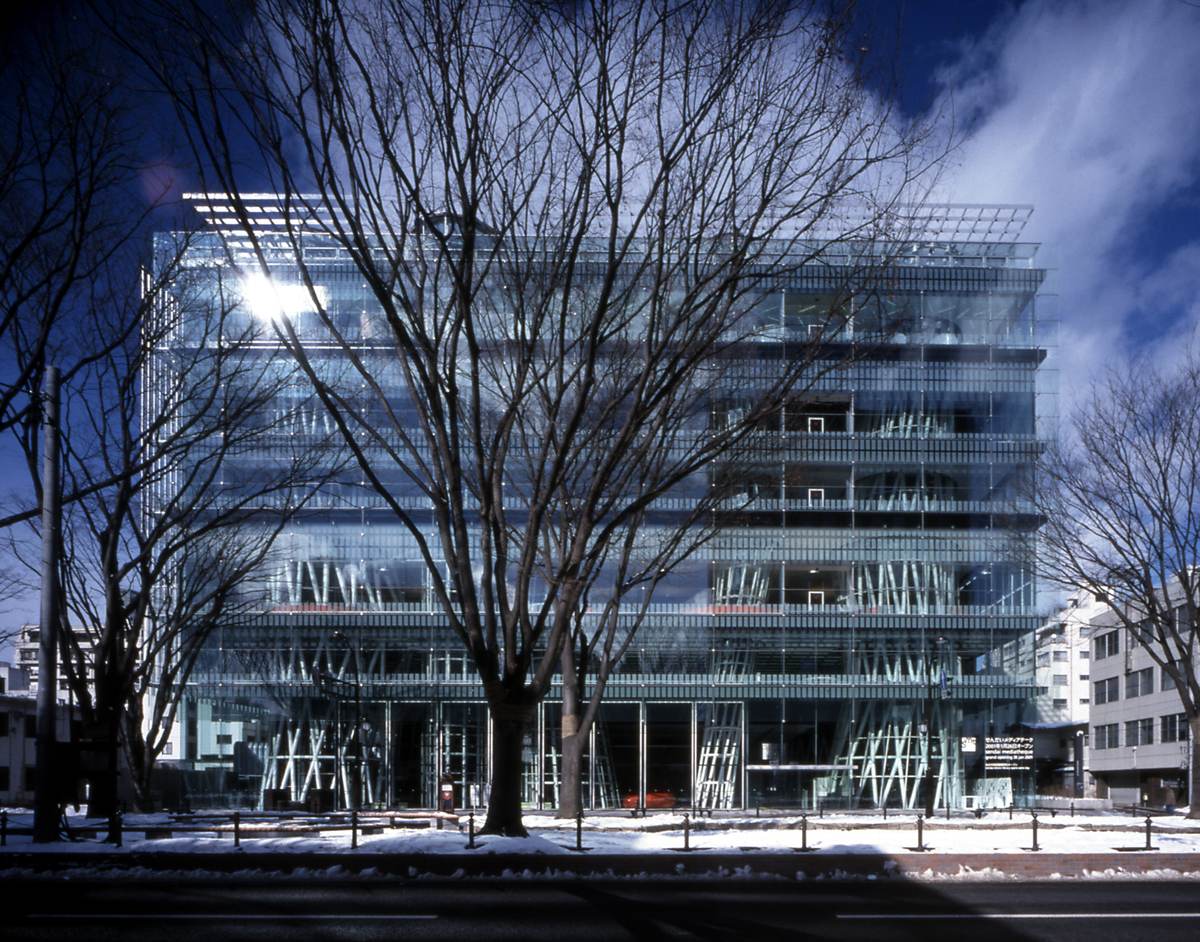
The Sendai Mediatheque is the building the Pritzker citation would later foreground, and reasonably. The brief was a public library, art gallery, audiovisual archive, and information centre for the city of Sendai, on a tight downtown block. Ito’s response was seven horizontal plates, fifty metres square, stacked at storey intervals, pierced by thirteen lattice-tube “columns” of welded steel mesh that run the full height of the building. The tubes are not columns in the conventional sense; they are basket-like clusters of steel rods, woven to form vertical voids that carry services, light, stairs, and lifts as well as load. The plates between them are flat and unobstructed, free of the usual rectilinear column grid.
The effect is a building with no rooms in plan. The library reads as a single horizontal field, articulated by the lattice tubes the way a sea floor is articulated by kelp. Each tube has a different program — one is a primary stair, another a lift, a third pulls daylight from the roof to the lower floors — and each is positioned by structural logic rather than by axes. Walking the Mediatheque is the closest a person can come, in 2026, to inhabiting a Toyo Ito sectional drawing in real life.
Sendai opened in January 2001. In March 2011 it survived the Tohoku earthquake — a magnitude 9.0 event whose epicentre was off the Sendai coast — with its primary structure intact, confirming that the lattice-tube system was not only formally radical but seismically robust. The 2013 Pritzker citation names the Mediatheque as the moment Ito’s vocabulary reached civic scale, and the building has functioned, since, as the reference against which every later Japanese public library is measured.
Tokyo storefronts: TOD’S and Mikimoto
Between 2004 and 2005 Ito completed two flagship boutiques on Omotesando and in Ginza that operate as the urban-scale companions to Sendai. TOD’S Omotesando, finished in 2004, is a seven-storey concrete building whose façade is poured as an L-shaped self-supporting shell traced from the silhouette of the zelkova trees that line the avenue. The pattern is structural — the concrete is the wall, the openings are the windows, and there are no separate columns — but it is also literal: the building looks like the trees in front of it, and the eye reads the façade as foliage before it reads it as load-bearing concrete.
Mikimoto Ginza 2, completed in 2005, applies the same logic to a different material. The façade is a steel-sandwich system — two skins of thin steel plate, separated by an internal core of concrete — perforated by apparently random rounded openings of varying scale. The skin behaves as both structure and skin, the openings double as windows and as the building’s only ornament, and the result is a slim white tower that, on Ginza’s narrow plot grain, reads as a piece of jewellery rather than a building, which is the brief.
The two boutiques are the most under-discussed of Ito’s major works because they sit in the luxury-retail category that architectural criticism tends to underweight. They are, in fact, the moment when the office’s vocabulary — perforated skins, structural facades, openings that read as pattern — is compressed to a single elevation and made legible from the street.
Tama Library and the civic arch, 2007
The Tama Art University Library at Hachioji, completed in 2007, is the building in which Ito’s interest in structural plan-fields reaches its most legible form. The library is two storeys, set on a gentle slope, and its entire ground plan is generated by intersecting concrete arches of varying span — some four metres wide, some sixteen — that meet at slender concrete piers. The arches carry the upper floor; the piers carry the arches; the plan reads as a forest of structural sweeps with no clear boundary between corridor, reading room, café, and study carrel.
What Tama does that Sendai did not is collapse the plate-and-column distinction entirely. Sendai is still a stack of plates pierced by tubes. Tama is a single continuous structural pattern in which the arches are the walls, the floor, and the route through the building. Students enter on the slope, walk under the lowest arches, and rise as the floor rises with the site. Reading the library is reading the structural diagram. There is no other building in Ito’s catalogue that holds this principle with such clarity, and it is the work that the Pritzker citation pairs with Sendai as the proof of his architectural range.
Pritzker, 2013
Ito received the Pritzker Prize in 2013 at the age of seventy-one — late, by the prize’s own pattern, and after most of his Japanese peers (Tadao Ando 1995, SANAA 2010) had been named. The jury citation foregrounds Sendai Mediatheque and Tama Library as the works that resolved a long technical experiment into a civic argument. It also notes Ito’s post-2011 Tohoku reconstruction work, the “Home-for-All” project — small communal pavilions for tsunami-displaced communities, in collaboration with younger architects including Kazuyo Sejima, Sou Fujimoto, and Riken Yamamoto.
The Pritzker is, in Ito’s case, a hinge. Before 2013 his work was read as a long Japanese argument with Japanese conditions; after 2013 the office’s international commissions — Taichung in particular — were read as the export of that argument into other contexts. The lineage of recognition for contemporary Japanese architects, from the Pritzker through to the AIA Gold Medal that Toshiko Mori collected in 2026, runs through Ito’s 2013 citation.
Taichung Opera House, 2016
The Taichung Metropolitan Opera House, in central Taiwan, is the largest building Ito has completed and the clearest demonstration that the Tama logic scales. The structure is built from a continuous matrix of catenoid cells — concrete surfaces curved in two directions, like saddles — that meet to form a three-dimensional grid in which floor, wall, and ceiling are the same surface seen from different sides. Three theatres are carved out of the grid: a 2,007-seat grand theatre, an 800-seat playhouse, and a 200-seat black-box space. Lobbies, corridors, restaurants, and the rooftop garden flow through the rest of the matrix as if through a coral reef.
The building’s completion was protracted — design competition won 2005, structural construction substantially complete by 2014, public opening in 2016. The interior is the part that matters. There are almost no flat walls in the public spaces. The catenoid cells are formed in white-painted reinforced concrete, and visitors move through the building as if through a series of rooms hollowed from a single solid. The Taichung Opera House is, in 2026, the only building of its scale in which the entire interior is a single continuous curved surface, and it is the work that exports Ito’s plan-field idea into civic architecture outside Japan.
The 2015 Minna no Mori Gifu Media Cosmos is the smaller-scale Japanese companion: a public library and community building in Gifu, with eleven funnel-shaped fabric “globes” hanging from a timber lattice roof, each globe defining a circular reading or workshop zone below it. Gifu reads as a domestic, low-key restatement of the Taichung idea — fields and globes instead of cells and theatres — and it is the Ito building that most Japanese readers will have visited in person.
Andrea Branzi: Continuous Present, 2026
This brings the work to Milan. Andrea Branzi: Continuous Present opened at Triennale Milano in spring 2026 and runs until 4 October 2026. The official curatorial credits name Stefano Bassoli and Francesca Alessandrini; the conceptual force is Toyo Ito’s, and the show reads as Ito’s reading of Branzi rather than as an institutional retrospective. The detail of the install and the argument the rooms make is the subject of a separate FORMA piece on Branzi: Continuous Present at Triennale 2026 and of an essay on the Toyo Ito–Andrea Branzi conversation. The relevant point here is what the show says about Ito’s own work.
Branzi (1938–2023) co-founded Archizoom Associati in Florence in 1966 with Massimo Morozzi, Paolo Deganello, and Gilberto Corretti. Archizoom’s No-Stop City (1969–1972), an unbuilt project for a continuous urban interior with no boundaries between dwelling, workplace, and circulation, is the Italian radical position with which Ito’s plan-fields rhyme. Branzi’s later Domestic Animals, Weak and Diffuse Modernity, and Agronica projects extend the same logic into a forty-year argument about architecture as continuous atmosphere rather than discrete object.
That is the third move named at the top of this piece. Ito has stopped building, more or less, and started reading. He has read Branzi — the Italian radical who solved the same problem from the other side, with paper rather than concrete — as a precursor, and he has used Triennale Milano, the home of Italian radical design since the 1960s, as the room in which to make the reading. The show is not retrospective; it is composed, by an eighty-four-year-old architect, as a final argument about what architecture has been for. It belongs in the Japanese-design programming at Milan Design Week 2026, and the parallel cases — the SANAA-and-Ishigami Vitra Campus, Kengo Kuma’s Capella Kyoto — clarify that the generation downstream of Ito is reading the same lineage.
Coda
White U was a concrete arc closed against the world, opened only to a small square of sky for a particular grief. Continuous Present is a Milanese gallery hung with the work of an Italian radical who died in 2023, read by a Japanese architect who has spent fifty years dissolving walls. Between the two are the buildings: Silver Hut, the Tower of Winds, Yatsushiro, Sendai, TOD’S, Mikimoto, Tama, Taichung, Gifu. They share a single idea — that the wall is the part of architecture that does the least work, and that the plan is best read as a field. Ito has spent his career proving this at the scale of the family house, the train-station vent, the regional museum, the city library, the global flagship, and the opera house. The 2026 turn at Triennale is not retirement. It is the last drawing in the set.