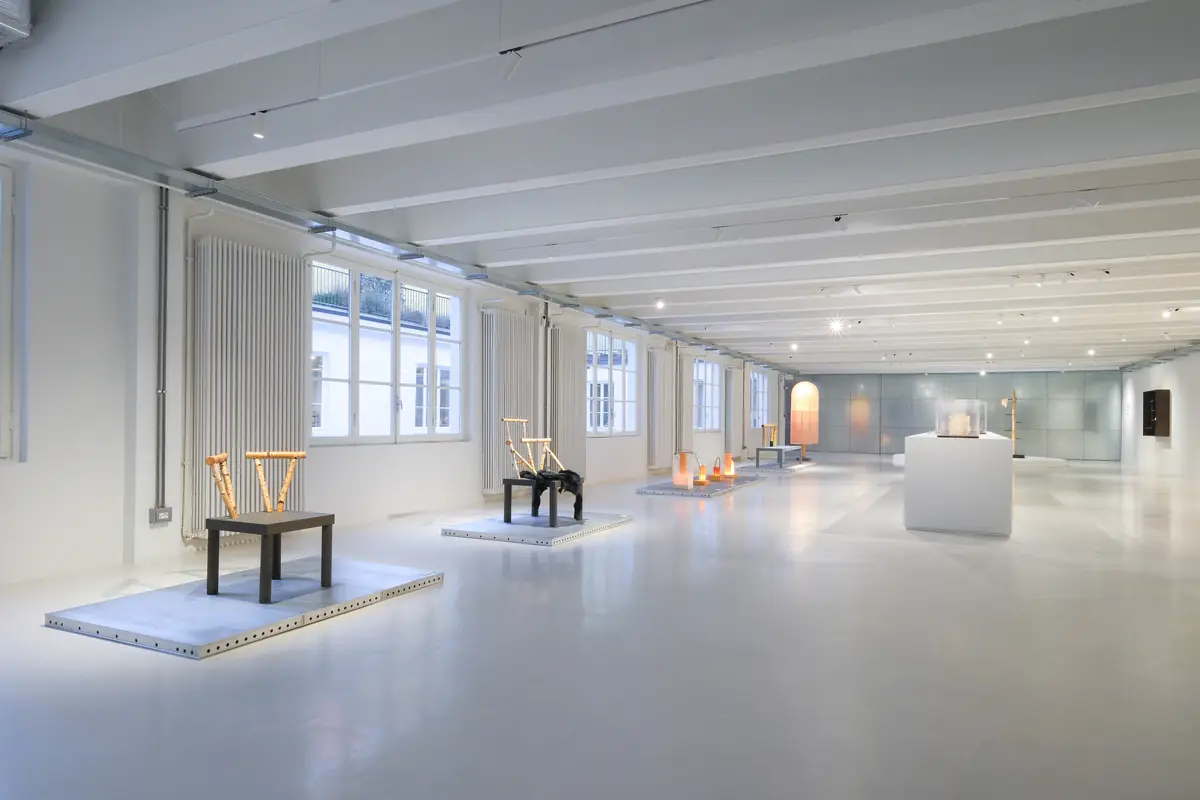
Toyo Ito picked eight Andrea Branzi works for Continuous Present at Triennale Milano (19 March – 4 October 2026), and the earliest is a 1968 photograph of Branzi himself — not a chair, not a building. The eight picks are the curatorial spine of a show co-produced with Fondation Cartier that holds more than 400 works across eleven thematic sections in Giovanni Muzio’s Palazzo dell’Arte. Ito, working with Triennale’s Michela Alessandrini and Nina Bassoli, did not assemble a greatest-hits list. He assembled a thesis. The companion Continuous Present overview maps the architecture of the exhibition; this article maps the eight objects Ito singled out as the load-bearing argument and reads them as a sequence — Autoritratto (1968) through Voliera (2016), a forty-eight-year arc that the title of the show insists is one continuous moment.
The framing matters because the picks are not chronologically distributed for balance. Three are from the late 1960s and early 1970s, when Branzi was inside Archizoom Associati. Two are from the 1970s and 1980s, when he was building the Domus Academy and contributing to Memphis with Ettore Sottsass. Three are from the late 2000s through the 2010s, when he had returned to large-scale installation work with Nilufar and the Maribor Art Gallery. The arc front-loads the manifesto years and back-loads the late hybrid objects, leaving the entire 1990s — Agronica, the Strijp Philips master plan — to the wider exhibition rather than the eight-pick spine. Ito picked the moments where Branzi’s argument was made through an object, not through a text.
The eight picks, 1968 to 2016
A timeline, because the chronology is the structure of the argument and the argument loses its grip if you read the eight picks as eight discrete moves.
- 1968 — Autoritratto. Photographic self-portrait. Branzi at thirty, framing his own practice as questioning rather than making.
- 1969–1972 — No-Stop City. Theoretical urban project with Archizoom Associati. The metropolis as a continuous, isotropic, air-conditioned interior. Reconstructed at 1:1 scale in the show.
- 1973 — Animali Vestiti. Mixed-media animism series with Nicoletta Morozzi. Animals dressed as objects; objects animated as creatures.
- 1985 — Animali Domestici. Furniture series in raw, unprocessed wood. Design as criticism of design’s own categories.
- 2008 — Modello di Urbanizzazione Umida. Wet-urbanisation model produced for Expo Zaragoza. Urbanism as climatic substrate rather than built form.
- 2009 — Grandi Legni GL02. Large-scale composition in raw wood and industrial fragments, from the Grandi Legni cycle. The hybrid object at totemic scale.
- 2010 — Bosco d’Arte. Indoor “art forest” environmental installation for the Maribor Art Gallery. Trees as architecture, gallery as clearing.
- 2016 — Voliera. Aviary-like installation at Galleria Luisa Delle Piane in Milan. The last major installation of Branzi’s lifetime; the threshold between object and habitat.
The earliest pick is a photograph. The latest is an aviary. In between, Ito picked one architectural project, one collaborative animism series, one furniture series, one wet-urbanism model and two environmental installations. There is no single chair in the eight picks; no single building. Branzi designed both, prolifically; the wider Triennale show has rooms full of them. Leaving them out of the curated eight is itself the editorial signal. Ito is reading Branzi as a maker of propositions, not products.
Pick 1 — Autoritratto, 1968
The opening pick is a 1968 photographic self-portrait — a frontal shot of Branzi at thirty, two years out of his Florence architecture degree, two years into Archizoom Associati. He looks directly into the lens, not posed at a drafting table, no object in his hands. Ito’s wall text frames the work as evidence that Branzi’s practice was rooted “less in making than in questioning.” That phrase is the curatorial key for the entire show. To open with a self-portrait, in a retrospective of a designer-architect with a fifty-seven-year output, is to insist that the practitioner’s mind is the first object on display.
Italian design retrospectives typically open with the first object — Sottsass at Triennale in 2007 opened with the Valentine typewriter. To open with a photograph of the practitioner is to refuse the standard frame. The position is sustained, in Ito’s reading, for forty-eight years through to the Voliera of 2016. Every subsequent pick re-states the position in a different material register.
1968 is also the year Dario and Lucia Bartolini joined Archizoom, the year of the Superonda sofa for Poltronova, the year of European political rupture. Branzi at thirty, photographing himself, is making a quiet argument that the practitioner is the unit of analysis the radical-Italian moment had to defend. The studio mattered, the manifesto mattered, the consumer object mattered — but the practitioner’s questioning was the substrate. Ito picks the photograph because it is the cleanest possible statement of that substrate.
Pick 2 — No-Stop City, 1969–1972
The second pick is the most famous unbuilt project in Italian post-war architecture. No-Stop City, developed inside Archizoom Associati between 1969 and 1972, is a theoretical metropolis without architecture: an infinite, gridded, air-conditioned interior in which the distinction between city and building has dissolved. Branzi and his Archizoom collaborators — Gilberto Corretti, Paolo Deganello, Massimo Morozzi, Dario and Lucia Bartolini — produced the project as drawings, models and photographic montages that have become the canonical images of Italian radical urbanism.
Ito’s installation reconstructs No-Stop City at 1:1 scale. Mirrored walls extend the gridded plan to a visual infinity; Branzi’s original 1969–1972 drawings line the perimeter. The reconstruction is the largest single environmental gesture in Continuous Present and the one that grounds the show’s title. No-Stop City refused the modernist proposition that the city was a sequence of typologies — house, street, square, park — and proposed in its place a single isotropic field. To stage that argument inside Muzio’s 1933 Palazzo dell’Arte, with its Novecento façade and symmetrical plan, is to set the radical-Italian thesis against the rationalist building that holds it.
The 1:1 reconstruction is a quiet act of canonisation. No-Stop City has been exhibited in fragments — drawings at MoMA, models at Pompidou-Metz, montages in the 2008 Fondation Cartier show — but never built. Building it, even in mirrored projection, argues that an unbuilt project from 1971 is the most important Italian architectural work of the long 1960s. Ito makes that claim with the room, not the wall text. The quietness is the strength.
Pick 3 — Animali Vestiti, 1973
The third pick moves into a register most retrospectives skip. Animali Vestiti (Dressed Animals) is a 1973 mixed-media series Branzi developed with Nicoletta Morozzi — fabric designer and longtime collaborator. The works combine photography, drawing, fabric and small sculptural elements to produce hybrid creatures: domestic animals in tailored clothing, household objects given fur and limbs. It is the moment in Branzi’s practice where the question of what an object is — animate or inanimate, functional or aesthetic — gets posed directly through anthropomorphism.
Ito’s wall text positions Animali Vestiti as the bridge between the Archizoom theoretical work and the Memphis-era domestic objects. No-Stop City dissolved the boundary between city and building; Animali Vestiti dissolves the boundary between object and creature. Both moves are arguments against category, made in the same five-year window. The series is not widely reproduced outside Italy, and the decision to elevate it into the curated eight is one of Ito’s strongest editorial choices.
The collaboration with Morozzi also tells you something about the show’s gender politics, which Italian radical-design retrospectives have historically handled badly. Lucia Bartolini co-founded the late Archizoom; Nicoletta Morozzi co-authored Animali Vestiti. Ito’s eight picks credit the collaborators in the wall texts. The standard retrospective does not.
Pick 4 — Animali Domestici, 1985
The fourth pick is the show’s first piece of furniture, and it is not the kind that reads as Branzi to a casual viewer. Animali Domestici (Domestic Animals) is a 1985 series of chairs, tables and seating elements built from raw, unprocessed wood — branches, trunk sections, off-cuts — combined with simple industrial components. The pieces look as if a forest had been dragged into a workshop and minimally industrialised. The series is the cleanest expression of what Branzi himself called “design as criticism”: objects that refuse the standard processing chain — sawn lumber, planed surface, lacquered finish — and propose instead a typology where the material’s biographical history is part of the object’s argument.
Animali Domestici sits five years into the Memphis Group, which Sottsass founded in Milan on 11 December 1980 and which Branzi contributed to. Memphis is remembered for laminate, pattern and saturated colour. Animali Domestici is the deliberate counter-move from inside the same circle. Where Memphis processed industrial materials into post-industrial colour, Animali Domestici refused processing altogether. Both moves argue that the standard industrial-design pipeline is the problem, from opposite directions. Ito’s pick brings that internal opposition to the foreground.
The series also marks the moment Branzi’s practice turned toward what the wider exhibition calls the post-industrial condition: the argument that the long Italian post-war boom had reached its limit by the mid-1980s, and what came next would not be more industrial design but a different relationship between maker, material and object. Animali Domestici is one of the most collected Branzi series in the secondary market today, with auction comparables for original 1985–1987 pieces appreciating in step with the broader Lalanne and post-industrial design moment.
Pick 5 — Modello di Urbanizzazione Umida, 2008
The fifth pick is the only urban-scale piece in the eight, and it closes the long arc from No-Stop City. Modello di Urbanizzazione Umida (Model of Wet Urbanisation) is a 2008 model Branzi developed for Expo Zaragoza, the international exposition that took water as its theme. The model proposes urbanisation as a climatic and hydrological substrate rather than as built form: instead of buildings on a ground plane, the city is registered as a field of moisture, vegetation, atmospheric humidity and water-borne infrastructure. The visual language is gentle, the argument is hard. Branzi is proposing, in 2008, a post-architectural urbanism in which the city is not made of objects.
The continuity with No-Stop City is the curatorial point. No-Stop City dissolved architecture into infinite interior; Urbanizzazione Umida dissolves architecture into climate. Both projects argue that the unit of urbanism is not the building. The forty-year gap between them — 1969 to 2008 — is the gap the show’s title most directly addresses. Continuous Present names the proposition that Branzi was working on the same problem across that span, restated through whatever material register the moment offered.
The Zaragoza commission also matters because it places Branzi inside the late-2000s wave of Expo urbanism — Aichi 2005, Zaragoza 2008, Shanghai 2010 — the last decade in which large international expositions could plausibly stage a single architect’s vision of the future city.
Pick 6 — Grandi Legni GL02, 2009
The sixth pick is the first object from Branzi’s late hybrid-object cycle. Grandi Legni GL02 (Large Woods, GL02) is a 2009 large-scale composition in raw, partially worked wood combined with industrial fragments — metal plates, found components, small functional elements at non-functional scale. It is part of the Grandi Legni series Branzi began with Nilufar in 2008 and continued for roughly a decade. The series consists of totemic, vertical compositions that read as furniture-scale but propose no domestic function — they are too large to be tables, too sparse to be cabinets, too compositional to be sculpture. Branzi’s term for the typology was the “hybrid object.” The wider Triennale show dedicates a room — the Hybrid Object section — to the cycle.
GL02 is the example Ito picked from the larger series. The choice is editorial: there are GL pieces with more dramatic silhouettes and stronger market histories. GL02 is a composed, almost contemplative piece — a vertical assembly of two wood elements, offset in plan, connected by a horizontal industrial component that registers the relationship rather than joining it. That Ito picked it reads as an argument that the Hybrid Object proposition is best understood through the quietest example, not the loudest.
The Grandi Legni cycle is the part of Branzi’s late practice that the collectible-design market has organised around. Nilufar built the series as a sustained gallery proposition across multiple Salone editions; the secondary market for original GL pieces is now thick. GL02’s placement in the curated eight is the show’s clearest acknowledgement of the market that has carried Branzi’s late argument into 2026.
Pick 7 — Bosco d’Arte, 2010
The seventh pick is the larger of the two late environmental installations Ito selected. Bosco d’Arte (Art Forest) was an indoor art-forest installation Branzi built in 2010 for the Maribor Art Gallery in Slovenia. The installation filled the gallery with vertical wood elements arranged as a clearing — visitors walked among them, the path emerged from the spacing rather than being marked. The piece extends the Animali Domestici and Grandi Legni propositions into an environmental register: if a chair could be made from raw wood without losing its category, and if a totemic composition could occupy a gallery without becoming sculpture, then a whole room could be a forest without becoming a stage set. The argument is consistent across all three works; the scale is the variable.
Ito’s pick of Bosco d’Arte — over the more famous Fondation Cartier 2008 Open Enclosures installation, over the various Nilufar gallery shows — is a deliberate move into the institutional register. Open Enclosures was a gallery-collector show; Bosco d’Arte was a public-museum commission. The eight picks include only one piece from a public-museum context, and Bosco d’Arte is it. The implicit argument is that Branzi’s environmental work belonged in museums, and that the institutional record of his late practice is thinner than it should be.
Pick 8 — Voliera, 2016
The eighth pick — and the latest in the timeline — is Voliera (Aviary), an aviary-like environmental installation Branzi built in 2016 at Galleria Luisa Delle Piane in Milan. The piece extended the Bosco d’Arte logic into a domesticated typology: where the forest had been an open clearing, the aviary was a contained habitat, with vertical elements arranged to suggest enclosure. There were no birds in the installation; the aviary was the architectural type, not the literal cage. Visitors walked through it the way they would walk through a glasshouse — registering the structure as the object, themselves as the occupants.
Voliera is the last major installation Branzi completed in his lifetime; he died in Milan in 2023 at the age of eighty-five. To close the eight picks with the final installation rather than with a late drawing or an unrealised project is a quiet curatorial decision with biographical weight. Galleria Luisa Delle Piane has been one of the consistent Milan supports for Branzi’s late work, and closing the show with a Milanese venue reads Branzi back into the city that held his practice from the Domus Academy years onward.
The aviary is the architectural type that most explicitly negotiates the boundary between inside and outside, between domesticated and wild, between architecture and habitat. To make the threshold the last word of an eight-pick spine that opened with a self-portrait is to argue that Branzi’s entire arc — from the practitioner’s questioning gaze to the fully constructed habitat — was a working out of the same threshold. Continuous Present is the title; Voliera is the demonstration.
What Toyo Ito sees in Branzi’s continuous present
Ito did not write a long curatorial essay for the eight picks; the wall texts are short, and the longer programmatic argument sits in the catalogue Triennale and Fondation Cartier co-published. But the shape of the eight picks tells you what Ito sees, and it is worth saying directly. He sees a designer-architect who, across forty-eight years and multiple material registers, was making a single argument: that the categories design culture inherited — architecture, urbanism, furniture, object, sculpture, installation — were the wrong categories, and that the right unit of analysis was the practitioner’s continuous proposition. The eight picks are eight statements of that proposition in eight materials. The proposition does not change. The materials do.
The Japanese-Italian framing matters. Ito’s own buildings — the Sendai Mediatheque (2001), the National Taichung Theater (2014), the Pritzker citation in 2013 — have spent forty years asking a structurally similar question: how to make an architecture that dissolves the boundary between room and field, between structure and infrastructure. The line between Sendai’s vertical-tube floor plates and Branzi’s No-Stop City gridded interior is a working similarity. The wider Milan Design Week 2026 architects’ guide reads Ito as part of the Japanese architectural corpus on European display this year, alongside Junya Ishigami at Vitra and Kengo Kuma at Capella Kyoto, and that corpus is the contextual frame the eight picks finally land inside.
The picks also do something the wider exhibition cannot. The eleven thematic sections hold more than four hundred works; the visitor cannot read them all as a single argument. The eight picks are the version of the argument the visitor can hold in mind — the curatorial spine that makes the rest of the show legible. To leave out Superonda, the Memphis contributions, the Agronica master plan, the Strijp Philips work, the Domus Academy teaching materials and the Compasso d’Oro pieces is the show’s strongest signal about what Ito thinks Branzi’s practice is for. The omitted works are not less important to the canon; they are less load-bearing for the Continuous Present argument.
Branzi spent his last decade saying, in interviews and in the introductions to his own books, that Italian design culture had spent too long thinking of him as a historical figure and not enough time using his work as a brief. The eight picks are Ito’s answer to that complaint. They treat Branzi the way Branzi asked to be treated: as a practitioner whose arguments are still live, whose objects are still working, and whose continuous present is the present of the visitor walking through the Palazzo dell’Arte between 19 March and 4 October 2026. The exhibition does not memorialise. It briefs. The brief is the eight objects above, in the order Ito put them. What contemporary practice does with the brief is the question the show declines to answer, and the decline is the point.