When FOA’s Yokohama International Passenger Terminal opened at Osanbashi Pier in 2002, no one called it parametricism. Twenty-four years later, when Zaha Hadid Architects’ Audi Origin pavilion arrived at Portrait Milano in April 2026, no one called it anything else. The parametricism lineage is the story of how a working method became a style, how a style became a brand, and how a brand became — depending on who you ask this month — either the dominant grammar of late-capitalist architecture or a premise that has quietly expired. The shape of the answer is a near-quarter-century arc with three protagonists (FOA, Patrik Schumacher, ZHA), one corpse (the 2008 manifesto’s optimism), and one open question — which is what the Audi Origin pavilion at Milan Design Week 2026 was really for.
FOA at Yokohama, 2002
Foreign Office Architects was founded in 1993 by Alejandro Zaera-Polo and Farshid Moussavi, then two young architects with sharper essays than buildings. Their break came in 1995, when they won the open international competition for the Yokohama International Passenger Terminal against a field of more than 660 entries. The competition brief asked for a ferry terminal on Osanbashi Pier in Naka Ward, fronting Yokohama Bay. What FOA gave back was not a building in the conventional sense — no facade, no clear separation between floor, wall and roof, no front or back — but a continuous folded surface that resolved circulation, structure and public space into one warped topology.
The terminal opened in 2002 at 34,732 square metres. Its underlying logic was diagrammatic: the building was, in effect, the topological transformation of a flow diagram, computed and tested across hundreds of digital iterations. It is the building Dezeen’s 8 May 2026 retrospective named as the first major parametric building, and the description has the virtue of being defensible. Yokohama predates the term parametricism in its later, capitalised sense by six years. But its method — variation through controlled parameters, geometry derived from circulation and structural logic rather than imposed on them — is the method the manifesto would eventually claim.
FOA itself did not survive the success. Zaera-Polo and Moussavi dissolved the practice in December 2009, and by 2011 each had launched a successor firm — AZPML and FMA respectively. The Yokohama terminal, the project that should have founded a dynasty, instead founded two. That orphaning matters for the lineage: the building most often cited as parametricism’s first masterpiece belongs, institutionally, to no one. It is a free agent in the narrative, and other practices have used it accordingly.
Bilbao, CATIA, and the Software Question
Any honest account of the parametricism lineage has to pause for a software footnote. Frank Gehry’s Guggenheim Bilbao opened in 1997, five years before Yokohama, and it was the project that put CATIA — the Dassault Systemes engineering platform originally built for aerospace — into architectural practice at scale. Bilbao’s titanium curves were not parametric in Schumacher’s later sense; they were sculptural forms rationalised through software for fabrication. The geometry was conceived, then computed. In parametricism’s stricter definition, the order reverses: the geometry is generated by the parameters.
The distinction is real, but the inheritance is also real. Without CATIA in architectural offices in the late 1990s, the digital fluency that Yokohama and the early ZHA work depended on would not have existed. Bilbao is parametricism’s CATIA precursor, and Gehry — who has been publicly impatient with the parametricist label — is nonetheless one of the people who made the toolchain available. This is the pattern: the lineage’s most important figures often refuse the label, and the label persists anyway.
Schumacher’s Manifesto, Venice 2008
Patrik Schumacher was born in Bonn in 1961 and joined Zaha Hadid in 1988, working with her on the Vitra Fire Station — the small early project at Weil am Rhein that is now read as ZHA’s first canonical building. By the mid-2000s he was the practice’s principal theorist as well as its day-to-day operational partner. At the 11th Venice Architecture Biennale in 2008, curated by Aaron Betsky, Schumacher launched the Parametricist Manifesto. The following year he expanded it into the essay “Parametricism: A New Global Style for Architecture and Urban Design,” published in AD in 2009.
The argument was, and is, ambitious. Schumacher framed parametricism not as a tendency or a software preference but as a successor to modernism — a style capable of organising the complexity of contemporary life because, unlike modernism’s grids and repetitions, its base operations were variation, differentiation and continuous gradient. The taboos were explicit: no rigid geometric primitives, no simple repetition, no collage of unrelated elements. The dogmas were equally explicit: all forms must be parametrically malleable, all systems must be differentiated, all elements must associate.
The 2008 Biennale was also the year Greg Lynn — the American architect whose 1999 book Animate Form had helped name “blob architecture” and theorise the move from static to time-based geometry — was awarded the Golden Lion. Lynn’s win and Schumacher’s manifesto sat in the same room. They were not the same project. Lynn’s animate form was a phenomenology of motion; Schumacher’s parametricism was a theory of style. But to anyone in the Arsenale that summer, the message was that the digital generation now had both its prize and its programme.
Heydar Aliyev Center and the Soft Period
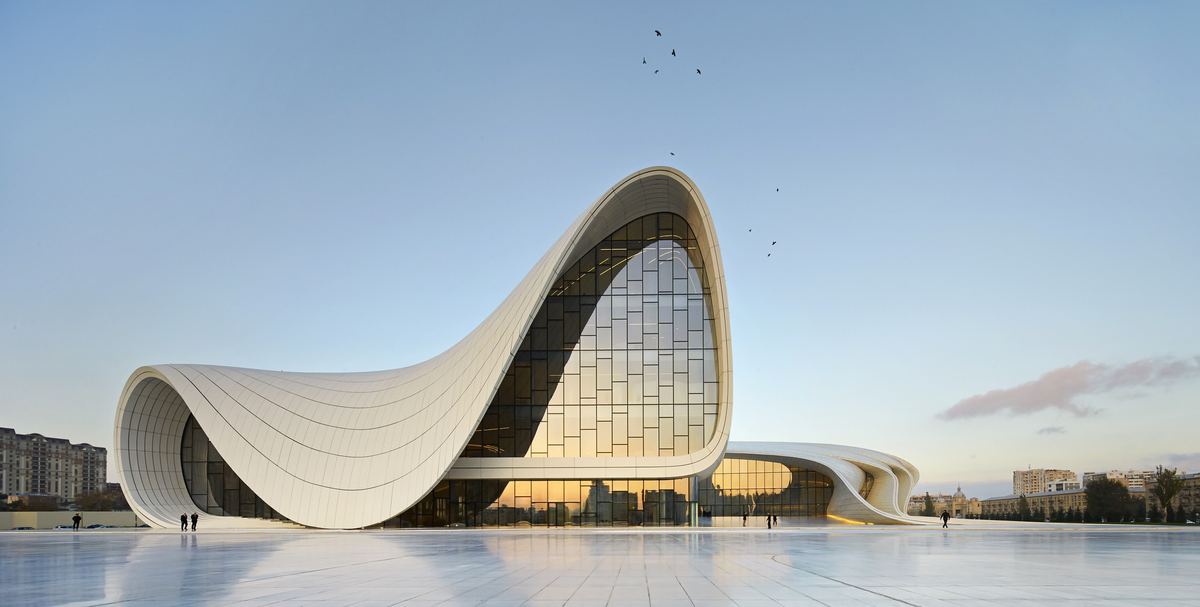
If 2002 is parametricism’s prologue and 2008 its manifesto, the years that follow are the soft period — the moment the rhetoric and the buildings briefly matched. Zaha Hadid Architects’ Phaeno Science Centre opened in Wolfsburg in 2005, a concrete landscape on stilts that read more like a continuous terrain than a building. But the project that fixed the image in the public mind was the Heydar Aliyev Center in Baku.
ZHA was appointed in 2007. The building covers 57,500 square metres. It soft-opened in May 2012, suffered a fire in July 2012, and formally reopened in November 2013. In 2014, the Design Museum named it Design of the Year — the first time a building, rather than a product, took the overall prize. Aliyev is the project most often used to illustrate the parametricist claim, because it does what the manifesto says architecture should do: there are no straight lines visible as primary features, no separation between roof and wall, and the entire envelope reads as one continuous, differentiated surface.
It is also the project that has produced the most durable counter-arguments. The Aliyev Center is named for Heydar Aliyev, the former president of Azerbaijan; the commission was a state project of the Aliyev family’s government. Critics — most prominently Douglas Spencer, in his 2016 book The Architecture of Neoliberalism — argued that parametricism’s affinity for monumental, state-or-corporate commissions was not incidental to its style but constitutive of it. The form, in this reading, was the alibi.
Zaha Hadid died in March 2016. Schumacher has been ZHA’s sole principal since April 2016. The practice that had been a partnership between an architect and her theorist became a practice run by the theorist.
Schumacher Alone, and the Slow Decade
The decade after Hadid’s death has been, for parametricism, the slow period. ZHA the practice has grown — Beijing Daxing Airport opened in 2019, the Morpheus Hotel in Macau in 2018, the Generali Tower at Milan’s CityLife tower district topped out in 2018, and a stream of stadium, tower and masterplan commissions have followed. But the manifesto’s central claim — that parametricism would become the dominant global style, the unmistakable successor to modernism — has not obviously come true. Mid-2020s architecture is a wider field than that: timber, retrofit, climate-driven typologies, the return of mass and weight as expressive values. Peter Zumthor’s LACMA replacement in Los Angeles, opened in April 2026, is a useful anti-parametric foil — a low, dark, board-marked concrete building that proposes that the present moment wants slowness, not gradient.
Schumacher himself has been frank about this. In an interview with Dezeen on 7 May 2026, he told Tom Ravenscroft that he is not happy with the pace at which parametricism has been adopted. The complaint is interesting because it implicitly concedes the criticism. If parametricism were already the global style the manifesto predicted, there would be nothing to be unhappy about.
The interview is also a tell about the state of the lineage. The theorist is now defending the project he announced eighteen years ago against the slowness of its own reception. That is a different position from the one he occupied in Venice in 2008, when the argument was that the style was inevitable.
Audi Origin Pavilion, Milan 2026
Which brings us, inevitably, to the Audi Origin pavilion. The project is a collaboration between Zaha Hadid Architects and Audi, installed at Portrait Milano during Milan Design Week 2026 and Fuorisalone 2026 in April. It is the most visible ZHA project of the year, and the most efficient single object for thinking about where the parametricism lineage now sits.
The pavilion is, formally, a fully developed parametricist object. It has no flat planes as primary surfaces, no separation between structure and skin, and an envelope whose curvature varies continuously across its footprint. It is a textbook application of the manifesto’s dogmas, twenty-four years after Yokohama and eighteen years after the manifesto itself. As a demonstration that the practice can still produce the canonical object on demand, it is unimpeachable.
The harder question is what the object is doing there. Audi is not commissioning a building; it is commissioning an experience, a brand-anchored pavilion at a design week, in partnership with the most recognisable parametricist practice in the world. The lineage that began with a public ferry terminal won by open competition in 1995 now produces, in 2026, a temporary corporate pavilion at a luxury hotel courtyard. That is not a moral failing — pavilions are a long-standing architectural form, and the brief at Portrait Milano is legitimate. But it is a meaningful migration. The category of project at which parametricism is doing its most public work has narrowed.
This narrowing is the context for the manifesto’s complaint about slow adoption. The style has not become the universal grammar of buildings; it has become the signature grammar of certain kinds of buildings — airports, opera houses, stadia, towers in Asian and Gulf capitals, and, increasingly, branded pavilions at design weeks. That is a strong commercial position. It is not the position the 2008 manifesto described.
Douglas Spencer and the End of the Premise
The other reason May 2026 is a useful moment to take stock is Douglas Spencer’s Dezeen essay, published on 11 May 2026 — the day before this piece. Spencer, whose 2016 book remains the most cited critique of parametricism’s political alignment, has now made a sharper claim: that the premise on which parametricism was built — a capitalism interested in differentiating mass production, in serving large populations through variation rather than repetition — has ceased to exist. The masses parametricism proposed to serve are no longer, in Spencer’s reading, the subject of capital’s interest. The relevant subject is now smaller, richer, and far more concentrated.
The argument is worth taking seriously on its own terms. Schumacher’s original case for parametricism leaned heavily on the idea that contemporary social life was characterised by intensified differentiation, and that architecture needed a language capable of registering it. If the social premise has shifted — if the operative logic of contemporary capital is concentration rather than differentiation, scarcity rather than mass — then parametricism is left producing differentiated objects for a world that no longer requires the differentiation it was designed to express.
Spencer’s claim does not invalidate the buildings. The Heydar Aliyev Center is still the Heydar Aliyev Center. Yokohama is still Yokohama. But it reframes the lineage. Parametricism becomes, in this reading, the architectural style of a moment that has ended — comparable in this respect to high modernism in the 1970s, when the social housing premise that had underwritten it collapsed and the towers remained.
Parametricism timeline, 1995–2026
| Year | Project / event | Architect or author | Note |
|---|---|---|---|
| 1995 | Yokohama Terminal competition won | FOA | 660+ entries; open international |
| 1997 | Guggenheim Bilbao opens | Frank Gehry | CATIA precursor in architecture |
| 1999 | Animate Form published | Greg Lynn | Time-based geometry, “blob architecture” |
| 2002 | Yokohama International Passenger Terminal opens | FOA | 34,732 m2, Osanbashi Pier |
| 2005 | Phaeno Science Centre opens | ZHA | Wolfsburg, concrete landscape |
| 2007 | Heydar Aliyev Center commissioned | ZHA | Baku, state project |
| 2008 | Parametricist Manifesto launched | Patrik Schumacher | 11th Venice Architecture Biennale |
| 2008 | Golden Lion at Venice | Greg Lynn | Same Biennale |
| 2009 | “Parametricism: A New Global Style” essay | Patrik Schumacher | AD magazine |
| 2009 | FOA dissolves | Zaera-Polo and Moussavi | December |
| 2011 | AZPML and FMA established | Zaera-Polo; Moussavi | FOA successors |
| 2012 | Heydar Aliyev Center soft-opens; fire in July | ZHA | Baku |
| 2013 | Heydar Aliyev Center formally reopens | ZHA | November |
| 2014 | Design Museum Design of the Year | Heydar Aliyev Center | First building to win |
| 2016 | The Architecture of Neoliberalism published | Douglas Spencer | Parametricism critique |
| 2016 | Zaha Hadid dies, March; Schumacher sole principal, April | ZHA | Transition |
| 2018 | Morpheus Hotel opens | ZHA | Macau |
| 2019 | Beijing Daxing Airport opens | ZHA | Largest single-terminal airport |
| 2026 | Audi Origin pavilion | ZHA + Audi | Portrait Milano, Milan Design Week |
| 2026 | Schumacher Dezeen interview, 7 May | Patrik Schumacher | “I’m not happy” with adoption pace |
| 2026 | Spencer essay, 11 May | Douglas Spencer | Premise has ceased to exist |
What the Lineage Actually Looks Like
Read end to end, the parametricism lineage is not the linear inheritance Schumacher’s manifesto implied. It is a network with at least four nodes that do not entirely agree with one another.
The first node is FOA at Yokohama — the working method, applied to a public competition brief, by architects who were not interested in founding a style and whose practice dissolved before the manifesto was a decade old. The second is Gehry and CATIA, the toolchain that made the method possible and whose author has been openly skeptical of the parametricist programme. The third is Lynn and the animate-form generation, which gave parametricism much of its early theoretical vocabulary but routed it toward film, product and installation as often as buildings. The fourth is ZHA and Schumacher — the only node that fully adopted the style as institutional identity, and the only one that produced the canonical buildings in the canonical quantities.
The Audi Origin pavilion at Portrait Milano is what the fourth node currently produces. It is highly accomplished, fully resolved, and instantly recognisable. It is also, by Schumacher’s own admission, not the centrepiece of a global style with universal adoption. It is the signature object of a specific practice, working with a specific brand, at a specific design week, in a specific year — 2026, the year in which the most prominent surviving critic of parametricism declared the premise expired and the style’s chief theorist conceded the adoption was slower than promised.
That is not, in itself, an obituary. Styles outlive their premises; modernism produced excellent buildings for decades after the social housing argument that underwrote it had collapsed. Parametricism, in 2026, is in a comparable position. The Audi Origin pavilion is a beautiful object made by a serious practice; it sits inside a lineage that runs cleanly from Osanbashi Pier to Portrait Milano; and the question of whether the lineage is still gaining ground or quietly closing is no longer answered by the buildings alone. It is answered by what the next commission is, and who signs it, and where it lands.