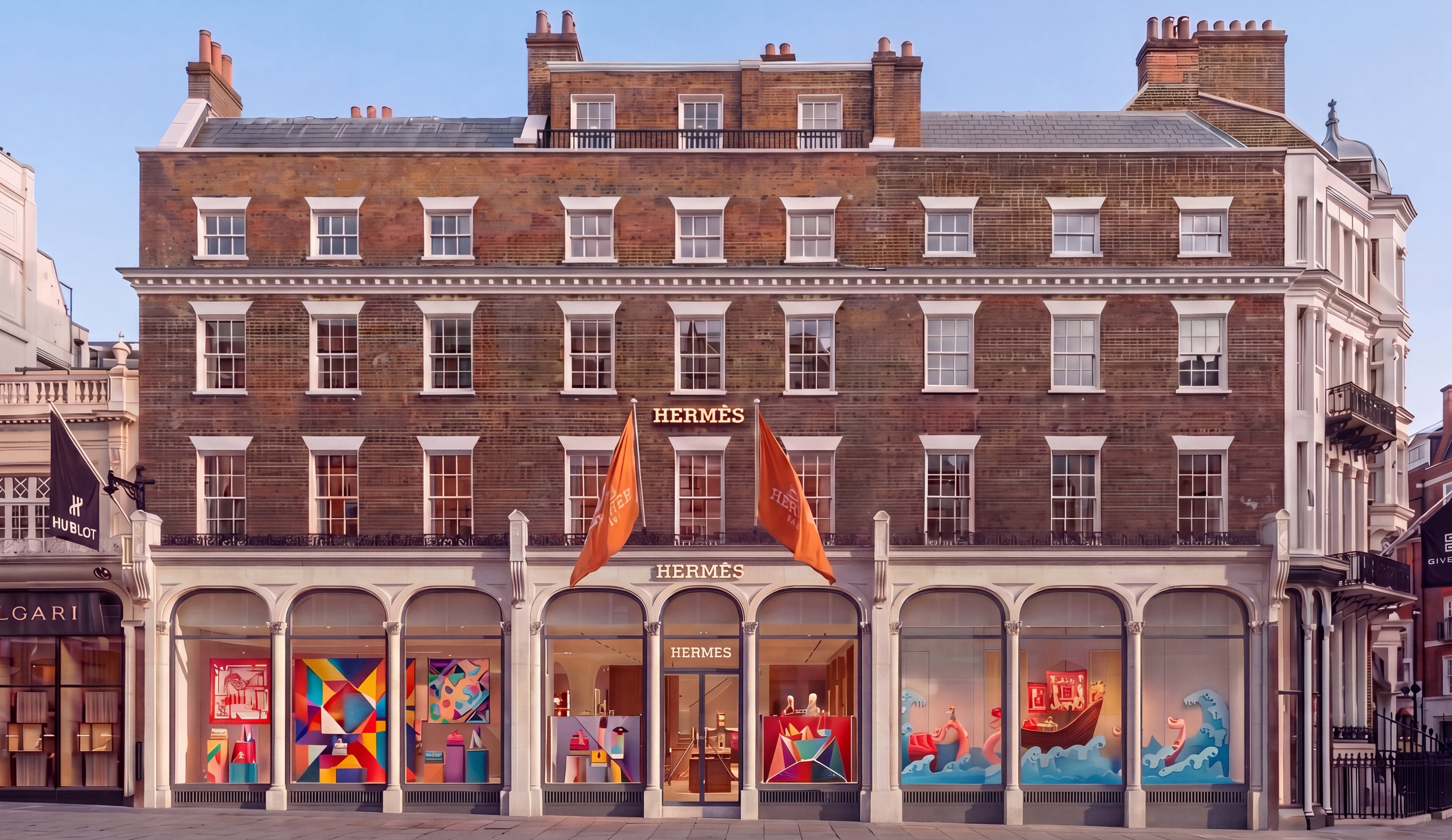
The Hermès Maison RDAI opening on New Bond Street in June 2026 is the latest entry in a fifty-year lineage that began when Rena Dumas drew her first Hermès boutique in 1976, and it is the most architecturally ambitious one yet: 2,000 square metres stitched across six Grade II-listed buildings, 55 rooms, five staircases, four elevators, and 500-plus artworks curated by Pierre-Alexis Dumas. The architect of record, as it has been for every Hermès point of sale since 1972, is RDAI — Rena Dumas Architecture Intérieure — now run by Denis Montel and Julia Capp from the same Paris studio that Rena Dumas founded the year before her son Pierre-Alexis was born. The London Maison is not a one-off commission to a starchitect. It is the 300th iteration of a system the family has been refining since the Pompidou era.
That system is what this article is about. The Bond Street project is the headline, but the story is the fifty-year arrangement between a single family-owned maison and a single architecture studio founded by the chairman’s wife — an arrangement that has produced, depending on how you count Tokyo Ginza, between five and eight buildings legible as full Maisons rather than boutiques, and roughly 300 points of sale in the smaller format. The unit of analysis here is the Maison: the city-flagship-as-building, the format Hermès reserves for its anchor cities. There are seven of them so far on the timeline, the last in London, and they are the cleanest way to read what RDAI has been doing for the family.
Every Hermès Maison by RDAI, by year
| Year | Maison | City | Address | Architect | Signature feature |
|---|---|---|---|---|---|
| 1880 | Faubourg Saint-Honoré | Paris | 24 rue du Faubourg Saint-Honoré | Pre-RDAI; Hermès historic site | Workshop opened 1880, boutique 1889; ~1,700 sq m |
| 2001 | Maison Hermès Tokyo Ginza | Tokyo | Ginza, 5-4-1 Ginza | Renzo Piano + RDAI | 15 floors, c.13,000 Seves glass blocks |
| 2006 | Maison Hermès Dosan Park | Seoul | Gangnam-gu, Sinsa-dong | RDAI (Rena Dumas) | 24 m cube, 27 m high, gold-copper silk-screened glass |
| 2014 | Maison Hermès Shanghai | Shanghai | 217 Middle Huaihai Road | RDAI (Denis Montel) | Red-brick garden villa, former French Concession |
| 2015 | Miami Design District | Miami | 163 NE 39th Street | RDAI (Denis Montel) | 13,000 sq ft glass box, white steel rods |
| 2022 | Madison Avenue | New York | 706 Madison Avenue | RDAI (Denis Montel) | Inside former bank building |
| 2026 | Bond Street | London | 165–167 New Bond Street | RDAI (Denis Montel) | Six Grade II-listed buildings, 2,000 sq m, 55 rooms |
1972–2009: Rena Dumas and the founding of RDAI
Rena Dumas was born in Greece in 1937 and trained in Paris, married Jean-Louis Dumas in 1962, and founded Rena Dumas Architecture Intérieure in 1972 in Paris — six years before her husband became chairman of Hermès. The chronology matters: RDAI predates Jean-Louis Dumas’s chairmanship by six years, which is the standard family answer to the recurring journalistic question of whether the firm was created to service Hermès. It was not. It became the sole architect of Hermès points of sale because Rena was good and because she was already running an independent studio when her husband took over the maison in 1978.
The first Hermès commission came in 1976. Rena Dumas designed a boutique, and the relationship between RDAI and Hermès then quietly settled into what it would remain for the rest of her life: every new store, every renovation, every Maison, drawn by her studio. By the time she died on 30 June 2009, RDAI had executed something in the order of 300 Hermès points of sale across the maison’s global network. That is a forty-three-year monopoly, exercised by a small Paris studio across roughly seventy countries, without any of the architect-as-celebrity machinery that LVMH brands have used to commission Sou Fujimoto in Osaka or the cohort of architects Dior has cycled through its store programme since 2020.
The design language Rena Dumas established is legible even when it is not signed. Pale stone and timber floors. Leather-clad mezzanines. The Faubourg-orange wrapped into wall surfaces in modest quantities — a single panel, a stair riser — rather than splashed across the façade. The mosaic floor pattern from 24 rue du Faubourg Saint-Honoré quoted, in stone or terrazzo, in cities where the original would be out of place. Ceiling heights generous enough to read as residential. A scarf-presentation table at the room’s centre even when there are no scarves on it. The consistency is structural rather than imposed.
1880 and 1889: 24 rue du Faubourg Saint-Honoré, the site before the system
The Hermès Maison at 24 rue du Faubourg Saint-Honoré is the original site, predating RDAI by almost a century. The workshop opened in 1880; the boutique followed in 1889 at the same address, on the corner that has been the maison’s headquarters ever since. The current building’s footprint, after expansion into numbers 26 and 28, is roughly 1,700 square metres of retail and showroom, plus the historic apartments above. The famous saddle workshop on the upper floors is the same workshop that became, in the 1920s, the receiving address for the first orders from Jean-Michel Frank — the commission that opened Hermès to furniture as a category — and that has, in the century since, hosted every iteration of the maison’s design-objects programme up to and including the Atelier Horizons workshop that delivered the May 2026 Disque Jockey Club.
Faubourg is not an RDAI building. It is the building all RDAI buildings refer back to. The motifs the studio later disseminated — the mosaic floor, the Faubourg-orange triggers, the ceremonial scarf table, the suspended ribbons over the silk hall — were either inherited from the original premises or developed for it. Read the Tokyo Ginza tower or the Seoul cube without Faubourg in the background and the surfaces look minimal; read them with Faubourg in the background and they look like translations.
The relevant biographical fact about Faubourg in the period covered here is that Jean-Louis Dumas, who became chairman in 1978 and ran the maison until 2006, was the family figure who chose to formalise the relationship with his wife’s studio. Pierre-Alexis Dumas, the son born in 1966 and now the maison’s artistic director, inherited both halves of the arrangement: the maison from his father, the trust in RDAI from his mother. The Bond Street curation, with Pierre-Alexis personally selecting 500 artworks, is the most explicit demonstration to date that the artistic-director role is, in part, the role of art-directing the architect his mother trained.
2001: Maison Hermès Tokyo Ginza, the magic lantern
The Maison Hermès in Ginza opened in 2001 and is the only Maison on the timeline that is not, formally, an RDAI solo. The architect of record is the Renzo Piano Building Workshop; RDAI is the interiors architect. The building is fifteen floors at 5-4-1 Ginza, roughly 6,000 square metres of floor area, sheathed almost entirely in approximately 13,000 custom-cast Seves glass blocks. The blocks are 42.8 by 42.8 centimetres on the face, 12 centimetres deep, and each one is a single piece of cast glass. When lit from inside at night, the tower glows uniformly along all four elevations; the Ginza nickname — “the magic lantern” — describes the night-time reading of the building rather than its programme.
Programmatically, the tower is a vertical Maison. Retail on the lower floors, exhibition and event spaces above, the Hermès Foundation’s Tokyo gallery (Le Forum) at the eighth floor, offices and back-of-house higher up, a rooftop garden, a small cinema. The interior architecture by RDAI is the part of the building that ties it to the rest of the Hermès Maison RDAI lineage: the leather-faced lift cabs, the mosaic-floor quotation, the orange in trace quantities, the scarf table on the ground floor. Without Piano’s glass-block envelope, the interiors would read as a maximally tall version of a Faubourg-derived store; without RDAI’s interiors, Piano’s envelope would read as an art building wrapped in retail.
Tokyo Ginza is the Maison most often discussed in the architectural press, because Piano’s name is on it and because the Seves block is a research artefact in its own right. This is the project where RDAI is least visible from outside; the studio’s discipline elsewhere is interior, and the Piano envelope is, by design, what one sees from the street. But the agreement to share authorship with a Pritzker laureate, in 2001, is itself a statement of the family-firm-architect model. Hermès did not replace RDAI with Piano for its Tokyo flagship. It added Piano.
2006: Maison Hermès Dosan Park, the Seoul cube
The Seoul Maison opened in 2006 in Gangnam-gu, at the edge of Dosan Park in Sinsa-dong, and is Rena Dumas’s most complete solo Maison. The brief was a free-standing building on a small park-adjacent site; the answer was a cube. The building is ten floors — three below ground, seven above — on a 24-metre-square plan, rising 27 metres above grade. The façade is a double skin of silk-screened glass: an outer layer printed in a gold-copper pattern, an inner layer printed in white, with the gap between them functioning as both light-buffer and ventilation cavity.
The cube reads as restraint by an architect who had spent thirty years interpreting other people’s shells. Given a free-standing volume to draw from scratch, Dumas drew the smallest plausible volume — a 24-metre cube — and spent the entire surface budget on one decision: the gold-copper screen-printed glass. The pattern derives from a 19th-century Hermès silk scarf design, abstracted to function at the scale of an entire elevation. At night, the building reads bronze; in daylight, it reads as a pale gold-pink shimmer.
Programmatically, Dosan Park is a canonical Maison: retail on the lower floors, the Atelier Hermès art gallery above, Seoul administrative offices higher up, a rooftop garden. The interior reuses the standard RDAI vocabulary — mosaic floor quotations, leather mezzanine balustrades, the scarf table on the ground floor — but at the cube’s scale these read as set pieces rather than as the architecture itself. The architecture is the screen.
Seoul is the last full Maison Rena Dumas designed before her death three years later, and the one that most clearly establishes the studio’s competence as a full architect rather than as an interior firm. The cube is small but it is a building. That the next three Maisons — Shanghai, Miami, Madison Avenue — are all interior commissions inside existing shells reflects the post-2009 RDAI under Denis Montel choosing, mostly, to work inside found buildings rather than draw new ones.
1999–2026: Denis Montel and the second-generation studio
Denis Montel joined RDAI in 1999, working alongside Rena Dumas for the decade that produced Tokyo Ginza and Seoul Dosan Park. He became artistic director of the studio in 2009, on Rena’s death, and has run the design office since then. Since 2020 he has been co-managing director with Julia Capp; the two of them now run RDAI as a partnership, with Montel responsible for design direction and Capp for the firm’s operational management.
The Montel-era RDAI looks, at first reading, similar to the Rena-era RDAI: the same mosaic floor quotations, leather mezzanines, restraint with orange. What has changed is scale. Shanghai, Miami, Madison Avenue and Bond Street are all larger and more architecturally complex than anything RDAI executed in Rena Dumas’s lifetime except Tokyo Ginza and Seoul Dosan Park. The studio under Montel has scaled from a roughly forty-person interior practice into a firm capable of leading 2,000-square-metre, six-building, listed-heritage projects in central London — without losing the design vocabulary the founder established.
It helps that Pierre-Alexis Dumas, the artistic director who personally signs off on every Maison, was raised by both halves of the original arrangement. The brief he gives Montel is legible: keep the vocabulary, scale the buildings up, never let the architecture out-compete the objects. The Bond Street project is the cleanest demonstration of that brief working at the new scale.
2014: Maison Hermès Shanghai, the French Concession villa
The Shanghai Maison opened in September 2014 at 217 Middle Huaihai Road, in the former French Concession, and is the first Maison fully directed by Denis Montel. The site is a 1930s-vintage red-brick garden villa, three storeys, with a small walled garden — the kind of building the French Concession is full of, mostly converted into restaurants or offices. The Maison occupies the entire villa.
The Montel-era discipline reads clearly here. The exterior is preserved almost untouched — red brick, white window frames, slate roof — and the architectural work is entirely interior. The ground floor is reorganised as a sequence of small connected rooms rather than a single open retail volume; the staircase is rebuilt as a ceremonial element clad in pale stone and leather; the upper floors host the residential categories — furniture, tableware, the Hermès Maison line — in rooms that read as a domestic interior rather than a shop. The garden is preserved and given a tea room.
The Shanghai building is the first one where the RDAI-Hermès system explicitly chooses the inverse of the Tokyo Ginza solution. Tokyo is a fifteen-floor purpose-built tower designed to be visible from across the city; Shanghai is a three-storey villa designed to be invisible until you are standing in front of it. Both are Maisons. The maison’s preferred reading is that each city gets the Maison the city needs, and that the decision to build new versus to inhabit is taken on a site-by-site basis. The Shanghai villa is the prototype for the inhabit-the-found-building model that Madison Avenue and Bond Street then extend.
2015: Hermès Miami Design District, the white-rod glass box
The Miami Maison opened in November 2015 at 163 NE 39th Street, inside the Miami Design District master-planned by Craig Robins and the architectural cohort that has, over the past decade, made the district a free-standing retail-architecture exhibition. The Hermès building is three storeys, roughly 13,000 square feet, a glass-volume parallelepiped wrapped on three sides in white-coated vertical steel rods spaced at close intervals.
The rod façade is the building’s single design idea. The rods are slender, white, vertical, and dense enough to read as a continuous screen at street distance but open enough at close range to reveal the glass volume behind them. The reading is intentionally ambiguous: a screened pavilion in Miami’s hard sunlight, a glowing box at night. The interior is canonical RDAI — Faubourg-derived stone floor, leather mezzanines, restrained orange — and the entire architectural work is the envelope.
Miami is the post-2009 RDAI’s first new-build Maison. Shanghai inhabited a villa; Madison Avenue inhabits a bank; Bond Street inhabits six listed buildings. The Design District plot was a blank lot, and the studio under Montel drew a building on it. The white-rod façade is the most overtly architectural gesture RDAI has made since the Seoul cube, and the closest the studio has come to a piece of contemporary commercial architecture in the language of its district peers. That it remains, on the inside, a recognisably Hermès interior is the point.
2022: Maison Hermès Madison Avenue, inside the bank
The Madison Avenue Maison opened in October 2022 at 706 Madison Avenue in New York, inside the building that had previously housed a bank. The building is a stone-faced, neo-classical commercial block — the type of structure Madison Avenue is built out of between 57th and 70th Streets — and the Hermès brief was to inhabit it without altering its civic exterior.
The interior architecture is the Maison. RDAI under Montel reorganised the bank’s banking-hall ground floor into the retail volume, kept the high ceilings and the marble columns, and added a leather-clad mezzanine in the negative space the banking hall left behind. The upper floors host the residential categories and the appointment salons; the basement vault is converted into the watches-and-jewellery space, with the original vault door preserved as a piece of inherited theatre. The orange appears, as elsewhere, in trace quantities — a single panel, a stair riser, a leather banquette.
Madison Avenue is the Maison most explicit about the inhabit-the-found-building thesis. The bank’s exterior is unchanged; a passer-by from the previous tenancy would recognise the building immediately. The Hermès Maison is the interior, and the interior is RDAI. The model is the same one Shanghai prototyped — find the building, preserve the shell, rebuild the interior — and the one Bond Street is now extending across six buildings simultaneously.
June 2026: Hermès Maison RDAI on Bond Street, the listed-heritage Maison
The Hermès Maison RDAI opening in London in June 2026 occupies 166 New Bond Street as its primary address, and behind that address sits an assembly of six Grade II-listed buildings: 165, 166 and 167 New Bond Street; 16 Grafton Street; and 22–23 Albemarle Street. The originals were drawn in 1769 by Sir Robert Taylor and the later sections by R.J. Worley; the listing covers all six. The Maison occupies 2,000 square metres across five floors and contains 55 rooms, five staircases and four elevators stitched between the buildings. Pierre-Alexis Dumas personally curated more than 500 artworks for the rooms. Materials reported include patinated copper, Lancashire textiles and reclaimed oak. RDAI under Denis Montel is the architect.
The scale and complexity are unprecedented inside the Hermès Maison lineage. Tokyo Ginza is bigger in floor area, but Tokyo Ginza is one building on one site. Bond Street is six buildings on three streets, all listed, none originally drawn for retail. The architectural problem is not envelope design — the envelopes are protected — it is the choreography of stitching the buildings together into a single 55-room sequence that reads, from the inside, as one Maison. Five staircases, four elevators, and what is reported to be a continuous floor-level reconciliation across listed party walls. This is heritage architecture as primary discipline, executed by an interior firm.
The 500-artwork curation by Pierre-Alexis Dumas is the family-firm-art-direction system at its most explicit. The role of the artistic director, in the post-Jean-Louis Dumas Hermès, is partly to curate the contemporary art the maison hangs in its Maisons; Bond Street is the largest single deployment of that curation to date. The artworks include a mix of commissioned and acquired pieces, distributed across the 55 rooms in a residential rhythm — a single piece per room, sized to the room — rather than as gallery hang. That a Hermès Maison is also a privately curated 500-piece collection of contemporary art is not new. That a Hermès Maison has 55 rooms in which to hang it is.
The materials palette — patinated copper, Lancashire textiles, reclaimed oak — is the most explicitly British vocabulary RDAI has used. Lancashire textiles read as deliberate sourcing; the maison has historically used French and Italian textiles in its store interiors. Reclaimed oak ties the project to British heritage-conservation orthodoxy; patinated copper is the only material that reads as fully Hermès, in the same family as the bronze-gold of the Seoul screen and the white steel of Miami.
Bond Street is what fifty years of the family-firm-architect arrangement looks like at heritage scale in central London. The studio that drew its first Hermès boutique in 1976 is now stitching six Grade II-listed buildings into a 2,000-square-metre Maison without changing the design vocabulary in any structural way. That is what continuity of architectural authorship can buy, when both halves of the arrangement are family-owned long enough to outlast the careers of any individual architect.
The family-firm-architect model, fifty years in
The pattern is worth stating cleanly. Hermès is family-controlled, run by the sixth-generation Dumas branch. RDAI was founded by the wife of the fifth-generation chairman, has been run since 2009 by her chosen successor, and has been the sole architect of every Hermès point of sale for at least fifty years. The artistic director — the son of the founder of RDAI and the chairman who employed her — personally curates the art in every Maison. There is no design committee, no architect-of-the-season rotation, no LVMH-style cohort of starchitects competing for individual flagships, no biennial review of the brand’s retail vocabulary by an external creative director.
What this produces, at the Maison scale, is a series of buildings that do not look alike the way a chain looks alike, but that are unmistakably the same client’s work. The Tokyo Ginza tower, the Seoul cube, the Shanghai villa, the Miami glass box, the Madison Avenue bank conversion and the Bond Street listed-heritage assemblage do not share a façade type. They share an interior vocabulary, an art-curation system, a materials palette, and an unhurried sense of programme recognisable across all six. Six Maisons, five cities, three decades, one family. Bond Street is the latest exhibit, and the most architecturally ambitious — but it is not a departure. It is the system’s longest stretch, executed by the second-generation studio for the second-generation chairman’s son. The next Maison, wherever it lands, will be drawn by the same office.