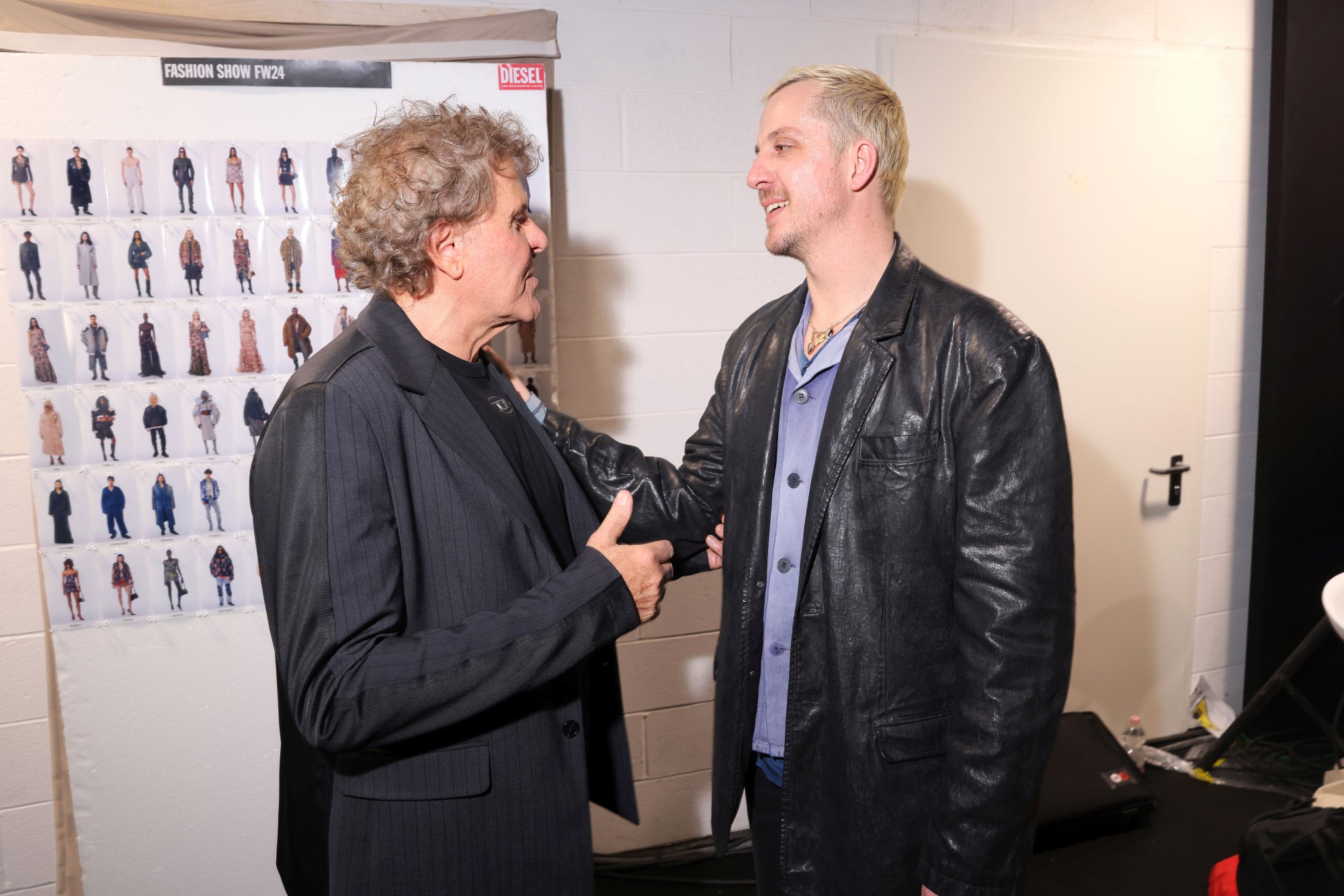
The OTB Group portfolio acquired its final missing percentage point on 4 June 2026, when Renzo Rosso’s Breganze-based holding bought out the last 30 percent of Viktor & Rolf from Viktor Horsting and Rolf Snoeren and consolidated the Amsterdam couture house at 100 percent ownership eighteen years after the first 51 percent acquisition in 2008. The buyout makes Rosso, who turned seventy-one in September 2026, the only Italian luxury-holding founder still personally signing acquisition papers in a market where every comparable rival — LVMH, Kering, Prada Group, Richemont — runs on salaried CEOs and treasury teams. The Diesel founder is the only principal who built the holding and is still inside it.
That single fact restructures how the OTB Group portfolio should be read. The seven labels Rosso has assembled since launching Diesel in 1978 — Diesel, Maison Margiela, Marni, Jil Sander, Viktor & Rolf, plus a minority in Amiri and the industrial arm Staff International — do not form a competing version of the LVMH or Kering model. They form a founder-led counter-proposition: a smaller, designer-protective, Veneto-anchored holding that treats acquired houses as authorship vehicles rather than cash-flow assets, and that held Viktor & Rolf at 70 percent for seven years before closing the last 30. This piece walks the OTB Group portfolio in acquisition order, brand by brand, founder by founder, creative director by creative director.
The OTB Group portfolio thesis: a founder-led holding in a CEO market
OTB stands for Only The Brave, a phrase Rosso used as the title of his autobiography and then borrowed as the holding’s name when he formally constituted it in 2002 to consolidate Diesel and the newly-acquired Maison Margiela under one roof. The name encodes a thesis: that the holding’s job is not to optimise a multi-brand balance sheet but to give designer houses the protective scaffolding they need to keep making the work that justified buying them. The Breganze headquarters — a converted industrial site in the Vicenza hinterland that doubles as Diesel’s operating base — broadcasts it architecturally: the holding sits where the original denim factory sat, not in a glass tower in central Milan.
The contrast with the Kering portfolio and the Paris-headquartered conglomerates is sharpest at the management layer. LVMH and Kering operate as salaried-executive groups whose founders (Bernard Arnault, François-Henri Pinault) work through layered CEO structures; the LVMH leather goods design machine and the Kering creative-direction reshuffles of 2023–2025 are run by professional luxury managers. Rosso, by contrast, still personally chairs OTB, still personally signs the Viktor & Rolf paperwork, and still personally decides — as he did with Glenn Martens at Maison Margiela on 29 January 2025 — which creative director takes which seat. The 2026 Viktor & Rolf full takeover is the clearest evidence in years that Rosso intends to keep the holding founder-led for the rest of his active mandate.
Diesel (founded 1978, in-house): the original asset and the Glenn Martens revival
Diesel is the founding brand of the OTB Group portfolio and the only label in the holding that Rosso created himself. He launched it in 1978 in Molvena, in the province of Vicenza, in partnership with Adriano Goldschmied, the Austrian-born denim entrepreneur. The name Diesel was chosen because it was pronounceable in every major European market; the denim was sourced from the Veneto industrial district around the founding workshop. Rosso bought out Goldschmied in 1985 at age thirty and spent the next fifteen years building Diesel into one of the few European denim labels that could be sold at premium price points without losing youth-market credibility.
Diesel is the only OTB Group portfolio asset that pre-dates the holding by twenty-four years. When OTB was constituted in 2002, Diesel was already a mature global business with its own retail network and its long-running “For Successful Living” campaign identity. The holding was built around Diesel’s cash flow as much as around the Margiela acquisition; without the 1978–2002 denim build-out, the 2002 Margiela deal would not have been financeable.
The contemporary Diesel story is the Glenn Martens story. The Belgian designer, born in Bruges in 1983 and trained at the Royal Academy of Fine Arts in Antwerp, was named Diesel’s creative director in October 2020 and debuted his first collection for the brand in the autumn 2021 cycle. Martens turned Diesel from a heritage denim label trading on its 1990s campaigns into a critically credible Milan Fashion Week presence, and by 2024 he had become the single most-watched creative director inside the OTB Group portfolio. His January 2025 appointment to Maison Margiela on top of the Diesel role — a dual-mandate structure unprecedented inside the holding — confirmed that Rosso reads Martens as the OTB Group portfolio’s strongest creative-direction bet and intends to centralise his most important creative authorship around the Belgian. Diesel’s Breganze base remains the holding’s operational anchor.
Maison Margiela (founded 1988, OTB-controlled since 2002): the Galliano-to-Martens transition
Maison Margiela is the OTB Group portfolio’s first acquired asset and the deal that turned Diesel-the-brand into OTB-the-holding. The house was founded in 1988 in Paris by Martin Margiela, the Belgian designer trained at the Royal Academy of Fine Arts in Antwerp who emerged from the same generation as the Antwerp Six and had spent the second half of the 1980s as Jean Paul Gaultier’s assistant. Margiela’s house was the most conceptually radical of the Antwerp-trained Paris houses: anonymous tags, white labour-coat staff uniforms, replica garments quoting historical pieces, the Tabi split-toe boot. By 2002 the brand had a global cult audience and a chronically undercapitalised back office, and Rosso’s controlling-stake offer was structured around protecting the design office while industrialising the rest.
OTB acquired Maison Margiela in 2002. Martin Margiela himself departed the house in 2009, leaving creative direction to the in-house team for five years. The decisive succession came in October 2014, when John Galliano — three years after his Dior dismissal — was named creative director and given the Artisanal couture line as his showcase platform. Galliano’s tenure, from his January 2015 debut through his final collection in December 2024, became one of the defining creative-direction runs of the 2010s and early 2020s: the Artisanal show at the Pont Alexandre III in January 2024 generated more press than any other Paris couture event of the year, and the brand’s commercial trajectory lifted it from cult cash drain to one of the OTB Group portfolio’s most discussed assets.
Galliano left Maison Margiela in December 2024. Rosso announced Glenn Martens as successor on 29 January 2025, with Martens retaining his Diesel role in parallel — the first time a single creative director has held two creative-director seats inside the OTB Group portfolio simultaneously. Martens debuted his Margiela Artisanal in the July 2025 couture cycle; the brand’s headquarters remain at 163 rue Saint-Maur in the 11th arrondissement of Paris.
Marni (founded 1994, OTB stake 2013, full control November 2015): from Castiglioni to Risso to Rogge
Marni is the third pillar of the OTB Group portfolio and the brand that completed Rosso’s Milan footprint. The house was founded in 1994 in Milan by Consuelo Castiglioni, with Gianni Castiglioni handling the business side; the Castiglioni family had operated Ciwi Furs since the 1970s, and Marni was the family’s pivot from fur into a women’s ready-to-wear label characterised by sculptural prints, oversize silhouettes and an anti-minimalist colour palette. Castiglioni’s Marni was, for two decades, one of Milan Fashion Week’s most distinctive design signatures.
OTB took an initial minority stake in 2013 and completed full control in November 2015. Consuelo Castiglioni departed in October 2016, and Francesco Risso, previously at Prada under Miuccia Prada, was named creative director the same month and debuted in February 2017. Risso’s eight-year run extended the house’s reputation for chromatic risk and for unconventional show formats, including the Marni / Enzo Cucchi café residency and a sequence of artist collaborations that kept the brand visible in art-world venues.
Risso departed in early 2025. Meryll Rogge — the Belgian designer trained at the Royal Academy of Fine Arts in Antwerp and previously at Dries Van Noten and Marc Jacobs, who ran her own Ghent-based label from 2020 — was named creative director and debuted her first Marni collection for FW2026 in Milan in February 2026. Rogge’s appointment confirms an OTB pattern of favouring Antwerp-trained designers: Martens at Diesel and Margiela, Rogge at Marni. Marni’s headquarters remain at Viale Umbria, Milan.
Jil Sander (founded 1968, OTB-acquired 2021): the Hamburg minimalist and the Bellotti appointment
Jil Sander is the most recent fully-acquired house in the OTB Group portfolio and the only one whose founder is still alive but no longer involved. The label was founded in 1968 in Hamburg by Heidemarie Jiline Sander, who opened her first boutique on Milchstrasse and built the brand into the dominant European minimalist house of the 1990s. Sander sold the company to Prada Group in 1999, departed in 2000, returned briefly in 2003, departed again, and made a final return for the 2012–2013 cycle before exiting permanently. The house then passed through Onward Holdings, the Japanese apparel group that acquired it in 2008, before OTB bought it from Onward in 2021 on undisclosed terms.
The Onward-era final creative directors had been Lucie and Luke Meier, the Swiss-Canadian husband-and-wife team appointed in 2017 who shared the artistic-director role through the OTB acquisition and into 2024. The Meiers departed after FW2024, leaving the house without a named creative director for almost a year. In March 2025 OTB named Simone Bellotti — previously creative director of Bally from 2023, after a long internal run at Gucci — as Jil Sander’s new creative director. Bellotti debuted in the September 2025 womenswear cycle; the studio operates from Milan with commercial headquarters split between Milan and Hamburg. The 2021 timing, at the bottom of the Onward divestment cycle, let Rosso acquire one of European luxury’s most respected minimalist names at a valuation no comparable transaction has produced since.
Amiri (founded 2014, OTB minority stake June 2019): the Los Angeles option
Amiri is the only brand in the OTB Group portfolio held as a minority position rather than a controlling or full stake. The label was founded in 2014 in Los Angeles by Mike Amiri, the Iranian-American designer who had previously customised pieces for the LA music scene before his first formal collection. Amiri’s distressed denim, leather and rock-aesthetic ready-to-wear caught the high-spend American luxury market faster than any West Coast brand of the previous decade.
OTB took a minority stake in Amiri in June 2019 — the only American position in the holding and the only minority structure across the portfolio. Mike Amiri himself remains founder, majority owner and creative director, with the OTB investment functioning as strategic capital and industrial platform rather than takeover. The arrangement is the OTB Group portfolio’s clearest geographic hedge: every other brand is European-headquartered (Breganze, Paris, Milan, Hamburg, Amsterdam), and Amiri gives the holding an American foothold without requiring a US back office. The brand shows in Paris.
Viktor & Rolf (founded 1993, OTB 51% in 2008, 70% in 2019, 100% on 4 June 2026): the eighteen-year close-out
Viktor & Rolf is the OTB Group portfolio’s most recent full acquisition and the longest ownership ramp in the holding’s history. The house was founded in 1993 in Amsterdam by Viktor Horsting (born 1969 in Geldrop) and Rolf Snoeren (born 1969 in Dongen), who met as students at ArtEZ Institute of the Arts in Arnhem and launched the label with a conceptual couture show at Hyères that won the festival’s grand prize the same year. The Dutch duo built Viktor & Rolf through the 1990s and 2000s as one of European fashion’s most theatrical couture houses, eventually adding ready-to-wear and a fragrance business (Flowerbomb, 2005) that became one of the most commercially successful designer fragrances of the decade.
OTB took an initial 51 percent stake in 2008, structured to give the holding operational control while leaving the founders with majority creative authorship and substantial equity. The arrangement was raised to 70 percent in 2019. The remaining 30 percent — held by Horsting and Snoeren personally — was acquired on 4 June 2026, completing the eighteen-year ramp at 100 percent. Financial terms were not disclosed. Horsting and Snoeren signed a renewed five-year creative-direction mandate at closing, meaning the Amsterdam house remains under its founders’ authorship through at least 2031.
The eighteen-year ramp is the story. Most luxury acquisitions close at 100 percent inside three to five years; the OTB pattern of stair-stepping across nearly two decades while keeping founders inside the creative-direction office is unusual at this scale, and reads as a deliberate signal about how Rosso intends future deals to work — the inverse of the LVMH and Kering pattern of buying majority on day one and managing through salaried executives thereafter.
Staff International (acquired October 2000) and Brave Kid: the industrial back office
The OTB Group portfolio also includes two non-brand assets that are structurally essential to how the holding operates. Staff International, acquired by Rosso in October 2000, is the industrial-licensing and manufacturing platform that produces and distributes ready-to-wear for several of the OTB brands and for licensing partners across the holding’s contract portfolio. The 2000 Staff International acquisition predates the formal 2002 constitution of OTB by two years; it is the platform on which the holding was eventually built, in the same way Diesel’s denim cash flow was the equity base. Without Staff International, the 2002 Margiela deal would not have had the operational platform it needed to scale.
Brave Kid is the children’s wear platform, structured separately as an OTB subsidiary, that handles licensed children’s lines for several of the holding’s brands and for external licensors. Brave Kid is not a brand in its own right but a platform; its existence inside the OTB Group portfolio is part of why the holding does not look like its Paris-based rivals on an organisational chart. The two industrial assets sit underneath the brand portfolio rather than alongside it.
The OTB Group portfolio creative-direction map, June 2026
The table below lists every brand inside the OTB Group portfolio as of 4 June 2026, with founding date, acquisition date, current creative director and headquarters location. The acquisition column reads chronologically as a single sequence: Diesel 1978 (founded), Staff International 2000 (acquired), Maison Margiela 2002, Marni 2013/2015, Amiri 2019 (minority), Jil Sander 2021, Viktor & Rolf 2008/2019/2026.
| Brand | Founded | OTB acquired | Current creative director | Headquarters |
|---|---|---|---|---|
| Diesel | 1978, Molvena (Vicenza) | In-house (Rosso bought out Goldschmied 1985) | Glenn Martens (from October 2020) | Breganze, Veneto |
| Staff International | 1976 | October 2000 | n/a (industrial platform) | Noventa Vicentina |
| Maison Margiela | 1988, Paris | 2002 | Glenn Martens (from 29 January 2025) | 163 rue Saint-Maur, Paris 11e |
| Viktor & Rolf | 1993, Amsterdam | 51% 2008, 70% 2019, 100% 4 June 2026 | Viktor Horsting and Rolf Snoeren (founders, renewed five-year mandate June 2026) | Amsterdam |
| Marni | 1994, Milan | Minority 2013, full control November 2015 | Meryll Rogge (from 2025, debuted FW2026) | Viale Umbria, Milan |
| Amiri | 2014, Los Angeles | Minority stake June 2019 | Mike Amiri (founder) | Los Angeles |
| Jil Sander | 1968, Hamburg | 2021 (from Onward Holdings) | Simone Bellotti (from March 2025) | Milan and Hamburg |
| Brave Kid | n/a (OTB platform) | n/a | n/a (children’s wear platform) | Veneto |
Two patterns surface from the table. First, four of the five most important creative-direction seats inside the OTB Group portfolio are now held by Belgian-trained or Italian-trained designers — Martens (Antwerp) at Diesel and Margiela, Rogge (Antwerp) at Marni, Bellotti (Italian) at Jil Sander — with the Viktor & Rolf founders the only Dutch authorship in the holding and Mike Amiri the only American. The holding has become, at the creative-direction layer, a Belgian-Italian axis with one Dutch couture node and one Los Angeles minority. Second, the headquarters map is overwhelmingly European: Breganze, Paris, Milan, Hamburg, Amsterdam, with the LA Amiri stake the only non-European base. Rosso runs the OTB Group portfolio as a Veneto-Paris-Milan triangle with northern European and US options on the edges.
What the Viktor & Rolf full takeover reveals about Rosso’s playbook
The June 2026 buyout of Viktor & Rolf’s last 30 percent closes a chapter in the OTB Group portfolio’s eighteen-year build-out and opens a question about what Rosso intends to do with the holding now that every major target on his list is either fully owned, controlled, or held in a protective minority. The acquisition column above has no obvious next entry. Rosso has not telegraphed a 2026–2028 target the way he telegraphed Marni in 2013 (with the initial minority) or Jil Sander in 2020 (with the public reporting of the Onward negotiation). The portfolio is, by his own design, complete enough to operate.
The Viktor & Rolf close-out is therefore better read as a statement about the founders he has chosen to back than as a signal about future deals. Horsting and Snoeren’s renewed five-year creative-direction mandate, signed simultaneously with the 100 percent acquisition, means the Amsterdam house remains under original-founder authorship through at least 2031. The OTB Group portfolio now contains exactly one house run by its original founders (Viktor & Rolf), one house run by its original founder as a minority partner (Amiri), one house run by its founder-owner (Diesel under Rosso himself, who functions as both holding chair and brand principal), and three houses run by appointed creative directors whose tenures are entirely Rosso’s call (Maison Margiela, Marni, Jil Sander). That distribution — founder-led where possible, appointed-director where necessary — is the OTB Group portfolio’s operating grammar made structural.
The contrast with the Paris-headquartered rivals sharpens in the same direction. The Givenchy creative-direction lineage reads, across seventy-four years inside LVMH and predecessors, as a sequence of appointed directors hired and fired by holding-level executives. The Loewe 180-year creative direction history reads similarly inside LVMH. Rosso’s portfolio reads differently because Rosso himself is still the holding’s principal and is still personally negotiating the deals: the Viktor & Rolf close-out was reported as a transaction Rosso conducted with Horsting and Snoeren directly, not through a corporate-development team. That is the structural fact that the 4 June 2026 buyout makes visible.
What the OTB Group portfolio looks like a decade from now will depend on the succession question that Rosso has not publicly addressed: who, when Renzo Rosso is no longer personally signing the papers, inherits the founder-led grammar that has defined the holding for twenty-four years? Stefano Rosso, his son, has held senior operating roles inside the holding for over a decade and is the named heir on most external readings of the group. Whether the OTB Group portfolio under a second-generation Rosso retains the protective, slow-ramp, founder-respecting acquisition pattern that brought Viktor & Rolf to 100 percent over eighteen years — or whether it converts to the salaried-executive model that the rest of luxury has adopted — is the question the next decade will answer. The 4 June 2026 transaction is the last clean signature of the founder-led era.