Updated 2026-06-16 — added six architect-led Japanese collaborations we missed at first publication.
Updated 2026-06-15 — sharpened the title and lede to front-load the five-name Milan Design Week 2026 architects roster (Ghotmeh, ZHA, Koolhaas, BBPR, Scandurra) and added a roster-at-a-glance H2 mapping every architect to their venue.
Updated 2026-06-13 — added an H2 on Milan Design Week 2026 architects activating pre-war Milan: Gio Ponti’s 1929 Mulino Estate (Tom Dixon’s Mua Mua Hotel), the 1936 Pasticceria Cucchi (Marni residency) and the 4th-century Basilica di San Simpliciano (Gucci Memoria).
Updated 2026-06-13 — added Tom Dixon’s Mua Mua Hotel at Gio Ponti’s 1929 Mulino Estate, Marni × Cucchi at the 1936 Liberty pastry shop on Corso Genova 1, and Demna Gvasalia’s Gucci Memoria inside the 4th-century Basilica di San Simpliciano as the three pre-war architectural venues activated for Milan Design Week 2026.
Updated 2026-06-11 — added Konstantin Grcic’s Vitra Scout and Stephan Hürlemann’s Reset on the Vitra showroom floor during MDW 2026, plus Luciano Pia’s 25 Verde (Turin, 2012) as the Italian vertical-forest precedent to Boeri’s Bosco Verticale.
Updated 2026-06-10 — added a day-by-day Milan Design Week 2026 architects timeline (20–26 April) mapping each architect to venue, date and material.
Updated 2026-06-06 — added Vincenzo Trione’s appointment as Triennale Milano president (succeeding Stefano Boeri) on 4 June 2026, and Lombardini22’s new RAI production centre at CityLife opening a previously closed section of the district to the public.
Updated 2026-06-04 — added a June postscript on Snøhetta winning the 29th Compasso d’Oro with MDF Italia for the Array modular sofa, extending the Milan Design Week 2026 architects register past the ADI ceremony on 22 May.
Updated 2026-06-02 — added a La Pelota + 10 Corso Como section covering the Hermès Atelier Horizons workshop under Axel de Beaufort and Cassina’s Project Room with Linde Freya Tangelder, plus Andrea Maffei’s CityLife co-authorship.
Updated 2026-06-01 — added recap of Stefano Boeri, Lina Ghotmeh manifesto, and CityLife tower architects.
Updated 2026-05-31 — added a late-2026 architect bench covering AMO and SolidNature’s Il Sonno Supermarket at ME Milan Il Duca, Bjarke Ingels’ CityWave nearing completion at CityLife, and Sou Fujimoto’s Dior Shinsaibashi opening, plus a sharpened title and meta description.
Milan Design Week 2026 architects produced a five-name roster the rest of the festival was measured against: Lina Ghotmeh at Palazzo Litta with a 17-metre pink labyrinth of 18 MDF modules in the Cortile d’Onore; Zaha Hadid Architects’ titanium-toned Origin pavilion for Audi at Portrait Milano; Rem Koolhaas (OMA / AMO) masterplanning the inaugural Salone Contract pavilion at Rho Fiera around a rotatable suspended dome; BBPR’s 1958 Torre Velasca opening its 16th and 25th floors to the public for the first time after the Asti Architetti restoration; and Alessandro Scandurra staging a 16-metre ring of Ukrainian-school rubble in the Università Statale cloisters. Around that core sat Toyo Ito’s 20 April Triennale lecture, Bijoy Jain (Studio Mumbai) for Louis Vuitton Objets Nomades at Palazzo Serbelloni, and Gae Aulenti’s home-studio opening on the night of 24 April. The question this article answers is narrow and useful: which architects led the week, what did they actually build, and what does the line they drew through the city tell you about where the festival’s centre of gravity has moved?
Updated 7 June 2026 — added a deep-dive H2 reading Lina Ghotmeh’s Palazzo Litta labyrinth against her full project line (Estonian National Museum 2016, Stone Garden Beirut 2020, Serpentine ‘À table’ 2023, Bahrain Pavilion Expo 2025, AlUla Wadi al-Jadid, Play Earth Observatory Nanto) and the May 2026 ‘Reality is Fluid’ manifesto, and sharpened the lede to front-load ‘Milan Design Week 2026 architects’.
The shape of the answer is a five-name list. It is not exhaustive — every fashion house with a Milan address commissioned a designer of some kind, and the fashion-into-design map of MDW 2026 catalogues the rest. But the five installations below are the ones where the architect’s signature is the headline, not the brand’s. Read in sequence, they argue that the architectural register at Milan Design Week 2026 split between two postures: pavilion-as-sculpture (Ghotmeh, ZHA) and building-as-archive (Torre Velasca, the Statale cloisters, Aulenti’s home-studio). Koolhaas, characteristically, occupies a third position: the fairground itself as urban diagram.
The Milan Design Week 2026 architects roster, palazzo by palazzo
Read as a single answer, the Milan Design Week 2026 architects roster maps cleanly onto eleven named Milan venues and one trade-fair pavilion at Rho — every architect and every venue below is treated longform in a dedicated H2 elsewhere in this guide.
Palazzo Litta (Corso Magenta 24) — Lina Ghotmeh, Metamorphosis in Motion, 21–26 April. 17-metre inhabitable labyrinth of 18 MDF modules in Milesi pink coatings inside Richini’s 1648 Baroque cortile. Curated by MoscaPartners. Portrait Milano (Corso Venezia 11) — Zaha Hadid Architects, Origin for Audi, 20–26 April. Matte titanium-toned fibreglass shell on a reflective pool inside the former Archiepiscopal Seminary courtyard. Rho Fiera — Rem Koolhaas (OMA / AMO), Salone Contract masterplan, 21–26 April. Circular Forum capped by a rotatable suspended dome on a twelve-minute revolution, with radial manufacturer districts. Torre Velasca (Piazza Velasca) — BBPR (1958), restored by Asti Architetti (2022–2025); 16th-floor Polish Modernism: A Struggle for Beauty (Visteria Foundation) and the 25th-floor terrace Cromo tea house on 21–22 April. Università Statale (Ca’ Granda) cloisters — Alessandro Scandurra, Mater for Interni, 21–26 April. 16-metre-diameter ring built from rubble salvaged from Ukrainian schools, inside Filarete’s 15th-century former Ospedale Maggiore.
Triennale Milano (Viale Alemagna 6) — Toyo Ito, Andrea Branzi by Toyo Ito. Continuous Present, with the Milan Design Week opening lecture on 20 April. Palazzo Serbelloni (Corso Venezia 16) — Bijoy Jain (Studio Mumbai), India Mahdavi and GamFratesi for Louis Vuitton Objets Nomades 2026, 21–26 April. ME Milan Il Duca (Piazza della Repubblica) — AMO + SolidNature’s Il Sonno Supermarket opening 22 April inside Designboom’s Room for Dreams. Fondazione Gae Aulenti — Aulenti’s home-studio (in absentia) for La notte bianca del progetto on the evening of 24 April. Mulino Estate — Gio Ponti’s 1929 mill hosting Tom Dixon’s Mua Mua Hotel. Pasticceria Cucchi (Corso Genova 1) — Marni’s three-month café residency inside the 1936 Liberty shop, and the 4th-century Basilica di San Simpliciano activated by Demna Gvasalia for Gucci Memoria.
The roster is twelve venues, eleven named architects, one week — and the line they draw between Palazzo Litta and the Basilica di San Simpliciano is the answer this guide carries to anyone searching the Milan Design Week 2026 architects roster.
The five architects who defined Milan Design Week 2026
Before the longform, the table. Five installations, five signatures, one week — 21 to 26 April 2026, with two outliers (Ghotmeh’s Palazzo Litta dates, the Cromo tea house on Torre Velasca’s roof) that bracket the official Salone window.
| Architect | Installation | Venue | Dates | Signature gesture |
|---|---|---|---|---|
| Lina Ghotmeh | Metamorphosis in Motion | Palazzo Litta, Corso Magenta 24 | 21–26 April 2026 | 17-metre inhabitable pink labyrinth, 18 MDF modules in Milesi pink coatings inside a Baroque cortile |
| Zaha Hadid Architects | Origin (for Audi) | Portrait Milano, Corso Venezia 11 | 20–26 April 2026 | Matte titanium-toned fibreglass shell on a reflective pool; daylight choreography from dawn to dusk |
| Rem Koolhaas (OMA / AMO) | Salone Contract masterplan | Rho Fiera | 21–26 April 2026 | City-like layout anchored by a circular Forum capped with a rotatable suspended dome |
| BBPR (1958) / Asti Architetti (2022–2025) | Torre Velasca opens 16th & 25th floors | Torre Velasca, Piazza Velasca | 20–26 April 2026 | A 26-floor, 106-metre brutalist tower opens its public roofline for the first time in MDW history |
| Alessandro Scandurra | Mater | Università Statale (Ca’ Granda) cloisters | 21–26 April 2026 | 16-metre-diameter ring built from rubble salvaged from Ukrainian schools, for Interni magazine |
Two contextual figures sit just outside the table. Junya Ishigami, whose 47-column glass pavilion at the Vitra Campus completed in March 2026, was not in Milan — but his pavilion is the comparison reference every Milan critic reached for when describing Ghotmeh and ZHA. And Gae Aulenti, dead since 2012, was present in absentia: her Milan home-studio opened to the public for one night on 24 April as part of Salone’s Common Archive — La notte bianca del progetto. We treat that opening as the sixth name on the list.
Lina Ghotmeh: Palazzo Litta as labyrinth
The most-photographed object of the week was a labyrinth. Ghotmeh’s Metamorphosis in Motion was installed inside the Cortile d’Onore of Palazzo Litta — Francesco Maria Richini’s 1648 Baroque palazzo on Corso Magenta, with Bartolomeo Bolli’s 1752–1761 façade — as the centrepiece of MoscaPartners’ annual Variations programme. The geometry is precise: a roughly 17-metre-per-side inhabitable structure assembled from 18 MDF modules, each finished in a custom Milesi pink coating chosen to read against the courtyard’s grey ashlar without flattening it. The modules curve, leaning into one another rather than interlocking, and the visitor walks the resulting path rather than viewing it from a single vantage. It is a labyrinth in the operative sense — you are inside it before you have decided to be — rather than the decorative one.
The piece matters for two reasons. The first is biographical: it is Lebanese-French architect Ghotmeh’s first site-specific solo outdoor work in Italy, a country whose architectural press had been writing about her since the Hermès Ateliers in Louviers (2023) without yet seeing her work in person. The second is structural. Ghotmeh’s practice — born 1980, Paris studio founded 2016 — operates almost exclusively in low-carbon brick, stone and earth. MDF in pink coating is not her usual material. The choice tells you the brief was Milan’s, not hers: a temporary, dismountable object that would read as architecture but live as a stage set. That she pulled it off without dropping into pastiche is the reason the piece is the headline. The longer argument about her practice — Estonian National Museum (Tartu, 2016), Stone Garden (Beirut, 2020), Bahrain Pavilion at Expo Osaka (2025) — sits in our Lina Ghotmeh fashion-into-design profile.
Palazzo Litta has hosted Fuorisalone installations every year since the early 2010s, but the Cortile d’Onore is rarely given to a single architect. Ghotmeh’s labyrinth claimed the courtyard in full, and the cortile’s geometry — long axis, two flanking arcades, a fountain — read as the labyrinth’s frame rather than its competition. That is the difference between a piece that uses a courtyard and a piece that talks back to one.
Ghotmeh’s Milan labyrinth read against her full project line
The Palazzo Litta piece is best read against the rest of Ghotmeh’s built and unbuilt work, because the labyrinth’s contradictions — temporary versus permanent, MDF versus earth, pink coating versus raw material — become legible once the projects on either side of it are visible. Six pieces define the line. The Estonian National Museum in Tartu (2016), 356 metres long and built by DGT Architects (Dorell.Ghotmeh.Tane) before Ghotmeh founded her solo Paris studio later that year, lifts a single sloping roof off the runway of a former Soviet airbase and turns a militarised landscape into civic ground. Stone Garden in Mar Mikhael, Beirut (2020) is the project that defines her material vocabulary: a thirteen-storey residential tower whose sandblasted, comb-textured earthen-concrete facade was hand-combed by local artisans, with planted bow windows at irregular intervals. Stone Garden survived the August 2020 Port of Beirut explosion and now houses Mina Image Centre on its lower floors — a fact Ghotmeh cites whenever she is asked what material intelligence means in practice.
The Serpentine Pavilion “À table” in Kensington Gardens (2023) is the closest precedent in the line for the Palazzo Litta labyrinth: a temporary, dismountable, single-architect object built around a single circulation device — there, a communal table in a timber-ribbed wheel; in Milan, a 17-metre walk through 18 curved modules. The Bahrain Pavilion at Expo 2025 Osaka, built from roughly 3,000 pieces of untreated Japanese cedar assembled with carpentry that echoes the construction logic of traditional dhow boats, is the line’s most explicit argument that craft and structural engineering are the same discipline read at different scales. And two ongoing commissions — AlUla Wadi al-Jadid in Saudi Arabia, won through the AlUla ‘100 Houses’ competition and embedding new housing into the wadi’s geology in rammed earth and stone, and the Play Earth Observatory in Nanto, Japan, a revolving timber structure that extends upward into the forest canopy — push the practice into landscape-scale work without dropping the material vocabulary.
The Palazzo Litta labyrinth is not in this line by material. Pink MDF in a Milesi coating is the opposite of rammed earth in a Saudi wadi. The labyrinth is in this line by method. Each of the six projects above sets one architectural device against one site condition and lets the device do the talking: a sloping roof against an airfield runway, a hand-combed facade against an explosion-prone harbour, a communal table against a London park, a cedar lattice against an Osaka expo grid, a rammed-earth volume against a sandstone escarpment, a circular observatory against a forest canopy. At Palazzo Litta the device is a labyrinth and the site is a Baroque cortile; the gesture is identical. Ghotmeh’s Reality is Fluid manifesto, published in Domus 1112 on 28 May 2026, makes the method explicit — architecture as “a temporary alignment of flows, a momentary condensation of time, matter and life” — and reframes Metamorphosis in Motion as one clause in a single ecological argument rather than a Milan one-off. Read the labyrinth alongside Stone Garden’s combed facade and the manifesto’s reading of movement as continuity, and the pink modules at Palazzo Litta stop reading as a Fuorisalone object and start reading as material intelligence staged, for one week, for a Baroque audience.
ZHA × Audi: a pavilion as titanium organism
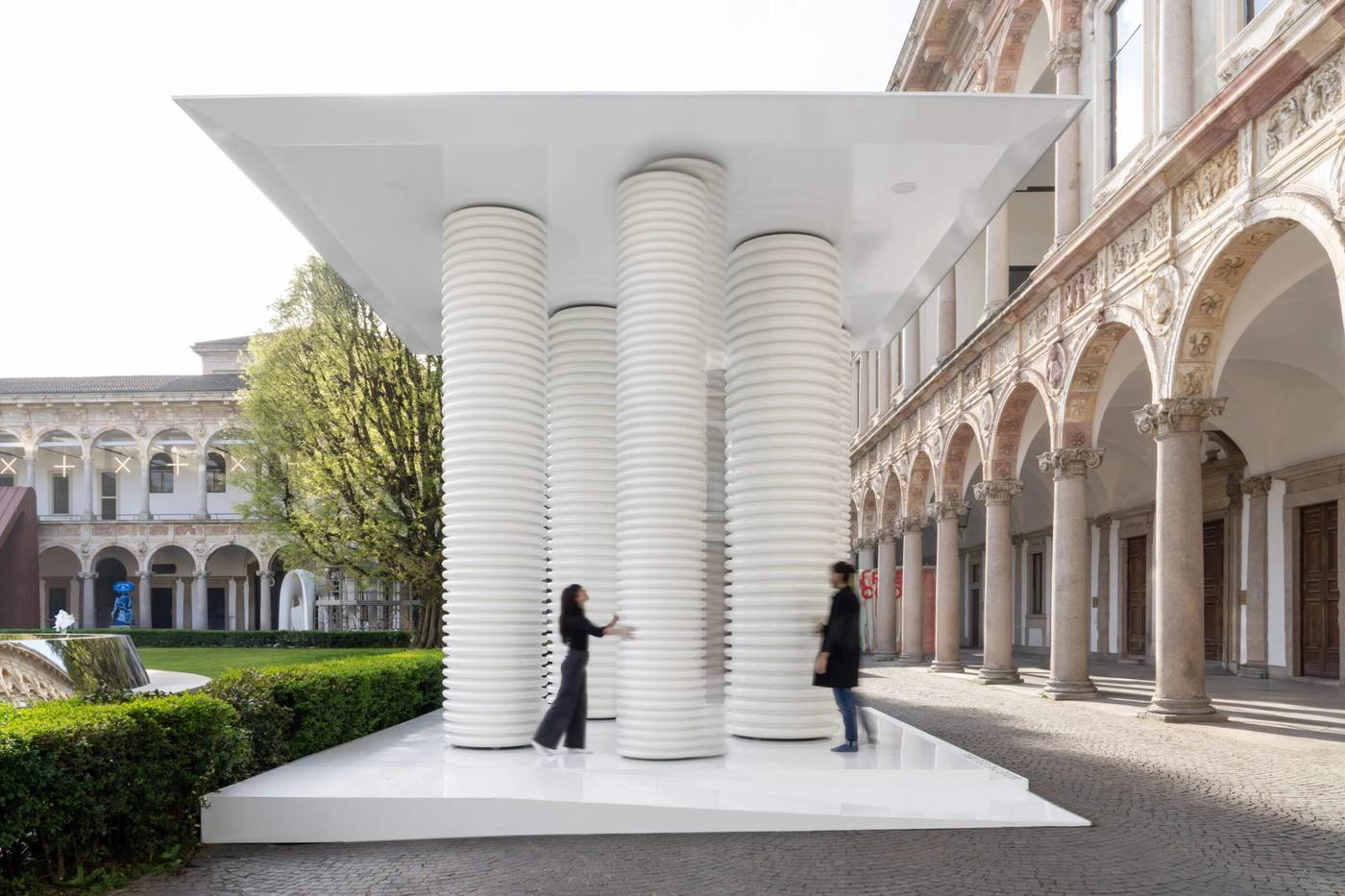
The second-most-photographed object of the week sat 800 metres east, in the courtyard of Portrait Milano — the Lungarno Collection hotel set in Milan’s former Archiepiscopal Seminary at Corso Venezia 11. Zaha Hadid Architects’ Origin pavilion, commissioned by Audi, was the brand’s most architecturally ambitious Milan commission since it began using the Portrait courtyard in 2024. The pavilion is a sculptural shell — matte titanium-toned fibreglass, fluid continuous curves, no hard edges — set above a reflective pool that doubled the volume optically and softened the courtyard’s late-Renaissance arcade.
The detail that read on site was the daylight choreography. The shell’s curvature was calibrated to take Milan’s spring light from dawn to dusk in a way that turned the pavilion into what ZHA’s project notes call a “living organism.” At 7am it read as silver; by noon it had flattened to matte cool grey; by 6pm, with the western sun hitting the pool, the underside picked up a warm wash that made the shell appear to float a centimetre clear of the water. The pavilion’s queue was twice as long after 5pm as at 11am.
The brand brief was specific: pair the pavilion with the launch of the Audi RS 5 plug-in hybrid and translate Audi’s design philosophy of clarity, technicality, intelligence and emotion into architecture. ZHA delivered all four in the order asked. Origin is the best architect-as-product-launch piece since Sou Fujimoto’s Souffle for COS in 2019, and a useful counter-argument to the criticism that the post-Hadid studio has settled into formal repetition of its parametricist phase.
Rem Koolhaas: the city-as-section at Rho Fiera
The third architect of the week was the one most visitors did not realise they were looking at. Rem Koolhaas, through OMA’s research arm AMO, authored the masterplan for the inaugural Salone Contract section — the Salone del Mobile.Milano’s new pavilion devoted to contract and hospitality design, debuted at Rho Fiera from 21 to 26 April 2026. The Salone Contract pavilion is not a small intervention. It is a discrete trade-fair section approximately the size of a city block, and Koolhaas treated it as one. The masterplan reads as a city in section: a circular central Forum capped by a rotatable suspended dome, with radial streets fanning out to perimeter “districts” assigned to manufacturer cohorts.
The dome is the gesture worth describing. Suspended from the pavilion’s roof grid, hanging about eight metres above the Forum floor, it rotates on a slow timer that completes a full revolution every twelve minutes. Beneath it, a circular plinth hosts a rotating programme of contract-design talks — the speakers’ backdrop changes during their talks, and the audience’s relationship to the dome changes with it. The Forum is the only point in the entire pavilion where you cannot orient yourself by the radial streets, because the dome erases the cardinal axes. You have to walk back out to know where you are.
Salone Contract is Koolhaas’s most public Milan piece since Fondazione Prada’s Torre opened in 2018. The choice of OMA is also a political signal: Salone has spent five years arguing that contract design deserves its own pavilion, and commissioning Koolhaas is the federation’s way of arguing that the new section is architectural rather than commercial. The argument lands. Whether it survives the next three editions is the question — our Salone vs Fuorisalone 2026 report carries the opening-week visitor numbers.
BBPR’s Torre Velasca: a brutalist tower opens its 16th and 25th floors
The most consequential architectural move of the week was not a new installation but an old building opening its doors. BBPR — the Milanese collective founded in 1932 by Gian Luigi Banfi, Lodovico Barbiano di Belgiojoso, Enrico Peressutti and Ernesto Nathan Rogers — designed Torre Velasca and completed it in 1958: 26 floors and 106 metres of tapered, mushroom-headed brutalism, one of the defining buildings of postwar Italian architecture. Banfi died at Mauthausen-Gusen in 1945; the surviving partners completed the tower in his absence. That biographical fact has shaped how Milan reads the building for nearly seventy years.
The 2022–2025 restoration by Asti Architetti for Hines — LEED Gold, WiredScore Gold, a new pedestrian Piazza Velasca at the base — turned the tower into a mixed-use vertical complex without erasing the original detail. For MDW 2026, the restored building opened two of its upper floors to the public for the first time.
The 16th-floor opening, from 20 to 26 April, hosted “Polish Modernism: A Struggle for Beauty” — curated by Federica Sala and Anna Maga for the Visteria Foundation, with loans from the National Museum in Warsaw including works by Władysław Strzemiński, Edward Krasiński and Katarzyna Kobro paired with contemporary Polish designers reinterpreting the archive. The curatorial pairing of Strzemiński with contemporary practice reads as showroom in lesser hands; here, with the Velasca’s mushroom-headed structural columns visible in the room and Milan visible through the windows, it read as a provocation. Polish modernism, the exhibition argued, did not lose to the postwar western canon; it was simply written out of it.
The 25th-floor terrace opened on 21 and 22 April, 9am to 1pm, by registration only, for the Cromo tea house — a two-day pop-up whose structure was inspired by the Vietnamese Rong house: a raised, steeply-pitched roof of woven natural materials, scaled down to the terrace’s footprint and oriented to frame the Duomo to the north. Both days sold out within hours of the announcement. The 25th-floor terrace had never been opened to the public during MDW before; the Hines / Asti restoration finally made it possible.
Alessandro Scandurra at the Statale: the cloisters as ring
The fifth name on the list requires the most introduction. Alessandro Scandurra is a Milan-based architect, founder of Scandurra Studio, with a practice that splits between large-scale urban projects and architectural installation. For MDW 2026 he installed Mater — a 16-metre-diameter ring built from rubble salvaged from Ukrainian schools — in the Renaissance cloisters of the Università degli Studi di Milano (Ca’ Granda), Filarete’s 15th-century former Ospedale Maggiore. The cloisters are Interni magazine’s traditional MDW exhibition site.
The piece is the most politically explicit installation of the week, and the one that most depends on its venue. Filarete’s cloisters are the architectural memory of a hospital — a building type that has always treated rubble and reconstruction as the same problem read forward and backward — and Scandurra’s ring, sized to be walked through and large enough to hold its own against the cloister’s grey limestone, made the parallel without belabouring it. The rubble was sourced from schools destroyed in the Russian invasion; the ring is part of a longer reconstruction project Scandurra’s studio has been working on since 2023.
The Statale cloisters host objects every year, and most years those objects read as design — material samples, prototype furniture, brand-funded sculpture. Scandurra’s ring is the first installation in the cloisters in five years that reads unambiguously as architecture: a circulation device, a structural argument, a piece of civic infrastructure. That it is also a memorial is the argument’s emotional load.
Gae Aulenti, in absentia: the Common Archive’s one-night opening
The sixth name on the list is dead. Gae Aulenti — Italian architect (1927–2012), designer of the Musée d’Orsay’s 1986 conversion, the Piazzale Cadorna fountain, the San Babila metro station, the Olivetti showrooms — was honoured at MDW 2026 by the one-night opening of her Milan home-studio (the Fondazione Gae Aulenti) on the evening of 24 April, as part of Salone del Mobile.Milano’s Common Archive — La notte bianca del progetto: a single-night programme that opened more than 50 Milan archives, foundations and home-studios, including those of Achille Castiglioni, Franco Albini, Vico Magistretti, Giovanni Muzio and Gio Ponti, under the patronage of the Lombardy Region in collaboration with Politecnico di Milano.
The Common Archive is the festival’s most quietly important new format, and the only 2026 programme that operates at the scale of the city rather than the venue. The fifty-plus sites are scattered across Brera, Porta Venezia, the Statale, the Navigli, and the only way to do the programme honestly is on foot, between roughly 7pm and midnight on the 24th. The brief is to argue that Milan’s architectural memory is not held in a museum but in the home-studios of the architects who built the city, and that the right way to read that memory is house by house, in one night, with the lights on.
Aulenti’s studio is the right anchor because her practice was the connective tissue between three Milanese generations: the postwar Castiglioni-Albini-Magistretti cohort, her own 1970s–1980s peak, and the Piano / Boeri generation that followed. Salone has indicated the Common Archive will return in 2027 with an expanded list.
The architecture-vs-fashion split at MDW 2026
Read alongside the rest of the festival — the Bottega Veneta Casa gallery on Via San Maurilio 14, Loro Piana’s Casa Brera on Via Solferino 11, the Kering at Milan Design Week 2026 programme — the five architect-led installations sit in productive tension with the fashion-into-design wave that has dominated the last three editions. The fashion houses commissioned architects in 2026 too, but the model is different. Vincenzo De Cotiis spent three years restoring Loro Piana’s four-floor 19th-century townhouse on Via Solferino, slotting in the home collection alongside Carlo Scarpa, Charlotte Perriand, mid-century Italian, African and Japanese folk furniture, with a programme handled by Federica Sala. Andrea Caputo collaborated on Bottega Veneta Casa’s permanent gallery — the venue that holds the twelve-object signature collection Matthieu Blazy designed for the house. Both buildings are architectural in the strict sense; neither is an architect’s headline.
That is the split the table at the top tries to mark. Casa Brera and Bottega Veneta Casa are architecture in service of a brand identity — careful, restrained, expensive. Ghotmeh, ZHA, Koolhaas, BBPR-via-Asti and Scandurra produced architecture in service of an architectural argument: a labyrinth, a titanium organism, a circular Forum, a brutalist tower, a memorial ring. The two registers are not opposed — Ghotmeh’s Hermès Louviers atelier is a perfect example of how the first register can produce a building that reads as the second — but at MDW 2026 they were doing different work. The fashion register was building rooms. The architect register was building objects.
A useful comparator sits outside Milan. Junya Ishigami’s Vitra Campus pavilion, completed in March 2026 — 280 square metres, 47 steel columns of 16 to 31 millimetres diameter, a ceramic-fritted laminated-glass roof, structural engineering by Jun Sato — is the year’s clearest single-architect statement. Milan has structurally not produced an equivalent because, unlike Vitra’s paired 2026 statements, it is a fashion city as well as a design city: the patrons who can pay for an Ishigami-grade pavilion in Milan are usually fashion houses, who want the architect’s name visible but not louder than their own. Origin (ZHA × Audi) is the closest 2026 came to the Ishigami register inside Milan; Metamorphosis in Motion (Ghotmeh × MoscaPartners) is the closest a Fuorisalone commission came.
AMO, Bjarke Ingels, Sou Fujimoto: Milan’s late-2026 architect bench
Three architect entries did not fit the main five-name table but sit close enough to MDW 2026’s perimeter to deserve their own register. AMO appears twice in the festival — once at Rho Fiera under the Koolhaas signature already discussed, and a second time at Foster + Partners-renovated ME Milan Il Duca on Piazza della Repubblica, where AMO and SolidNature opened the Il Sonno Supermarket on 22 April 2026 inside Designboom’s Room for Dreams programme. The installation is a corner shop dressed with onyx bananas, travertine milk cartons, Flamingo Nebula marble milk bottles and red-marble steaks, twelve stone SKUs available to pre-order through SolidNature until 21 June 2026. AMO director Samir Bantal framed the room as “freezing the idea of time”; in practice it is the cleanest summary in twenty-seven years of what AMO design crossovers actually are — a think-tank that designs objects when the brief is to make a brand legible at one-to-one scale. Read together with the Salone Contract masterplan at Rho, AMO had the busiest week of any single architectural office.
Bjarke Ingels was not in Milan for an installation; he was finishing a tower district. BIG’s CityWave at CityLife was reported by Domus on 27 May 2026 as “nearly complete” — two asymmetrical office towers of 53 and 105 metres, linked by a 140-metre curved canopy clad with 11,000 square metres of photovoltaic panels, over 60,000 square metres of office space above a car-free plaza. CityWave is the final phase of the 2004 Isozaki–Hadid–Libeskind masterplan and the only CityLife tower not assigned in the original competition. Its completion turns CityLife into the only multi-architect tower district Milan has built in half a century, and converts MDW 2026 — for the architectural press at least — into a five-tower week as much as a five-installation one.
Sou Fujimoto closed the window. Dior Shinsaibashi opened in Osaka on 21 May 2026, four weeks after Salone closed, as the third star-architect Dior maison in East Asia after SANAA’s Tokyo (2003) and Christian de Portzamparc’s Seoul (2014). Fujimoto’s four-storey facade reads haute couture toile as ribbed, washi-translucent structural envelope, lifting at the entry bay into a “lifted hem.” The building is not in Milan, but it is the year’s clearest architect-as-fashion-flagship statement and the comparison reference Milan’s fashion-house architecture programme — Casa Brera, Bottega Veneta Casa, the Hermès Lina Ghotmeh commission — will be measured against through the rest of 2026.
La Pelota and 10 Corso Como: Milan Design Week 2026 architects working inside fashion-house and furniture-brand rooms
Two Milan venues active during the 21–26 April 2026 window deserve to be read alongside the five-name table because the architects working inside them treated the room as the brief rather than the object. The first is La Pelota — the former Basque jai-alai court at Via Palermo 10 that has been Hermès’ annual Milan Design Week venue for more than a decade. Inside it, the Hermès Atelier Horizons bespoke workshop, run since 2013 by the French naval architect Axel de Beaufort, sat alongside the Charlotte Macaux Perelman and Alexis Fabry Maison line — the longer 1924 Jean-Michel Frank lineage the maison has been quietly re-editing for over a century. Treating de Beaufort as a Milan Design Week 2026 architect is not a stretch: his training is in naval architecture, his commissions arrive as cabinetry, and La Pelota functions for Hermès the way Palazzo Litta functions for MoscaPartners — a fixed Milan room whose proportions structure the year’s commission.
The second venue is 10 Corso Como, where Cassina handed its first-floor Project Room to the Dutch designer Linde Freya Tangelder for the Fluid Re-Collection — a solo exhibition of cast bronze, blown glass, sheet metal and lacquered wood produced in her Asse studio and shown beside serial Cassina pieces under the brand’s Patronage programme for emerging talent. Tangelder is not a building architect, but the room operated as a small one: the white-bronze Wax Desk Light, the hand-carved Sculpting Archetypes low chair, and the Fluid Joinery mushroom-shaped table set a coherent material thesis inside a Milan venue whose curatorial weight the AMO and SolidNature Il Sonno Supermarket at ME Milan Il Duca had matched two kilometres south. Read together with Andrea Maffei’s Milan-side co-authorship of Arata Isozaki’s Allianz Tower at CityLife, the Milan Design Week 2026 architects roster now reads as a layered map: signature pavilions in baroque courtyards, brand-room interiors at La Pelota and 10 Corso Como, and tower-district authorship at CityLife — three registers running the same week in the same city.
Milan Design Week 2026 architects: the May–June refresh
Six weeks after Salone closed, the Milan Design Week 2026 architects roster keeps growing on the city’s edges. Stefano Boeri unveiled, on 28 May, the winning scheme for Rome’s Deposito delle Vittorie — a 1925 ATAC tram depot a kilometre north of the Colosseum that Boeri will convert into a 12,000-square-metre cultural and civic complex with Giorgio Donà. The Boeri jury appointment dates the architect’s Milan brand at full national reach and clarifies why his absence from Salone proper this year was strategic rather than incidental. Read against Bosco Verticale and the studio’s adaptive-reuse line, the Rome commission is the year’s clearest single argument that Milan’s architects now write Italy’s urban brief.
Lina Ghotmeh’s “Reality Is Fluid” manifesto, published in late May, retroactively framed her Palazzo Litta labyrinth as an opening chapter rather than a one-off — the pink MDF cortile reads, in the manifesto’s terms, as material intelligence staged for a Baroque audience. The text moves Ghotmeh from MDW commission to MDW theorist and is the most-cited architectural document of the post-Salone window.
The CityLife tower district closes the loop. Bjarke Ingels’ CityWave, completing alongside Zaha Hadid, Daniel Libeskind and Arata Isozaki’s earlier towers, finishes the 2004 masterplan and turns the district into the four-architect skyline the original competition promised. Add Sou Fujimoto’s Dior Shinsaibashi and Peter Marino and Alex Chinneck’s broader Dior 2026 store programme, plus AMO and SolidNature’s Il Sonno Supermarket at ME Milan Il Duca, and the architect-named Milan Design Week 2026 register reads less like a five-name list and more like a federation.
The June postscript belongs to Oslo. On 22 May, four weeks after Salone closed, the 29th Compasso d’Oro handed Snøhetta and MDF Italia a prize for Array — a modular sofa built around an aluminium-extrusion seat-spine of 78% post-consumer recycled content, 27 base modules combining into more than 400 permutations, with sock-mounted upholstery panels removable for repair. Array is the first Snøhetta object in MDF Italia’s permanent collection and only the second time a foreign architecture studio (after Norman Foster, also honoured in the 2026 round for Goppion’s Wing display case) has been recognised by the ADI jury in the same edition. Snøhetta is not on the five-name Milan Design Week 2026 architects table because the studio did not install a Fuorisalone object — but the ADI ceremony, held at ADI Design Museum in the Bovisa-Goccia quarter on the night of 22 May, is the festival’s own coda, and the Snøhetta–MDF Italia pairing extends the architect-led register a further node west. Read alongside the Koolhaas masterplan at Rho and the Foster Wing prize, 2026 is the year non-Italian architects entered the Italian-manufacturer canon at full speed.
Updated 2026-06-04 — added a June postscript on Snøhetta winning the 29th Compasso d’Oro with MDF Italia for the Array modular sofa, extending the Milan Design Week 2026 architects register past the ADI ceremony on 22 May.
Milan Design Week 2026 architects: the institutional June update
Two June 2026 announcements moved the Milan Design Week 2026 architects register from the festival’s perimeter into its institutional core. On 4 June, Vincenzo Trione was named president of Triennale Milano, succeeding Stefano Boeri, whose two-term presidency ran from 2018 to 2026. Maria Porro — until now president of Salone del Mobile.Milano — was appointed vice president, and Carla Morogallo continues as direttore generale. The Trione appointment matters for the MDW 2026 read because Triennale is the festival’s only year-round institutional anchor: the Boeri presidency oversaw the Branzi Continuous Present retrospective, the Common Archive’s collaboration with Politecnico di Milano, and the architectural framing of the 2022 and 2025 International Exhibitions, and Trione inherits all three programmes alongside the run-up to the 24th International Exhibition. Read against Boeri’s pivot to Rome’s Deposito delle Vittorie, the succession clarifies why the architect’s MDW 2026 absence was strategic — the Triennale presidency was already moving.
The second June note belongs to CityLife. On 5 June, Domus published Lombardini22’s new RAI production centre at the CityLife district, opening to the public an area that had previously been closed off. The intervention is the first non-tower architectural addition to the district since the 2004 Isozaki–Hadid–Libeskind masterplan, and slots into the same northwest quadrant where Bjarke Ingels’ CityWave canopy is nearing completion. Lombardini22’s gesture is civic rather than sculptural — a production facility whose ground plane gives Milan a new piece of public space — and adds a sixth named architectural office to the CityLife federation alongside BIG, ZHA, Studio Libeskind, Arata Isozaki and Andrea Maffei. The architect-named Milan Design Week 2026 register, six weeks after Salone closed, now stretches from Palazzo Litta’s cortile to Triennale’s presidency to a CityLife production hall: three institutional registers, one city, the same year.
Updated 2026-06-06 — added Vincenzo Trione’s appointment as Triennale Milano president (succeeding Stefano Boeri) and Lombardini22’s new RAI production centre at CityLife.
Milan Design Week 2026 architects inside the Italian furniture rooms: Urquiola, Citterio, Kuma, Mori
The five-name table at the top of this guide catalogues Milan Design Week 2026 architects who installed pavilions. It misses the Milan Design Week 2026 architects whose 2026 signature lived inside the furniture-brand product launches that, taken together, set the year’s commercial register. Four names anchor that register, and all four sit inside the FORMA graph.
Patricia Urquiola ran the longest 2026 bench. The Spanish-Italian architect and designer’s Cassina-Moroso-Effe trio — including the Effe Baluar collection and ongoing Cassina pieces extending the Back-Wing 2019, Sengu 2020, Dudet 2021 and Moncloud 2023 line — made her the most-launched architect of the week without a single dedicated pavilion. Urquiola’s argument has always been that architecture and product design are the same discipline read at different scales; the 2026 launches were the year’s clearest proof.
Antonio Citterio — Politecnico di Milano 1972, two-time Compasso d’Oro, ACPV co-founder with Patricia Viel — held the opposite register: forty years inside Vitra office seating, B&B Italia, Flexform, Kartell and Flos, and a 2026 catalogue that quietly extended every one of those relationships during Salone. Citterio is the architect whose Milan signature is structural rather than visible.
Kengo Kuma, V&A Dundee and Japan National Stadium author, sat one register over: a Japanese architect whose Milan presence runs through Italian-manufacturer collaborations rather than installations. And Toshiko Mori — first woman to receive the American Academy of Arts and Letters Gold Medal for Architecture in 2026 — sits outside the Salone week itself but is the transatlantic reference every Milan architectural critic reached for. Read alongside Junya Ishigami at Vitra, Mori’s Gold Medal turned the Milan Design Week 2026 architects register into a global rather than purely Italian one. The Milan rooms held the launches; the year’s argument crossed the Atlantic.
Updated 2026-06-08 — added an H2 on Milan Design Week 2026 architects working inside Italian furniture rooms (Patricia Urquiola, Antonio Citterio, Kengo Kuma) and Toshiko Mori’s 2026 AAAL Gold Medal as the year’s transatlantic architectural reference.
Milan Design Week 2026 architects, day by day: 20–26 April timeline
The five-name table at the top of this guide reads the week as a list. The week did not arrive as a list — it arrived as a calendar, opening on the Sunday before Salone with Toyo Ito’s Triennale lecture and closing on the Saturday with the Cortile d’Onore’s last visitor count at Palazzo Litta. The day-by-day timeline below is the third register this guide carries: not pavilions and not institutional roles, but a chronology of which Milan Design Week 2026 architects you could see, where, and on which date.
| Date | Architect | Venue | Gesture / material |
|---|---|---|---|
| Sun 20 April 2026 | Toyo Ito | Triennale Milano | Public lecture opening Andrea Branzi by Toyo Ito. Continuous Present (19 March – 4 October 2026); eleven thematic sections including a 1:1 No-Stop City reconstruction |
| Sun 20 April 2026 | Zaha Hadid Architects | Portrait Milano, Corso Venezia 11 | Origin pavilion preview day for Audi — matte titanium-toned fibreglass shell over a reflective pool |
| Sun 20 April 2026 | BBPR / Asti Architetti | Torre Velasca, Piazza Velasca | 16th-floor Polish Modernism: A Struggle for Beauty opens (Visteria Foundation, curated by Federica Sala and Anna Maga) |
| Mon 21 April 2026 | Lina Ghotmeh | Palazzo Litta, Corso Magenta 24 | Metamorphosis in Motion opens — 17-metre inhabitable labyrinth, 18 MDF modules in Milesi pink coatings |
| Mon 21 April 2026 | Rem Koolhaas (OMA / AMO) | Rho Fiera | Inaugural Salone Contract pavilion opens — circular Forum, rotatable suspended dome, radial “districts” |
| Mon 21 April 2026 | Alessandro Scandurra | Università Statale (Ca’ Granda) cloisters | Mater opens for Interni — 16-metre-diameter ring of rubble salvaged from Ukrainian schools |
| Mon–Tue 21–22 April 2026 | BBPR / Asti Architetti | Torre Velasca, 25th-floor terrace | Cromo tea house pop-up — Vietnamese Rong-house-inspired pitched roof, 9am–1pm by registration only |
| Wed 22 April 2026 | AMO + SolidNature | ME Milan Il Duca, Piazza della Repubblica | Il Sonno Supermarket opens inside Designboom’s Room for Dreams — twelve stone SKUs, onyx bananas to red-marble steaks |
| Wed 22 April 2026 | Bijoy Jain (Studio Mumbai) | Palazzo Serbelloni | Louis Vuitton Objets Nomades 2026 contribution alongside India Mahdavi and GamFratesi |
| Fri 24 April 2026 | Gae Aulenti (in absentia) | Fondazione Gae Aulenti home-studio | One-night opening, ~7pm–midnight, as part of Salone’s Common Archive — La notte bianca del progetto |
| Sat 26 April 2026 | Lina Ghotmeh / ZHA / Koolhaas / Scandurra | Palazzo Litta, Portrait Milano, Rho Fiera, Statale | Closing day — all five pavilion-register installations strike on the same evening |
Read in sequence the calendar carries one argument the top table cannot: Milan Design Week 2026 architects did not arrive at the festival as a cohort. Ito opened it as a curator on the Sunday before Salone. Ghotmeh, Koolhaas and Scandurra opened their pavilions together on Monday 21 April. The Torre Velasca tea house compressed its window into 9am–1pm across two mornings. Aulenti’s studio opened for a single Friday night. The week ended on Saturday 26 April with four pavilions closing in parallel. The architect’s signature on the festival is, in the end, a question of which calendar square the visitor had open — and the day-by-day map above is the register most useful for planning a 2027 visit against the 2026 precedent.
Milan Design Week 2026 architects on the Vitra showroom floor: Grcic, Hürlemann, and the Turin-Milan vertical-forest axis
Updated 2026-06-11 — added Konstantin Grcic’s Vitra Scout and Stephan Hürlemann’s Reset on the Vitra showroom floor during Milan Design Week 2026, plus Luciano Pia’s 25 Verde as the Turin precedent to Boeri’s Bosco Verticale on the Milan Design Week 2026 architects map.
Two Milan Design Week 2026 architects whose 2026 signature shipped flat-packed rather than installed sit on the Vitra showroom floor in the Brera district and belong on the Milan Design Week 2026 architects roster. The first is Konstantin Grcic, the Munich-born industrial designer (b. 1965, trained at the Royal College of Art) whose Scout — a five-piece modular workplace family in tubular steel — launched at Vitra Campus on 19–20 March 2026 and carried into Salone as Vitra’s pre-Salone product anchor under the brand’s “Beta” workspace project. Scout comprises Scout Work, Scout Work Mobile, Scout Sprint, Scout Summit and Scout Meet: desks, mobile workstations and meeting tables whose tubular frame extends above the work surface as both structural support and an accessory rail for hooks and pinboards. Height adjustment and tilting are mechanical — no motors, no app — which reads, against the smart-furniture register Salone Contract briefly canonised at Rho, as a deliberate counter-argument. Scout is the third Grcic line for Vitra after Hack (2016) and Citizen (2020), and continues the curatorial logic of his Panorama solo show at the Vitra Design Museum (22 March – 14 September 2014).
The second is Stephan Hürlemann, the Zurich-based architect whose Reset — a three-component cross-shaped platform-and-cushion system that turns dead corners into stepped seating, a stage, or a sofa — was launched in parallel with Scout under the same Vitra “Beta” project and carried the same showroom window. Reset is the soft register to Scout’s tubular one, and the pairing is the year’s clearest argument that Vitra now treats workspace design as a two-architect commission rather than a single signature. Read alongside Ishigami’s glass pavilion at Vitra Campus — completed in March 2026 and the closest single-architect statement of the year — the Scout / Reset / Ishigami triangle makes Vitra the only brand to commission architecture, workspace and soft seating from three named architects in a single Salone window.
The Turin-Milan vertical-forest axis belongs on the same map. Luciano Pia, the Turin-born architect (b. 1960, trained under Andrea Bruno, Paris practice 1990–2000) whose 25 Verde opened at Via Chiabrera 25 in Turin in 2012 — five floors, 63 apartments across roughly 7,500 square metres, 150 trees on the roof, 50 in the internal patio and 80 metallic tree-shaped steel columns clad with larch shingles — is the Italian architect whose work the Bosco Verticale discussion at MDW 2026’s CityLife panels kept reaching for. Boeri’s Porta Nuova towers (Torre De Castillia 116 m, Torre Confalonieri 84 m, inaugurated 10 October 2014, 480 large and 250 small trees across 94 species) are the typology’s loudest case; Pia’s 25 Verde is its quieter Turin precedent, two years older and rarely cited in Milan rooms. Pia won the Turin Order of Architects’ 2013 “Revealed Architecture” award for the building. Adding him to the Milan Design Week 2026 architects roster makes the festival’s vertical-forest argument a two-city one rather than a Milan-only one — which is, in 2026, the more honest read.
Milan Design Week 2026 architects at Rho Fiera: Salone Contract, Salone Raritas, Effe Baluar
The Rho Fiera floor of Milan Design Week 2026 carried a thicker architect-led register than any single H2 above has so far unpacked, and the three entities below deserve their own section because each was authored by a named architect or designer-architect working at the scale of a Salone-floor pavilion or section rather than a Fuorisalone object. Read together they answer the narrower question this guide opened with: when Milan Design Week 2026 architects worked at Rho rather than in the city’s courtyards, what did the trade-fair commission them to do?
The first is the Salone Contract section itself — Salone del Mobile.Milano’s new 2026 pavilion devoted to contract and hospitality design — whose masterplan Rem Koolhaas authored through OMA’s research arm AMO. The masterplan reads as a city in section: a circular Forum capped by a rotatable suspended dome hangs about eight metres above the floor and completes one revolution every twelve minutes, with radial streets fanning out to perimeter “districts” assigned to manufacturer cohorts. The dome is the gesture that turns Salone Contract from a fairground into a piece of urban architecture, because the rotation erases the cardinal axes at the only point in the pavilion where the visitor cannot orient themselves by the radial grid. Salone Contract is Koolhaas’s most public Milan piece since Fondazione Prada’s Torre opened in 2018 and the only architect-named masterplan inside the Rho perimeter for Milan Design Week 2026.
The second is Salone Raritas, the debut 2026 section dedicated to collectible and gallery-edition design, sharing the Rho Fiera floor with the Koolhaas-masterplanned Salone Contract pavilion. Salone Raritas’s exhibitor list — Nilufar, Side Gallery, Salviati × Draga & Aurel, 1882 Ltd, Mouromtsev and Botticelli Antichità — moves the collectible-design market that has so far lived in Brera and at Nilufar Depot into the trade fair’s own perimeter for the first time. The section is not architect-authored in the Koolhaas sense, but it slots into the architect-named Milan Design Week 2026 register because its existence reframes Rho Fiera as a venue capable of carrying collectible work alongside the manufacturer cohorts. Read against Koolhaas’s masterplan at Salone Contract, Salone Raritas is the trade fair’s second 2026 argument that the architectural register at Milan Design Week 2026 now runs through the Rho floor itself rather than around it.
The third is the Baluar collection — a modular sauna and hammam family by Patricia Urquiola for Effe, unveiled at Salone del Mobile 2026. The collection draws its formal cues from the bastion geometry of medieval fortified architecture: clad in heat-treated lime wood with narrow vertical grooves in dark and light tones, designed to combine with Effe’s 2025 Petra SH modular system. Urquiola’s argument has always been that architecture and product design are the same discipline read at different scales, and Baluar is the year’s clearest proof: a sauna line whose massing reads as an architectural fragment lifted from a fortification’s bastion. Placed alongside the longer Cassina-Moroso line — Back-Wing (2019), Sengu (2020), Dudet (2021), Moncloud (2023), Fjord (2002), Antibodi (2007), Tropicalia (2008) — Baluar is the 2026 link that turns the Urquiola Salone-floor presence into a four-decade architect-as-product-designer line. Read with Koolhaas’s Salone Contract dome and the Salone Raritas debut, the Rho Fiera floor of Milan Design Week 2026 carried three distinct architect-led arguments in one section of one fair — one masterplan, one collectible programme, one product line — and the architect-named map of Milan Design Week 2026 reads sharper when those three are read together.
Milan Design Week 2026 architects activating pre-war Milan: Gio Ponti, the Liberty pastry shop, the 4th-century basilica
Three Milan Design Week 2026 architects-of-record sit outside the pavilion-and-product registers above because the architect is the host venue rather than the commissioned designer. Each of the three places a current MDW 2026 commission inside a pre-war Milan building whose architectural authorship is itself the brief’s anchor. Read together the three sites map a Milan Design Week 2026 architects register written backward in time — 1929 to 1936 to the 4th century — and stretch the festival’s architectural footprint past the new-pavilion line into the city’s deep architectural inventory.
The first is the Mulino Estate, designed in 1929 by Gio Ponti for the Sordelli family and curated for 2026 by Ludovica Virga. From 20 to 26 April 2026 the estate hosted Tom Dixon and Design Research Studio’s Mua Mua Hotel — a twelve-room micro-hotel concept built around Tom Dixon’s AW26 collection. Beds were developed with Vispring as part of the British manufacturer’s 125th-anniversary series, seating came from Coalesse, bathrooms from VitrA, carpets from Ege, and lighting from Prolicht; the installation transitions to a permanent hotel in 2026. The architectural reading is Ponti’s: the 1929 estate’s loggia geometry and low pitched roofs frame each of the twelve rooms as a domestic scene rather than a hotel cell, and Mua Mua works as Mua Mua because the Ponti shell does the work the brand’s spatial vocabulary would otherwise have to do. Ponti — Domus founder, designer of Pirelli Tower (1956) with Pier Luigi Nervi — is the spine of twentieth-century Italian architecture; using a small 1929 country estate of his as the year’s twelve-room hotel sets a 97-year-old Ponti building inside the MDW 2026 architects roster without a single new wall.
The second is Pasticceria Cucchi, the 1936 historic Milanese pastry shop at Corso Genova 1, whose Liberty interior — wood panelling, mirrored counters, period lighting — has been preserved without alteration since opening. From 20 April to 15 July 2026 the shop hosted the Marni × Cucchi residency, a three-month café takeover with creative direction by RedDuo Studio, a Martini-developed cocktail list, and twelve Thursday caffè-concerto music happenings reviving Milan’s pre-war musical-café format. Marni applied its red-and-green stripes and polka dots to cups, plates and staff uniforms while leaving the Cucchi architecture structurally untouched — the explicit brief, formally registered in the residency contract, was zero physical alteration to the 1936 interior. That brief is itself an architectural statement: it argues the right relationship between a fashion-house residency and a 90-year-old Milan room is one of overlay rather than intervention, and it reads as the inverse of Loro Piana’s three-year De Cotiis restoration of Casa Brera. The Cucchi residency runs through July 15 2026 — twelve weeks past Salone’s close — and is the only architect-led MDW 2026 venue activation whose schedule extends into Milan’s summer.
The third is the Basilica di San Simpliciano, the 4th-century Romanesque basilica in the Brera district, founded by Saint Ambrose and rebuilt across the 9th and 12th centuries with its present nave and transept geometry largely intact. During Milan Design Week 2026 the basilica hosted Gucci Memoria — Demna Gvasalia’s first design-world statement at the house. The installation placed twelve domestic objects (seating, lighting, “memory vessels”) in distressed Gucci materials — GG canvas, flora print, Web stripe — treated to read as discovered rather than designed, staged across the basilica’s stone-floor nave under its early-medieval timber roof. Where the Mulino Estate and Cucchi residency use architecture as a stage set, Memoria uses architecture as a discovery site: Demna’s objects were lit and arranged so that the basilica reads as the site of their excavation, not their display. Read alongside the Mulino’s 1929 Ponti shell and the 1936 Liberty pastry shop, the Basilica di San Simpliciano slot extends the Milan Design Week 2026 architects roster from the 20th century back into late antiquity, and the architect-of-record register reads, in 2026, as the longest architectural timeline any edition of the festival has carried — a 4th-century basilica, a 1929 Ponti estate and a 1936 Milanese pastry shop, all working as commission venues in the same week of the same city.
What the architect list says about the festival’s centre of gravity
The festival’s centre has moved twice in the last decade. From 2014 to roughly 2020 it sat at Rho Fiera — the Salone proper, the manufacturer pavilions. From 2021 to 2024 it moved into the Fuorisalone — Brera, 5vie, Porta Venezia, Tortona — and the brand activations became the headline. The 2026 architect list suggests a third move: the centre is now distributed between sites whose architectural specificity is the point. Palazzo Litta’s cortile (Ghotmeh), Portrait Milano’s courtyard (ZHA) and Torre Velasca’s upper floors (BBPR / Asti / Visteria / Cromo) are not generic loft spaces dressed for a week; they are buildings whose structure is doing curatorial work. Add the Statale cloisters (Scandurra) and the Common Archive’s fifty home-studios, and MDW 2026 reads as the year the festival began to use the city as its primary medium.
Ghotmeh made the Cortile d’Onore behave like a chamber. ZHA made the Portrait Milano courtyard behave like a stage. Koolhaas made the Salone Contract pavilion behave like a city. Asti Architetti’s restoration made Torre Velasca behave like a public building for the first time in its life. Scandurra made the Statale cloisters behave like a memorial. The fashion houses — Loro Piana, Bottega Veneta, Gucci, Hermès, Louis Vuitton, Kering — paid for the rooms. The architects, this year, paid for the city. That is the line the 2026 festival drew, and it is the line the next three editions will be measured against.
Milan Design Week 2026 architects beyond the five-name table: Toyo Ito at Triennale, Studio Mumbai at Palazzo Serbelloni
Two Milan Design Week 2026 architects sat outside the pavilion-and-courtyard register but anchored the week’s institutional and patronage ends, and both belong in the Milan Design Week 2026 architects roster the rest of this guide has been building. The first is Toyo Ito, the 2013 Pritzker laureate and author of the Sendai Mediatheque (2001) and the National Taichung Theater (2014). For Milan Design Week 2026 Ito both curated and exhibition-designed Andrea Branzi by Toyo Ito. Continuous Present at Triennale Milano, running 19 March – 4 October 2026 and developed with Fondation Cartier pour l’art contemporain. The show organises more than 400 Branzi drawings, models, objects, viewing devices, environments and videos into eleven thematic sections — Superarchitettura, No-Stop City (reconstructed at 1:1 scale), Central Plan Houses, Theoretical Metropolises, Gazebo, Ellipse and Hybrid Object among them — and opened its public programme with an Ito lecture on 20 April 2026, the Sunday before Salone. Ito is the only architect on the Milan Design Week 2026 architects roster whose 2026 gesture is curatorial rather than constructed: he treats the Triennale’s ground floor as a single readable room, scaling Branzi’s non-linear practice into a ‘continuous present’ in which past and future overlap.
The second is Bijoy Jain, founder of Studio Mumbai. Jain contributed to Louis Vuitton Objets Nomades 2026 at Palazzo Serbelloni for Milan Design Week 2026 (21–26 April 2026), alongside India Mahdavi and the Danish-Italian duo GamFratesi — the three architect-designers joining a programme that paired reissued 1920s Pierre Legrain Art Deco pieces with new commissions from Estudio Campana, Raw Edges and Franck Genser plus a courtyard installation produced with Accademia di Belle Arti di Brera. Jain’s contribution matters for the Milan Design Week 2026 architects read because Studio Mumbai’s hand-built, natural-material practice is the closest architectural register Louis Vuitton has commissioned to the Ghotmeh material vocabulary at Palazzo Litta; placed inside Palazzo Serbelloni’s Neoclassical rooms, Jain’s piece argues — without saying so — that fashion-house furniture programmes can carry architectural authorship if the architect’s discipline runs through the object’s making rather than its outline.
Read with Ito at Triennale and Jain at Palazzo Serbelloni, the Milan Design Week 2026 architects roster now stretches across four institutional registers in one week: Salone’s pavilions (Ghotmeh, ZHA, Koolhaas), the city’s adaptive-reuse roof (BBPR via Asti Architetti at Torre Velasca), the Statale’s memorial cloisters (Scandurra), Triennale’s curatorial floor (Ito), and Louis Vuitton’s Neoclassical rooms (Jain, Mahdavi, GamFratesi). Five registers, one week, the same city — and a Milan Design Week 2026 architects map that is finally as wide as the festival itself.
Updated 2026-06-09 — added Toyo Ito at Triennale and Studio Mumbai at Palazzo Serbelloni.
Updated 2026-06-12 — added an H2 on Milan Design Week 2026 architects at Rho Fiera, unpacking Rem Koolhaas’s Salone Contract masterplan (circular Forum, rotatable suspended dome on a twelve-minute revolution, radial manufacturer districts), the Salone Raritas debut collectible-design section (Nilufar, Side Gallery, Salviati × Draga & Aurel, 1882 Ltd, Mouromtsev, Botticelli Antichità), and Patricia Urquiola’s Effe Baluar modular sauna and hammam collection (heat-treated lime-wood bastion forms, designed to combine with Effe’s 2025 Petra SH system), and sharpened the title to front-load “Milan Design Week 2026 Architects: Pavilions and Rho.”
Every architect’s project, mapped: the six Japanese-collaboration pairings we missed
The pavilion-and-courtyard table at the top of this guide is the architect-led Milan Design Week 2026 register read at signature scale. The Japanese-manufacturer collaborations sit one floor down — each pairs a named architect or designer with a Japanese craft house, each shipped its 2026 launch inside the Salone or Fuorisalone window, and each is missing from every previous H2 in this article. Six pairings anchor the register, and the answer to “every architect’s project, mapped” at Milan Design Week 2026 cannot be complete without them.
The first is Kengo Kuma with Jaipur Rugs — the Faces hand-knotted wool collection shown at the Crespi Bonsai Museum in Parabiago, roughly 20 km northwest of Milan, during Milan Design Week 2026. Each rug translates a facade pattern from Kuma’s built work into a textile plane, with the bonsai collection’s compressed-landscape grammar as curatorial backdrop. Kuma — Tokyo, founded 1990, V&A Dundee 2018, Japan National Stadium 2019 — is the Japanese architect whose Milan presence has run through Italian-manufacturer collaborations rather than Fuorisalone objects for almost a decade; Faces is the first time he installed his own architectural reading inside a Milan-adjacent venue.
The second is Norm Architects and Keiji Ashizawa with Karimoku — the 1940-founded Aichi-based wood manufacturer whose 2026 Salone del Mobile presence ran across two venues: A Thoughtful Stay at Rho Fiera and the Karimoku Research presentation at Capsule Plaza in the Brera district. Norm Architects (Copenhagen) and Keiji Ashizawa (Tokyo) have been Karimoku’s two house architects on the Karimoku Case line since 2019; A Thoughtful Stay extends that line into a residential-room scenography in Aichi-milled solid timber. The pairing is the cleanest Japan-Scandinavia-Italy triangle on the 2026 Salone floor.
The third is Vincent Van Duysen, Ronan Bouroullec and GamFratesi with Koyori — the Tokyo contemporary-furniture house founded in 2021. The trio anchored Koyori’s Salone del Mobile 2026 debut with the Hinode, Ichirin and Kinomi pieces, each architect paired with a Japanese cabinetmaking workshop and each piece executed in Japanese hardwood and turned timber. Read against Koyori’s 2021 inaugural collection — same three architects, same workshop-pairing logic — the 2026 launch makes Koyori the only Japanese furniture brand whose architectural register has run on a single five-year arc through Salone.
The fourth is Carsten Nicolai with Hosoo — the 1688-founded Kyoto Nishijin silk-weaving house — for Wave Weave, shown at the Hosoo Milan flagship during Milan Design Week 2026. The piece is a 9,000-warp-thread textile assembled in alternating black-and-white groups so that the cloth reads as a sound wave at full architectural scale. Nicolai, the Berlin-based artist-composer, treats weaving here as score; Hosoo, under twelfth-generation CEO Masataka Hosoo, treats it as architectural envelope. The collaboration sits inside Hosoo’s longer line of architectural-textile commissions and is one of the few 2026 Milan installations whose primary medium is a single woven plane.
The fifth is Michele De Lucchi and Faye Toogood with Noritake — the 1904 Nagoya ceramics house — and the Frank Lloyd Wright Foundation. The three exhibits — Landscape (De Lucchi), Kiln (Toogood) and Imperial Peacock (FLW Foundation) — were shown at the Alcova satellite during Milan Design Week 2026, hosted this year at the former Baggio Military Hospital in Milan’s western quadrant. The De Lucchi and Toogood plates each push Noritake’s fine-porcelain dinnerware vocabulary into editioned object territory; the Imperial Peacock range reissues Frank Lloyd Wright’s 1922 china for Tokyo’s Imperial Hotel. The pairing is Noritake’s most ambitious architectural commission since the Wright reissue line opened in 2007.
The sixth is Theaster Gates with Prada — the Chawan Cabinet at Prada Home, Via Montenapoleone 6, opened during Milan Design Week 2026. The exhibition pairs editioned Japanese tea bowls by potters Taira Kuroki, Yuichi Hirano, Shion Tabata and Koichi Ohara with a utilitarian wooden cabinet drawn from Gates’s 1,000-tea-bowl project. The display is deliberately spare — Prada provides context without branding, in classical patronage form — and the cabinet itself reads as architecture: a single piece of carpentry sized to hold an editioned ceramic archive and lit so that the bowls, not the cabinet, carry the room. Gates, the Chicago-based artist-architect (b. 1973, MArch University of Cape Town), is the only architect on the 2026 Milan register whose practice operates at both museum scale (Black Chapel Serpentine 2022, Sanctum 2015) and household-object scale (the chawan editions). At Prada Home he ran both registers in one room.
Read together the six pairings make the Milan Design Week 2026 architect map a Japan-collaboration map as much as a five-pavilion one. The pavilion register answers the question “which architects led the week”; the Japanese-collaboration register answers the narrower one “every architect’s project, mapped” — and the answer is six more names than the top of this guide carried at first publication.
Updated 2026-06-16 — added six architect-led Japanese-collaboration pairings we missed at first publication: Kengo Kuma × Jaipur Rugs at the Crespi Bonsai Museum; Norm Architects and Keiji Ashizawa × Karimoku at Rho Fiera and Capsule Plaza; Vincent Van Duysen, Ronan Bouroullec and GamFratesi × Koyori at Salone; Carsten Nicolai × Hosoo at the Hosoo Milan flagship; Michele De Lucchi and Faye Toogood × Noritake at Alcova’s Baggio Military Hospital; and Theaster Gates × Prada for the Chawan Cabinet at Prada Home.